Era Jabe Kobe? Basu’s Brutal Truth: Really!
Feb 19, 2026 - By Ashutosh Roy Politics
Key Highlights
- The explosive claim that “Era Jabe Kobe” was allegedly said by Jyoti Basu to Mamata Banerjee has triggered sharp political debate in West Bengal.
- Mamata Banerjee made the revelation during an interview on ABP Ananda with journalist Suman Dey, claiming Basu questioned how long the Buddhadeb government would last during the Singur and Nandigram movements.
- Critics strongly doubt the authenticity of the remark, citing Jyoti Basu’s lifelong ideological discipline and unwavering loyalty to CPI(M).
- Basu was one of India’s longest-serving Chief Ministers, leading the Left Front government in West Bengal for 23 years and pioneering coalition politics at the state level.
- Historical records show Basu consistently followed party decisions—even refusing the Prime Minister’s post when CPI(M) did not approve.
- The controversy intensifies because Basu reportedly maintained strict adherence to party ideology and rarely deviated from the official line.
- Observers noted that the ABP Ananda interview appeared unusually soft, raising discussions about media neutrality and political positioning.
- Mamata Banerjee also recalled interactions with several late political leaders, turning the interview into a reflective political narrative.
- Basu had publicly criticized Mamata Banerjee in the past, especially regarding her political alignments and positions.
- The alleged remark appears contradictory to Basu’s established political character, making the claim highly sensitive and contentious.
- Political analysts suggest the statement may reflect ongoing strategic messaging rather than verifiable historical fact.
- The debate has revived emotional and ideological divisions in Bengal politics, making “Era Jabe Kobe” a trending political flashpoint.
Era Jabe Kobe: Mamata claims as Basu’s Remark
Jyoti Basu allegedly told Mamata Banerjee, “Era Jabe Kobe” (এরা যাবে কবে)? In other words, when will the CPI(M) lose power in Bengal and when will Mamata take charge? Now people claim that he said this.
However, many find this hard to believe. Jyoti Basu never moved away from his party’s principles, ideology, or discipline. He loved his party throughout his life. Therefore, it sounds shocking to hear such claims about him. Rather, reports reveal that Jyoti Basu had a deep affection for Buddhadeb Bhattacharya.
No, I will not call it a mere fantasy. Instead, I would say that habitual lying is a kind of psychological disorder. Hence, Mamata Banerjee may need some urgent rest for a few days.
In reality, people can say anything about a dead person. After all, the person cannot return to protest or defend himself.
Moreover, those who believe in rebirth need not worry either. Jyoti Basu donated his eyes. Not only that, he also donated his body for medical research. By now, doctors must have already used it for scientific study. Therefore, Suman Dey or Mamata Banerjee can stay relaxed. Even a séance will not bring him back.
Interview of ABP Ananda’s Suman Dey
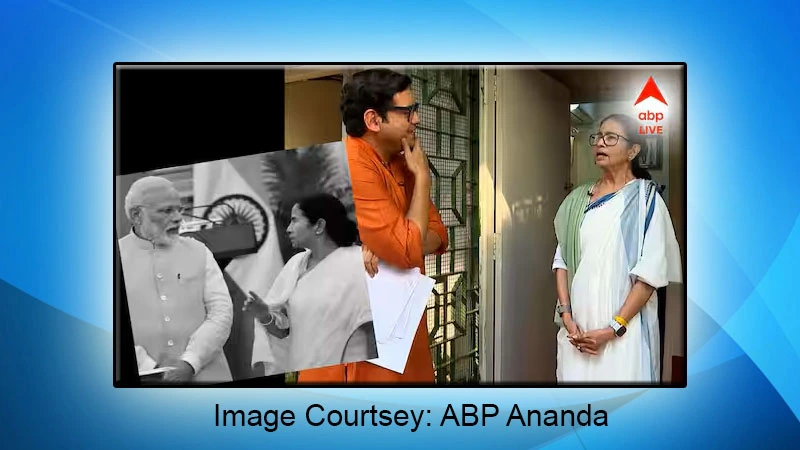
ABP Ananda’s Suman Dey interviewed Mamata Banerjee. During the interview, she spoke about many issues. However, most of the people she mentioned are no longer alive. Therefore, Mamata can remain comfortable here as well.
She spoke about Ajit Panja, Subhash Chakraborty, Narasimha Rao, and Atal Bihari Vajpayee. She shared many memories about them. According to her, almost all senior leaders showed her affection. She even mentioned the pocket money her mother used to give her.
In short, the interview turned into a journey down memory lane.
However, one thing remains unclear. Why did Suman Dey appear so soft and generous during the interview, just like his saffron kurta? He did not ask any uncomfortable questions. Instead, he accepted everything Mamata said without challenge.
Interestingly, the same Suman Dey once asked Biman Bose several tough and sharp questions. Moreover, ABP Ananda generally does not air government advertisements. Therefore, it raises questions. Was there any compulsion on a skilled anchor like Suman Dey?
In conclusion, such a sweet and completely smooth interview feels unusual and unexpected.
Could Jyoti Basu ever say “Era Jabe Kobe”?
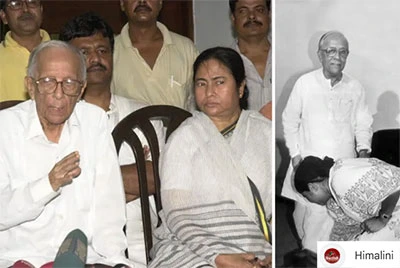
After she became Chief Minister, Mamata Banerjee reportedly kept in touch with Jyoti Basu quite often. However, an old Bengali song comes to mind: “The one you did not garland in life, why offer flowers after death?”
Below is the direct excerpt of the alleged historic conversation, copied from ABP Ananda.
Mamata Banerjee said, “I clearly remember one more thing. He often told me, ‘When will they go?’”
Suman Dey responded, “What are you saying!”
Mamata Banerjee replied, “Yes, I am telling the truth.”
Suman Dey then asked, “Jyoti Babu was asking when Buddhadeb’s government would fall?”
Mamata Banerjee answered, “Yes. He told me this during the Singur and Nandigram movements.”
Therefore, the claim suggests that during the Singur and Nandigram protests, Jyoti Basu questioned how long the Buddhadeb Bhattacharjee government would remain in power.
However, this statement has sparked debate and political discussion. Critics question its authenticity, while supporters treat it as a personal recollection.
Jyoti Basu’s Political Legacy
Perhaps Mamata Banerjee forgot which Jyoti Basu she was referring to. Jyoti Basu was a glittering example of political elitism in West Bengal.
- Jyoti Basu was a communist to the core. He remained committed to his ideology and discipline throughout his life.
- He was a true secular and free from prejudices like a true communist. That’s why he could donate his body after death.
- Moreover, he was one of the founding leaders of the CPI(M).
- He served as a member of the Bengal Legislative Assembly even before India’s Independence.
- After that, he spent many years in opposition politics. Only later did he come to power.
- Furthermore, he became the face of the Left Front, which consisted of 13 political parties. In fact, he pioneered coalition politics in India at the state level.
- Most importantly, he served as the Chief Minister of West Bengal for 23 long years.
Therefore, his long political journey and ideological discipline make the recent claims even more controversial and widely debated.
Jyoti Basu ruled for many years. Therefore, he had many critics. However, no one can honestly say that he ever acted against his party’s line.
Did Jyoti Basu ever act against CPI(M)’s line?
Here are some clear examples:
- Although many across India wanted him to become Prime Minister, his party did not approve. Therefore, he did not accept the post.
- Later, when he wanted to step down as Chief Minister due to health reasons, the party did not permit it. As a result, he did not resign at that time.
- Even though he studied in England, he removed English from primary education because his party wanted that policy.
- He had a very close relationship with Somnath Chatterjee. However, when the party expelled Somnath Chatterjee, Jyoti Basu did not interfere or challenge the decision.
- Subhash Chakraborty was one of his closest associates. Even then, Basu never pressured the CPI(M) leadership to include him in any top committee.
Therefore, critics argue that a leader with such firm discipline and ideological loyalty would hardly tell Mamata Banerjee, Era Jabe Kobe?
This contradiction makes the claim highly controversial and politically sensitive.
Didn’t Jyoti Basu criticize Mamata Banerjee?
In brief, if we evaluate Jyoti Basu’s view of Mamata Banerjee, one point stands out. Since Mamata aligned with what he considered communal forces like the BJP, he was reportedly very upset. Moreover, Jyoti Basu used to criticize Mamata Banerjee in various public meetings due to her suspicious Doctorate degree of East Georgia University.
On the other hand, Mamata herself has said that Jyoti Basu’s police administration subjected her to the most harassment during his tenure.
Yes, there are visuals where Mamata Banerjee is seen touching Jyoti Basu’s feet as a mark of respect. However, many consider that gesture to be simple political courtesy.
Jyoti Basu built his party through lifelong dedication and struggle. He always placed the party’s interests above his personal preferences.
Therefore, critics argue that he would never wish to see the end of his own party’s rule.
For that reason, the claim that he hoped for his party’s downfall appears deeply contradictory and politically contentious.
Desperation to create conflict?
However, Mamata Banerjee often tries to create divisions within political parties. For example, she has suggested that L.K. Advani was not good, but Atal Bihari Vajpayee was better. Similarly, she has implied that Amit Shah is not acceptable, but Narendra Modi is better.
- Therefore, many observers now ask: Is she attempting the same strategy again?
- In the past, such efforts did not succeed. Likewise, critics believe this attempt may also fail.
Perhaps this reflects her own assessment of her party. In fact, she may be struggling with a sense of political insecurity.
Therefore, critics argue that such statements reveal more about Mamata Banerjee’s internal concerns than about her opponents.
Frequently Asked Questions (FAQ)
1. Did Jyoti Basu really say “Era Jabe Kobe”?
Mamata Banerjee claimed that Jyoti Basu made the “Era Jabe Kobe” remark during the Singur and Nandigram movements. However, critics question the authenticity of this statement.
2. Why is the “Era Jabe Kobe” comment controversial?
The comment is controversial because Jyoti Basu was known for strict party discipline and lifelong loyalty to CPI(M). Many believe he would not wish for his own party’s fall.
3. What was Jyoti Basu’s political legacy?
Jyoti Basu was a founding leader of CPI(M) and served as West Bengal’s Chief Minister for 23 years. He played a key role in shaping Left Front politics and coalition governance in India.
4. Did Jyoti Basu ever go against his party’s decisions?
There is no major example of Basu defying party discipline. In fact, he declined the Prime Minister’s post in 1996 because his party did not approve.
5. Why did the ABP Ananda interview spark debate?
Observers felt the interview lacked tough counter-questions. As a result, the discussion around the “Era Jabe Kobe” claim became more politically sensitive.
6. Is this controversy politically significant today?
Yes. The debate continues to influence discussions about political legacy, party loyalty, and current political strategy in West Bengal.