Modi’s Note to Bengal: BJP Edge
Feb 25, 2026 - By Ashutosh Roy Current AffairsElection AnalysisGovernance & AdminPoliticsRegional UpdatesWest Bengal Politics
Key Highlights
- BJP Edge strengthens as Modi’s direct letter reaches all 294 constituencies.
- Strategic shift from personal attacks to development-focused messaging.
- Anti-incumbency after 15 years boosts opposition momentum.
- SIR voter list revisions may alter close-seat equations.
- Border districts emerge as crucial battlegrounds.
- Women’s safety, unemployment, and infiltration dominate campaign narrative.
- Emotional connect through “Jai Maa Kali” replaces usual slogans.
- 2021 data shows many seats decided by 5–10% vote margins.
- Public frustration against alleged corruption shapes 2026 outlook.
- BJP positioned as principal opposition with potential electoral advantage.
Is 2026 Election reshaping BJP Edge?
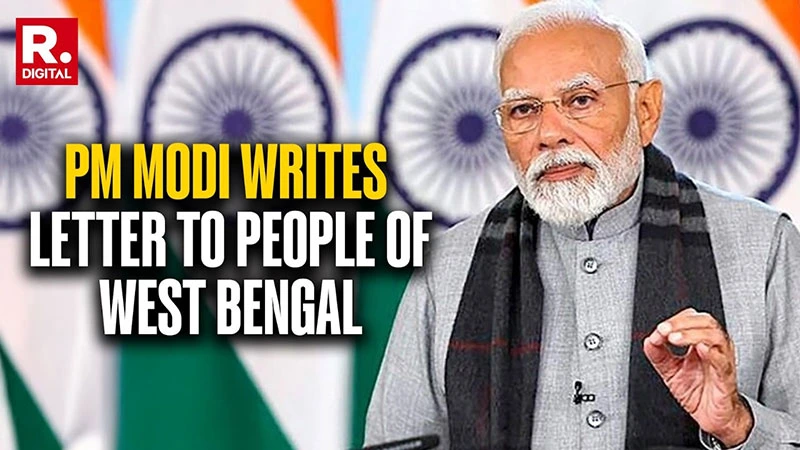
On February 23, the Prime Minister of India, Narendra Modi, sent a letter to the people of Bengal. However, this was not just a letter. Rather, it was a clear pledge to build a “Viksit” (developed) and “Sonar Bangla” (Golden Bengal). It is rather a tactical reset aimed at sharpening the BJP edge ahead of the 2026 Assembly polls.
Moreover, the message reached voters in all 294 Assembly constituencies. As a result, this direct-outreach strategy might be the very thing that secures a decisive BJP edge in the battle for Bengal’s soul.
Meanwhile, after 15 years of continuous rule by the All India Trinamool Congress, a natural anti-incumbency sentiment has developed. Long-term governance often creates public fatigue. Therefore, dissatisfaction has slowly grown among sections of voters.
In addition, allegations of massive corruption have further strengthened this anti-incumbency mood. At the same time, incidents ranging from the Abhaya controversy to widespread law-and-order concerns have left many ordinary citizens feeling helpless. Consequently, any political opposition would view this situation as a strategic opportunity.
Furthermore, even the harshest critics rarely question the political foresight or strategic skills of the BJP. For this reason, the party’s outreach through the Prime Minister’s letter appears to be a calculated and well-timed move ahead of crucial elections.
Can BJP stop the decline of West Bengal?
Prime Minister Narendra Modi expressed concern over what he described as the “dilapidated and broken condition” of West Bengal. Naturally, such remarks fit into a broader political narrative. By bypassing local intermediaries and writing directly to the household, the Prime Minister has sharpened the BJP edge in rural constituencies where grassroots contact is king.
Moreover, he referred to the state’s decline over nearly the last half-century. Therefore, many observers see this statement as a calculated and strategic move rather than a casual comment.
Meanwhile, the Left parties remain the declared ideological rivals of the Bharatiya Janata Party. Their opposition is rooted in fundamental political differences. At the same time, criticizing the current ruling party is the primary responsibility of any opposition force. Everyone understands this political reality.
Consequently, through this letter, Modi is clearly attempting to position the BJP as a forward-looking and strategically capable alternative. In other words, he is using this outreach to keep the BJP ahead in the political race in West Bengal.
Is Modi trying to establish an emotional BJP edge?
Notably, the letter does not use the BJP’s usual slogan, “Jai Shri Ram”. Instead, it says “Jai Maa Kali”. Through this shift in the slogan, the Bharatiya Janata Party attempts to build a stronger emotional connection with Bengali voters.
The emotional appeal in the letter, invoking the state’s cultural icons, is designed to create an emotional BJP edge in the hearts of undecided voters.
Moreover, the letter highlights key issues such as women’s insecurity, unemployment, and illegal infiltration. By raising these concerns, Prime Minister Narendra Modi tries to win the trust of ordinary Bengalis.
At the same time, he points to what he calls the “mismanagement and appeasement politics” of the current state administration. Consequently, he draws attention to what he describes as a volatile ground situation.
Can BJP Stop illegal immigrants?
A brief look at demographic trends adds context. In border districts like Uttar Dinajpur, population growth has reportedly surged by around 105% since the last SIR process in 2002. Similarly, districts such as Malda, Murshidabad, and Nadia have witnessed sharp demographic increases.
Therefore, when this letter in Bengali reaches a marginal household in Malda or Dinajpur, it may create a strong emotional response. The hilarious episode of brutal murder of hargobind das and chandan das and inactive police creates panic for Hindus. RSS will certainly attempt to consolidate the Hindu Votes.
For many families in these regions, issues like illegal infiltration and women’s safety are daily realities.
They often see changes in local demographics firsthand. As a result, fear and uncertainty grow.
Furthermore, some residents allege that certain leaders of the All India Trinamool Congress help illegal infiltrators obtain fake Aadhaar and voter ID cards. They also claim that such individuals continue to receive welfare benefits like Lakshmir Bhandar or free rations.
Political analysts argue that tapping into regional sentiment through personal letters provides a crucial BJP edge over opponents who rely solely on mass rallies.
Urban Bengalis living in Kolkata’s apartment culture may not always be aware of these developments. However, in villages, such news spreads quickly and rarely stays hidden. Despite this, many locals hesitate to protest. They fear political pressure and the influence of the local administration.
Therefore, a direct letter from the Prime Minister may offer them a sense of reassurance. It may give them hope that their concerns are finally being heard at the highest level.
Can the SIR change the result of 2026 Election?
The SIR process has reportedly removed a significant number of names from voter lists. In many constituencies, the number of deleted names is higher than the previous margin of victory or defeat. Therefore, this revision alone could change many electoral calculations in the coming election. Such realities may become a tool for highly Decisive BJP edge.
As a result, if the Bharatiya Janata Party successfully reaches a broader section of voters through direct outreach, it could gain a clear advantage. More importantly, the party is trying to connect emotionally with voters and appeal to their sense of identity and security.
We must also remember the results of the 2021 West Bengal Legislative Assembly election.
- In that election, around 50–60 seats were decided by a narrow margin of just 5% votes.
- Moreover, more than 90 seats saw a victory margin of about 10%. Notably, many of these constituencies are located in border districts.
Therefore, even a small swing in votes, combined with changes in voter rolls through the SIR process, could significantly alter outcomes in several seats. In close contests, minor shifts often produce major political consequences.
Has Modi learned from 2021 mistakes?
Many may ask: didn’t the Modi–Shah duo project a “200-plus” dream in 2021 as well? Indeed, Prime Minister Narendra Modi and Home Minister Amit Shah ran an aggressive campaign in Bengal. However, the BJP’s march stopped at 77 seats in the 2021 West Bengal Legislative Assembly election.
This time, however, a clear shift in strategy is visible. In 2021, much of the campaign focused directly on attacking Mamata Banerjee and Abhishek Banerjee by name. The messaging centered heavily on personal and political criticism.
In contrast, the current campaign appears more development-focused.
From Alipurduar to Malda, and from Durgapur to Singur, Modi has combined political rallies with visible development activities.
He has inaugurated multiple projects and highlighted central schemes.
Only after that does he turn to criticism of the state government. This leads to a a Strategic BJP edge, when the 2026 Bengal Election is just around the corner.
Moreover, instead of focusing primarily on personal attacks, the campaign now emphasizes administrative failures and Bengal’s economic slowdown.
By shifting the narrative from individual leaders to governance issues, the Bharatiya Janata Party is attempting to position itself as a development-driven alternative.
Therefore, this strategic recalibration may be giving the distinct BJP edge. A development-first approach, followed by governance critique, appears more structured and potentially more persuasive than a campaign built mainly on personal confrontation.
What Should be the West Bengal Election 2026 Strategy?
The real challenge for the Bharatiya Janata Party in West Bengal is its organizational strength. Strong booth-level organization often determines electoral success. But History has revealed a lot of contradictions also. For example, when V. P. Singh came to power in 1989, his government did not have a deeply rooted grassroots structure. Yet, political circumstances helped him rise.
Similarly, in the 2011 West Bengal Legislative Assembly election, when Mamata Banerjee formed the government, the Left Front still had a much stronger organizational network across the state.
However, public sentiment for change overpowered organizational muscle. This shows that while organization matters, history does record exceptions.
At present, allegations of widespread corruption under the All India Trinamool Congress government and simmering public anger against sections of the police administration have created visible political pressure. Consequently, as West Bengal moves toward the 2026 election, the ruling party appears somewhat cornered.
Therefore, the key question is how effectively the BJP can convert this dissatisfaction into votes. The opportunity exists. However, execution will determine the outcome. Can they turn a simple letter into a sharp BJP edge in the battle for Sonar Bangla?
What do Bengal people feel before 2026 election?
Meanwhile, many people in West Bengal appear frustrated. Much like in 2011, there is growing talk of a desire for “change of a change.” At the same time, the BJP has firmly established itself as the principal opposition force in the state. Hence, if any party is expected to capitalize on the current political climate, it is the BJP.
People Also Ask (PAA)
1. What is meant by the term BJP Edge in West Bengal politics?
BJP Edge refers to the growing political advantage of the BJP due to anti-incumbency, strategic campaigning, and voter list revisions ahead of the 2026 election.
2. How does the SIR process impact the 2026 election?
The SIR voter list revision has reportedly removed several names. In many seats, the number of deleted names exceeds previous victory margins. Therefore, even small shifts could change final results.
3. Why is anti-incumbency a major factor in Bengal?
After nearly 15 years of rule, voter fatigue has grown. Allegations of corruption, administrative failures, and law-and-order concerns have strengthened public dissatisfaction.
4. How is BJP’s 2026 campaign different from 2021?
Unlike 2021, when the focus was largely on personal attacks, the current campaign emphasizes development projects, governance issues, and administrative accountability.
5. Why are border districts considered crucial battlegrounds?
Many closely contested seats in 2021 were in border areas. Demographic changes, infiltration debates, and security concerns make these districts politically sensitive.
6. Can a small vote swing change the outcome?
Yes. In 2021, dozens of seats were decided by just 5–10% vote margins. Therefore, even a minor swing could significantly reshape the 2026 results.
7. Is BJP now the principal opposition in West Bengal?
Yes. BJP has firmly positioned itself as the main opposition force, making it the primary challenger in the upcoming election.
8. What could determine the final outcome in 2026?
Organizational strength, booth-level management, voter turnout, and the ability to convert public anger into votes will ultimately decide the election.
[…]Modi’s Note to Bengal: BJP Edge BJP Edge sharpens in West Bengal as Modi’s bold outreach, SIR impact, and anti-incumbency wave reshape the 2026 political battle. Is a dramatic shift coming?[…]
[…]Modi’s Note to Bengal: BJP Edge BJP Edge sharpens in West Bengal as Modi’s bold outreach, SIR impact, and anti-incumbency wave reshape the 2026 political battle. Is a dramatic shift coming?[…]