Mamata's SIR Drama in Delhi Exposed Now
Feb 04, 2026 - By Ashutosh Roy PoliticsCurrent AffairsElection AnalysisGovernanceNational PoliticsRegional UpdatesWest Bengal Politics
Key Highlights
- Mamata’s SIR Drama shifted from Kolkata to Delhi, raising questions about political intent.
- Morning protests at Raj Bhavan and afternoon scenes at the Election Commission set the stage.
- Black shawls and coordinated visuals signaled a carefully planned political message.
- Allegations of voter list errors dominated the narrative, but visual proof remained absent.
- Claims and counterclaims emerged between TMC and Election Commission sources.
- Mamata accused officials sharply; EC sources alleged verbal misconduct by TMC leaders.
- Absence of INDIA alliance partners highlighted Mamata’s political isolation in Delhi.
- Nostalgia-driven imagery attempted to revive her old “ghorer meye” political persona.
- Public trust, once Mamata’s biggest strength, now appears contested and fragile.
- The central demand remains unanswered: Will Bengalis get a transparent voter list?
Voter List Errors Take Center Stage by Mamata’s SIR Drama in Delhi
Mamata’s SIR Drama was staged in Delhi this time. In the morning, the scene unfolded at Banga Bhawan. Later in the afternoon, it shifted to the Election Commission office.
On February 2, during Delhi’s pleasant winter, residents witnessed this new political theatrics. However, the event failed to generate real public interest. Apart from journalists and police personnel, the crowd remained thin.
Why Delhi instead of Kolkata?
Meanwhile, a bigger question surfaced. Why did Mamata choose Delhi instead of Kolkata for her SIR protest? After all, she rose through Kolkata’s political streets. Her sudden preference for Delhi felt unusual.
Perhaps, she aimed to attract national media attention. Otherwise, if the same event had taken place in Kolkata, a massive crowd would have gathered. This approach reflects Mamata’s familiar political pattern, one that Bengalis have seen repeatedly.
Is Mamata Banerjee isolated in National Politics?
However, one detail stood out sharply today. She appeared largely isolated in this fight. Even in the heart of Delhi, no major opposition party stood beside her. Surprisingly, partners from the INDIA alliance also remained absent.
Still, despite this isolation, it would be incorrect to call Mamata’s SIR Drama a complete failure.
In terms of political optics, she managed to make her presence felt.
What INDIA alliance partners have done in SIR?
Tamil Nadu and Kerala have taken this logical discrepancy to the Supreme Court. However, Pinarayi Vijayan or M.K. Stalin did not take the fight to the streets.
In contrast, Mamata Banerjee, her party, and the West Bengal government are fighting the Election Commission as if it were a political rival.
Clearly, even other opposition leaders do not seem comfortable with this approach.
Moreover, the issue is no longer limited to protest or opposition. Shockingly, some Trinamool MLAs and ministers are allegedly seen vandalising offices on camera. As a result, the situation raises serious concerns.
Meanwhile, Akhilesh Yadav is currently in Delhi, focused on the Lok Sabha session. Ironically, the same Akhilesh had recently visited Kolkata and said one must learn from Mamata on how to defeat the BJP.
So why is he not standing beside her today? Similarly, Arvind Kejriwal, who often meets Mamata whenever she visits Delhi, is also missing now.
Ultimately, no sensible political leader can support treating the Election Commission as an enemy. Likewise, openly attacking or making irresponsible remarks against the Election Commissioner is unacceptable.
Can Old Mamata Wipe Today’s Stains?
After a long time, Bengalis saw Mamata in her old, familiar look again.
- A simple cotton sari.
- Open hair.
- No embellishment.
For those of us standing at the edge of middle age, this image feels deeply familiar. We grew up seeing her exactly like this. No show. No concern for style. She appeared like the girl next door, a daughter of a Bengali household.
As a result, a section of Bengal slipped into nostalgia. They felt they had found their old “ghorer meye” once again.
However, the difference is huge.
Back then, she was genuinely simple. She openly challenged Bengal’s culture of political elitism.
In fact, she was the first real exception in the world of bhadralok politics. That disruption once created real noise in Bengal’s political space.
From Simplicity to Needless Showmanship
At that time, the dark stain of corruption had not yet covered her image. She did not represent arrogance born out of power. Instead, she reached people effortlessly.
Whenever there was unrest or death, Mamata would arrive personally, whether in the foggy early morning or deep at night. People could reach her easily. Sometimes she walked. Sometimes she rode pillion on a bike. She even travelled in a Matador.
Her vehicle was modest. She did not need a helicopter to go from Kolkata to Malda or Rampurhat. Luxury had not yet touched her life. Cheap saris. Rubber slippers. Expensive shawls were unthinkable.
She also faced severe police brutality. Yes, torn saris or hospital exits wrapped in bandages may have carried an element of theatrics. Still, she managed to leave a deep mark on the public mind.
That image, of the ordinary household daughter, once felt real.
Return of the Old Face: Aiming to Rebuild Image?
Today, during Mamata’s SIR Drama, that old visual returned briefly. It stirred emotions. Yet the past and the present no longer stand on the same ground.
Meanwhile, early in the morning, Mamata suddenly appeared at Banga Bhawan. She alleged that the Delhi Police were conducting room-to-room searches inside the premises.
According to her claim, police personnel entered multiple rooms. The people gathered there by the Chief Minister and her close aides—were they Khalistanis or Al-Qaeda members? Or does the Delhi Police have no other work to do? The allegation raised sharp questions.
However, verifying this claim immediately is not easy. Notably, no photographs or videos surfaced to support the accusation.
What we did see was an argument between Kakoli Ghosh Dastidar and the Delhi Police, ironically, over a parking issue. It is worth remembering that Kakoli Ghosh Dastidar is not just anyone. She is a doctor and a Member of Parliament.
At the same time, she carries another important identity. She is one of Mamata’s old companions and a trusted soldier of Mamata’s loyal political brigade.
In the end, Mamata Banerjee made only a brief guest appearance. Dressed in her simple sari, with open hair, she arrived, delivered the optics, and left.
Meanwhile, Mamata has ordered to bring RAF from West Bengal for protection of Banga Bhawan. The force has reached Delhi by flight at midnight of February 03, 2026. We don’t know whether the constitution permits such state forces in the country capital. Also, such steps may raise a conflict of duties and responsibilities.
Mamata’s SIR Drama before Bengal 2026 election
Thus, another scene of Mamata’s SIR Drama concluded short, sharp, and visually calculated. Perhaps to erupt a political slugfest on the eve of West Bengal Assembly Election 2026
The second, and real, act of Mamata’s SIR Drama unfolded in the afternoon. In every drama or movie, costume changes are common for the hero and heroin. With a bigger budget, characters change outfits in every scene. This drama was no different.
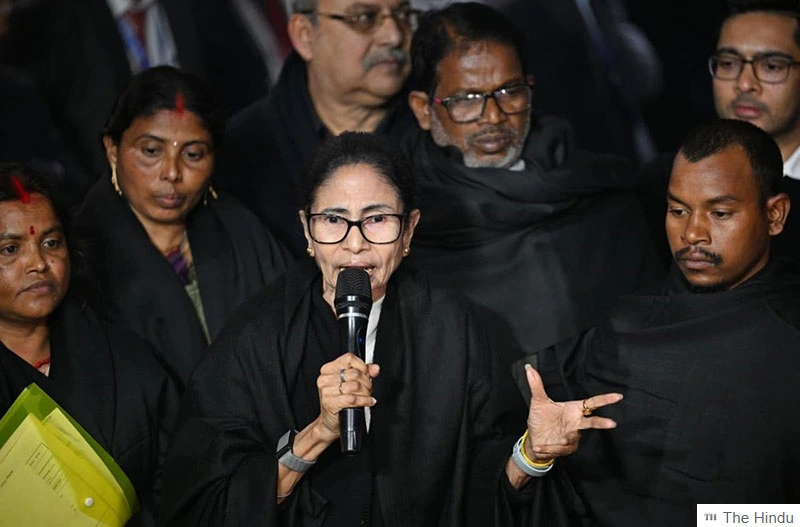
This time, Mamata appeared on stage wrapped in a black shawl. Her companions also dressed in black. The visual was deliberate.
Special Intensive Revision and Trinamool Congress
It is worthy mentioning that Mamata Banerjee and Trinamool Congress has been raising hue and cries even before the Special Intensive Revision for voter list correction had been announced by the Election Commission. Perhaps the black dresses symbolized their uncompromising stand against SIR to purify the voter list of West Bengal.
Next, she moved toward the Election Commission for the scheduled meeting. She was accompanied by Abhishek Banerjee and several other party leaders of Trinamool Congress only. Along with them came a few individuals whose names appear as dead in the voter list, but who are very much alive.
Meanwhile, what exactly happened inside the Election Commission meeting remains unclear.
- Once outside, Mamata launched a sharp verbal attack on the Election Commissioner, using strong words and harsh descriptions.
- On the other hand, sources from the Election Commission claimed that Trinamool Congress leaders verbally abused officials using crude language.
Allegedly, video footage exists. Yet, whether it will ever be made public is uncertain.
Finally, Mamata Banerjee declared that she would boycott the Election Commission.
Mamata Banerjee and the Election commission of India has filed suit against each other in the Supreme Court.
This raises serious questions.
- Can a sitting Chief Minister boycott a constitutional democratic institution?
- And even if she does, what does it achieve?
- Is it only about creating political optics?
As the curtain falls on this act of Mamata’s SIR Drama, the spectacle remains loud, but the answers remain missing.
In reality, Mamata still cannot move away from the core of her politics, opposition to the Centre. That remains her political anchor.
Objective of Mamata’s SIR Drama
So what was her real objective?
- First, she wanted to highlight how logical discrepancies in the voter list are causing harassment to many ordinary people. She aimed to bring this issue directly before the public.
- Second, she tried to project herself as the only leader willing to fight at every level for those affected, without hesitation.
However, in politics, perception often works better than truth. A classic example is the slogan “Rajiv Gandhi chor hai”. Vishwanath Pratap Singh successfully created a public belief that Rajiv Gandhi took money in the Bofors deal, even though no court has proven it to this day.
Similarly, Mamata attempted once again to prove that she is a partner in the suffering of Bengalis.
Yet, there is one crucial difference.
Earlier, people trusted her words. Do they still? Today, she has been forced to step away from the branding of absolute integrity.
How much political gain the Trinamool Congress can extract from Mamata’s SIR Drama will be decided by time.
Were the Grievances Genuine?
However, another twist followed.
In the evening, on ABP Ananda, BJP representative Keya Ghosh identified a person named Gangadhar. She claimed that his name was deliberately removed by a Booth Level Officer. Later, BJP corrected the issue by submitting Form 6.
Will Bengal Get a Transparent Voter List?
But the real question remains.
Will ordinary Bengalis finally get what they truly demand—a clean, transparent voter list?
That answer, for now, remains unresolved.
The Ultimate of Mamata’s SIR Drama
Ultimately, Mamata’s SIR Drama exposes a deeper political truth. Optics can still dominate headlines, but they no longer guarantee belief.
Mamata tried to reclaim her old role, as the lone fighter, as Bengal’s voice of resistance. But the ground has shifted. The audience is no longer passive. Skepticism has replaced emotion.
This drama may energize party cadres and feed the news cycle. Yet for ordinary Bengalis, symbolism is not enough. They want answers, transparency, and fairness in the voter list.
Power thrives on trust. And trust does not survive on theatrics alone.
When the curtain finally falls on Mamata’s SIR Drama, the verdict will not come from rallies or television debates. It will come silently, from the ballot box.
[…]Mamata’s SIR Drama in Delhi Exposed Now Mamata’s SIR Drama in Delhi highlights voter list discrepancies and political confrontation with the Election Commission. Here’s what it means.[…]
[…]Mamata’s SIR Drama in Delhi Exposed Now Mamata’s SIR Drama in Delhi highlights voter list discrepancies and political confrontation with the Election Commission. Here’s what it means.[…]
[…]Mamata’s SIR Drama in Delhi Exposed Now Mamata’s SIR Drama in Delhi highlights voter list discrepancies and political confrontation with the Election Commission. Here’s what it means.[…]
[…]Mamata’s SIR Drama in Delhi Exposed Now Mamata’s SIR Drama in Delhi highlights voter list discrepancies and political confrontation with the Election Commission. Here’s what it means.[…]
[…]Mamata’s SIR Drama in Delhi Exposed Now Mamata’s SIR Drama in Delhi highlights voter list discrepancies and political confrontation with the Election Commission. Here’s what it means.[…]
[…]Mamata’s SIR Drama in Delhi Exposed Now Mamata’s SIR Drama in Delhi highlights voter list discrepancies and political confrontation with the Election Commission. Here’s what it means.[…]
[…]Mamata’s SIR Drama in Delhi Exposed Now Mamata’s SIR Drama in Delhi highlights voter list discrepancies and political confrontation with the Election Commission. Here’s what it means.[…]
[…]Mamata’s SIR Drama in Delhi Exposed Now Mamata’s SIR Drama in Delhi highlights voter list discrepancies and political confrontation with the Election Commission. Here’s what it means.[…]
[…]Mamata’s SIR Drama in Delhi Exposed Now Mamata’s SIR Drama in Delhi highlights voter list discrepancies and political confrontation with the Election Commission. Here’s what it means.[…]