Ultimate Blow: Mamata Lost to Suvendu
May 05, 2026 - By Ashutosh Roy Current AffairsElection AnalysisGovernance & AdminPoliticsRegional UpdatesWest Bengal Politics
Did Mamata Lose to Suvendu Again?
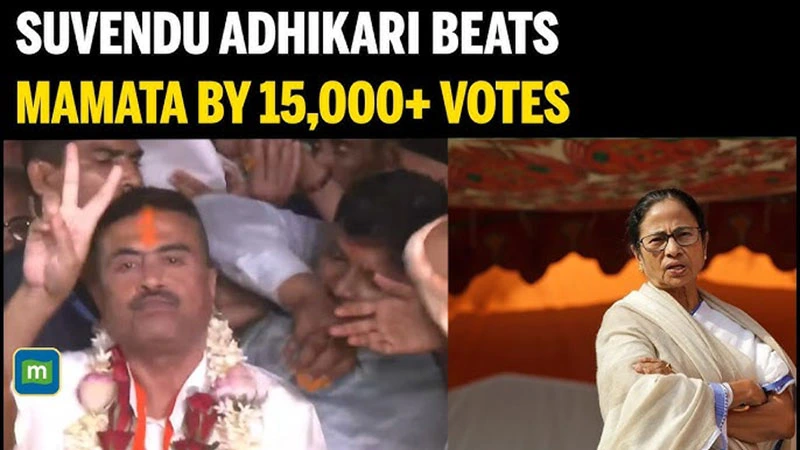
Mamata lost to Suvendu once more, and this defeat shattered her invincible image. First, she lost in Nandigram in 2021. Now, she has faced a setback right in her home turf of Bhowanipore by 15, 105 Vote Margin.
Many are asking: does Suvendu Adhikari hold a secret magic stick against the Chief Minister?
How did Suvendu win on home turf of Mamata Banerjee?
In 2021, Mamata Banerjee chose to contest from Nandigram out of stubbornness and lost. However, the current situation feels different. This time, Suvendu Adhikari, backed by the influence of Amit Shah, challenged her in her own backyard and won.
Mamata remained a silent spectator while digesting this heavy defeat. At the end, the breaking news remains, Mamata Lost to Suvendu.
Is this a repeat of Political History of Bengal?
It seems like political karma has come full circle. In 2011, Manish Gupta, defeated the incumbent Chief Minister, Buddhadeb Bhattacharya in his own constituency of Jadavpur. Today, she faces a similar fate.
History has a cruel way of repeating itself, as Mamata finds herself in the same position her predecessor once held.
This is also to mention that Pradeep Gupta did not publish the results of the exit polls for West Bengal. He said he did not receive adequate response from the voters.
On the other hand, he expressed his analysis to Barkha Dutt. So, it the revolution of the silent voters that brought about this phenomenal change in Bengal Elections 2026.
Is Two-Party System A Tradition of West Bengal?
Historically, elections of West Bengal have always been a two-party fight. Aside from the years between 1967 and 1972, voters have consistently backed one dominant side. Bengali voters usually give a massive mandate rather than a slim majority.
For example, Mamata Banerjee won with a huge majority in 2011. Similarly, the people of Bengal have now voted overwhelmingly for the BJP.
Political Turbulence in West Bengal Government (1967–1972)
| Period | Government Type | Chief Minister | Notes |
|---|---|---|---|
| Feb 1967 – Nov 1967 | United Front Govt (1st) | Ajoy Mukherjee | First non-Congress govt; collapsed due to internal conflicts |
| Nov 1967 – Feb 1968 | Presidential Rule | – | Political instability after UF collapse |
| Feb 1969 – Mar 1970 | United Front Govt (2nd) | Ajoy Mukherjee | Re-elected coalition; again unstable |
| Mar 1970 – Apr 1971 | Presidential Rule | – | Govt collapsed amid infighting |
| Apr 1971 – Jun 1971 | Democratic Coalition Govt | Ajoy Mukherjee | Very short-lived government |
| Jun 1971 – Mar 1972 | Presidential Rule | – | Continued instability and law & order concerns |
| Mar 1972 onward | Congress Govt | Siddhartha Shankar Ray | Stable govt after elections |
Was there a signal before Mamata lost to Suvendu?
In the past, political shifts were predictable. In 2011, signs of change appeared years earlier during the 2008 Panchayat polls and the 2009 Lok Sabha elections. However, this recent election offered no such hints.
The real shift became clear when Amit Shah accompanied Suvendu Adhikari to file his nomination. Their massive rallies and meetings proved that the BJP was laser-focused on Bhowanipore. Ultimately, Suvendu delivered on that goal and the result is on the scoreboard that Mamata Lost to Suvendu.
Why was the Bhowanipore result so shocking?
By the afternoon of election day, the only question left was whether Mamata would win or lose her own seat. In the end, Mamata lost to Suvendu by a much larger margin than in Nandigram.
Before the final results, Mamata spoke to the press in a way that sounded like a cry of failure. This stood in stark contrast to 2011, when Buddhadeb Bhattacharya showed grace by visiting the Governor to resign.
Can Mamata Banerjee accept the democratic verdict?
Democracy involves both victory and defeat. While politics of Mamata Banerjee are driven by deep emotion, she must return to reality quickly.
To move forward, she needs to accept this loss with the same political courtesy seen in the past of Bengal.
Why Did the Public Turn Against Mamata?
To understand why Mamata lost to Suvendu, we must look at the deep-seated issues in West Bengal. Voters expressed their anger against several government failures.
Here are the primary reasons behind this political shift:
Did Industrial Failure and Corruption Lead to the Defeat?
Many believe the stubbornness of Mamata regarding factories hurt the economy of state. Beyond industrial loss, the cash-for-jobs scam left a talented generation unemployed.
Instead of protecting qualified teachers, the administration allowed corruption to ruin the education system. So, everything becomes reflected in a nut shell when one can read the writing on the wall, Mamata Lost to Suvendu.
How Did Law and Order Affect the Election?
The public felt unsafe due to rising issues, including:
- Safety Concerns: Failing to protect women and targeting protesters instead of criminals.
- Police Interference: Allowing miscreants to threaten the police without consequences.
- Syndicate Raj: The widespread culture of cut-money and extortion, even from small-time workers like Toto drivers.
- Illegal Immigration: The unholy nexus between the BSF, State Administration, Political Leaders and Police have encouraged illegal immigration for Vote Bank Politics.
Why Is the Youth Leaving West Bengal?
While the government promoted summits like BGBS, real employment remained low. This forced the youth of the state to migrate elsewhere for basic jobs. Additionally, the privatization of health and education made essential services unaffordable for many. It’s better for her to introspect why Mamata Lost to Suvendu.
Was Arrogance a Factor When Mamata Lost to Suvendu?
Politics in the state shifted from social service to personal gain. The looting of natural resources like coal, sand, and soil became a structured business.
Furthermore, the attempt of the government to silence the opposition and suppress free speech backfired.
The voters ultimately rejected this atmosphere of extreme arrogance. By choosing the opposition, the people proved that in a democracy, the voice of public cannot be ignored.
Will Suvendu Adhikari Become the Next Chief Minister?
The BJP has not officially announced its candidate for Chief Minister yet. However, Suvendu Adhikari has emerged as a top contender for the position.
By defeating the sitting Chief Minister on her own turf, his political stock has risen significantly.
Why is influence of Suvendu growing in Delhi?
Since the BJP is a national party, support from central leadership is crucial. After this victory, Suvendu has successfully proven his worth to the BJP high command in Delhi.
This win gives him a major advantage within the party hierarchy. It is evident that the news Mamata Lost to Suvendu will increase his value by leaps and bounds.
How did the win impact his political standing?
The fact that Mamata lost to Suvendu in such a high-stakes battle has changed the power dynamic. Suvendu is no longer just a state leader; he has positioned himself as a giant-killer.
This success makes him the most prominent face of the BJP in West Bengal as the party prepares for its next move.
Is the 2011 Political Shift Repeating Itself?
West Bengal has witnessed a political earthquake that mirrors the events of 2011. Many heavyweight ministers faced shocking defeats. In their place, several lesser-known BJP candidates secured victories.
This shift proves that the desire of the public for change is stronger than individual political status.
Was this a vote for BJP or against TMC?
While the BJP won significantly, the result is seen more as a fierce wave of anti-incumbency. The people did not just vote for a new party; they voted to remove the TMC from power.
Just as Mamata lost to Suvendu, the entire ruling structure faced a rejection from the masses.
What do voters expect from the new leadership?
The people of Bengal have ousted the previous government with great hope for the future. They want a break from the corruption and arrogance of the past. Now, the responsibility lies with the BJP to honor this massive mandate.
The citizens have placed their trust in a new direction. It remains to be seen if the new leadership can deliver the progress and transparency that the voters demand.
What is the Future of West Bengal After This Election?
The 2026 election results have rewritten the political landscape of West Bengal. The fact that Mamata lost to Suvendu in Bhowanipore, by a margin of over 15,000 votes, marks the end of an era.
With the BJP securing a historic majority of over 200 seats, the state is now entering a new chapter under fresh leadership.
Can West Bengal recover from this political shift?
Voters have clearly chosen a path of change over the status quo.
This mandate is a call for better governance, industrial growth, and an end to corruption.
While the TMC faces a tough road to recovery, the BJP now has the massive responsibility of fulfilling the high expectations of the Bengali people.
Ultimately, this election proves that in a democracy, no leader is invincible, and the power always remains with the citizens.
10 Key Takeaways: Why Mamata Lost to Suvendu
- Loss of Invincibility: The invincible tag of Mamata Banerjee was shattered after she lost her own home turf. So, Mamata Lost to Suvendu has become the breaking news in all the TV channels.
- Bhowanipore Setback: After the Nandigram defeat, Mamata lost to Suvendu in Bhowanipore by an even larger margin.
- Historical Repeat: The result mirrors 2011, when the then-CM Buddhadeb Bhattacharya lost his own seat to a rising opposition.
- Massive Anti-Incumbency: The mandate was less about party preference and more about a desperate public desire to remove the TMC.
- The Giant Killer: Suvendu Adhikari cemented his status as a top-tier leader and a primary CM contender within the BJP.
- Strategic Precision: Backed by Amit Shah, the BJP’s bird’s eye focus on Bhowanipore successfully dismantled the TMC stronghold.
- Corruption Backlash: Public anger over the cash-for-jobs scam and the theft of 100-day work funds played a decisive role.
- Migration Issues: The lack of industrial growth and job opportunities forced the youth to vote for a change in leadership.
- End of Arrogance: Voters rejected the Syndicate Raj and the perceived arrogance of the top brass of the ruling party.
- Demand for Change: With the BJP winning over 200 seats, the people of Bengal have demanded a return to transparent governance.
People Also Ask (PPA)
By how many votes did Mamata Banerjee lose to Suvendu Adhikari?
In the 2026 Bhabanipur contest, Mamata lost to Suvendu by a margin of 15,105 votes. Suvendu Adhikari secured 73,917 votes compared to Mamata’s 58,812.
Has Mamata Banerjee ever lost an election before?
Yes. Before the 2026 Bhabanipur defeat, the famous Mamata lost to Suvendu Adhikari in the 2021 Nandigram Assembly election by a narrow margin of 1,956 votes.
What was the total seat count in the 2026 West Bengal election?
The BJP achieved a historic victory, winning 206 seats out of the 294-seat assembly. The Trinamool Congress (TMC) was reduced to 81 seats, marking the first BJP government in the history of West Bengal.
Who is likely to be the next Chief Minister of West Bengal?
While the BJP has not made an official announcement, Suvendu Adhikari is considered a frontrunner due to his giant-killer status after defeating the sitting CM twice. So, Mamata Lost to Suvendu has given him a distinct mileage.
Why did Mamata lose her home turf of Bhabanipur?
Analysts point to high anti-incumbency, public anger over the cash-for-jobs scam, and the intense strategic focus of BJP on the constituency as the primary reasons why the Chief Minister lost her seat.
[…]Ultimate Blow: Mamata Lost to Suvendu Political history repeats as Mamata lost to Suvendu in Bhowanipore. Discover why Bengal chose the BJP and what this means for the state’s future. Read more![…]
[…]Ultimate Blow: Mamata Lost to Suvendu Political history repeats as Mamata lost to Suvendu in Bhowanipore. Discover why Bengal chose the BJP and what this means for the state’s future. Read more![…]
[…]Ultimate Blow: Mamata Lost to Suvendu Political history repeats as Mamata lost to Suvendu in Bhowanipore. Discover why Bengal chose the BJP and what this means for the state’s future. Read more![…]