Urgent Mamata Vs ED Case: Unexpected Delay
Feb 20, 2026 - By Ashutosh Roy PoliticsCurrent AffairsElection AnalysisGovernance & AdminNational NewsNational PoliticsWest Bengal Politics
10 Key Highlights
- Dramatic Supreme Court Turn: The Mamata Vs ED Case saw an unexpected delay after the Solicitor General sought time to file a rejoinder.
- One-Month Postponement: The Supreme Court fixed the next hearing for March 18, effectively delaying the case by a full month.
- ED’s Earlier Urgency: Notably, the Enforcement Directorate had earlier pushed for an urgent hearing and moved the case from Calcutta High Court to the Supreme Court.
- January 8 Raid Controversy: The ED raided I-PAC’s office and Prateek Jain’s residence in connection with the coal scam, triggering a major political flashpoint.
- Chief Minister’s Intervention: Mamata Banerjee entered the raid location with senior officials, leading to allegations and counter-allegations over files and digital devices.
- State vs Central Agencies Clash: The Supreme Court stayed any probe against ED officers and ordered preservation of CCTV and related evidence.
- Multiple Adjournments: Between February 3 and 10, the matter was repeatedly adjourned, adding to concerns about delays.
- Affidavit Defense: Mamata Banerjee filed an affidavit claiming that ED officers voluntarily handed over documents.
- Pattern of Prolonged Cases: Observers compare this case with other long-running Bengal matters like the DA case, recruitment scam, RG Kar case, and OBC case.
- Public Perception Issue: Critics argue that CBI and ED investigations in major scams like Saradha and Narada rarely reach final closure.
- Political Fallout: The biggest political risk may be for the Bengal BJP if public trust in central investigations weakens.
- Core Question Remains: Will the Mamata Vs ED Case conclude swiftly, or will it become another prolonged legal battle in the Supreme Court?
Why Mamata Vs ED Case in the Supreme Court?
On February 18, an unbelievable drama unfolded in the Supreme Court. First, the Central Solicitor General Tushar Mehta informed the court that the government wanted to file a rejoinder in the Mamata Vs ED Case. However, the rejoinder was not ready at that time. Therefore, he requested more time.
Importantly, it was the Enforcement Directorate (ED) that had earlier pushed for an urgent hearing. Moreover, the agency itself had moved the case from the Calcutta High Court to the Supreme Court.
Although Enforcement Director (ED) submitted the rejoinder, the opposition counsel Kalyan Banerjee strongly opposed the fresh request. He argued that the hearing should be postponed until after Holi.
Notably, Tushar Mehta did not oppose the delay. He is widely seen as the legal face of Narendra Modi and Amit Shah in major cases.
As a result, the court fixed the next hearing for March 18. In effect, the case has been delayed by a full month.
So, who benefits from this delay?
Clearly, Mamata Banerjee, the West Bengal government, and their IPS and IAS officers gain crucial time.
What Exactly Happened During Mamata Banerjee’s Visit to the Raid Site?
Now, let us revisit this case. Here, the chronology is extremely important.
January 8: ED Raid and Political Shockwaves
On January 8, the Enforcement Directorate (ED) conducted a raid at the office of Indian Political Action Committee (I-PAC) and at the residence of its director, Prateek Jain. The raid was linked to the alleged coal scam and financial irregularities.
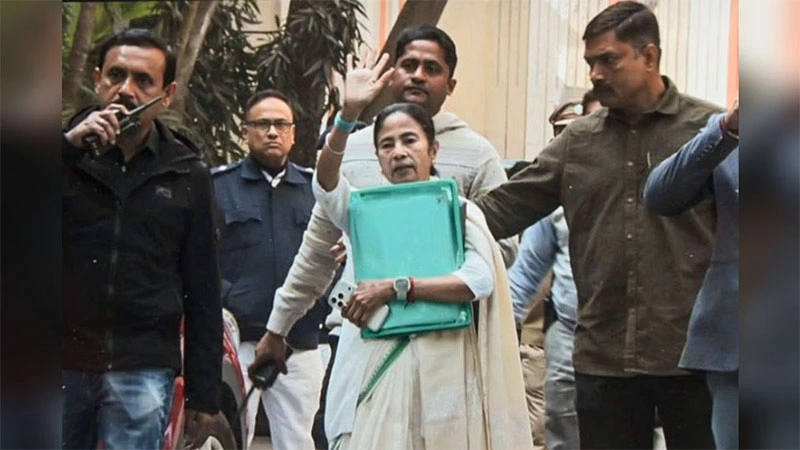
However, the situation took a dramatic turn. Chief Minister Mamata Banerjee suddenly entered the premises along with senior bureaucrats and top police officials. She later left the location carrying files, hard disks, and mobile devices. Police officers were seen transporting files in Trinamool Congress vehicles.
Meanwhile, Trinamool Congress filed a complaint against the ED at Shakespeare Sarani Police Station.
January 9: Chaos in Calcutta High Court
On January 9, the matter came up before the Calcutta High Court under Justice Shampa Ghosh.
However, the hearing turned chaotic. Trinamool lawyer and minister Chandrima Bhattacharya was present in court. Due to the disruption, the case was adjourned.
January 14: Partial Order, Matter Moves to Supreme Court
On January 14, the Calcutta High Court delivered an order on part of the case. It then allowed the remaining issues to be heard by the Supreme Court.
What Did the Supreme Court Say in Its Interim Order?
January 15: Supreme Court’s Interim Order
On January 15, the Supreme Court passed an interim order.
First, it stayed any investigation against ED officers by the state. Second, it directed that all evidence, including CCTV footage, must be preserved.
Importantly, the judges observed that the matter required urgent resolution. Otherwise, similar incidents could occur in other states.
February 3-10: Multiple Adjournments
Between February 3 and 10, the case was adjourned several times in the Supreme Court. On one occasion, senior advocate Kapil Sibal was reportedly unwell.
What Did Mamata Banerjee State in Her Affidavit?
February 9: Chief Minister’s Affidavit
On February 9, Mamata Banerjee filed an affidavit before the Supreme Court.
In her submission, she argued that she did not forcibly take any documents. Instead, she claimed that ED officers handed them over voluntarily.
February 18: Rejoinder Request and One-Month Delay
Finally, on February 18, the Solicitor General sought time to file a rejoinder. As a result, the Supreme Court postponed the hearing by one month.
The next date was fixed for March 18. Consequently, the high-profile case now faces a significant delay.
Is There a Pattern of Pending Bengal Cases in the SC?
For unknown reasons, many major cases from West Bengal continue for a long time in the Supreme Court. Over the years, people have become used to seeing “date after date” in such matters.
Let us look at some key examples:
| Cases | Proceedings |
|---|---|
| DA Case (Dearness Allowance Case) | The long-running Dearness Allowance (DA) dispute between the West Bengal government and state employees has seen repeated hearings and adjournments in the Supreme Court. The matter remains politically sensitive and financially significant. |
| Recruitment Scam Case | The school recruitment scam case, involving allegations of job irregularities and corruption, has also witnessed prolonged proceedings. Multiple agencies, including the Enforcement Directorate, became involved. Hearings have stretched over months. |
| RG Kar Case | The RG Kar case has drawn national attention. Legal proceedings and related investigations have moved through various judicial stages, including the Supreme Court. The case continues to remain under scrutiny. |
| OBC Reservation Case | The OBC reservation case from West Bengal has also seen extended litigation. The matter involves constitutional questions and administrative decisions. As a result, it has required detailed hearings. |
Now, the big question remains: Will the Mamata Vs ED Case follow the same path of prolonged hearings and repeated adjournments?
At this stage, it is unclear.
However, given past trends, many observers are watching closely to see whether this case moves swiftly or becomes another long legal battle in the Supreme Court.
Who Gains from the Delay in the Mamata Vs ED Case?
Many people also raise another serious concern.
They argue that cases investigated by the CBI or the ED rarely reach a final conclusion. From the Saradha scam to the Narada sting case, and even the school recruitment scam, investigations often continue for years without clear closure.
As a result, political voices from the Left and Congress frequently promote the “TMC-BJP setting” theory. They claim that investigations move slowly for strategic reasons.
Do people believe Mamata Vs ED Case is a natural delay?
Moreover, a section of ordinary people in Bengal has started believing that many of these cases are merely symbolic. They feel that nothing substantial will happen. They doubt whether anyone from the top level will ever face real punishment.
Therefore, a perception is growing that justice moves strictly and swiftly for common citizens, but not for the powerful.
However, it is equally important to remember that the Indian judicial system also has a glorious and historic record. In several landmark cases, courts have delivered strong and independent judgments, even against powerful individuals.
So, the debate continues.
Is delay equal to denial of justice?
Or does the legal system simply take time because of complex procedures and constitutional safeguards? The answer may ultimately depend on how these high-profile cases conclude in the coming months and years.
Probable Reasons for this delay
Now, let us move beyond the “setting theory” and think differently. Politics is the art of possibility. Here are some alternative political interpretations:
- Is Mamata Banerjee Too Powerful for Delhi to Directly Confront? One argument suggests that Mamata Banerjee remains so politically influential in West Bengal that the central leadership in Delhi prefers caution. Therefore, direct confrontation may carry political risks.
- Does the BJP Need Trinamool as a Strategic Backup? Currently, the BJP does not enjoy a single-party majority at the Centre. Moreover, allies like Nitish Kumar or Chandrababu Naidu are often seen as politically unpredictable. As a result, some believe the BJP may want to keep Trinamool Congress, with its 29 Lok Sabha seats, as a potential third option in case of political instability.
- Could There Be a Future “Odisha Model” in Bengal? Another theory compares the situation with Odisha. In Odisha, Naveen Patnaik’s long rule eventually ended, and the BJP rose sharply. Some observers believe a similar political shift could happen in West Bengal where Mamata’s government may weaken over time, creating space for BJP’s growth.
- Did Amit Shah’s February 18 Bengal Visit Matter? On February 18, Amit Shah visited an ISKCON temple in Bengal. Therefore, some argue that authorities may have wanted to avoid any unwanted legal or political flashpoint on the same day.
- Will the Election Commission’s Control Change the Equation? Soon, West Bengal’s administration will come under the supervision of the Election Commission due to the upcoming electoral process. At that stage, major administrative or legal decisions may be taken in a different environment.
Is the Bengal BJP the Biggest Political Loser?
However, if we look at the bigger political picture, one party appears to be the biggest sufferer in this entire episode, the Bengal BJP. As the West Bengal Election 2026 is close by, the BJP has to pay a price for it.
First, the party’s organisational structure in West Bengal is still considered relatively weak compared to its rivals. It continues to struggle with grassroots consolidation.
Second, during the SIR (Special Intensive Revision) process, the expected removal of 1 to 1.5 crore names did not happen. That narrative did not translate into a major political shift. Rather this delay in Mamata Vs ED Case raises questions in political landscape.
As a result, if the BJP now loses public credibility over high-profile cases like ED vs Mamata, the political damage could deepen further.
Will Mamata Vs ED Case Change the perception before election 2026?
Many observers argue that public perception matters more than courtroom arguments. If people begin to believe that investigations are merely symbolic, then the opposition’s momentum weakens.
In political language, one may say: The Ganga will certainly flow from Bihar into Bengal. But whether the BJP can cross the “Rajmahal Hills” politically and expand its influence in Bengal remains uncertain.
Ultimately, credibility is the key battlefield. If trust erodes, electoral expansion becomes extremely difficult.
People Also Ask (PAA)
What is the Mamata Vs ED Case?
The Mamata Vs ED Case refers to the legal battle involving Mamata Banerjee and the Enforcement Directorate over actions taken during an ED raid linked to an alleged coal scam and related investigations.
Why did the Supreme Court delay the hearing?
On February 18, the Solicitor General sought time to file a rejoinder. As a result, the Supreme Court of India postponed the hearing of Mamata Vs ED Case to March 18, causing a one-month delay.
What happened during the January 8 ED raid?
The ED conducted a raid at I-PAC’s office and the residence of its director. The situation escalated when Mamata Banerjee arrived at the location with senior officials, leading to allegations over files and electronic devices.
What did Mamata Banerjee state in her affidavit?
Mamata Banerjee told the Supreme Court that she did not forcibly take any documents. Instead, she claimed that ED officers handed them over voluntarily.
Has the Supreme Court passed any interim order?
Yes. The Supreme Court stayed any investigation against ED officers by the state and directed that all evidence, including CCTV footage, must be preserved.
Why is this Mamata Vs ED Case politically significant?
The case has triggered political debate in West Bengal. Opposition parties question delays in central agency investigations, while others argue the legal process requires time and due procedure.
Could this case become another prolonged legal battle?
Several high-profile cases from West Bengal have seen long proceedings in the Supreme Court. Whether the Mamata Vs ED Case follows a similar path remains to be seen.