The Truth About Political Split of Society
Mar 10, 2026 - By Ashutosh Roy National PoliticsPoliticsSocietyWest Bengal Politics
What Is the Political Split of Society?
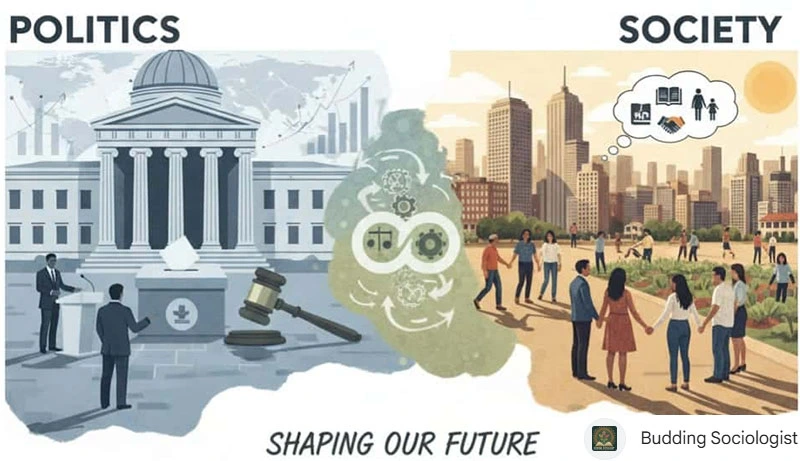
Politics is an integral part of society. In fact, it develops alongside social structures and reflects the values, culture, and behavior of people. Therefore, politics and society remain closely connected in everyday life. But the political split of society is really unfortunate and hilarious.
However, serious problems begin when politics aggressively enters the deeply personal space of individuals. At that point, politics no longer acts as a guiding framework. Instead, it starts creating divisions within society.
Since both politics and society are essential parts of daily human life, such divisions directly affect ordinary people. As a result, common citizens become the primary victims of political conflicts and polarization. This situation is highly undesirable and harmful to social harmony.
In brief, while politics should support and organize society, it must not invade personal spaces in a way that creates fear, conflict, or separation among people.
How Do Regional Parties Shape Indian Politics?
Politics and society share a deep and interdependent relationship. In fact, they constantly influence each other. Moreover, they shape and build one another over time.
A political leader always emerges from society itself. Society creates that leader and brings him or her into power. Therefore, politics never develops in isolation. Instead, it grows out of social needs, demands, and dissatisfaction.
Did Central Neglect Create Regional Leaders?
For example, many regional political parties in India rose because of strong social demands. Whenever a particular community felt neglected by the central government, a new leader emerged to represent that frustration.
As a result, leaders like Lalu Prasad Yadav, Mulayam Singh Yadav, and Mayawati gained prominence by raising their voices against what they saw as central neglect.
Their political rise reflected the social anger and aspirations of their respective communities.
However, politics does not only unite social groups; sometimes it also creates divisions. For instance, political strategies and power struggles later caused a split between Lalu Prasad Yadav and Nitish Kumar. Thus, while society gives birth to leaders, political competition can divide even former allies.
In conclusion, politics and society remain deeply connected. Society shapes leadership, and leadership, in turn, reshapes society. However, political ambition and power struggles can transform social unity into division.
Key Roles of Politicians
What is the real role of politicians?
- First, they make laws.
- Second, they design development plans.
- Moreover, they work to improve education, healthcare, and economic opportunities for citizens.
In short, their primary responsibility is to serve society through policy and governance.
At the same time, many policy demands actually originate from society itself. Politicians do not create every idea on their own. Instead, people raise issues, and leaders respond to them.
For example, during the COVID-19 pandemic, society demanded free ration support. As a result, the government implemented free food distribution schemes to address that urgent need.
Therefore, politics often acts as a mechanism to transform public demand into practical action.
In addition, politicians must take responsibility for reducing long-standing social inequality. They need to fight structural injustice through targeted policies, welfare programs, and inclusive development strategies. Without active political intervention, deep-rooted inequality cannot be reduced.
Unfortunately, inequality remains a serious concern in modern India. Even today, the top 10% of the population controls nearly two-thirds of the country’s wealth. Consequently, economic imbalance continues to challenge social justice and equal opportunity.
In conclusion, politicians must not only govern but also respond to social needs and correct systemic inequality. Only then can politics truly serve society rather than deepen existing divisions.
Why Do Social Movements Rise and Fall?
If we look at the issue from the opposite direction, we see that social movements, cultural values, and public opinion often put strong pressure on governments to change. In many cases, these forces determine the rise and fall of political leaders and policies. Therefore, politics does not control society alone, society also reshapes politics.
India has witnessed several powerful social movements in its history. For example, under the leadership of Jayaprakash Narayan, people united against the government of Indira Gandhi. As a result, the once powerful government lost power.
This clearly shows that public anger and organized movements can challenge even the strongest political authority.
Ideally, politics should create a framework to manage conflicts arising from different interests within society. In other words, institutions like laws and legislatures should regulate disagreements peacefully and constitutionally.
The Constitution of India clearly separates the legislature, executive, judiciary, and media.
This separation protects democracy and prevents the misuse of power.
However, problems begin when a ruler with authoritarian tendencies tries to erase these institutional boundaries. When the executive interferes with the legislature, judiciary, or press, democracy becomes a mockery. Political authoritarianism weakens accountability and damages public trust.
Can Public Anger Overthrow Powerful Governments?
Nevertheless, Indian history repeatedly shows that people reject authoritarianism through their voting power. For instance,
- The fall of Indira Gandhi in 1977 was not an accident.
- Similarly, the defeat of the Communist Party of India (Marxist)–led Left Front government in 2011 was not sudden.
Both events reflected organized public anger against perceived authoritarian rule.
In conclusion, democracy survives when people actively use their voting rights. Whenever political power crosses constitutional limits, society responds. Ultimately, the collective voice of citizens remains the strongest defense against authoritarianism in India.
Is Religion Used for Political Polarization?
Theoretically speaking, politics is the study of how power is distributed and exercised within a society. In simple terms, it examines who holds power, how they use it, and how decisions affect people. Therefore, politics should ideally function as a structured system that ensures fairness and balance.
However, in reality, politics sometimes tries to secure its own power by deliberately creating social divisions. Instead of uniting people, certain political forces attempt to divide society along religious or caste lines. As a result, polarization increases, and social harmony weakens.
Does Caste-Based Politics Deepen Inequality?
Many leaders in India have risen by addressing the long-standing neglect of backward communities.
If we look closely, both Lalu Prasad Yadav and Nitish Kumar built their political careers by mobilizing support from marginalized and backward sections of society.
They capitalized on social injustice and converted it into political strength. However, despite emerging from similar social concerns, they eventually formed separate political parties. This clearly shows how political competition can divide even leaders with common social roots.
Furthermore, the political landscape of West Bengal provides another example of how politics can deepen social divisions. In many instances, political rivalry has moved beyond ideological debate and entered everyday social life.
For example, reports suggest that Jayanta Roy, a Member of Parliament from the Bharatiya Janata Party, faced obstruction while distributing COVID relief materials. Moreover, there have been allegations of social boycott against individuals simply because of their political affiliation.
Consequently, when political identity becomes more important than social unity, democracy suffers. Politics should manage social conflicts through laws and institutions. Instead, when it actively promotes division, it damages the very society it claims to represent.
In conclusion, while politics theoretically studies and regulates power within society, in practice, it sometimes uses division as a tool to maintain authority. Therefore, citizens must remain alert and protect social harmony from excessive political interference.
Can Democracy Survive Political Polarization?
One example may create controversy. However, no one can completely deny its seriousness. Take the massive recruitment scam in West Bengal. How did such large-scale job corruption become possible? How did multiple people from the same village allegedly pay bribes for the same job, yet everyone kept silent?
The reason is that the political split of society became evident. Indeed, “Divide and Rule” is a tested policy of the rulers.
Why Can’t Victims Unite Against Corruption?
Villages in India are still socially connected and transparent spaces. Usually, news spreads quickly. Nothing remains hidden for long. So why did this exception occur in this case?
The answer may lie in political division. Politics, instead of uniting society against injustice, may have divided communities so deeply that even neighbors stopped trusting each other. In some cases, even two adjacent households may stand on opposite political sides. As a result, people hesitate to speak out together.
How Does Fear Silence Public Unity?
Most importantly, jobs were lost for thousands. The figure of 26,000 affected candidates is not small. Such a number should normally trigger a massive social movement. Yet, we did not see a sustained, united public uprising of the same scale. Why?
The first reason may be fear. Many people may fear administrative pressure or political consequences. However, the second and more serious reason could be political polarization.
When politics divides society into rigid camps, victims fail to unite under one common cause. Even if everyone suffers, they cannot stand together under one roof.
Why Do Protests Lose Momentum Over Time?
A similar pattern appeared during the protests related to R. G. Kar Medical College and Hospital. Initially, public outrage seemed strong and widespread. However, over time, the intensity suddenly faded. Many observers argue that political maneuvering and divisive strategies weakened the collective momentum.
Is Political Division Weakening Social Harmony?
Therefore, the larger issue is not only corruption. The deeper concern is how political division prevents social unity. When politics plays a calculated game of polarization, society becomes fragmented. Consequently, even genuine victims struggle to build a united movement for justice.
In conclusion, corruption harms individuals. But political division harms society as a whole. When society cannot unite against injustice, democracy itself becomes weaker.
How Does Politics Create Social Division?
If we examine the Indian context, we notice a major political shift during the leadership of Indira Gandhi. She moved away from many traditional values of the Indian National Congress and gradually centralized authority within both the party and the government. As a result, she became the undisputed center of power.
Moreover, critics argue that during her tenure, political influence expanded over institutions such as the judiciary and the media. Consequently, a culture of centralization and political dominance began to grow. Many observers believe that traces of this tradition still exist today, which becomes evident when we look at contemporary political developments.
However, this period of centralized control also triggered a political reaction. In the 1980s and 1990s, several strong regional parties emerged across India. At the same time, the rise of the Bharatiya Janata Party changed the national political landscape. Therefore, authoritarian tendencies at the center indirectly contributed to political diversification.
It is important to remember that even today, the BJP-led government at the center depends on alliances and is not always solely dominant in terms of overall coalition strength. As regional parties gained influence, coalition politics became the norm.
However, the rise of regional parties brought both opportunities and challenges. On one hand, they gave voice to local aspirations. On the other hand, they increased political bargaining at the national level. Political analysts may debate whether this trend strengthened democratic decentralization. Meanwhile, ordinary citizens often observe a rise in “horse-trading” and party switching.
Today, a voter may elect a candidate under one party symbol. Yet, there is no guarantee that the same leader will remain loyal to that party for five years. As a result, political stability sometimes suffers.
Does Coalition Politics Increase Instability?
Furthermore, regional leaders often use their bargaining power to secure special benefits for their states. For instance,
- Leaders like Lalu Prasad Yadav and Nitish Kumar as Railway Minister focused on Bihar’s interests.
- Similarly, Mamata Banerjee emphasized West Bengal’s development priorities.
- In recent years, figures like N. Chandrababu Naidu and Nitish Kumar have negotiated for special financial packages for their respective states.
While such negotiations may appear beneficial for individual regions, they also create a form of regional division. Political compulsion and coalition arithmetic sometimes prioritize state-level bargaining over national coherence.
In conclusion, India’s shift from centralized dominance to coalition politics reshaped its democracy. However, this transformation also introduced new forms of political competition, regional assertion, and institutional instability.
Therefore, while political diversification expanded representation, it also created fresh challenges for democratic consistency and unity.
What Should Be the True Role of Politics?
Ultimately, we want to see politics as a process of governing and guiding society. We do not want to see it as a tool for social division. Instead of creating conflict, politics should promote unity, justice, and collective progress.
Should Politics Reflect Social Values?
In its true sense, politics reflects the values, culture, and power structure of a society. Therefore, if society believes in equality, tolerance, and fairness, politics should mirror those principles. It should not distort them for short-term power gains.
Can Development Replace Division Politics?
Moreover, politics must focus on development and human welfare. It should prioritize education, healthcare, employment, and equal opportunity. When political leadership works in the interest of people’s growth, democracy becomes stronger and more meaningful.
In conclusion, politics should act as a constructive force. It must represent society’s highest values rather than its deepest divisions. Only then can politics truly serve the people and contribute to long-term social progress.
Key Takeaways
- Politics and society share a deep and interdependent relationship.
- Ideally, politics should manage social conflicts through laws and institutions.
- However, the political split of society often creates division based on religion, caste, or regional identity.
- Social movements in India have repeatedly challenged authoritarian tendencies through democratic voting.
- Regional parties emerged from social neglect, but coalition politics also increased bargaining and instability.
- Political polarization weakens collective protests, even when large-scale corruption or injustice affects thousands.
- Fear and division prevent victims from uniting under a common cause.
- Ultimately, politics should reflect society’s values and focus on development, equality, and public welfare—not division.
People Also Ask (PAA)
What does political split of society mean?
The political split of society refers to deep divisions among people caused by political ideologies, party loyalty, religion, caste, or regional identity. It often weakens social unity and increases polarization.
How does politics divide society?
Politics can divide society when leaders use religion, caste, or regional identity to gain votes. As a result, communities become polarized instead of united around common development goals.
Is political polarization harmful to democracy?
Yes, excessive political polarization harms democracy. It reduces constructive debate, increases hostility, and prevents people from uniting against corruption or injustice.
Why do social movements lose momentum in India?
Social movements often lose momentum due to political pressure, fear, internal division, or strategic polarization. When society remains divided, sustained collective action becomes difficult.
How do regional parties contribute to political division?
Regional parties represent local interests. However, coalition politics sometimes encourages bargaining and competitive regionalism, which can deepen political fragmentation.
Can voters stop the political split of society?
Yes, voters play a crucial role. By choosing development-focused and inclusive leadership, citizens can reduce polarization and strengthen democratic values.
What is the ideal role of politics in society?
Ideally, politics should manage social conflicts through laws and institutions. It should promote equality, development, and social harmony—not division.