An Authentic analysis of nuclear families
Oct 16, 2025 - By Ashutosh Roy Culture & HeritageSocial IssuesSociety
Nuclear Families: A retrospective Lens
Human interdependence
Since God created Eve as a companion of Adam, they selected the Garden of Eden as a place to live in. Thus the concept of bonding and family has been established. Although, Some old myths reveals that the need of protection of physically weak women had ascertained the concept of family. Carlos Salinas de Gortari with the saying, “No one can live entirely on their own, nor can any country or society exist in isolation”, has empowered us to shift our focus even to a broader horizon. However, after a series of evolution under the influence of ever-changing socio-economic scenarios, the concept of nuclear families emerged. Traditionally, India has been maintaining joint families as system since the beginning.
Joint Families to Nuclear Families
The family is the nucleus of any society. If we try to go to the core concept of family, we can find it to be a basic social unit that consists of individuals connected by ties of blood, marriage, or adoption. They typically stay in a single unit, share household works, aids economic growth. The individuals try to meet physical, emotional, and social needs by engaging in various forms of social interaction.
Thus, they become inter-dependent by default. So, they develop a sense of belongingness and security. The Unit itself define familial roles, obligations, and expectations. These families develop the ways to care for the elderly members and production of offspring in a disciplined and systematic manner.
These bonding helps them to shape their identities within the social fabric and to transmit their own culture and ideologies. These family networks also transfer their cultural knowledge, traditions, and history down the ladder.

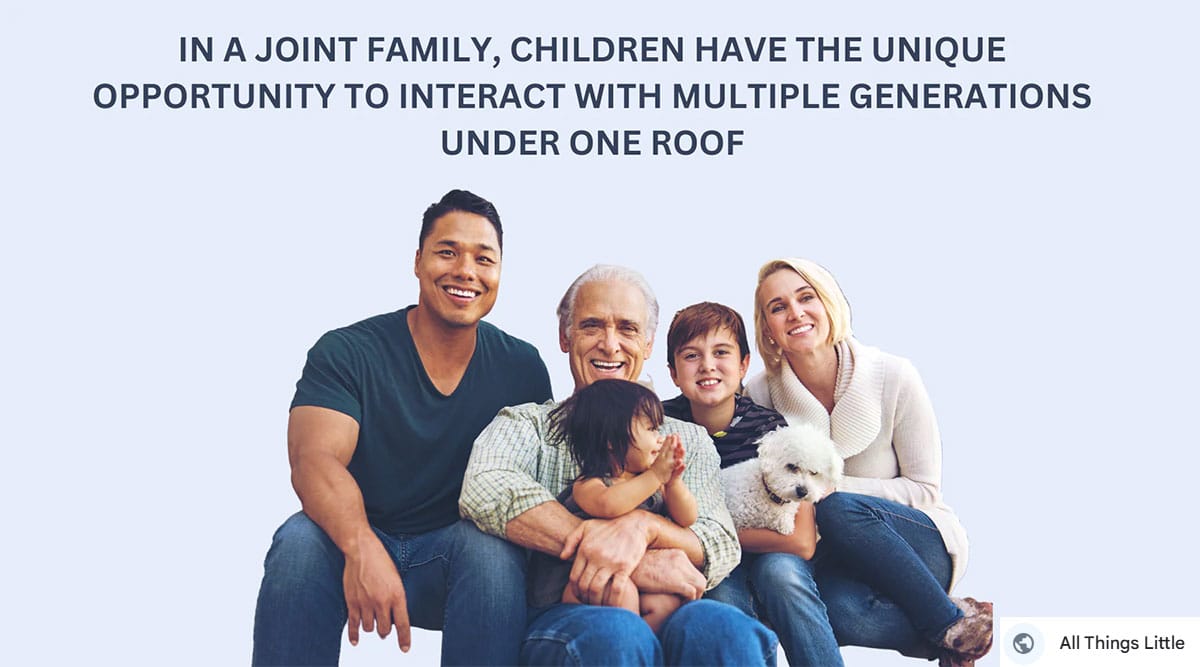
A typical joint family
India is a traditional place for the ideal conventional family structure in the form the joint families. The socio-economic compulsion and an ever-grown demand of individual freedom coupled with economic independence and urbanizations have forced Indians to opt for today’s nuclear families. Studies show a significant increase in the number of nuclear families splitting the traditional joint families.
Nuclear families offer greater privacy and a sense of freedom for members to live as they choose but the biggest challenge that they can face like economic insecurity and a lack of social support from a wider kin network.
In fact today’s flat culture mainly in the city and urban areas has even challenged the conventional definition of society at large.
Pitfalls of nuclear families
The rapid rise in nuclear families has also brought with it societal concerns. An increase in divorce rates, and a shrinking of kinship ties and the inter-family violence have become a devastating trend in nuclear families. With more women becoming financially independent has seriously told upon the conventional gender roles, leading to intolerance and frustrations. Various Psychic disorders are often attacking people.
The kids do feel for the absenteeism of its parents, where both the couples join paid workforce and isolation at times generates anxiety, sadness, anger, or withdrawal. They can hardly withstand the quote of May Sarton, “Loneliness is the poverty of self; solitude is the richness of self”.
Ipsos survey found 43% of urban Indians felt lonely, and other sources cite around 25% of adolescents feeling lonely. Simultaneously the elderly aged people are often shifted to the old age home, which has become am upcoming trend even in semi-urban areas. The bonding between children and their parents are reducing drastically; And such weak bonding gets transmitted from one generation to the next, raising concerns for the sociologists.
As the structure of family changes, so too does the social fabric that binds communities together.
Are Nuclear Families a Modern Necessity or a Desperate Search for Freedom? 👇Share Your Views
[…] family counseling and cordial behavior from the other family and close […]
[…] cognitive biases to create artificial needs, manipulating consumers into unnecessary purchases. Online shopping platforms and credit card companies compound this with easy EMI options, encouraging impulsive […]
[…] Chatterjee, the step child often faces tortures from their step mother or father. The age of Nuclear families has already reduced the bonding of the family. Now, even if the couples break up, it can lead to a […]
[…] split of conventional family structures to nuclear families have further made the people further lonely. Such loneliness plays a pivotal role for mental […]
[…]An Authentic analysis of nuclear families Explore whether nuclear families are a blessing or curse with deep insights into advantages, social challenges, emotional impact, and modern family dynamics.[…]