The Truth About Federal structure in India
Dec 21, 2025 - By Ashutosh Roy Governance & AdminNational PoliticsPoliticsRegional UpdatesWest Bengal Politics
India’s Democracy and Federal Structure in India in front of a strong challenge
Federal structure in India faced its first major blow on July 31, 1959. The Nehru government at the Centre used Article 356 to dismiss the democratically elected Communist government led by E. M. S. Namboodiripad in Kerala. Next, this action marked the first time the Centre showed an authoritarian attitude against a non-Congress state government against the cohesive Centre-State relations, as demanded by the Constitution.
It clearly revealed how the Centre could misuse its power. Moreover, President’s Rule effectively means that the Centre directly runs the state government. It takes control in the name of constitutional authority. So, the Centre-State relations face the wrath.

Image Courtesy: Newsd
However, for historical clarity, it is important to remember that President’s Rule did not begin in 1959. It actually started earlier. Earlier, on June 20, 1951, the Centre imposed President’s Rule in Punjab. At that time, it did so because of internal conflicts within the ruling Congress party itself.
Moreover, we also saw the same trend of violating the Centre-State relations during Indira Gandhi’s time. The Centre repeatedly used Article 356 against democratically elected governments in opposition-ruled states. It also sent loyal governors to control state governments indirectly. As a result, the misuse of President’s Rule became so serious that the Supreme Court had to intervene.
Then, the S. R. Bommai case (1994) became a landmark judgment of the Indian Supreme Court. The court clearly placed firm limits on the Centre’s unchecked power to impose President’s Rule under Article 356 in the states.
Bengal Against discrimination
The freight-related discrimination that we have seen against West Bengal is historic. It did not happen once. It continued over time. Next, journalist Ranjit Ray’s book The Agony of West Bengal serves as an important historical record. It documents this discrimination with evidence.
Moreover, the contemporary state government repeatedly raised its voice against the Centre’s step-motherly attitude. It openly protested this unfair treatment. Finally, this issue was not just a narrow political interests. It equally involved the broader interests of the state.
Centre–State Conflict Beyond Article 356
The issue of centralization of power does not limit to Article 356 alone. We have repeatedly seen an authoritarian attitude from the central government even on subjects listed in the Concurrent List of the Indian Constitution.
For instance, the implementation of the National Education Policy (NEP) is one such example. Here too, the Centre has acted in a somewhat high-handed manner.
Moreover, a series of continuous dialogue in a cohesive environment could easily resolve many of these issues. If the Centre had sat at the table with all states, solutions would not have been difficult. So, it is hard to understand why such confrontational behavior was necessary.
On the other hand, the Goods and Services Tax (GST) show how well Centre–state coordination can work. It proves that cooperation and cohesiveness can deliver results. Finally, when the Centre and the states move together while respecting India’s federal structure, the benefits are clear. The success of GST clearly demonstrates this.
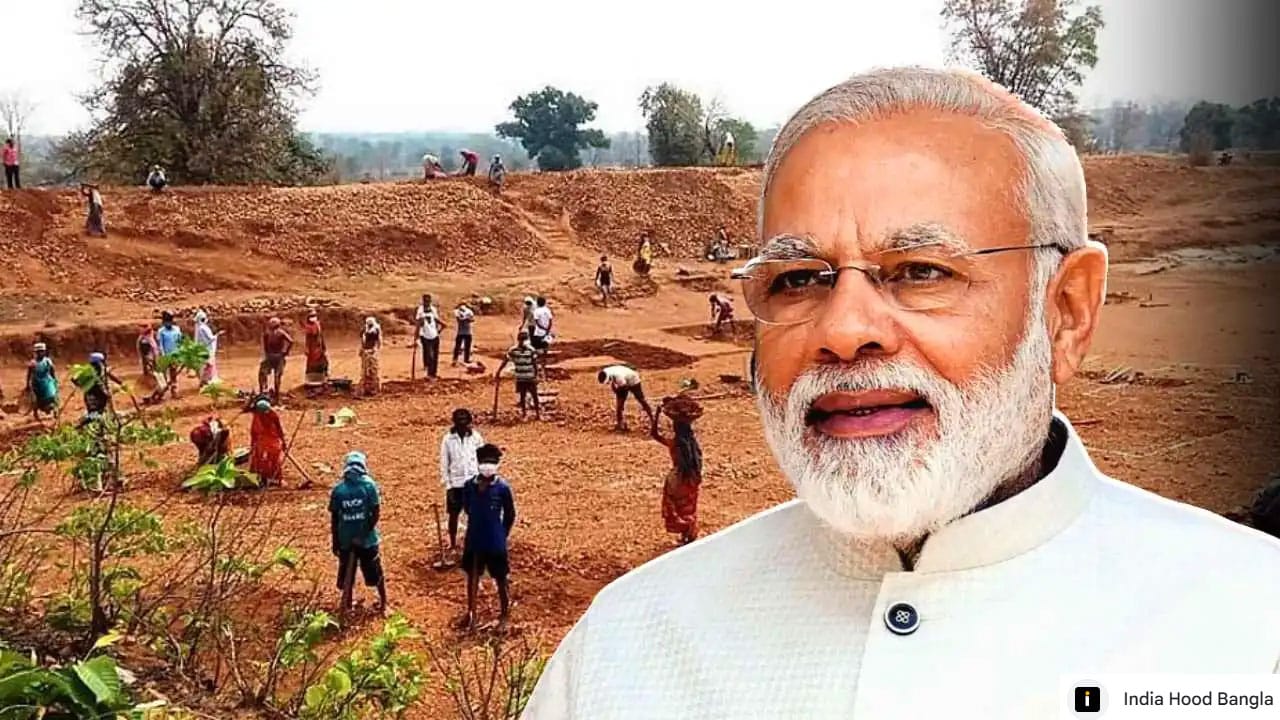
MGNREGA: the Question of State Autonomy and federal structure in India
There is a lot of debate about the renaming of the MGNREGA scheme. The issue has created political slugfest. However, where is the united opposition to the Centre’s unilateral decision to change the funding ratio from 90:10 to 60:40? That question remains unanswered. They seem to be non-existent.

Image Courtesy: Vibes of India
Next, it is clear that the MGNREGA scheme is undergoing a fundamental transformation. The Centre will now decide where work will take place and when it will happen.
Moreover, if all powers move into the Centre’s hands, questions about the role of the states will certainly arise. The states will have very little say. Finally, the autonomy of the states, the cornerstone of federal structure in India, is slowly changing. Such changes area against the ethics of Centre-State relations.
This shift raises serious concerns about the future of Centre-State relations.
Coalition Politics limits unilateral power in Centre-State relations
When a strong government rules at the Centre, authoritarian tendencies become more visible. Such governments often exercise power in a more centralized manner. In contrast, when a coalition government is in power, it usually avoids this kind of unchecked authority.
The need to consult allies acts as a restraint. For example, India saw long periods of coalition rule under Atal Bihari Vajpayee and Manmohan Singh. During these years, power was more balanced.
However, challenges arise in coalition governments when the Government needs to take tough decisions for the future. Internal disagreements often slow down decision-making. For instance, we saw the CPI(M) withdraw support during the Indo–US nuclear deal.
Although the government survived with Mulayam Singh’s support, the difficulties were obvious. Moreover, coalition politics has also led to misuse of ministries.
Several leaders tried to turn the Railway Budget into a budget for their own states. Thus, Mamata Banerjee, Nitish Kumar, and Lalu Prasad Yadav are clear examples of this trend.
Indian history has witnessed some unusual developments. It is important to remember that when Manmohan Singh introduced economic liberalization, P. V. Narasimha Rao was leading a minority government.
Despite this, the government took bold and decisive steps. As a result, these reforms pushed India forward in a significant way.
No one can deny the impact of those decisions have paved the path of the country’s progress.
Narendra Modi Government and federal structure in India
At present, Narendra Modi does not have a clear single-party majority either. However, there is hardly any visible difference between how the BJP ran the government in 2014 or 2019 and how it is running the government in 2024. The reason is clear.
Modi has created a unique ecosystem with the allies on whom his government depends. Moreover, leaders like Nitish Kumar and Chandrababu Naidu seem satisfied with holding on to their chief ministerial chairs and securing development funds for their states. As a result, they show little concern about what happens at the Centre.
Finally, this is why we continue to see BJP leaders holding the key and powerful ministries in the central government without any hindrances.
Weak Opposition: A threat to Federal Structure in India
In this situation, democracy urgently needs a united or strong opposition. Unfortunately, we see neither. Next, within the INDIA alliance, the focus has shifted away from accepting Congress leadership. Instead, parties are more interested in forming smaller groups within the alliance.
However, the reality is different. Most opposition parties have very limited power, while the Centre has a strong prime minister like Narendra Modi. As a result, only opposition unity can give them some advantage. Without it, their ability to challenge the government remains weak.
In conclusion, today India’s democracy and its federal structure in India are facing a serious test.
People Also Ask (PAA)
What was the core objective of the federal structure in India?
The fathers of the constitution intended to distribute the power so that the center and the states run in synchronization for the development and benevolence of the citizens.
What is in the Union List in Federal Structure in India?
The issue related to National importance like International and Bilateral policies, defense policy , currency policy etc.
What is in the State List?
The local issues like Civil Administration through Police, Agriculture etc.
What is there in the concurrent list?
The list that contains joint responsibility like education, health, marriage etc.
What happens in case of conflicts?
The fathers of the Constitution wanted a congenial Centre-State relations. However, in reality, it does not happen always. The central laws are binding by default to all states and union territories, excepting a very few exceptions, where the center frames special provisions for some states in some specific conditions.
The state can also frame laws, but in case of conflict, those will be overruled by the central law. However, any law passed in the assembly has to be duly approved by the Governor. However, the Governor may send it to the President, if required. In addition, the state can approach the court in case of conflicts
Latest Updates
Fresh Centre–State protocol row in West Bengal
A new administrative dispute has emerged after the Union government sought deputation of senior district and police officials following a protocol controversy during the President’s visit to North Bengal. The episode has triggered debate over federal norms, bureaucratic control and Centre-state coordination.
States allege delay in central fund releases
Political leaders in some states have accused the Centre of withholding statutory funds and financial allocations under major welfare schemes. Such allegations have revived discussions about fiscal federalism, revenue sharing and cooperative governance mechanisms.
Security coordination challenges highlight federal tensions
Recent criticism from regional leaders over issues like cross-border security management and law-and-order responsibility has underscored the need for stronger institutional coordination between Union agencies and state administrations.
Administrative reforms show evolving power balance
New financial-decision delegation frameworks in some Union Territories aim to speed up development projects while aligning with central rules. Analysts see such reforms as part of a broader trend of redefining governance authority within India’s federal system.
Policy-level debate on “structural reset” of federalism
Recent expert reports and academic discussions suggest India may need a recalibration of Union-State powers to improve fiscal autonomy, policy responsiveness and cooperative decision-making in a rapidly changing political economy.
[…]The Truth About Federal structure in India Understand the crisis of Federal structure in India as tendency of violating Centre-State relations grows analyzing Article 356, MGNREGA, GST, opposition unity.[…]