
Why Does the Saffron Colour Matter?
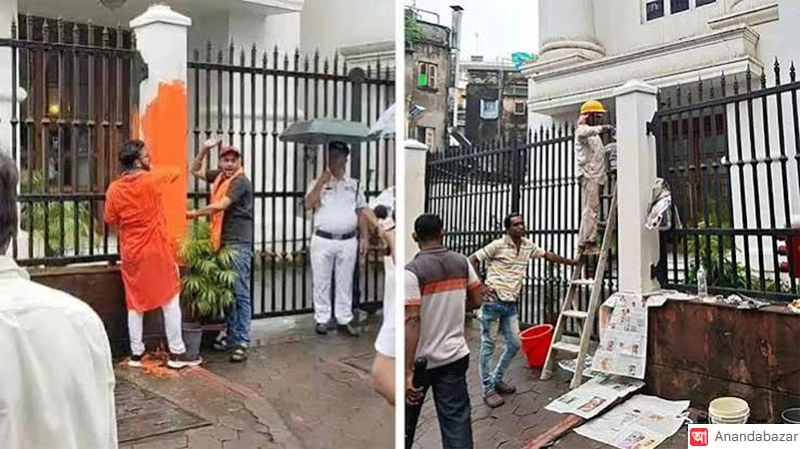
The idea for this article came after saffron colour was painted over Anandabazar and the Academy of Fine Arts. But here, we will focus on the significance of saffron colour and how it is used. We will also try to understand the difference between the saffron colour and politics and the saffron colour worn by a monk.
Look at the protest right in front of Anadabazar Patrika Office.
What Does Saffron Colour Mean?
To understand the saffron colour meaning, we first need to look at how Indians have traditionally viewed it.
We also need to understand what the significance of saffron colour is. We have grown up seeing pictures of Swami Vivekananda and reading his books. Our national flag also has saffron in it. So, our curiosity about the colour is natural and endless.
The saffron colour symbolism in different cultures and traditions points to courage, sacrifice, spiritual light and the search for detachment. Anyone who has been associated with the Ramakrishna Mission must have noticed the saffron robes worn by the Maharajs there. Of course, we are not talking about Ananta Maharaj here.
As children, many of us have also seen monks in saffron robes asking people for help. I still remember that after my sacred thread ceremony, I had to spend three days in the seclusion room wearing saffron robes.
What I am trying to say is simple. We are already quite familiar with saffron colour. For us, its most familiar identity was that of the monk. Those who could burn away greed, desire and other worldly attachments in the fire of renunciation were the ones who wore saffron robes. In one word, saffron was a symbol of sacrifice.
In Vivekananda’s case, it can also be seen as a symbol of courage. As for spiritual light, even if we do not accept that idea, his biography tells us something important. He was able to combine the spread of Hinduism with a life of great hardship and personal sacrifice, despite being born and raised in a well-to-do family.
How Did Saffron Become a Symbol of Renunciation?
The saffron and renunciation connection is therefore deeply rooted in our understanding of the colour. Long before its modern political use, saffron was familiar to us through monks, spiritual leaders and the idea of sacrifice.
Where Does Saffron Colour Stand in India?
In India’s national flag, the saffron colour stands for courage. At the same time, it also reminds us of the sacrifice made by the martyrs of India’s freedom struggle.
During the Constituent Assembly debates, Dr. S. Radhakrishnan explained that it referred to “Bhagwa”, or saffron, symbolising that leaders must give up worldly desires and material gains and dedicate themselves to public service. So, what was the underlying message? Saffron colour and politics can go together, but political leaders must give up personal greed and devote themselves to serving the people.
Today, when we look at the wealth of some political leaders and feel stunned, perhaps they should take a moment to remember our history.
Why Does RSS Follow the Saffron Colour?
The Rashtriya Swayamsevak Sangh (RSS) uses the saffron flag, or Bhagwa Dhwaj, as its supreme guide and symbol. The reason is simple. The colour represents the values of Hindu civilisation, sacrifice and historic bravery.
It is important to remember that in Hinduism and other Indian religions, saffron, or Bhagwa, is the colour of fire and the setting sun, or Sandhya. It is also seen as a symbol of purity, the search for truth and the renunciation of material desires. In that sense, the RSS too sees saffron as a symbol of sacrifice. That is why the saffron colour appears in the symbols of many of its affiliated organisations.
RSS Link Saffron to Hindutva
The RSS connects the saffron flag with the idea of a Hindu Rashtra, meaning a Hindu nation and culture. It considers the flag an authentic representation of the indigenous traditions of this land. But its ideology does not say that other religions should be treated with intolerance. A Hindutva-based state and intolerance towards other religions are not the same thing.
This is something Mohan Bhagwat knows, and so do Narendra Modi and Amit Shah.
Did Modi Follow His Idea of Raj Dharma?
We must remember what Modi did in Gujarat. Narendra Modi had also sought to control the more hardline activities of the VHP and build an image centred on good governance. That is why he did not allow Dr. Pravin Togadia to enter Gujarat after 2002.
What does it actually imply? As a Chief Minister, Modi gave importance to his Raj Dharma.
Which Saffron Colour Is More Visible Today?
Now we have to come to the question of visibility. Which one is more visible before us today – the saffron of politics or the saffron of a monk? The answer is known to everyone. Thanks to the visibility of politics, the political saffron symbol is far more visible today. The media’s TRP game also plays a role in this.
If Narendra Modi calling someone a “dimagi naxal” can attract more public attention, it is easy to see why political statements get more space than the life and spiritual practice of a monk. One is easy publicity. The other demands difficult and sustained discipline.
This is where the saffron colour symbolism takes a very different turn. The saffron of a monk represents sacrifice, while political saffron is often seen as a symbol of material enjoyment. If the monk’s saffron represents burning away lust and anger in the fire of renunciation, political saffron can sometimes turn into a symbol of burning others down through anger.
The saffron of a monk is associated with calmness and self-control. Political saffron, however, is often presented on television through angry speeches, attacks and attempts to crush opponents. A monk may live with very little, sometimes surviving on fruits or whatever food is available. In contrast, political saffron may hesitate to begin the day without a rich breakfast.
The contrast becomes sharper when we look at the idea of coexistence. A monk’s saffron teaches acceptance and restraint, while political saffron can sometimes turn into a campaign against those seen as the other side. The monk is expected to control his own greed and desires. Political ambition, on the other hand, can push leaders towards greater power and personal influence. The same colour that once stood for harmony and self-control can, in politics, become a marker of division between “us” and “them”.
This is exactly where the fundamental difference in outlook lies. The saffron and renunciation tradition asks a person to conquer himself. The saffron colour and politics we see today can often become a pursuit of power over others.
Why Is Political Saffron More Visible Today?
Of course, someone can ask a fair question: why single out saffron? Who teaches anyone to encourage greed and desire? We can teach our children to be selfish in the race to stand first in an examination, but at the same time, we also teach them many moral values.
The difference is that our narrow-mindedness does not create much disturbance in society because we are not powerful. At most, it may become a topic of discussion among elderly women during their evening gatherings. Beyond that, our influence is limited.
But the situation changes when the saffron colour in India is also the political colour of governments at the Centre and in around 22 or 23 states. That is why the discussion becomes important.
We do not know who painted saffron over Anandabazar and the Academy of Fine Arts. But the incident is connected with two larger issues: the freedom of the media and an important cultural tradition. I certainly believe that Suvendu Adhikari or Shamik Bhattacharya would not support such an incident. But simply saying that we do not support it cannot be the end of the responsibility. What is needed is action.
Suvendu Adhikari has shown administrative firmness and a zero-tolerance approach in many matters. But in this particular case, the bigger question is whether he took active steps.
Political Saffron Must Rise Above Party Identity
Now Let us look at a much larger issue: one that we have watched for the last 15 years and have become tired and frustrated with. The police and administration must rise above party symbols. There had been barriers on the Media for the voice of dissent.
If there is wrongdoing, punishment should follow without looking at the colour of the political flag. That should apply whether the accused belongs to the ruling party or the opposition.
On September 5, Delhi Police arrested Swatantra Bhardwaj. Perhaps it happened under pressure from CJP representatives, but even if it came late, the police eventually had to act. In Bengal, however, while BJP leaders accused of extortion may face action within the party, there has been no corresponding administrative action.
It is high time for Suvendu Adhikari to make a clear choice about the future of political saffron in Bengal. The saffron colour and politics must ultimately represent sacrifice, restraint and public service, not power, privilege and personal gain.
That is ultimately the real test of the saffron colour symbolism in politics.
Media Freedom Must Apply to Everyone
Now we come to the media. The experts who speak passionately about freedom of the press also have a responsibility to speak when that freedom comes under pressure.
The Chief Minister’s reported direction to Anandabazar to apologise on the front page within 24 hours deserves serious scrutiny. Such pressure on a media organisation cannot be treated as a routine political matter. Freedom of speech and expression is constitutionally protected, and the media remains an important pillar of democracy.
Suman Bhattacharya, the Kolkata-based senior journalist, political analyst, and media personality in West Bengal, has criticized the Anandabazar chaos in harsh language.
There was a time when the media in Bengal faced intense political pressure. Journalists and YouTube creators faced severe harassment. We also saw instances of police action against them. The government has changed today, but a change of government alone does not guarantee a real change in political culture.
When Suvendu Adhikari invites opposition MLAs to government meetings, the move deserves appreciation. The same democratic principle must extend to the media, which is widely regarded as the fourth pillar of democracy.
If pressure is imposed on one media organisation while others remain silent, press freedom becomes weaker. Silence does not protect the media. It only makes such pressure easier to repeat.
Political Power Must Accept an Uncomfortable Media
Suvendu Adhikari also needs to remember that an unwanted news report can be challenged through democratic and legal means. A political movement can be organised, and legal action can be taken where there are genuine grounds. But pressure on the media cannot become the default response.
The job of the media is to hold a mirror before those in power. That mirror will not always show a flattering picture. A government committed to democracy must be prepared to face uncomfortable reporting.
It becomes even more pertinent because Suvendu Adhikari represents a government led by a party whose political symbol is saffron. The saffron colour and politics must therefore stand for more than electoral power. If the saffron colour symbolism is rooted in sacrifice, restraint and public service, those values must also be visible in the government’s approach to the media.
What Should Political Saffron Really Stand For?
In the end, one can only hope that some of the values associated with a monk’s saffron robes also reach those who carry the political saffron today. The saffron colour should not be reduced to a mark of power or political identity. It has long stood for sacrifice, restraint and service. A little of that spirit of saffron and renunciation in politics would make the colour mean something far greater than power. It would make it a reminder of responsibility.
10 Key Takeaways:
- Saffron colour has traditionally represented courage, sacrifice, spirituality and renunciation in India.
- The saffron worn by monks stands for self-control, sacrifice and freedom from worldly desires.
- The meaning of saffron changes when the colour enters electoral and political life.
- Saffron colour and politics have become far more visible today, helped in part by political publicity and media attention.
- The article draws a sharp contrast between saffron and renunciation and saffron used as a symbol of political power.
- Political saffron can lose its association with sacrifice when personal ambition, privilege and material gain take centre stage.
- The saffron colour symbolism of Hindu and Indian traditions cannot be separated from ideas of sacrifice, truth and self-restraint.
- Political power must rise above party identity when dealing with wrongdoing, including attacks on media freedom.
- An independent media must be allowed to question those in power, even when its reporting is uncomfortable for the government.
- The real test of political saffron is whether it reflects the values of sacrifice, restraint and public service rather than simply the pursuit of power.