
What happens to TMC Rebel MPs joining NCPI?
The TMC Rebel MPs initially appeared to be enjoying a comfortable position in New Delhi. They met senior BJP leaders including Prime Minister Narendra Modi and the West Bengal chief Minister, Suvendu Adhikari, attended strategy meetings and even shared informal moments with people in the government. Their seating arrangements in the Lok Sabha also gave them some temporary political leverage.
Even though they formally registered under the NCPI banner, their days remained packed – holding private consultations with senior BJP ministers, confidential talks with parliamentary leaders, and closed-door sessions with Union Home Minister Amit Shah amidst regular media coverage.
They met senior BJP leaders, attended strategy meetings and even shared informal moments with people in the government. Their seating arrangements in the Lok Sabha also gave them some temporary political leverage.
Then Abhishek Banerjee initiated decisive legal action, altering the faction’s momentum entirely.
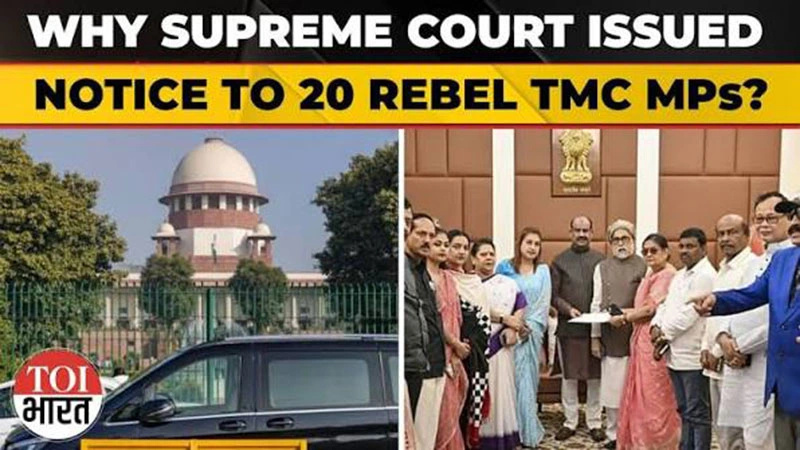
Bypassing standard parliamentary delays, he launched a direct legal challenge in the Supreme Court, with senior advocate Kalyan Banerjee managing the proceedings. The sudden move highlighted the volatile nature of state politics, where personal rivalries yield quickly to high-stakes legal strategy. At Knowledge Mart, our analytical team has tracked each development during this political shift.
Will TMC Rebel MPs lose their Lok Sabha seats?
The registry of the Supreme Court accepted the petition, immediately creating serious legal liabilities for the group.
Formal notices targeted all twenty TMC Rebel MPs, sparking concern across their parliamentary bloc. Compounding their situation, the Lok Sabha Secretariat acted in parallel. While the apex court granted a multi-week timeline for filing written submissions, the Lok Sabha Speaker Om Birla notice required a complete formal response within seven days. This raises a simple question: why did Speaker Om Birla take so long to act?
Watch the Speaker’s Notice in India Today News.
Legal Vulnerabilities of the NCPI Merger
The TMC rebel MPs now face a difficult constitutional battle. Senior advocate Kapil Sibal – frequently representing TMC in constitutional disputes – publicly contended that their merger with the NCPI fails statutory anti-defection tests. Prime-time news broadcasts amplified the critique while regional newspapers led with front-page developments. Whatever protection the faction thought it had is now being tested in court.
Don’t ask me, why did the NCPI allow these rebel MPs to use their party as a bunker? Just have a look at their track records.
TMC split 2026 West Bengal political news
The trouble began after the TMC electoral debacle in 2026 West Bengal Assembly election results. Citing discontent over election outcomes, Kakoli Ghosh Dastidar severed ties with Mamata Banerjee. A group of lawmakers joined her faction, forming an internal revolt that formally repudiated Abhishek Banerjee’s parliamentary leadership.
Shortly afterward, Sudip Banerjee aligned with the breakaway faction. The news quickly appeared across television channels as Breaking News.
Don’t get shocked! The meetings soon shifted to private locations in New Delhi. The live channels telecasted that Suvendu Adhikari arriving for crucial talks at Bhupender Yadav’s official residence. Days later, regional television networks broadcast images of the TMC Rebel MPs alongside central BJP leaders.
Constituency Work vs. Central Strategy in New Delhi
Adding to the controversy, the dissident bloc conducted separate meetings with Chief Minister Suvendu Adhikari in New Delhi, attributing the talks to routine constituency development work. Questioned by reporters, representatives offered limited justification as to why local administrative issues required national capital venues. We have emphasized that dodging these questions deepened public skepticism, particularly given the lack of official briefings regarding the closed-door proceedings.
How Are Bengal Voters Reacting to the TMC Rebel MPs?
While national capital infrastructure offered temporary security, returning to West Bengal presented sharp local opposition. Upon arriving in Kolkata, representatives faced immediate ground-level resistance.
In Jadavpur, local party cadres locked Saayani Ghosh’s Garfa office. Jagadish Basunia encountered hostile crowds in Cooch Behar late at night, forcing him and his wife to depart the district. His wife, Sangita Roy, is a sitting TMC MLA aligned with the Ritabrata-led state assembly bloc.
Earlier investigative reports by Knowledge Mart detailed how local party infrastructure fractured along regional lines.
It’s an irony that the cadres also switch their loyalty to the rulers in case of debacle. Bengal has witnessed it in the post-2014 era and has started watching the repeat telecast of the same after 4th May 2026.
The Dual Alignment of Murshidabad MPs
In New Delhi, Kakoli Ghosh Dastidar’s group uses the official NCPI designation. In West Bengal, constituents frequently refer to them as “Rito-TMC.” Mirroring their division in Parliament, they function as a separate group within the West Bengal Assembly under Ritabrata’s leadership.
While most TMC Rebel MPs minimize public appearances locally, three Muslim MPs from Murshidabad established an unusual position. They regularly skip general NDA coalition meetings yet retain formal NCPI membership. They maintain private meetings with Chief Minister Suvendu Adhikari in Delhi and attend official luncheons.
As Knowledge Mart monitors the situation, this balanced posture complicates standard political classifications.
Murshidabad presents a very different political calculation. The district has a large Muslim population, so openly appearing too close to the BJP could carry a political cost for these MPs. Consequently, these representatives balance two risks: localized street-level protests from constituents, or severe damage to their long-term electoral prospects.
If these three MPs ultimately choose not to respond to Speaker Om Birla or the Supreme Court, the NCPI could face a major setback. The number game is quite simple. TMC currently has 28 Lok Sabha MPs, so a two-thirds figure would require 19 MPs. At present, 20 TMC rebel MPs have joined NCPI. But if three of them pull out, the number would fall to 17. That is below the crucial 19 needed to claim the two-thirds threshold and stay outside the scope of the Anti-defection law Tenth Schedule.
Why did TMC MPs switch to NCPI?
The choice by twenty TMC Rebel MPs to split from the parent organization immediately triggered statutory challenges under the Anti-defection law Tenth Schedule.
Introduced during Rajiv Gandhi’s tenure via the 52nd Constitutional Amendment in 1985, the Tenth Schedule grants the Presiding Officer decisive jurisdiction over disqualification petitions. However, because Speakers emerge from ruling party ranks, neutral handling of these cases remains a subject of ongoing legal debate.
Disqualification petitions can sometimes remain pending for years. That is where the real controversy begins. The Speaker is expected to act impartially, but the office itself is occupied by a member of the political establishment. Addressing this practice, the Supreme Court intervened in 2020 by placing a strict time bound on the Manipur Speaker regarding pending petitions.
Historical instances, such as Speaker Somnath Chatterjee upholding the independence of the Chair over party mandates during the 2008 vote, stand out in legislative history. He prioritized constitutional duties over party discipline, choosing expulsion over compromising the position.
Will the courts decide the fate of TMC Rebel MPs?
Because floor decisions routinely provoke court disputes, higher judicial bodies review anti-defection cases with increasing frequency. With the Supreme Court scheduling reviews of precedent cases involving the Shiv Sena split, analysts at Knowledge Mart note these judicial rulings will determine whether the TMC Rebel MPs retain their seats.
Catch political analyst Biswanath Chakraborty’s sharp, sarcastic remarks on ABP Ananda.
How Does the TMC Rebel MPs Crisis Impact the BJP?
For the BJP, numbers matter. A larger bloc of MPs can strengthen its position in Parliament and make constitutional changes easier to pursue. They are desperate for two-thirds supermajority for constitutional amendments. Simultaneously, the state-level effort to absorb 60 to 65 rebel TMC MLAs in West Bengal highlights broader regional goals. Is it to make West Bengal an opposition-free state?
Political dynamics have shifted significantly from past practices.
Historical leaders like Atal Bihari Vajpayee accepted a single-vote government collapse over engineering defections. In contrast, current national managers employ direct numerical strategies.
Focusing on these parliamentary goals, party operators utilized statutory provisions to help defectors navigate the restrictions of the Anti-defection law Tenth Schedule.
However, floor counts fell short during crucial moments. Following weeks of negotiation to build a reliable majority, the BJP ran out of time in the Monsoon session without managing to table major priority bills, including delimitation and women’s reservation measures.
The BJP tried its best but failed to reach that number.
| Timeline | MPs | Original Party | Destination | House | Merger Status |
|---|---|---|---|---|---|
| April 2026 | Raghav Chadha + 6 others | AAP | BJP | Rajya Sabha | Recognised merger – 7 of AAP’s 10 Rajya Sabha MPs |
| June-July 2026 | 20 MPs | TMC | NCPI / NDA | Lok Sabha | Claimed 2/3 merger; disputed and subject to disqualification proceedings |
| July 2026 | 6 MPs | Shiv Sena (UBT) | Shiv Sena (Shinde) | Lok Sabha | Merger recognised by the Speaker; challenged by UBT |
| July 2026 | Sukhendu Sekhar Roy, Sushmita Dev, Prakash Chik Baraik | TMC | BJP | Rajya Sabha | Not a 2/3 merger – they resigned from TMC/Rajya Sabha before joining BJP |
Another problem has cropped up in Bengal Politics. Sukanta Majumdar, who is in-charge of Kolkata and Howrah Corporations, announced in the morning that BJP will contest alone in the election. In the evening, Sudip Banerjee, the current NCPI MP announced that NCPI will contest jointly in the corporation election. He has even confirmed that there has been an initial discussion with the Chief Minister, Suvendu Adhikari. When ABP Ananda tried to clarify his stance, he replied on air that he doesn’t have such information.
In addition to that, Tapas Roy, the Industrial Minister of West Bengal has had a long-standing rivalry with Sudip Banerjee during their TMC days. Will he be ready to share the stage with Sudip in the election campaign?
Did Mamata Banerjee start this party-switching trend in Bengal?
Historically, Mamata Banerjee utilized similar strategies within West Bengal. Over previous terms, Trinamool Congress regularly inducted opposition leaders without requiring prior resignation from their elected posts. When Bayron Biswas left Congress for TMC shortly before the INDIA bloc formed, party leadership categorized criticism as a routine local matter.
Today, the central BJP applies identical tactics in reverse. The irony is hard to miss: a tactic once used against the BJP is now being used against the TMC.
How long will this political head-hunting continue? When will political parties stop searching for loopholes in the Anti-Defection Law under the Tenth Schedule of the Indian Constitution and using them whenever it suits them?
Is This a Betrayal of the Voters by TMC Rebel MPs?
Beyond technical constitutional arguments lies a core political question: Prime Minister Narendra Modi sharing platforms with TMC Rebel MPs previously criticized during election campaigns creates obvious ideological tension. Similarly, rebel leaders face difficulty explaining their alliance with an administration their constituents voted to oppose.
This dynamic damages standard voter expectations.
Amid rising discontent in districts like Jadavpur and Cooch Behar, TMC Rebel MPs and state MLAs face hostile public reactions when attempting constituency visits. Had these representatives resigned their seats before altering affiliations, they would have preserved greater institutional legitimacy.
Don’t they feel even a little ashamed when they stand in front of a mirror and look at their own reflection?
Will voters punish TMC Rebel MPs in the next election?
Electoral cycles progress quickly, and voters consistently track mid-term realignments. Analysts at Knowledge Mart emphasize that politicians who disregard constituent mandates frequently experience negative outcomes at the polls.
Knowledge Mart Exclusive Analysis: The Final Verdict on the TMC Rebel MPs Trap
Managing political strategy in New Delhi involves vastly different variables than addressing voter sentiment across West Bengal. Executing a rapid merger with an obscure party like the NCPI to circumvent anti-defection clauses provided the twenty TMC Rebel MPs brief procedural margin. High-level strategy meetings and media exposure created an impression of security, but formal court notices and tight parliamentary deadlines are systematically dismantling that position.
The core risk facing these MPs remains political rather than purely statutory.
While legal challenges move through judicial processes, public opinion shifts rapidly. Technical compliance under the Tenth Schedule does not neutralize constituent reactions to sudden political shifts. Local demonstrations across home districts represent clear indicators of voter sentiment ahead of future elections.
This friction was visible during confrontations involving TMC Rival Groups during July 21st events.
What lies ahead for the TMC Rebel MPs?
The coming weeks will be crucial for the rebel MPs. They have to answer the Speaker as well as defend their position before the courts. But even a favourable legal outcome may not settle the political question. They still have to face their voters. The real test is not only whether the merger survives the Tenth Schedule. It is whether these MPs can explain the decision to the people who elected them.
Sustainable political representation depends on voter trust, and bypassing constitutional standards carries long-term penalties. Comprehensive tracking by Knowledge Mart demonstrates that whether through judicial rulings or voter decisions, the group’s political maneuver carries severe risks.
10 Key Takeaways: TMC Rebel MPs NCPI Trap 2026
- Post-Election Fallout: Following defeat in the 2026 West Bengal Assembly elections, 20 TMC Lok Sabha MPs broke away from the parent party, citing internal disagreements and rejecting Abhishek Banerjee’s leadership.
- The NCPI Move: To bypass disqualification under the Tenth Schedule (Anti-Defection Law), the 20 TMC Rebel MPs merged with the registered regional party, Nationalist Citizens Party of India (NCPI).
- Legal Trap Closes: Abhishek Banerjee submitted petitions to both the Lok Sabha Secretariat and the Supreme Court seeking disqualification of the defecting members.
- Tight Deadlines: The Lok Sabha Secretariat issued formal notices granting the TMC Rebel MPs a 7-day window to respond, forcing an immediate legal response.
- Expert Warning: Senior advocate Kapil Sibal publicly analyzed the NCPI merger as legally unsustainable under constitutional provisions, increasing court risk.
- Dual Faction Identity: While Kakoli Ghosh Dastidar heads the group under the NCPI banner in Delhi, the faction functions locally in Bengal under the “Ritabrata-TMC” designation.
- Public Backlash: Rebel leaders encountered local resistance in home constituencies, marked by public demonstrations against leaders like Jagadish Basunia and office blockades in Jadavpur.
- The Murshidabad Fence-Sitters: Three Muslim MPs from Murshidabad established an unusual position by abstaining from NDA meetings while maintaining formal NCPI affiliations.
- Strategic Shift by BJP: Aiming to secure a two-thirds parliamentary majority, central BJP leadership backed the TMC Rebel MPs, mirroring historical state-level party-switching tactics.
- Voter Accountability: Looking ahead to future elections, Knowledge Mart analysis indicates that circumventing the Anti-Defection Law carries substantial electoral penalties.