
Why BJP Ex TMC Strategy in RS Sparks Fury?
The political chessboard in West Bengal has just witnessed a stunning, quiet tactical move, highlighting the controversial BJP Ex TMC strategy.
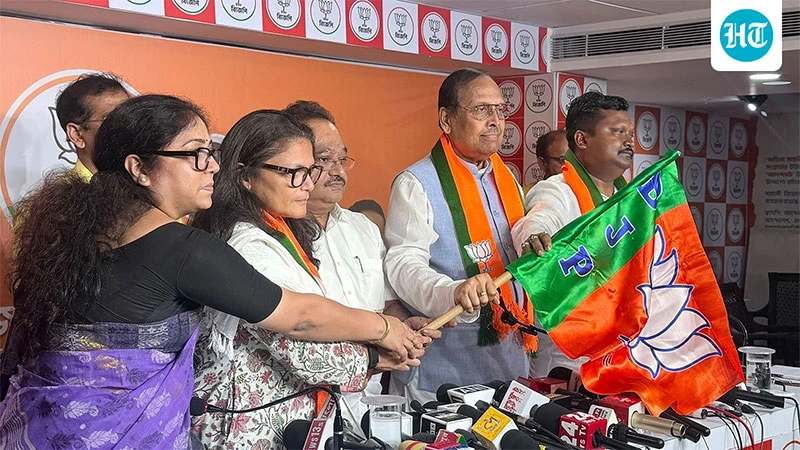
The ink was barely dry on their resignation letters when three prominent Trinamool Congress (TMC) Rajya Sabha MPs jumped ship. Within hours of joining the Bharatiya Janata Party (BJP), they received a massive reward: official nominations back to the Upper House of Parliament under the saffron flag.
For the dedicated BJP grassroots workers, this move felt like a sudden punch to the gut. The state leadership quickly wrapped these newcomers in saffron scarves.
They showered them with high praise. They even called them “intellectuals” and “distinguished personalities”.
However, behind closed doors, a bitter question is echoing across the state. Why is the BJP using backdoor politics to absorb Ex TMC leaders in BJP right after a historic mandate?
The public has a right to know the truth. This sharp investigative report by Knowledge Mart unpacks the deep frustrations, the hidden compromise, and the major structural risks of this silent power play.
Why Did BJP Reward Former TMC MPs with Rajya Sabha Bypolls?
The political timeline moved at lightning speed. Analysts are still scrambling to decode the real motives behind the BJP Rajya Sabha nominees Bengal selection.
- The leaders quit their parliamentary seats.
- They crossed over to the opposition camp.
- They instantly secured their old seats back under a brand-new banner.
The sheer speed of this transition proves this was no organic shift. Instead, it was a pre-planned, calculated political trade.
According to a detailed report by Livemint, this strategic move ensures the central leadership secures immediate, experienced parliamentary voices. Yet, it completely bypasses the local party workers who built the actual election victory on the ground.
Who Are These Three “Distinguished Personalities”?
The central question troubling most voters is simple. What extraordinary talent did the BJP leadership discover in these three specific individuals? Let us break down the ground reality behind the elite political titles.
1. Sukhendu Sekhar Ray: Living in a Father’s Shadow?
Sukhendu Sekhar Ray is a veteran politician. His father is late Shibendu Sekhar Roy, who was a prominent civil lawyer and Hindu Mahasabha leader. Historically, his father made an unforgettable, patriotic contribution. He fought hard to keep Malda within West Bengal during the tense partition era.
Even Prime Minister Narendra Modi publicly appreciated his father’s historic role during a major public meeting.
But a serious question remains. Can a son automatically qualify as an intellectual giant based entirely on his father’s past national service?
Stripping away his ancestral prestige reveals a career largely spent backing the dictatorial whims of the TMC machinery.
Therefore, the grassroots workers find it hard to celebrate his sudden promotion.
2. Sushmita Dev: Is Legacy Her Only Asset?
Sushmita Dev’s entire political identity revolves around being the daughter of the late Congress heavyweight Santosh Mohan Dev. She has hopped across three major political parties.
She moved from Congress to TMC, and now directly to the BJP. You can check her complete political timeline and party shifts on her official Wikipedia Profile.
What is her actual, tangible contribution to the grassroots people of West Bengal? Can she pull a single voter to the polling booth without using her family’s historical surname?
Her political career lacks any major mass movement or grassroots victory in Bengal. Still, she sits at the top of the selection list.
3. Prakash Chik Baraik: A Slap to the Victims of Violence?
The inclusion of Prakash Chik Baraik is the most shocking pill for local BJP cadres to swallow. For several years, local BJP leaders in the northern districts consistently accused him of wrongdoing.
They claimed he orchestrated state-sponsored torture against opposition workers. The party regularly demanded his immediate arrest.
Now, he sits comfortably inside the ruling camp. What happens to those loyal BJP cadres who faced physical violence, false police cases, and severe torture under his local regime?
This move feels like an outright betrayal of their immense sacrifices.
Can Samik Bhattacharya Save the Morale of Loyal BJP Cadres?
Not long ago, state leader Samik Bhattacharya gave a famous speech. He divided the ruling party into two clean columns: “Good TMC vs. Bad TMC“.
But, today, the party is completely erasing those lines. As reported by India TV News, the induction took place smoothly at the state headquarters, but the inner circle remains deeply divided.
The BJP absorbs TMC leaders blindly, treating tainted political operators as elite intellectuals. This dynamic creates severe issues for internal party morale:
- Bypassing Worthy Aspirants: There were dozens of highly educated, dedicated, and clean ideological faces within the BJP. They fully deserved a seat in the Rajya Sabha. What is their fault?
- Killing Grassroots Motivation: Why should a local worker risk their life on the streets against opposition goons if the party simply plans to give top institutional power to newcomers?
- Diluting Party Identity: If the BJP populates its parliamentary ranks with old Trinamool faces, it risks transforming into a mirror image of the very party it fought to defeat.
Is the Backdoor Entry Strategy a Fatal Mistake?
The context here is highly critical. The BJP has just achieved a historic, mammoth victory in the West Bengal Assembly Elections 2026.
The people voted decisively for real structural change. They explicitly rejected the old culture of corruption, nepotism, and political violence.
By utilizing this indirect, backdoor method to adjust elite turncoats, the central leadership is playing a dangerous game. Let us look at the structural comparison below.
| The 2021 Blunder | The Current High Stakes |
|---|---|
| In 2021, the BJP mass-imported leaders right before the elections. This move destroyed its clean image and lost the public trust. | The party won a massive public mandate on the strict promise of clean, alternative governance. |
| Old party loyalists sat at home silently, refusing to campaign for corrupt turncoats. | Bringing back the same controversial Ex TMC leaders in BJP via Rajya Sabha bypolls threatens to alienate voters instantly. |
The analyst team at Knowledge Mart emphasizes that public memory is short, but political betrayal leaves deep scars.
If the party continues this trend, it risks turning a hard-won democratic victory into a shallow, elite musical chairs game. Strategists must remember their past missteps before the damage becomes irreversible.
TMC Leaders Who Joined BJP in 2021 & Got Tickets
| Leader Name | Former Role in TMC | Joined BJP | Contested Seat (2021) | Result |
|---|---|---|---|---|
| Suvendu Adhikari | Senior Minister, Mass Leader | Dec 2020 | Nandigram | Won |
| Rajib Banerjee | Forest Minister | Jan 2021 | Domjur | Lost |
| Baishali Dalmiya | MLA | Jan 2021 | Bally | Lost |
| Prabir Ghoshal | MLA | Jan 2021 | Uttarpara | Lost |
| Rathin Chakraborty | MLA | Jan 2021 | Howrah North | Lost |
| Rudranil Ghosh | Cultural Face, Leader | Jan 2021 | Bhabanipur | Lost |
| Sonali Guha | Senior MLA | Mar 2021 | Satgachia | Lost |
| Dipendu Biswas | MLA, Ex-Footballer | Mar 2021 | Basirhat Dakshin | Lost |
| Rabindranath Bhattacharya | Veteran MLA | Mar 2021 | Singur | Lost |
| Jatu Lahiri | MLA | Mar 2021 | Shibpur | Lost |
| Sital Kumar Sardar | MLA | Mar 2021 | Sankrail | Lost |
| Sarala Murmu | TMC Candidate | Mar 2021 | Habibpur | Lost |
| Sabyasachi Dutta | Ex-Mayor, MLA | 2019–2021 | Bidhannagar | Lost |
The above table certainly shows how the BJP Ex TMC Strategy backfired.
The Knowledge Mart Verdict: Real Change or a Recycled Regime?
The BJP Ex TMC strategy might seem like a clever, silent power play to the elite strategists sitting in New Delhi. It deprives the opposition of high-profile voices. It also gives the ruling party experienced parliamentarians for central debates.
You can read more about these structural realignments and expert opinions on India Today NE.
However, on the dusty streets of West Bengal, politics is deeply emotional.
If the party leadership forgets the bitter lessons of their 2021 election debacle, this backdoor dependency will eventually alienate their core voter base.
True political change requires clean, courageous, and home-grown leaders. It cannot rely on a recycled version of the old regime.
10 Ley Takeaways:
- The Core Blueprint Unveiled: The controversial BJP Ex TMC strategy has fundamentally shifted from a total blockade on turncoats to a calculated, elite absorption model.
- Instant Rewards via Bypolls: Under the latest framework of the strategy, newly inducted leaders are immediately returned to Parliament, completely avoiding the uncertainty of public assembly votes.
- A Strategic Strike at the Opposition: This aggressive attempt to TMC Split deliberately targets top-tier parliamentary voices to dismantle the intellectual defense system of the Trinamool camp.
- Cadre Conflict at the Grassroots: A major structural risk of this deep-level way by which BJP absorbs TMC leaders is the severe drop in local party morale, as veteran ground workers feel bypassed by incoming elites.
- The End of Ideological Purity: By deploying the this unethical strategy, which empowers such Ex TMC leaders in BJP right after a major victory, the central leadership has blurred the lines between its long-standing “Good TMC vs. Bad TMC” regional narrative.
- Securing Experienced Parliamentary Firepower: The operational intent behind this strategy is to secure highly capable, veteran debaters who understand the tactical vulnerabilities of the state administration.
- Bypassing Local Electoral Backlash: Utilizing Rajya Sabha vacancies under the lenses of increasing party strength that is shown by BJP Rajya Sabha nominees Bengal, allows the party to complete the absorption silently, entirely behind closed legislative doors.
- Risk of Echoing the 2021 Mistakes: Critics warn that over-reliance on the Ex TMC leaders in BJP mirrors the catastrophic mass-import errors that compromised the party’s clean image in previous polls.
- Weaponizing Inherited Political Legacies: A key tactical pivot within such a drastic move is the deliberate assimilation of leaders with strong, established ancestral and regional family weight.
- A Sharp Shift in Regional Power: The ultimate gamble of this BJP Ex TMC strategy lies in whether it effectively breaks the opposition’s remaining influence or subtly dilutes the ruling party’s hard-won original identity.
Frequently Asked Questions of the BJP Ex TMC Strategy
Why did the BJP choose the Rajya Sabha by-poll route instead of direct election?
The Rajya Sabha by-poll route allows the central leadership to quietly allocate powerful parliamentary seats to these newcomers without facing the heat of a public assembly vote. It enables an immediate absorption of Ex TMC leaders in BJP while bypassing any local electoral scrutiny or immediate public backlash.
Who are the official BJP Rajya Sabha nominees from Bengal for these bypolls?
The three official nominees are Sukhendu Sekhar Ray, Sushmita Dev, and Prakash Chik Baraik. All three individuals were prominent Trinamool Congress MPs who resigned from the Upper House following their party’s assembly poll defeat before formally crossing over to the saffron camp. So, can the BJP Ex TMC Strategy be called ethical?
How does this implementation of the BJP Ex TMC strategy affect the local grassroots workers?
It severely damages internal party morale across West Bengal. Grassroots workers who spent years risking their lives on the streets against the local Trinamool machinery now see their alleged tormentors and political adversaries rewarded with elite parliamentary posts just hours after changing sides. As a result, can BJP Ex TMC Strategy backfire?
Does this backdoor entry method contradict previous statements by the state BJP leadership?
Yes, it directly challenges the previous public stance. State leaders like Samik Bhattacharya had historically drawn a strict line between “Good TMC vs. Bad TMC”. Labeling these sudden inductees as “distinguished intellectuals” to justify their fast-tracked nominations has created massive friction with long-time party loyalists who expect clean, alternative governance.