
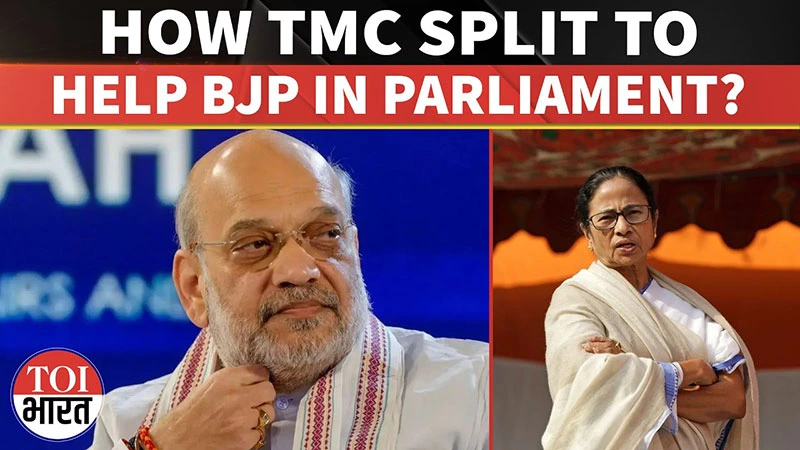
Why is the TMC Split 2026 Happening So Fast?
TMC Split 2026 has become a daily headliner. The dramatic breakdown of the Trinamool Congress (TMC) is unfolding at lightning speed. Honestly, this fast-moving West Bengal political crisis 2026 feels like a high-voltage movie script.
A historic TMC legislature party fracture has hit the West Bengal Legislative Assembly.
Rebel leader Ritabrata Banerjee is now officially recognized as the Leader of the Opposition in the West Bengal Assembly
In addition, the rebel faction has made one thing absolutely clear. Diamond Harbour MP Abhishek Banerjee has zero connection with this newly formed legislative group.
A fight between Abhishek Banerjee vs old guard has been continuing for long, but certain rebel of the young leaders have made the problem even more worse.
We have seen even Mamata Banerjee Abhishek Banerjee rift frequently in the past, but now Mamata has been backing him like anything.
The Numbers Behind the Legislative Collapse
The balance of power inside the assembly has shifted completely away from Kalighat. The table below outlines how the Trinamool Congress internal rebellion has split the party’s numbers and the complex reality of where key leaders stand:
| Power Metrics | Mamata Loyalist Bloc | Ritabrata Rebel Faction |
| Total Assembly Seats | 22 Seats Remaining | 58 MLAs (Claimed Majority) |
| Legislative Status | Fighting to Retain Party Identity | Recognized as the Core Assembly Group |
| Key Face in Assembly | Mamata Banerjee | Ritabrata Banerjee (Leader of Opposition) |
| Y-Channel Dharna Presence | Only 8 MLAs | N/A (Boycotted the event) |
| Adhikari Administrative Meet | Attended on administrative grounds (e.g., Kunal Ghosh, Nayna Banerjee) | Participated fully alongside the treasury bench |
The rebel group claims they represent the real Trinamool Congress. Even if people question their public acceptability, this is the harsh reality of the Trinamool Congress Internal Rebellion.
How Did Mamata Banerjee Lose Her MLAs?
The Mamata Banerjee political downfall is clearly visible through a painful set of numbers.
Following her historic election loss, Mamata Banerjee called her first major political program. She staged a sit-in demonstration (dharna) at Kolkata’s Y-Channel. Shockingly, only 8 elected MLAs showed up to stand by her side.
The fluid nature of this crisis became even more glaring just two days later. Saffron camp leader Suvendu Adhikari chaired a major administrative review meeting at Nabanna.
Interestingly, even die-hard Mamata Banerjee loyalists like Kunal Ghosh and Nayna Banerjee rushed to attend the Chief Minister’s session, citing constituency development needs. However, their presence right next to the rebel leaders highlights the total erosion of the party’s command structure.
Is the TMC Losing Control of Kolkata and Bidhannagar?
The Mamata Banerjee leadership crisis keeps intensifying as the party rapidly loses its grip on key urban power centers.
- Bidhannagar Municipal Corporation: Longtime Mayor Krishna Chakraborty suddenly resigned from her post.
- Kolkata Municipal Corporation (KMC): Shortly after, heavyweight loyalist Firhad Hakim resigned as the Mayor of Kolkata. The Firhad Hakim Resignation has further fueled Mamata’s agony.
Consequently, power is slipping away on all fronts. The Trinamool Congress has effectively lost control of both Nabanna (the blue-and-white state secretariat) and the historic KMC building (the little red building).
Will the TMC Split 2026 Now Break the Parliament Party?
The intense pain for Mamata Banerjee is growing sharper every single day. Veteran leader and Rajya Sabha MP Sukhendu Sekhar Ray has openly dropped a political bombshell. He warned that the exact same legislative collapse will soon repeat itself within the Indian Parliament.
Even the party’s usually vocal Lok Sabha Chief Whip, Kalyan Banerjee, sounded deeply broken and defeated. While speaking about the chaos surrounding the Trinamool Congress internal rebellion, he was heard saying that nobody can understand what is actually happening inside the party anymore.
This is the best opportunity for the veteran members of the houses to take revenge of the long-lasting Abhishek Banerjee vs old guard battle.
How Many TMC MPs are Planning to Leave?
According to highly placed media reports, a massive structural shift is already taking place behind closed doors in New Delhi. The parliamentary strength of the party is fracturing rapidly.
- The Lok Sabha Fraction: Around 20 to 22 Lok Sabha members are actively moving away to form an independent, separate block. Senior parliamentarian Kakoli Ghosh Dastidar is highly likely to lead this breakaway lower-house faction.
- The Rajya Sabha Fraction: Simultaneously, a matching rebellion is brewing in the upper house. Sukhendu Sekhar Ray is expected to lead a separate group of rebel MPs within the Rajya Sabha.
Watch this video of political analyst, Biswanath Chakraborty, who has analyzed the situation elaborately.
Why is This Second Split Easier for the Rebels?
The rebel MPs face a much smoother transition than their assembly counterparts. Fortunately for them, this parliamentary shift will not involve messy legal battles, forged signatures, or a prolonged TMC Calcutta High Court challenge.
The strategy this time is entirely different, as outlined in the table below:
| Structural Elements | The Assembly Split | The Imminent Parliament Split |
| Legal Disputes | Faced bitter rows over forged signature controversy | Zero legal mess expected |
| Court Battles | Dragged into a TMC Calcutta High Court challenge | No judicial interference needed |
| Method of Departure | Technical grouping under West Bengal anti-defection law 2026 | Voluntary resignation and clean floor-crossing |
Consequently, these MPs will resign completely on their own terms. This smooth structural exit signals the ultimate phase of the Mamata Banerjee leadership crisis, as the party she built from scratch completely disintegrates on both the state and national levels.
Had the Mamata Banerjee Abhishek Banerjee rift continued, perhaps Trinamool Congress Internal Rebellion would not take place so fast.
Why is the West Bengal Political Crisis 2026 a Perfect Opportunity for the BJP?
To understand the full scale of this crisis, we must analyze the dynamics inside both the Lok Sabha and the Rajya Sabha. Currently, the BJP does not hold an absolute single majority on its own in either house.
Consequently, the ruling saffron camp must constantly rely on intense floor management to pass crucial bills. Even though the Modi government has run smoothly for the past two years, an obvious question arises.
If a ruling coalition can organically expand its legislative numbers completely free of cost while strictly following the law, why would they pass up the opportunity?
How Did the Recent AAP Rupture Set the Example?
The political blueprint for breaking strong regional parties has already been executed successfully very recently.
- The Raghav Chadha Precedent: Under the prominent leadership of Raghav Chadha, a massive split hit the Aam Aadmi Party (AAP).
- The Rajya Sabha Shift: Chadha, along with 6 other AAP members, directly crossed the floor to join the BJP.
This unexpected mass defection naturally left the saffron camp ecstatic. Breaking the powerful Arvind Kejriwal, who built an empire across Delhi and Punjab, served as a massive tactical victory for the central ruling party.
Since the Congress party remains structurally weak, and AAP had successfully won seats across various states including the home turf of Gujarat, dismantling AAP was a logical target.
The central leadership has proven repeatedly that they will not hesitate to use every strategy, Saam, Daam, Danda, Bhed, (financial incentives, strategic division, and finally, outright force) to divide opposition blocks.
Will the West Bengal Political Crisis 2026 Target Abhishek Banerjee in Parliament?
This brings us directly to the collapsing structure of the Trinamool Congress. The party is already breaking from within. Around Mamata Banerjee and her nephew, only a handful of veteran faces remain visible at the core.
Even among those few loyalists, senior leaders like Kakoli Ghosh Dastidar and Sukhendu Sekhar Ray are actively singing a completely different tune.
We have already witnessed how the dramatic Trinamool Congress internal rebellion completely shattered the party inside the West Bengal Legislative Assembly.
To accelerate the ultimate Mamata Banerjee political downfall, breaking the TMC inside the Lok Sabha is the next logical step for the central strategists.
Lok Sabha Anti-Defection Numbers Game
The entire game relies strictly on meeting the legal thresholds. The table below breaks down the exact strength required to split the parliamentary party safely under the law:
| Parliamentary Strength Metrics | Current Data & Thresholds |
| Total TMC Lok Sabha Seats | 29 Elected MPs |
| 2/3rd Legal Requirement | 20 MPs minimum (to avoid anti-defection laws) |
| Estimated Breakaway Strength | 20 to 22 rebel MPs prepared to move |
| Targeted Parliamentary Leader | Abhishek Banerjee (Official Lok Sabha Leader) |
| Expected Breakaway Leaders | Kakoli Ghosh Dastidar & Sukhendu Sekhar Ray |
Significantly, the official leader of the TMC in the Lok Sabha is Abhishek Banerjee himself.
Therefore, launching a direct legislative challenge against him in New Delhi serves as a massive boost to the rebel morale.
As it stands now, the legislative wing in the state assembly has already drawn a clear line of separation.
Will Emotional Cards Stop the West Bengal Political Crisis 2026 in New Delhi?
Abhishek Banerjee reached New Delhi on Saturday. Mamata Banerjee landed yesterday.
Political critics quickly labeled this sudden trip for the national INDIA alliance meeting as a mere excuse. Instead, a desperate Mamata Banerjee rushed to the capital in person.
She wants to make a final, frantic effort to stop the imminent Trinamool Congress parliamentary rebellion. She will likely deploy her signature brand of emotional politics to win back her breakaway MPs.
Which Model Will the TMC Split 2026 Follow in Parliament?
The crucial question hanging over New Delhi is the structural blueprint of this upcoming fracture. Will the rebel parliamentarians copy the state assembly model, or will they execute a complete floor-crossing?
Political observers are weighing two distinct possibilities:
- The Ritabrata Banerjee Model (Internal Control): In this scenario, the breaking MPs keep the Trinamool name and claim they represent the “real” party. They act as a distinct group inside Parliament, offering “constructive opposition” without formally merging with the ruling party.
- The Raghav Chadha Model (Direct Defection): This alternative mirrors the recent Raghav Chadha structural split within the Aam Aadmi Party (AAP). Under this path, the breakaway group takes two-thirds of the parliamentary strength and merges directly into the saffron camp.
What is the BJP’s Real Stance on the TMC Faction?
The official public statements from the saffron camp add another layer of mystery. West Bengal BJP State President Samik Bhattacharya explicitly stated that the doors of the BJP are currently closed for TMC leaders.
However, Bhattacharya is now camping in New Delhi. In modern statecraft, local organizational rhetoric rarely dictates central legislative strategy. Politics remains the ultimate art of the possible.
If the central leadership requires stable floor management in Parliament, state-level posturing can change overnight.
Will Mamata Banerjee Face the Crisis During the INDIA Alliance Meet?
By a strange, dramatic twist of political irony, a major national opposition meeting is scheduled in New Delhi today, June 8, 2026. Mamata Banerjee is going to attend this gathering in the national capital.
- The Timing: While Mamata Banerjee is sitting at the meeting, sipping tea and eating cashew nuts with opposition leaders, the official paperwork of her parliamentary party’s collapse might land on her desk.
- The Changing Dynamics: In addition, the current opposition front has increasingly turned into an arena of defeated regional forces. Following the recent round of assembly elections, almost no major leader in the room, with the exception of Jharkhand Chief Minister Hemant Soren, retains real administrative power in their home states.
- DMK’s Absence: Even the DMK has announced a total boycott of the June 8 meeting due to bitter fallouts with the Congress party in Tamil Nadu.
Consequently, while many fellow leaders in New Delhi might offer sympathy for the Mamata Banerjee political downfall, their support will remain entirely symbolic.
No amount of national opposition solidarity can halt the fast-moving numbers game tearing her party apart from within.
The Final Verdict on Mamata’s Tragedy
In conclusion, watching the agonizing decline of a mass leader like Mamata Banerjee, who rose to power through decades of relentless street agitations and historic public movements, is deeply tragic. However, it also reflects an unyielding law of political history.
When a leadership chooses to govern almost exclusively through a circle of police officials and bureaucrats for nearly 15 years, the grounding with the public snaps.
Consequently, when deep-rooted institutional corruption stains the very fabric of the ruling administration, a painful and embarrassing downfall becomes completely inevitable.
Mamata Banerjee deeply misses her old inner circle. Previously, glittering celebrities constantly surrounded the powerful leader.
Subservient bureaucrats and top police officers continually nodded and agreed to her every command. Now, that gorgeous presence has completely vanished.
What is the Ultimate Takeaway of the TMC Split 2026?
The current crisis proves that an empire built on absolute administrative control cannot survive once the structural foundations begin to rot from within. The table below summarizes the core factors that transformed a powerful regional force into the current :
| The Rise (Street Agitation Era) | The Fall (West Bengal Political Crisis 2026) |
| Fueled by direct public connection and grassroots movements | Governed via top-down police and bureaucratic machinery |
| Built on an image of uncompromising personal sacrifice | Heavily burdened by systematic, multi-layered corruption scandals |
| Retained absolute, unquestioned loyalty from regional leaders | Shattered by a historic Trinamool Congress internal rebellion |
Neerja Chowdhury, the veteran political journalists says that even Mamata Banerjee may lose her party emblem in a talk show with Barkha Dutt.
Is the TMC chairperson shedding a few quiet, private tears behind closed doors away from the rolling media cameras? Perhaps she is.
Watching the slow, agonizing destruction of the very political party she gave birth to and nurtured with her own hands must be an unbearable emotional burden.
Yet, as the TMC Split 2026 rapidly moves from the state assembly benches straight into the corridors of Parliament, history leaves very little room for sentimentality.
The numbers have spoken, the old guard has fractured, and the ultimate political tragedy of Bengal’s longest-serving female Chief Minister is now unfolding in full public view.
Latest Update
- While Mamata Banerjee is attending the INDIA alliance, Mamata’s one of the most trusted loyalists Firhad Hakim, is meeting the rebel leader Ritabrata Banerjee, LoP at Kolkata.
- Sukhendu Shekhar Roy has resigned from Rajya Sabha and TMC membership
- Reports Reveal Rebel TMC MPs have already expressed their interest to join NDA and they have written a letter to the speaker also.
10 Key Takeaways
- The Historic 28-Year Rupture: The Trinamool Congress (TMC) faces the first formal split since its founding. Consequently, this internal rebellion has completely shattered party authority across West Bengal.
- Ritabrata Banerjee Seizes Power: Rebel leader Ritabrata Banerjee claimed the position of Leader of the Opposition in the assembly. Moreover, Speaker Rathindra Bose granted him full official recognition.
- Bypassing the Anti-Defection Law: Breakaway groups need a two-thirds majority to avoid legal disqualification. Therefore, the rebel camp secured their safety by presenting signatures from 58 out of 80 TMC MLAs.
- Abhishek Banerjee Sidestepped Completely: The rebellion directly targets the centralization of party power. As a result, the rebel MLAs explicitly declared that Diamond Harbour MP Abhishek Banerjee holds no authority over them.
- The Forgery Scandal Flashpoint: A massive signature controversy triggered the final explosion. The high command recommended Sovandeb Chattopadhyay for the LoP post, but rebels quickly exposed 14 forged block-letter signatures on the official document.
- The Failed Y-Channel Rally: Mamata Banerjee’s personal street-power has visibly eroded. For instance, her first post-election protest dharna at Kolkata’s Y-Channel drew a shockingly low turnout of only 8 elected MLAs.
- Lawmakers Shift to Nabanna: In contrast, power is rapidly shifting toward the opposition camp. Just two days after the failed rally, 20 TMC MLAs voluntarily attended a crucial administrative meeting with Suvendu Adhikari at Nabanna.
- Urban Strongholds Collapse Rapidly: The structural breakdown is quickly destroying local governance. Following the sudden exits of Bidhannagar Mayor Krishna Chakraborty and Kolkata Mayor Firhad Hakim, the party lost control of its key urban hubs.
- The Upcoming New Delhi Split: The rebellion is now moving straight to Parliament. Veteran leaders Sukhendu Sekhar Ray and Kakoli Ghosh Dastidar are singing a different tune, as 20 to 22 Lok Sabha MPs prepare to break away.
- The Tragic Final Verdict: Years of top-down bureaucratic rule have finally disconnected the leadership from the streets. Consequently, systemic corruption has left party founder Mamata Banerjee isolated in her toughest political hour.