
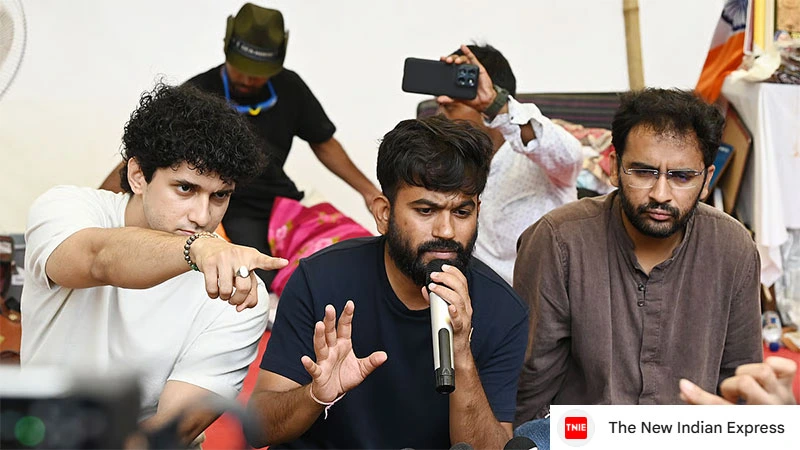
CJP Teachers Day Protest Ignites Again
Another student protest is now taking shape in Delhi, with CJP planning fresh demonstrations on Teachers’ Day. Security preparations are already becoming a concern, while students are preparing to return to the streets. The proposed CJP Teachers Day Protest is once again bringing the students’ grievances into the heart of Delhi. The latest developments have clearly damaged the trust between the government and the protesting students.
The frustration stems directly from events last month. Student groups called off their demonstrations after receiving assurances that pending legal charges would be dropped and examination reforms would move forward. But the next thirty days passed without much visible action from the administration. Officials continued with meetings and procedures, while the issue gradually disappeared from the centre of political attention. Now, thousands of young demonstrators plan to march from India Gate to Delhi Police HQ on September 5. For the protesters, the message is simple: the assurances they received have not been followed by enough action.
Why are young people reassembling in such large numbers? How did an online satirical group evolve into the driving force behind a nationwide student movement? And what became of the assurances tied to Sonam Wangchuk’s high-profile hunger strike that dominated headlines just weeks ago?
Look at how the Cockroach Janata Party is coming back on streets on teachers’ day. Watch the video.
We all have to wait anxiously for the live status of the CJP protest on September 5.
Why Is CJP Protesting Again?
The events of the past few weeks explain why CJP is returning to the streets of Delhi. On July 24 and 25, thousands of student demonstrators packed Jantar Mantar following weeks of agitation over the NEET paper leak scandal. High-level delegations met, senior ministers stepped in, and the Union Education Minister ultimately resigned under growing pressure.
Believing that the commitments would be implemented quickly, student groups packed up their banners and called off their 36-day sit-in. They trusted the process. Even, a month later, concrete administrative action remains absent. Rather than cooling student tempers, administrative delay has only reignited anger.
| Date | Movement Stage & Historical Event | Current Real-World Outcome |
|---|---|---|
| July 24 | Written assurances from Union Ministers J.P. Nadda and Dr. Jitendra Singh | Sonam Wangchuk ended his 26-day hunger strike after high-level hospital talks. |
| July 25 | Talks & Formal Agitation Suspension | Students called off their 36-day Jantar Mantar sit-in in total good faith. |
| August 25 | Zero Movement on Promises | Delay tactics, administrative red tape, and zero progress on quashing legal cases. |
| September 5 | Proposed Mass March | Youth reassembling from across India at India Gate to force fulfillment. |
Organizers from the Cockroach Janata Party (CJP) maintain that government departments spent the last month leaning on procedural technicalities rather than delivering results. Key notifications clearing student records remain unissued. Where is the written commitment promised to the student delegation?
Driven by these unmet promises, the CJP issued a call for a renewed wave of student agitation in Delhi. Many students now appear unwilling to wait any longer.
Here the question arises, When the government makes key promises and then fails to keep them, young people, especially students, are likely to take to the streets. CJP is likely to remain more cautious this time, having learnt from its previous movement. It will hopefully take adequate measures to ensure that the protest remains peaceful and non-violent.
I have a personal question. Did the Government fail to understand the intensity of the prolonged, nationwide CJP protests and Sonam Wangchuk’s hunger strike? Did it believe that the situation could be brought under control simply by dispersing the crowd at Jantar Mantar, followed by Dharmendra Pradhan’s resignation and meetings between ministers and CJP leaders?
Had the Government taken the protests seriously and turned its promises into concrete action, perhaps the CJP Teachers Day Protest would not have been necessary at all.
The Crucial Demands Left in the Dark
What exact commitments were made behind closed doors, and why do students feel cheated? The CJP highlights three main points of administrative neglect:
- FIR Withdrawal Pending: Dozens of student demonstrators still face active police cases filed during earlier rallies. Despite verbal assurances that non-violent protesters would not face prosecution, prosecutors have not formally quashed a single FIR in court.
- No Compensation for NEET Victims: Families of aspirants who lost their lives to exam stress and cancellation turmoil are still navigating bureaucratic delays for state relief.
- Paper Leak Law Implementation: Overhauling national testing agencies and enforcing anti-leak regulations remain stuck in committee discussions.
There is now a clear gap between what was promised in July and what has actually happened since then. Look at the contrast:
While leaders assured Complete FIR Quashing to clear student records, police prosecutors haven’t dropped active charges. Judicial proceedings move slowly, but that brings no relief to young candidates facing legal threats and police summons while trying to prepare for upcoming exams.
The compensation process for the affected families also appears to be moving slowly through the administrative system. For the affected families, the delay has added to an already difficult situation. Even legal protections promised to student leaders have dissolved into procedural debates in court.
The upcoming CJP Teachers Day Protest is set to include grieving parents and student survivors who experienced police action on July 20. They are taking their grievances back to the streets because official channels have failed to deliver.
Despite months of expert debate on reforming national entry examinations – including hybrid models and decentralized testing – no structural framework has been adopted. Vulnerabilities in the system persist.
Why Is Delhi Police Opposing the March?
The Delhi Police’s position has added another complication to the proposed march.
As reported across major outlets, including coverage by Anandabazar Patrika, the Delhi Police statement on CJP march introduces an unresolved conflict.
Senior police officers state publicly that they have not received any formal request for the September 5 march.
“We have not received any request letter so far. If we receive any request, we will review it accordingly”, stated senior police sources in news reports.
Deputy Commissioner of Police (New Delhi) Sachin Sharma pointed out that prohibitory orders under Section 163 of the Bharatiya Nagarik Suraksha Sanhita (BNSS) remain enforced around India Gate. Demonstrations in high-security zones are illegal. Police officials are pushing to redirect organizers toward Ramlila Maidan instead.
However, CJP representatives insist that gathering peacefully is a constitutional right and plan to march toward Police HQ regardless. Unless both sides find a workable arrangement, tensions could rise when the protesters gather on September 5.
The Dark Questions: Money, People, and Timing
The growing movement is also attracting questions about its funding, organisation and timing. CJP leaders will have to address these concerns as the September 5 protest approaches.
Why Pick Teachers Day?
September 5 in India marks the birth anniversary of Dr. Sarvepalli Radhakrishnan and is traditionally dedicated to honoring educators. CJP leaders say Teachers’ Day is an appropriate occasion to draw attention to what they see as serious problems in the education system. Critics counter that staging a high-profile march on Teachers Day turns an educational occasion into a public spectacle.
For generations, September 5 has stood as a day of respect for teachers across schools and universities. I clearly recall that we used to celebrate Teachers Day as to show respect to our teachers during student life.
Who Is Funding the CJP Protest?
A central point of curiosity revolves around CJP’s status, as the group is yet to be an officially registered political party.
- Where are they getting thousands of people to fill capital streets on short notice?
- Who is funding interstate transport, bulk logistics, legal aid, and digital campaigns?
- Are third-party political factions providing silent backing behind the scenes?
As the movement grows, these questions are unlikely to disappear. CJP should provide clear answers on its funding and organisational arrangements. Citizens and students alike have a right to clear answers regarding financial transparency from movement organizers.
Abhijeet Dipke and his team must be ready to answer these uncomfortable questions. At a time when rising travel costs due to Iran War have made air travel more expensive for many people, questions are bound to arise about how supporters from abroad managed to travel to India to join or express solidarity with the CJP protests.
Abhijeet Dipke’s earlier association with the Aam Aadmi Party (AAP), along with Arvind Kejriwal’s support for the movement from its early days, is likely to add another layer to these questions. These are not easy questions, but they deserve clear answers if CJP wants to maintain public trust and transparency.
We do not know yet whether CJP will eventually form a political party. We do not know yet whether CJP will eventually form a political party, the importance of accountability and transparency cannot be ignored.
Need for Bilateral Dialogue and Public Stances
At Knowledge Mart, our position remains that street battles and police standoffs rarely yield long-term policy solutions. Prolonged confrontations only deepen distrust between youth and administration.
The solution requires direct, transparent bilateral dialogue between state representatives and student delegates. Instead of that the proposed CJP protest could create another confrontation.
| Stakeholder | Required Practical Action | Intended Public Result |
|---|---|---|
| Government Ministers | Issue an official, signed status document on every July 25 commitment. | Clear proof of what has been done versus what remains pending. |
| CJP Student Leaders | Submit formal route applications and engage through legal counsel. | Prevention of violent clashes and structured negotiation. |
| Neutral Public Forum | Hold live, televised discussions between government officials and student reps. | Complete transparency before the entire country. |
Both sides now need to say clearly what was promised, what has been done and what is still pending. Both sides should state their positions openly on a public platform.
CJP has made clear that their movements will continue in various forms. They have already started the “School Thik Karo” (Fix the Schools) campaign for auditing and improving infrastructure in India’s government-run schools. CJP has also started the campaign in West Bengal.
Is CJP Protest Becoming a New Trend?
Is this becoming a new pattern? CJP protests against one irregularity after another, while the Government either tries to suppress the protests or responds with corrective measures. But what about the administration itself?
Where are the school inspectors and other officials responsible for monitoring the education system? Who is checking whether they are actually doing their jobs?
The Government also needs to answer a difficult question: will action be taken against officials who remain inactive despite holding key responsibilities and drawing substantial salaries every month?
If irregularities can continue under their watch, accountability should not stop with those who are protesting. It should also extend to those responsible for preventing such failures in the first place.
Knowledge Mart Final Thoughts
CJP’s rapid rise also raises a larger question about the future direction of the movement. Are students fighting a genuine battle for education reform and youth welfare, or is someone using this movement behind the scenes to trigger a crisis and force a political shift?
At Knowledge Mart, we analyze these socio-political shifts closely. The frustration among students may be genuine. At the same time, questions about permissions, funding and the organisation of these marches cannot simply be ignored.
If CJP leaders are dedicated strictly to educational reform, their focus must remain tied to policy dialogue, exam integrity, and legal accountability. If political posturing or administrative disruption becomes the primary goal, public confidence will wane.
The administration must act swiftly to address its stated promises. Simultaneously, CJP leadership must maintain operational and financial transparency. The immediate need is for both sides to sit down and discuss the outstanding issues openly. Until that happens, the dispute is likely to continue.
About Knowledge Mart: Knowledge Mart provides independent analysis on social, educational, and political developments across India. We advocate for policy transparency, democratic dialogue, and student rights.
10 Key Takeaways: CJP Teachers Day Protest
- Broken Guarantees Ignite Fresh Agitation: Students called off their 36-day Jantar Mantar sit-in after receiving verbal assurances on July 25, but lack of progress over 30 days forced a renewed march call.
- Massive March Route Target: Thousands of young protesters plan to assemble on Teachers Day (Sept 5) to march directly from India Gate to Delhi Police Headquarters.
- Zero Movement on Quashing FIRs: Despite government commitments, criminal cases filed against student demonstrators during previous rallies remain active in court.
- Grieving Families Stranded Without Relief: Institutional compensation promised to families of NEET aspirants remains delayed in administrative channels.
- Delhi Police Issue Venue Warning: Senior police officials confirmed no official permission was requested for India Gate, citing active Section 163 BNSS restrictions and suggesting a move to Ramlila Maidan.
- Symbolic Date Choice Raises Eyebrows: CJP organizers picked Teachers Day to highlight systemic educational failure, while critics view it as political timing.
- Financial Transparency Questions Surface: As CJP is not yet a registered political party, observers are questioning how the group funds interstate logistics and digital campaigns.
- Wangchuk’s Fast and Assurances In Limbo: High-level interventions that ended hunger strikes in late July have yielded no published administrative status updates.
- Demand for Open Bilateral Dialogue: Policy analysts at Knowledge Mart urge both government officials and CJP leadership to hold live, public discussions.
- Development Focus vs. Political Disruption: The core debate remains whether CJP’s movement focuses strictly on student reform or aims for broader administrative disruption.