
CJP Political Party: From Protest to Political Possibility (আন্দোলন থেকে দল? স্ট্রাটেজি, ঝুঁকি ও ভবিষ্যৎ বিশ্লেষণ)
What is CJP political party in India?
From a home drawing room to a small street-corner tea stall, one topic now dominates: CJP political party (সিজেপি রাজনৈতিক দল).
The same discussion reaches weekend hangouts too. Even on Knowledge Mart, this issue is getting steady attention.
I saw this myself. At a bar, two friends were in a heated argument. A few pegs were already empty.
Their voices kept rising. Their main question: what should the CJP political strategy be? What next to CJP Protests?
This is no longer a casual talk. It is turning into a wider public debate.
We should pause and ask: why now?
Who is the founder of Cockroach Janta Party?
Is this only because of voices like Abhijeet Dipke, who often speak about new political trends?
Or is it linked to how parties like the Aam Aadmi Party once grew from a movement into power?
Some people are making sharper claims. They say Arvind Kejriwal might be trying to stay relevant through this CJP party (সিজেপি পার্টি) formation, especially at a time when his own party faces challenges.
Read: Explained: The Rise of AAP in Indian Politics
Before jumping to conclusions, we need clarity.
What is the real gap between a non-political movement and a full CJP new political party?
A movement speaks from outside the system. A political party works from within it.
That shift changes everything: strategy, responsibility, and public trust.
On Knowledge Mart, this is where the real debate begins.
Core Features of Any Political Party
Any political party follows some clear basics. If the new political party takes shape, it will also need to match these.
1) Ideology, belief, and action plan:
Every party stands on an idea. Rather, it’s the ideology that drives its cadres. It believes in a clear path and moves forward with that vision. Without this, a party loses direction.
2) Structure:
A political party is not loose. It has a system. Leaders and workers have roles. There is accountability at every level.
3) Social connection:
Every party talks about change. It tries to connect with people and promises to improve society.
We can see this with real examples. Prashant Kishor, through his Jan Suraaj effort, is trying to send a message, enough of caste and religion politics, now focus on development.
Watch: Prashant Kishor on Jan Suraaj and New Politics in Bihar
Some groups like left speak strongly for class-struggle. The Congress has long supported socialism.
On the other side, left parties often attack the bourgeois class. But right-leaning groups like Congress and BJP believe the same class is key for economic growth.
Read: What Defines a Political Party? Basic Concepts Explained
Whatever the ideological differences might be, I feel each party in Indian political landscape, is focusing on dole politics.
From what I’ve seen in the election manifestos of each party just before Bengal Elections 2026 that there is a competition of subsidies and cash transfer benefits among the parties.
Now, if we look at the idea of a CJP new political party, the main question is simple: what will be its core belief?
It’s not easy. You have to pave the path for that ideology or belief. Transmit it to the party soldiers. Then it should be communicated to the common citizens.
If you have any problem in conviction level, you will fail to send the right message to the electorates.
Because without a clear line, no CJP party formation can survive long in real politics.
How CJP Emerged from Social Media Activism
CJP mainly runs on issue-based protests. It did not start as a full political structure. The early push came after a comment by the Chief Justice, where the word “cockroach” (আরশোলা) triggered reactions online.
Soon, a social media group formed. People began pointing out problems in society and the system. They used memes and satire. The tone was sharp, but many found it relatable.
Their Instagram reels went viral. Views crossed lakhs. Support started coming from different sides. In today’s frustrated social mood, satire connects fast. That worked in their favor.
Even their social media account was blocked for a couple of hours. But nothing could stop such a desperate Zen Z Community.
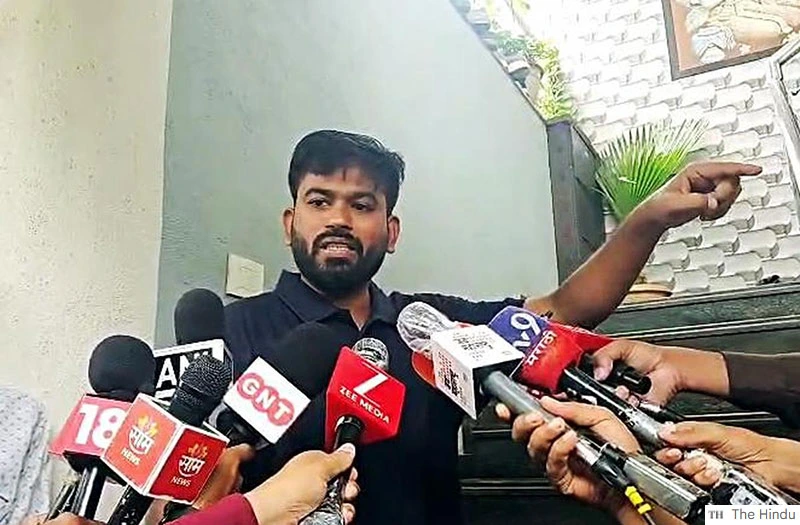
The creator behind this is Abhijeet Dipke. He has some political background. But that does not mean we should equate this with the Aam Aadmi Party or any fixed party model.
Watch: How Social Media Movements Turn into Political Narratives
In Delhi, the protest they organized was clearly issue-based. It focused on the NEET exam paper leak and the linked scam. The goal was simple, fix a broken system.
Over the past few years, the NEET issue had reached a bad stage. Many young students who wanted to study medicine felt cheated. That anger turned into public pressure.
At first, the government did not take it seriously. That may have been a mistake on their part. As support for the protest grew, political parties saw an opportunity.
We had seen almost a similar replica in Singur. When the protests of the farmers’ movement against the land encroachment gained momentum, Mamata Banerjee took the control of the movement and brought it to the heart of Kolkata to grab the entire media attention. The rest has become the history.
Congress, AAP, and many others showed support. In Kolkata, when CJP did not get permission, left groups stepped in and started protests. When any apolitical movement gains media visibility, the political parties become active.
One thing stands out. This movement had no fixed ideology. It was not about left or right. The focus stayed on corruption and system failure.
Most people in this group are educated. So they chose a non-violent path. That also shaped the early CJP political strategy, even before any formal CJP party formation idea came up.
On Knowledge Mart, this is where the shift begins: from protest to the thought of a CJP new political party.
CJP protest at Jantar Mantar NEET exam leak
| Phase | Timeline | Key Events | Outcome |
|---|---|---|---|
| Formation of CJP | May 2026 | Gen Z-led digital protest movement emerges over NEET paper leak | Rapid nationwide traction; leaderless activism gains attention |
| Social Media Revolution | May-July 2026 | Online mobilization, viral campaigns, youth-driven narratives | Mass youth participation; pressure builds on central government |
| Delhi Protests (Jantar Mantar) | July 2026 | Large-scale protests; demand for Education Minister’s resignation | Dharmendra Pradhan resigns after submitting letter to PM Modi |
| Govt Interaction | July 2026 | Talks between CJP reps and Centre; demands escalated | Centre accepts key demands; reforms initiated; protests paused |
| Jharkhand Protests | Late July 2026 | CJP extends support to regional recruitment protests | Movement expands geographically but faces consistency questions |
Why did education minister Dharmendra Pradhan resign CJP protest?
The key agenda of CJP movement was Dharmendra Pradhan resignation. The central Government didn’t show due diligence to the CJP protest at Jantar Mantar NEET exam leak in the beginning.
When the pressure mounted, the Prime Minister Narendra Modi took the control and tried to interact with the Social Media through their favorite social media Reels. His late night video perhaps supplied additional oxygen to the momentum of their protest.
The high-profile ministers met with the students, but ultimately, their indomitable demand made Dharmendra Pradhan’s resignation inevitable.
Structural Weakness: The Leadership Vacuum
This is where a key concern comes in. The current model has a structural gap. It follows a fully decentralized style. There is no fixed leader. No one person takes final calls.
Decisions depend on the moment. Representatives are picked quickly based on the situation. This may look flexible, but it brings risk.
When outsiders or anti-social elements enter the protest, there is no strong control. The group cannot act fast to stop them.
I saw personally this during a Dharmatala march in Kolkata. As the rally crossed Moulali, a few unknown young people joined in. From what I’ve seen, they did not look like students at all.
What followed changed the tone. There was abuse directed at journalists. Some were even attacked. Women reporters faced harassment. The original purpose got lost.
Critics may even raise question whether the rulers tried to create the calamity to dismantle the gravity of the protest and turn the political narratives to their favor.
Watch: When Peaceful Protests Turn Chaotic: Ground Reality Explained
A similar pattern was seen in Delhi too. Once such incidents begin, police action becomes certain. A lathi charge is almost expected in that situation. The Delhi Police was alleged of doing excesses by using pellet guns.
Now the political context has changed in West Bengal. It is not the Mamata Banerjee administration anymore. Police will act if there is violence or disorder.
Now here’s the catch. Had a proper political party existed, such gaps might be handled better. A defined system could prevent misuse and hinder the entries of hooligans.
This is where questions rise about CJP party formation. Can a decentralized model work in formal politics? Or does it need a tighter structure?
On Knowledge Mart, this becomes a key debate. Without clarity in structure, even a strong CJP political strategy may fail in real-world politics.
The recent India Today survey has highlighted some encouraging trends that deserve serious attention. Around 60% of Gen Z voters believe a candidate’s educational qualifications are very important when making their voting choice. At the same time, nearly 50% say they would not necessarily vote for a candidate simply because the candidate belongs to their own caste. Could these findings offer a glimpse of hope for a more informed and issue-based democracy?
If that happens, perhaps we can avoid such heart-rendering Ashish Banerjee Suicide Note in the future. We don’t think that politics is for the educated group only, but the educated group should be a part of the decision-making process, as things stand today.
We need to go back to those days when data-driven intellectual debates used to take places in parliament and assembly.
We should not forget that this educated lobby can set up a high moral values among our youths.
Can Issue-Based Movements Become Political Forces?
The next question is about social impact. Who is actually affected by these issues?
Take the NEET exam. It mainly involves students with higher academic goals, often from middle or upper-middle-class families. So, the direct victims form a specific group, not the whole society. That creates a distinction in any political move.
At the same time, protests against system failures attract wider public anger. People relate to the idea of injustice. But still, the core impact stays limited to a section.
This is where the CJP political strategy becomes important. If a CJP wants to grow as a political party, it must answer this clearly. Can it go beyond a limited group and connect with a larger population?
There are past examples. Anna Hazare’s anti-corruption movement gained strength because almost everyone felt affected. Corruption touched daily life across classes.
Read: How Anna Hazare’s Movement Mobilized Mass Support
In a similar way, Prashant Kishor’s efforts against caste divisions aim at a broader social base. It is not limited to one section.
That is why this issue also creates pressure for the BJP. Many students affected by the NEET paper leak belong to its core voter base.
We saw a similar pattern in the RG Kar movement. Doctors were the direct victims. Still, they received support from a larger section of society. It was the clever move from the vastly experienced politician Mamata Banerjee, that wrote its epitaph.
CJP vs Traditional Political Models
First of all, we should know: Is Cockroach Janta Party a real registered political party? The answer is: No.
Because it is not yet a full fledged political party, the group can act freely on different issues. Today, it protests against NEET irregularities. At the same time, it raises its voice against recruitment scams in Jharkhand.
This flexibility helps an issue-based movement. But politics works differently.
There is an interesting contrast. In Delhi, Congress has supported CJP’s protest. But in Jharkhand, Congress is part of the ruling alliance facing similar allegations.
Read: NEET Paper Leak Row Explained: Politics and Public Reaction
If CJP new political party becomes a reality, it may face the same situation. Taking a stand everywhere is not easy when you are in power or close to it.
Anti-corruption protests often get strong public support. People connect with the idea quickly. But running a corruption-free system is far more difficult.
Nevertheless, when you enter into the direct politics, you will have opponents. You will be identified as a separate entity.
Never forget that each political party knows how to combat their opponents. But the social movement raises their agonies as they feel they have to face out of syllabus questions.
We have seen this in Delhi. Even the AAP government under Arvind Kejriwal has faced multiple corruption allegations against its ministers.
But they had been the result of the anti-corruption movement led by Anna Hazare.
Moreover, there are allegations about corruptions against most of the ruling dispensations even at state levels.
The moment power looks possible, new challenges appear. Opportunists enter. A loyalist group forms. Competition and internal conflict grow.
Power can change behavior. It can make people more ambitious, sometimes even greedy. That is when internal clashes begin.
To handle such conflicts, a strong system is needed. A clear chain of command, accountability, and discipline matter.
Right now, that is where CJP party formation faces a key gap. Without a solid structure, managing growth and power will remain difficult.
On Knowledge Mart, this raises a simple but sharp question: can a movement sustain itself without becoming structured?
Though we know that the eminent journalist Rajdeep Sardesai prefers CJP to remain in this form for now. Watch his views is Straight Bat.
The Big Question: Should CJP Become a Political Party?
Now let’s look at the other side of the coin. What if the CJP political party never takes shape? What lies ahead then?
History gives clear patterns. The Left grew out of land movements. Arvind Kejriwal’s Aam Aadmi Party rose from an anti-corruption movement.
Watch: From Protest to Power: How Movements Become Political Forces
So the big question is simple. Can a platform survive on protest alone?
Every movement needs resources. Campaigns cost money. Organizing people takes effort and funding. Who will support that in the long run?
There is another concern. The current faces of the movement must return to their jobs or personal lives today or tomorrow. Then what happens next?
Can new leaders keep coming up again and again? That is not an easy task. Gen Z people have got high ambitions.
They watch the advertisement that even for a plate of Biriyani, one flies from Mumbai to Hyderabad. They set their standards of life based on many fantasies.
History shows one thing clearly. Almost every successful movement needs a strong leader. Without leadership, momentum often fades.
So where will that leadership come from for CJP?
Right now, it stands at a turning point. The decision ahead is crucial. Will it become a CJP new political party? Or stay an issue-based platform?
And if it does enter politics, what will its CJP political strategy look like?
Are we about to see the birth of a new political force?
The answer may come sooner than expected. As we often say at Knowledge Mart, moments like this shape the future.
Knowledge Mart Final Verdict: Smart Move or Blunder?
The CJP political party stands at a critical crossroads. Its strength lies in public anger and digital mobilization, but its weakness is structural instability.
Whether it transforms into a serious political force or fades like many protest movements depends on one thing, organization.
The next few months will decide whether CJP becomes a political revolution or just another viral moment.
10 Key Takeaways:
- The CJP political party currently operates as an issue-based movement, not a structured political organization.
- Its rapid rise on social media shows that satire and public frustration can mobilize large audiences quickly.
- Lack of a fixed leadership structure makes the movement flexible—but also vulnerable to disruption.
- Decentralization can lead to chaos when outsiders or disruptive elements enter protests.
- Issue-based protests (like NEET exam controversies) attract support, but often from a limited section of society.
- For long-term political success, broader public connection beyond specific issues is necessary.
- History shows that most successful movements eventually evolve into structured political entities.
- Without funding, leadership continuity, and organization, sustaining a movement becomes difficult.
- If CJP becomes a political party, it will face challenges like internal conflict, corruption risks, and power struggles.
- The future of the CJP political party depends on one key decision: remain a protest platform or transition into full political power.
Frequently Asked Questions – FAQs
What is the CJP political party?
CJP is an emerging political movement rooted in issue-based protests, especially around education and corruption.
Why did CJP gain popularity?
Its rise is linked to social media activism, NEET protests, and youth engagement.
Can CJP become a national political force?
That depends on leadership, structure, and expansion beyond issue-based movements.