
NEET Leak Protests: Do Outsiders Fuel Confusion?
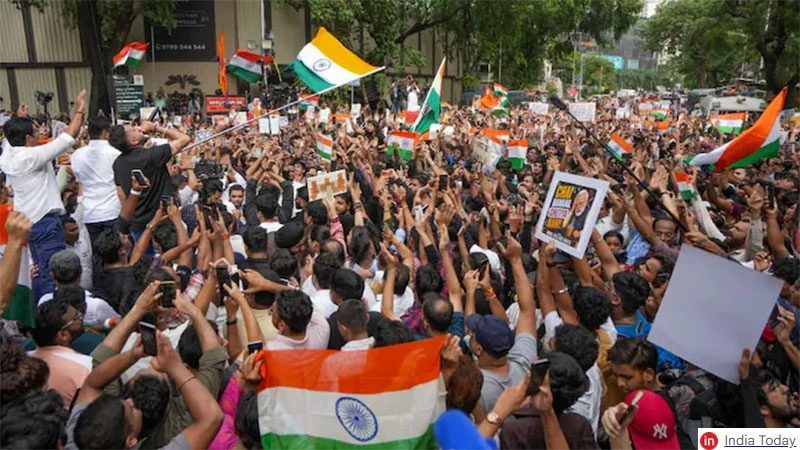
The NEET Leak Protests began not in political headquarters, but on dusty streets where young students watched their dreams shatter overnight.
Eighteen hours of daily study suddenly dissolved into complete chaos. Honest aspirants spent years sacrificing sleep, health, and family celebrations. But, widespread exam irregularities wiped out their hard work in a single instant.
At first, this nationwide student agitation was pure and desperate. Real victims led the charge. They demanded fairness, transparency, and justice. Yes, they started without any political colour.
However, a dangerous shadow now darkens these gatherings. Are political opportunists quietly hijacking a genuine fight for education reform?
Look at the irony. When Sonam Wangchuk started the hunger strike in support of the Cockroach Janata Party (CJP) for the NEET Leak Protests, the allegations like agent of China, anti-national activist had been showered upon him. As soon as he had withdrawn the hunger strike, the allegation has popped up that he is trying to drag the limelight to him from Rahul Gandhi. Even the AAP has raised a setting theory of BJP-Congress Setting. This is how the political theatrics have been unfolding the country capital.
Dharmendra Pradhan has finally submitted his resignation yesterday.
Was Narendra Modi forced to admit defeat in a fierce psychological battle over NEET Leak Protests? We don’t take it that way. Knowledge Mart treats it as the leader of a responsible Government, he accepted the rights of the citizens to question regarding accountability.
Even Mohan Bhagwat, the Sarsanghchalak (Chief) of Rashtriya Swayamsevak Sangh (RSS) raised his demand to the Government to respond the Gen Z’s call. It was rather a clarion call. Narendra Modi had no way out.
For the history lovers, we must state, Suresh Prabhu offered to resign from the post of Railway Minister in August 2017 taking moral responsibility for train derailments. Narendra Modi had come backward in Farmers’ bill also. So, it is not an humiliating defeat for him. Rather he has responded to the democratic demand.
Did Social Media Explosions Fuel This Massive Student Fire?
The incredible momentum of the current youth agitation did not happen by traditional methods. It exploded across India through smartphones, instant messaging, and viral clips.
The Cockroach Janata Party (CJP) took the lead in spreading the NEET Leak Protests across major Indian cities. They bypassed traditional media setups completely. Instead, they relied almost entirely on aggressive, high-energy social media campaigns.
The Shift From Digital Outrage to Street Protests
| Phase | Driving Force | Public Representation | Key Platform Used |
|---|---|---|---|
| Phase 1: Initial Outrage | Affected medical aspirants & worried parents | Completely apolitical victims | Telegram, Instagram, & X |
| Phase 2: Viral Mobilization | CJP digital campaign & youth influencers | City-wide student rallies | Short video reels & online petitions |
| Phase 3: Political Entry | Opposition parties & political youth wings | Party flags, banners, & megaphones | Press conferences & television debates |
As short videos swept through online networks, follower counts grew by leaps and bounds. Thousands of ordinary citizens joined hands with angry students.
In the beginning, these street gatherings remained visibly non-partisan. Protesters carried no party flags, wore no branded caps, and avoided partisan politics.
Analysts at Knowledge Mart tracked this digital surge from its earliest days. They noted that organic public anger can build a nationwide crowd within hours.
However, digital popularity acts as a double-edged sword. When a movement gathers massive public attention, career politicians notice immediately. Today, opposition parties like the Congress, Aam Aadmi Party (AAP), and various Left youth wings have entered the protest ground.
Look at the left-led NEET Leak Protests in Kolkata in this India Today Video.
They are carrying their own political banners. They are shouting their own customized election slogans.
In reality, the India state is grappling with a peculiar paradox. The nation that can build international-standard Highways, world-class flyovers, they fail to develop quality Government Schools and Higher Educational institutes (HEI).
We live in a country where many of the political top notches and ministers send their kids abroad for quality education. On the other hand, millions of Indian parents fail to provide the basic education to their children.
If you delve into the core of the agitation of NEET Leak Protests, you will find the deep seated anger, frustration and demand for the equal opportunity in their eyes. The youngsters may be politically nave, but their cries turn to be a cacophony to the ears of the rulers.
152 Paper Leaks: Why Did Political Parties Stay Silent?
Where were these high-profile leaders during previous testing disasters? Every student and parent should ask this uncomfortable question today.
According to official records cited during recent debates, India has witnessed over 152 separate instances of paper leak controversy across various states in recent years. Millions of young lives suffered. Though, those 152 incidents never brought senior opposition leaders onto the hot pavement.
They remained aloof for years. They issued polite press releases and moved on quietly.
So why are they suddenly marching alongside students today?
The answer is simple and brutal. They saw the massive crowd response generated by CJP and decided to fish in troubled waters.
Organic Student Demand vs Political Campaign
| Evaluation Metric | Organic Student Movement | Politicized Protest Campaign |
|---|---|---|
| Primary Goal | Direct education system reform & fair re-tests | Score quick political points against the ruling government |
| Street Leadership | Genuine test victims & education activists | Party spokespersons & political youth wing leaders |
| Core Tactics | Peaceful sit-ins, judicial petitions, & hunger strikes | Parliamentary stalls, street clashes, & TV shouting matches |
| Target Outcome | Secure examination halls & systemic transparency | Headlines ahead of upcoming state assembly elections |
When students march alone, politicians ignore them. But when a protest hits critical mass, every political party wants to claim ownership. This is similar to the way BJP supported the Anna Hazare protests.
These veteran politicians do not care about fixing the structural flaws inside the National Testing Agency (NTA). They care about news headlines. By jumping onto the bandwagon, they risk diluting the core message that genuine aspirants fought so hard to highlight.
NEET vs Abhaya Rallies: Can CJP Learn From The R.G. Kar Medical College Protests?
To understand how to save a movement from political hijack, one must examine recent public protests in West Bengal.
During the massive public outrage following the tragedy at R.G. Kar Medical College in Kolkata, citizens demonstrated extraordinary discipline. Protesters consciously kept all political parties at a safe distance.
When prominent opposition figures like Abhijit Gangopadhyay or Agnimitra Paul attempted to join the main rallies, the crowd firmly turned them away. Groups like the SUCI and independent Left factions marched without party banners. They refused to let party agendas contaminate their collective grief.
Even then, at the end of the day, we can notice that Ratna Debnath, the mother of the R. G. Kar Hospital victim contests election for BJP and won from Panihati Constituency.
According to detailed reporting on the Kolkata R.G. Kar protests by The Hindu, maintaining a non-partisan banner was the exact reason the movement retained its moral high ground for months.
Comparing Movement Dynamics
| Structural Aspect | Kolkata R.G. Kar Movement | Current CJP NEET Agitation |
|---|---|---|
| Party Leader Entry | Strictly blocked at perimeter | Allowed into core rally zones |
| Banners & Logos | Banned completely | Opposition flags widely visible |
| Public Trust Level | Extremely high across all voters | Vulnerable to counter-allegations |
| Government Response | Forced to negotiate with citizens | Treats as routine political opposition |
If CJP fails to keep mainstream political parties away from its rallies, the ruling establishment will crush this agitation easily.
Why? Because the ruling government does not know how to handle raw, unscripted public anger or social media memes. However, they are absolute masters at defeating political opposition theatrics.
Once party banners appear at a rally, the debate shifts instantly. It stops being about exam irregularities and becomes a standard battle between political rivals.
We are already seeing this trap unfold in real time:
- The Opposition Strategy: Congress leaders are demanding an urgent motion in the Rajya Sabha, insisting that the Union Education Minister answer their questions immediately.
- The Government Counter-Attack: Ruling party leaders quickly pointed out the logical contradiction. They asked: “If you demand the Minister’s immediate resignation, how can he stand in Parliament and give you answers?”
Watch the video of a legitimate question of Sudhanshu Trivedi of BJP to Rajdeep Sardesai in India Today at YouTube.
Just like that, the core struggle for student justice gets buried under parliamentary legalities and political scoring.
NEET Leak Protests: Is The Real Objective System Reform?
What is the true objective of the NEET Leak Protests? Every student, parent, and activist must pause and ask this fundamental question.
Is the goal to fix the broken machinery of national competitive exams, or is it to score a personal scalp?
History offers a very clear warning here. Think back to the historic anti-corruption movement led by Anna Hazare at Ramlila Maidan. As documented in The Hindu analysis of Anna Hazare’s fast, that massive gathering forced a powerful government to bow down and pass key legislation.
Historical Comparison of Public Agitations
| Historical Movement | Core Demand | Main Vulnerability | Final Outcome |
|---|---|---|---|
| Anna Hazare Movement (2011) | Strong Lokpal anti-corruption law | Personal allegations & political infiltration | Law passed, but core unity shattered into political parties |
| R.G. Kar Agitation (2024) | Safety reforms & criminal justice | Judicial delays & administrative pressure | High public sympathy, long-term civic pressure maintained |
| NEET Leak Protests (2026) | Exam security & systemic overhaul | Hijack by political opposition & CJP tactics | Standing at a critical crossroads between reform and derailment |
The CJP thinktank needs to give this serious thought. Is there any direct, personal allegation of financial corruption against Education Minister Dharmendra Pradhan?
Removing an individual minister might produce a dramatic news headline for twenty-four hours. But does it fix the structural vulnerabilities inside the testing software? Does it stop question papers from leaking in coaching hubs?
If you replace the driver without fixing the broken steering wheel, the bus will still crash.
As noted in recent policy reviews published by Knowledge Mart, institutional leaks require deep technological overhauls, strict criminal penalties, and complete transparency. Shouting personal insults from a political rally stage will not secure the future of millions of medical aspirants.
Anna Hazare Movement vs NEET Leek Protests: Key Differences
| Aspect | Anna Hazare Movement (2011) | NEET Protests (2024-2026) |
|---|---|---|
| Trigger Issue | Nationwide anger over corruption scams | NEET paper leak, result irregularities, exam crisis |
| Core Demand | Jan Lokpal Bill for anti-corruption | Fair exams, re-test, accountability, transparency |
| Nature of Protest | Peaceful fasts, Gandhian methods | Street protests, digital campaigns, scattered actions |
| Leadership & Public Participation | Strong central leadership under Anna Hazare. Massive nationwide support across all sections | Decentralized, mostly student-led protests. Primarily students and aspirants |
| Clarity of Agenda | Single clear demand: Lokpal Bill, which led to formation of AAP | Multiple demands, sometimes diffused messaging; No unified political outcome as of now |
| Government Response | Negotiations and eventual law passed | Investigations, reforms, partial corrective steps |
| Major Outcome | Lokpal and Lokayukt as Act, 2013 but Unity was Strong initially, later split | Ongoing probes, possible exam reforms, but Unity is Fragmented from early stages |
| Public Perception | “Second freedom movement” narrative for Sustained movement (2011-2013 peak) | Important but limited to exam-related concerns for Short bursts during crises |
Key Insight: The Anna Hazare movement succeeded due to a clear agenda and unified leadership, while NEET protests face challenges due to fragmentation and multiple demands.
Government Moves: How Are The Recent Responses?
Under mounting public scrutiny, the government has begun taking official steps to address examination security.
As reported in the Hindustan Times coverage on PM Modi’s paper leak statement, the administration announced plans to introduce strict anti-paper leak legislation with provisions for fast-track courts.
Also, reporting by Indian Express on Lok Sabha disruptions over NEET reveals how parliamentary tussles often overshadow actual policy debates.
Ground-level demonstrators in Mumbai are taking a tougher stance. Take a look at the Hindustan Times update on Mumbai student demonstrations, .
How Can CJP Protect Their Movement From Hijack?
If genuine aspirants want to rescue their agitation from complete collapse, they must act immediately. They cannot allow career politicians to use their heartbreak as fuel for election campaigns.
Essential Student Blueprint
- Enforce a Strict No-Banner Policy: Do not allow any political party flags, caps, or symbol-bearing placards within five hundred meters of a student gathering.
- Focus Strictly on Systemic Demands: Keep the emphasis on concrete reforms, such as multi-layered paper security, independent audit committees, and fast-track courts for paper leakers.
- Control the Platform Microphone: Ensure that only verified students, affected parents, and credible education experts are allowed to address the media from the main stage.
- Reject External Political Agendas: Do not permit outside groups to introduce unrelated state or national political disputes into the NEET Leak Protests.
- Utilize Non-Partisan Legal Channels: Support Supreme Court petitions and independent judicial inquiries that prioritize student rights over political soundbites.
Key Video Analysis
This video analysis breaks down how political interference and external agendas often derail student-led movements, explaining why keeping protests non-partisan is crucial for real policy change:
Watch: NEET Paper Leak Controversy & Student Protests Analysis
Knowledge Mart Final Thoughts
The NEET Leak Protests stand at a critical crossroad today. What started as a genuine, heartbreaking fight for student dignity is dangerously close to being ruined by political games.
Activist Sonam Wangchuk calling off his 26-day hunger strike after high-level negotiations with Union Ministers will certainly impact the momentum of the Cockroach Janata Party (CJP) movement. While his decision brought immense relief regarding his health, it also shifts the optics dramatically. Without a prominent figure fasting at the center stage, the movement loses a major moral anchor, making it easier for mainstream political parties to step in and drive their own agendas.
The entry of career politicians into CJP-led rallies is not genuine support, it is political opportunism. These leaders stayed completely quiet through 152 previous paper leaks when no TV cameras were around. Now that angry students have created a nationwide buzz through social media, political parties are rushing in to harvest the spotlight for their own benefit using the NEET Leak Protests.
This political interference is toxic. It gives the government an easy excuse to dismiss raw student anger as nothing more than a staged opposition plot. Instead of answering tough questions about testing security and systemic leaks, the administration can simply attack the political motives of the party leaders standing on the stage.
If CJP and student organizers fail to purge political opportunists and maintain focus after Wangchuk’s withdrawal, this agitation risks becoming just another ruined public movement. India’s youth deserve foolproof exams, strict security, and real accountability, not to be used as disposable pawns in political theatrics.
10 Key Takeaways:
- The Real Victims Get Sidelined: What began as a desperate fight by exhausted students for fair exams is rapidly turning into a political circus in the name of NEET Leak Protests.
- Social Media’s Double-Edged Sword: Digital campaigns helped the Cockroach Janata Party (CJP) build massive crowds fast, but that same popularity attracted power-hungry politicians.
- The 152-Leak Silence: Political parties stayed silent through 152 previous paper leaks, still suddenly rushed in the moment camera crews and mass crowds appeared.
- The R.G. Kar Lesson: Protests stay powerful only when they stay non-partisan; the moment party banners show up, the government easily dismisses the movement as political theatrics.
- System Overhaul vs. Personal Scalps: Demanding an individual minister’s resignation makes a flashy 24-hour headline, but it does zero to fix the broken examination system.
- Easy Escape for the Ruling Party: Political infiltration gives the administration a ready-made excuse to ignore genuine demands and label the entire agitation an opposition plot.
- The Anna Hazare Warning: History shows that when personal ambitions and political agendas infiltrate a massive public movement, the original focus shatters completely.
- A 500-Meter No-Party Zone: Students must strictly ban political flags, caps, and party speakers near their rallies to retain public trust and moral authority.
- Policy Over TV Noise: Real solutions require independent auditing, multi-layered digital security, and fast-track courts, not shouting matches in Parliament.
- Knowledge Mart Bottom Line: Unless student leaders immediately purge outside political elements, this struggle for justice will become just another ruined movement.
Frequently Asked Questions (FAQ)
What are the main demands of the NEET Leak Protests?
The primary demands of NEET Leak Protests include a complete re-examination for affected candidates, a independent judicial probe into National Testing Agency (NTA) operations, multi-layered digital exam security, and strict criminal punishment for paper leak syndicates.
What is the Cockroach Janata Party (CJP) involvement in the NEET protests?
The Cockroach Janata Party (CJP) helped mobilize early city-wide student rallies through viral social media campaigns. However, critics argue that the movement risks losing its core focus as mainstream political parties join their rallies.
Why are analysts at Knowledge Mart concerned about political interference in student protests?
Analysis by Knowledge Mart warns that when political parties enter apolitical student rallies, the ruling establishment can easily reframe the agitation as a staged opposition plot rather than addressing systemic examination flaws.
How does Sonam Wangchuk’s hunger strike withdrawal impact student movements?
The withdrawal of Sonam Wangchuk’s hunger strike removes a key moral anchor from public agitations, shifting political optics and making it easier for mainstream political wings to step in and direct the narrative.
How can student protesters prevent their movement from being hijacked?
Student leaders can protect their movement by enforcing a strict 500-meter no-party-flag zone around rallies, keeping mic access restricted to affected students and parents, and focusing strictly on policy reforms over personal attacks.