
Why Durga Puja Grants Highlight a Growing Taxpayer Debate?
The allocation of Durga Puja Grants has officially ignited a multi-crore debate over the financial future of West Bengal. Is a sovereign government elected to build roads, treat patients, and attract industries? Or is its true job to act as an event manager for local clubs?
This is the central question currently haunting everyday taxpayers. For years, the state treasury operated like a neighborhood charity counter. The previous Trinamool Congress (TMC) administration distributed massive public funds directly to local community organizations under the guise of festive cheer.
Investigative commentaries from various news reports have long highlighted how this extensive state patronage quietly institutionalized local club networks, essentially turning neighborhood committees into informal arms of political outreach.
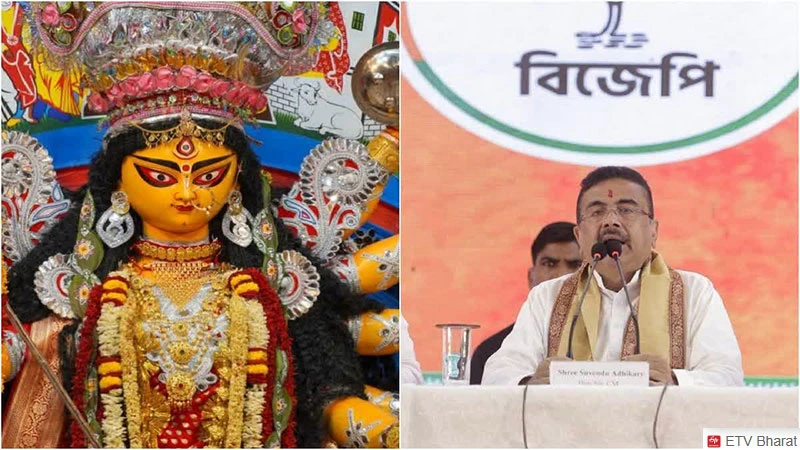
Now, a major structural shift is unfolding across West Bengal Politics. A newly formed BJP Government in West Bengal is beginning to confront this inherited fiscal mess. As reported by The Telegraph, Chief Minister Suvendu Adhikari recently signaled a potential policy departure, hinting that financial help might undergo a radical rewrite.
Implementing a targeted strategy for the Suvendu Adhikari Durga Puja grant 2026 is an explicit attempt to restrict these doles strictly to “need-based” clubs that genuinely lack corporate avenues.
This policy shift emphasizes that affluent, corporate-backed committees should no longer automatically qualify for a state payout. However, critics argue that a target-based approach does not solve the underlying crisis; it merely rebrands a system that challenges the core financial duties of a secular state.
Does Govt Funding of Religious Events Violate Secularism?
The core structure of Indian democracy rests on a simple premise: the state has no religion. Therefore, using public cash to bankroll a single religious event challenges the basic spirit of the Constitution.
If the new BJP Government in West Bengal selectively chooses which specific local organizations receive the adjusted Suvendu Adhikari Durga Puja grant 2026, it walks straight into a highly sensitive landscape.
| Governance Category | Constitutional Mandate | Political Vote-Banking Model |
|---|---|---|
| Primary Focus | Building Infrastructure, Healthcare, and Industry | Distributing Club Donations and Cash Doles |
| Financial Health | Prioritizing Capital Expenditure to Reduce Debt | Increasing Deficits Through Non-Productive Spending |
| Legal Status | Adhering Strictly to State Secularism | Fueling Local Communal Disturbances and Grievances |
Under Article 27 of the Indian Constitution, citizens possess a distinct right protecting them from paying taxes intended to promote or maintain any particular religion.
Documentation tracked by several news reports reveals that early legal interventions in the Supreme Court strongly argued that diverting the public exchequer for religious purposes fundamentally offends constitutional protections.
Though the previous state administration later maneuvered past these limitations before the Calcutta High Court by reclassifying the funds under “community policing”, “traffic safety”, and “tourism promotion”, critics argue the true intent remains transparently populist.
Once the official framework for the New rules for WB Durga Puja allowance is finalized, the structural details will become clearer.
How Other Indian States Spend Public Money on Culture
Defenders of festival handouts often claim that West Bengal is not alone in this practice. While other provincial administrations allocate funds for community heritage, their execution models look drastically different.
They focus heavily on registered public charitable trusts or broad tourism initiatives rather than handing unmonitored cash to neighborhood groups.
One can read more about how states manage these legal and structural boundaries on the official Ministry of Culture portal.
When looked at closely, the comparison exposes a glaring lack of fiscal discipline in Bengal’s past policies.
Still, implementing the New rules for WB Durga Puja allowance will continue to invite intense public debate regarding government priorities.
| State | Occasion / Festival | Beneficiary Entity | Nature of Financial Assistance |
|---|---|---|---|
| Goa | Shigmo, Christmas, Ganesh Chaturthi | Registered neighborhood associations | Direct grants bound to public street processions and float construction. |
| Odisha | Festivals in West Bengal equivalents (Durga Puja, Ratha Yatra) | Local neighborhood committees | Smaller, fixed cash honorariums (Rs. 10,000 to Rs. 25,000) or subsidized utility packages. |
| Tripura | Durga Puja | Registered local clubs | Modest institutional utility subsidies aimed strictly at public safety infrastructure. |
Who Started the Culture of Festive Doles in Bengal?
To truly comprehend this deep fiscal challenge, we must trace how it all began. The Left Front regime held an ideological commitment to state atheism.
Because they maintained this stance, they never involved themselves in religious organizing directly and completely avoided conceptualizing a Durga Puja Donation or setting up institutional stipends for priests.
However, the TMC administration under Mamata Banerjee transformed neighborhood clubs into a strategic civic asset. Detailed timelines by India Today show how the strategy rolled out in calculated, deliberate stages:
- The government instituted institutional allowances for Imams and Muezzins.
- To neutralize the immediate majoritarian backlash, the state introduced state-funded stipends for Hindu priests (Purohits).
- In 2018, the state officially rolled out a direct state honorarium of Rs. 10,000 per Durga Puja committee, bypassing traditional structural checks.
Despite fierce pushback from economists and repeated legal challenges filed in the Calcutta High Court, the payouts kept rising. The court also ordered for the account details of those clubs that received the grants to be formally audited.
What started as a modest token payment ballooned into a massive institutional drain on the public exchequer.
Scholars are closely investigating whether the New rules for WB Durga Puja allowance represents structural reform or a continuation of cultural payouts under a new name.
| Fiscal Year | Grant Amount Per Club (INR) | Estimated Total Budget Impact |
|---|---|---|
| 2018 | Rs. 10,000 | Baseline Launch |
| 2019 | Rs. 25,000 | Sharp Initial Increase (150% Hike) |
| 2020 – 2021 | Rs. 50,000 | Pandemic-Era Escalation |
| 2022 | Rs. 60,000 | Sustained Growth Trend |
| 2023 | Rs. 70,000 | Continued Fiscal Drain |
| 2024 | Rs. 85,000 | Pre-Election Surge |
| 2025 | Rs. 1,10,000 | Massive Peak of over Rs. 400 Crore Total Payout |
By the time the festive season arrived in late 2025, media reports confirmed the payout hit a staggering Rs. 1.10 lakh per club, accompanied by an 80% rebate on electricity charges. This cost the public treasury roughly Rs. 500 crore in a single season.
The historical irony is glaring: West Bengal boasts a glorious, centuries-old heritage of community-funded celebrations where neighborhoods successfully organized magnificent festivals entirely through local subscriptions and domestic donations without relying on state funding.
Can an 8-Lakh Crore Debt-Ridden State Afford Doles?
The absolute asymmetry of this massive handout system stands out starkly when looking at the state’s economic balance sheet. According to recent financial disclosures, West Bengal’s outstanding accumulated debt burden has breached a terrifying Rs. 8.15 lakh crore.
The state is navigating a classic fiscal challenge where it routinely borrows fresh capital from open markets to manage its obligations. For detailed tracking of state-level debts and economic stability markers, one can consult the official datasets on the Reserve Bank of India database.
The Reality Check: While hundreds of crores flowed to local festive clubs in the name of Durga Puja Grants, critics point out that the state’s basic industrial foundation requires heavy capital revival.
To kickstart genuine industrialization, policy analysts argue that public revenue should prioritize core infrastructure, including:
- Modernized deep-water port infrastructure to revive regional logistics.
- High-speed expressways and robust power distribution grids to attract global manufacturing.
- Direct capital investment in public healthcare networks and educational institutions.
- Structural economic drivers to stop the continuous Brain Drain of West Bengal.
Nehru vs. Rajendra Prasad: What History Teaches Us
This conflict between state duties and private faith is not a new phenomenon in Indian politics. The nation’s first Prime Minister, Jawaharlal Nehru, famously maintained an uncompromising boundary regarding public resources.
When the historic Somnath Temple underwent reconstruction, Nehru firmly abstained from attending the official inauguration, arguing that state officials must avoid associating public offices with religious property funding.
Regrettably, the then President, Dr. Rajendra Prasad, chose to attend the ceremony despite Nehru’s principled objections. Decades later, the current political landscape continues to mirror those exact fiscal and philosophical debates.
True governance requires drawing a definitive line between private religious celebrations and state funds, making sure allocations match the true secular spirit of the Indian Constitution.
| Year (FY) | Total Outstanding Debt (Rs. crore) | Approx Debt (Rs. lakh crore) | Debt Trend | Key Context |
|---|---|---|---|---|
| 2010-11 | 1,87,387 | 1.9 | Starting Point | Legacy obligations from previous regimes |
| 2015-16 | 3,06,043 | 3.1 | Rapid Rise | Borrowing increased for welfare + repayment (finance.wb.gov.in) |
| 2020-21 | 4,81,999 | 4.8 | Steady Escalation | Pandemic revenue stress and increased borrowing limits |
| 2025-26 | 7,50,000 – 7,80,000 | 7.5 – 7.8 | Accelerated Growth | Rising liabilities and comprehensive welfare allocations |
| 2026-27 (Proj.) | 8,15,891 | 8.2 | Peak Projection | Debt expected to cross Rs. 8 lakh crore (Indian Community) |
Is the New Government Ready for Real Reform?
Fortunately, we are seeing some early signs of rational, structural adjustment under the new leadership. The administration recently made a definitive move by systematically putting a stop to the controversial, religion-linked allowances for Imams, Muezzins, and Purohits.
Eliminating these direct religious stipends marks a solid step toward clearing out institutional favoritism.
In addition, leadership has shown that delicate cultural issues can be resolved responsibly through diplomatic dialogue rather than competitive populist doles.
A prime example is how Suvendu Adhikari worked collaboratively with the Chief Minister of Odisha to share administrative models for temple management frameworks.
If the administration can handle massive spiritual institutions through structured discussion, it can certainly apply that same logic to local club donations.
Adjusting the handout criteria through a selective approach is a step forward, but long-term economic recovery requires channeling every single paisa of taxpayer money directly into building roads, attracting heavy industries, and saving the state from its crushing debt crisis.
Frequently Asked Questions (FAQ): Durga Puja Grant & Policy Shift
1. What is changing with the Durga Puja Grant?
Chief Minister Suvendu Adhikari has announced a transition from a universal rollout to a need-based model. Rather than distributing funds across the board to all 44,000 registered committees, the state administration intends to restrict direct Durga Puja Grants exclusively to smaller, resource-strained neighborhood organizers that cannot sustain the festival without public support.
2. Will high-budget or corporate-sponsored clubs still get state funds?
No. Under the newly proposed selective framework, affluent, high-profile clubs that successfully secure substantial revenues through corporate sponsorships, consumer advertising, and private donations will be excluded from receiving automatic state payouts.
3. Why did the previous administration’s grant system face criticism?
The universal model introduced in 2018 faced heavy scrutiny because it grew aggressively from a modest Rs. 10,000 to a peak of Rs. 1.10 lakh per club by late 2025. Critics flagged this as an expensive fiscal drain that cost nearly Rs. 500 crore from the treasury in 2025 alone, even as West Bengal’s accumulated public debt breached Rs. 8.15 lakh crore.
4. Is the government trying to stop Durga Puja celebrations?
Absolutely not. The administration has explicitly clarified that the festival will be celebrated on an even grander scale. The Chief Minister and state representatives have encouraged the Forum for Durgotsab to host robust celebrations, with the clear directive to keep the cultural festival completely apolitical and free from partisan influence.
5. Are the 80% electricity subsidies and civic waivers still active?
While the transition to a need-based financial grant has been established, auxiliary concessions—such as the 80% rebate on electricity bills and fire license fee waivers—are currently undergoing formal regulatory review within the Information and Cultural Affairs Department before final guidelines are issued.