
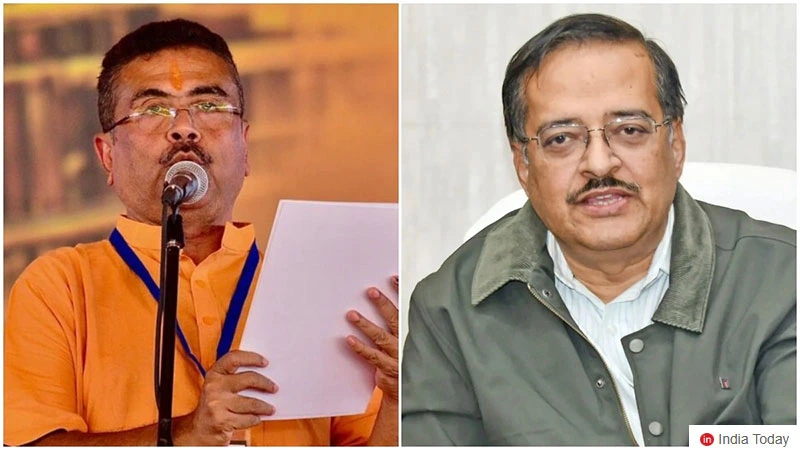
How Has Subrata Gupta Become The New Advisor?
The administrative landscape of West Bengal is currently undergoing a seismic shift. At the heart of this transformation is Subrata Gupta, a veteran 1990-batch IAS officer who has returned to the absolute center of focus after a significant hiatus from state-level influence.
Thus, his recent appointment as the Special Advisor to the Chief Minister is not merely a personnel change; it is a strategic signal of a new era in Bengal governance.
Gupta is far from a typical bureaucrat. He represents a rare blend of technical brilliance, having graduated from the prestigious IIT, and an unshakeable moral compass.
Throughout his career spanning over three decades, he refused to bend to political pressure. As a result, he earned widespread respect.
However, this same trait also led to professional exile at different points in his journey.
Furthermore, it is worthy mentioning that we have seen a gamut of Advisors in the past regime. Mamata Banerjee had recruited almost all the Chief Secretaries as advisors. Such names include Alapan Bandyopadhyay, H.K. Dwivedi, B.P. Gopalika, Manoj Pant.
Who is Subrata Gupta? The IAS Officer with an IIT Edge
To understand why the return of Subrata Gupta is so significant, one must look at his foundational years. Moreover. as a member of the 1990 IAS batch, he entered the service with a reputation for analytical rigor, thanks to his IIT background.
Comprehensive academic & career qualification for Subrata Gupta
| Qualification / Exam | Stream / Service | Institution / Board |
|---|---|---|
| Higher Secondary (HS) | Science | West Bengal Board |
| B.Tech | Electrical Engineering | Indian Institute of Technology Kharagpur |
| PhD | Engineering / Management-related research | Indian Institute of Technology Kharagpur |
| Civil Services (IAS) | Indian Administrative Service – 1990 (Batch Year) | Union Public Service Commission |
How Did Subrata Gupta Prove His Foundation of Integrity?
During his tenure as ADM and District Magistrate (DM) in various districts, Gupta built a strong legacy. As a result, administrative circles still discuss his work today.
- Strong Administration: However, he built a reputation as a strong officer. Additionally, he prioritized the rule of law over political convenience.
- Absolute Integrity: His reputation for honesty was ironclad, making him a difficult figure for local power brokers to influence.
- Data-Driven Governance: Furthermore, leveraging his engineering background, he introduced efficiency into district-level planning and infrastructure.
- Public Trust: He earned wide respect from common citizens. Furthermore, he maintained transparency and remained accessible..
The Industrial Era: WBIDC, Nirupam Sen, and the Singur Crisis
The career of Subrata Gupta took a high-profile turn when he joined the West Bengal Industrial Development Corporation (WBIDC).
As a result, he stepped into a key role in the industrial development of the state. This was a period of intense industrial push under the Left Front government.
How Does The Singur and Nano Project Context Appear?
- Land Acquisition: Gupta also played a key role in the complex and controversial land acquisition process for the Tata Nano project in Singur. As a result, he became a central figure in the developments of the project.
- Collaboration with Nirupam Sen: He maintained a close association with the then Industrial Minister, Nirupam Sen. Thus, the minister valued his efficiency and technical expertise..
- Managing Transition: When Tata Motors eventually exited the state due to political unrest, Gupta headed the WBIDC, managing the difficult transition and attempting to mitigate the industrial fallout.
- Crisis Management: His ability to maintain organizational stability during one of the most volatile economic periods of the Bengal showcased his resilience.
Why Did Not Mamata Banerjee Like Subrata Gupta?
In 2012, as the Managing Director of the Kolkata Metro Rail Corporation Limited (KMRCL), Subrata Gupta faced a defining moment of his career. Though, he was the primary architect facilitating the ambitious East-West Metro project, which included the historic underwater tunnel section.
The East-West Metro Realignment Conflict
The project hit a major roadblock when the newly formed Trinamool Congress (TMC) government demanded a significant realignment of the route.
- The Technical Refusal: Gupta, relying on engineering feasibility and project viability, refused to follow the directive of the state Government for realignment.
- Principled Stand: He argued that the change would lead to massive cost escalations and technical risks.
- The Tussle with Leadership: As the state leadership reportedly preferred subservient bureaucrats, the independence of Gupta led to a direct conflict with Chief Minister Mamata Banerjee.
- Professional Consequences: Gupta chose integrity over his position. Hence, Mamata Banerjee removed him from the project. Subsequently, they moved him to the Jute Corporation of India under the central government..
Political Journalist, Jayanta Ghoshal, writes in NDTV, about the transformation of Subrata Gupta.
How Was The Journey of Gupta Through Diverse Portfolios?
Before his retirement in early 2025, Subrata Gupta served across a spectrum of departments, gaining a 360-degree view of the machinery of the state of West Bengal.
Roles Under Both Left and TMC Governments:
- Food Processing & Horticulture: He applied his administrative rigor to these often-neglected sectors, focusing on supply chain efficiencies.
- Central Government Service: His tenure outside of Bengal allowed him to observe national best practices, which he would later bring back to the state.
- Institutional Memory: Having served under two vastly different political regimes, he possesses a deep understanding of the unholy nexuses that have occasionally paralyzed the progress of the state.
Professional Journey: Subrata Gupta (IAS, 1990 Batch)
| Phase / Role | Key Responsibilities & Milestone Events | Impact & Recognition |
|---|---|---|
| District Magistrate of Jalpaiguri and Burdwan districts | Served as a 1990-batch veteran officer with an IIT background. | Established a reputation for absolute integrity and a strong administrative spine |
| WBIDC Leadership | Managed land acquisition for the Tata Nano project in Singur and worked with Minister Nirupam Sen | Led the organization through the difficult transition period after Tata Motors exited the state. |
| MD, KMRCL (2012-2013) | Facilitated the technically complex underwater metro project for Kolkata. | Refused technically unsound route realignment demands from the TMC, prioritizing professional ethics. |
| Central Deputation | Transitioned to the Jute Corporation of India following a public tussle with state leadership. | Served in various high-level capacities within the central government during his time away from the state cadre. |
| State Portfolios | Managed multiple departments, including Horticulture and Food Processing. | Maintained efficiency across diverse sectors under both the Left Front and the Trinamool Congress governments. |
| Special Observer (SIR) | Oversaw the Special Intensive Revision (SIR) and election oversight before his 2025 retirement. | Achieved a historic death-free election process through surgical efficiency despite heavy political criticism. |
| Advisor to the CM (Present) | Appointed by Suvendu Adhikari to restore administrative order and tackle state corruption. | Tasked with utilizing his vast experience to bring Bengal out of its current debt-ridden and anarchic state. |
Is The SIR and the Death-Free Election The Turning Point?
Perhaps his most celebrated recent achievement was his role as the Special Observer for the Special Intensive Revision (SIR) and the general election process.
Delivering a Secure Democracy
- Efficiency in SIR: He oversaw the revision of electoral rolls with precision. As a result, he minimized ghost voters and discrepancies..
- The Zero-Death Achievement: In a state historically plagued by poll-related violence, the oversight of Gupta resulted in an election process completed without a single death.
- Resistance to Intimidation: Mamata Banerjee and various TMC leaders openly criticized him throughout this process.
- Core Vision: Despite the political heat, he remained focused on his vision of a fair, transparent, and peaceful democratic exercise.
Why Did Suvendu Adhikari Appoint Subrata Gupta?
The appointment of Subrata Gupta by Suvendu Adhikari is a calculated move to restore the lost spine of the Bengal bureaucracy.
Addressing the Administrative Crisis
- Restoring Integrity: Adhikari recognized that for Bengal to function peacefully, it requires bureaucrats whose integrity is beyond question.
- Combating Anarchy: The state has faced allegations of systemic corruption and an unholy nexus between administration and political muscle; Gupta is seen as the antidote to this anarchy.
Technical Expertise: His experience is vital for a state that is currently debt-ridden and in need of structural economic reforms. - Independent Oversight: The history of Gupta proves he is not afraid to say no to political leaders when the welfare of the state is at stake.
The Path Forward: A New Era for Bengal?
The role of Subrata Gupta as the Advisor to the CM is not just an advisory position, it is a mission to steer Bengal out of its current economic and social doldrums. However, Suvendu Adhikary has preferred the son of the soil.
Key Areas of Expected Impact:
- Economic Strategy: Utilizing his WBIDC and IIT background to attract legitimate investment and manage the burgeoning debt of the State.
- Bureaucratic Reform: Encouraging other officers to regain their independence and act according to the constitution rather than political whims.
- Infrastructure Oversight: Bringing his KMRCL experience to stalled or mismanaged state projects.
- Electoral Integrity: Ensuring that future administrative processes remain as clean and efficient as his SIR tenure.
How Subrata Gupta Will Be Useful?
| Feature | Impact on Bengal |
|---|---|
| IIT Background | Precision and technical excellence in governance. |
| Integrity | A clear break from the subservient bureaucrat mold |
| SIR Success | Proven ability to manage large-scale, volatile processes peacefully. |
| Industrial Vision | Depth of knowledge in land acquisition and industrial policy. |
Final Thoughts of Knowledge Mart:
Knowledge Mart as a watch dog of West Bengal Politics and Administration openly welcome the decision of inception of Subrata Guha in Chief Minister’s office.
Subrata Gupta: New Advisor to Bengal CM, is a title that carries the weight of a thousand expectations. He is the man who stood his ground in 2012, the man who delivered a peaceful election in 2024, and now finally, the man tasked with helping Suvendu Adhikari rebuild a state that has been fractured by years of corruption and administrative decay.
His journey from an IIT graduate and PhD to a Special Observer and finally to the office of the Chief Minister is a testament to the fact that talent and character cannot be suppressed forever.
As Bengal looks toward a future free from debt and anarchy, experience and talent of Subrata Gupta may very well be the foundation upon which a new era is built.
10 Key Takeaways:
- Veteran Leadership: First, Subrata Gupta brings decades of experience as a veteran 1990-batch IAS officer.
- Technical Excellence: Furthermore, he utilizes his prestigious IIT background to solve complex administrative and infrastructure problems.
- Strong Integrity: Notably, he earned a reputation as a strong officer with a straight spine during his tenure in Bardhaman.
- Industrial Insight: Consequently, his deep involvement with the WBIDC provided him with critical experience in land acquisition and industrial transitions.
- Principled Stand: Specifically, he famously refused technically unsound metro realignment demands from the TMC government in 2012.
- Diverse Experience: Additionally, he managed various portfolios ranging from the Jute Corporation to Horticulture and Food Processing.
- Election Efficiency: Impressively, his role as Special Observer ensured a historic election process without a single reported death.
- Resisting Pressure: Despite facing intense criticism from political leaders, he never wavered from his core professional vision.
- Strategic Appointment: Therefore, Suvendu Adhikari selected him as Advisor to restore order and dismantle unholy administrative nexuses.
- Future Vision: Ultimately, his talent offers a new opportunity to lead Bengal out of its current debt and anarchy.
People Also Ask (PAA)
Who is Subrata Gupta?
Initially, he is a veteran 1990-batch IAS officer and an IIT graduate known for his administrative integrity.
Why did BJP appoint him?
Consequently, Suvendu Adhikari appointed him as Advisor to restore a spine to the bureaucracy of the state and curb anarchy.
What is his role in the SIR?
Recently, he served as a Special Observer and efficiently managed the election process without a single death.
Why did he leave the TMC government?
Specifically, he had a fallout in 2012 after refusing technically unsound demands for the East-West Metro realignment.
Was he involved in Singur?
Furthermore, he managed land acquisition for the Nano project at WBIDC and led the body during the transition.
What makes him an expert?
Moreover, his vast experience in infrastructure, industrial planning, and election oversight makes him a unique administrative asset.
How does he handle political pressure?
Notably, he maintains his core vision despite heavy criticism from political leaders like Mamata Banerjee.
Can he fix the debt of West Bengal?
Ultimately, his expertise in key positions aims to help the state recover from its current debt-ridden and corrupt status.
What was his role in KMRCL?
Previously, he served as MD of the Kolkata Metro and facilitated the development of the underwater tunnel project.
Is he a strong bureaucrat?
Indeed, he is recognized as a leader with high integrity who refuses to be a subservient official.