Exclusive Myths of Cult figures in Politics
Oct 11, 2025 - By Ashutosh Roy International BriefsNational NewsPolitical IdeologiesPoliticsWest Bengal Politics
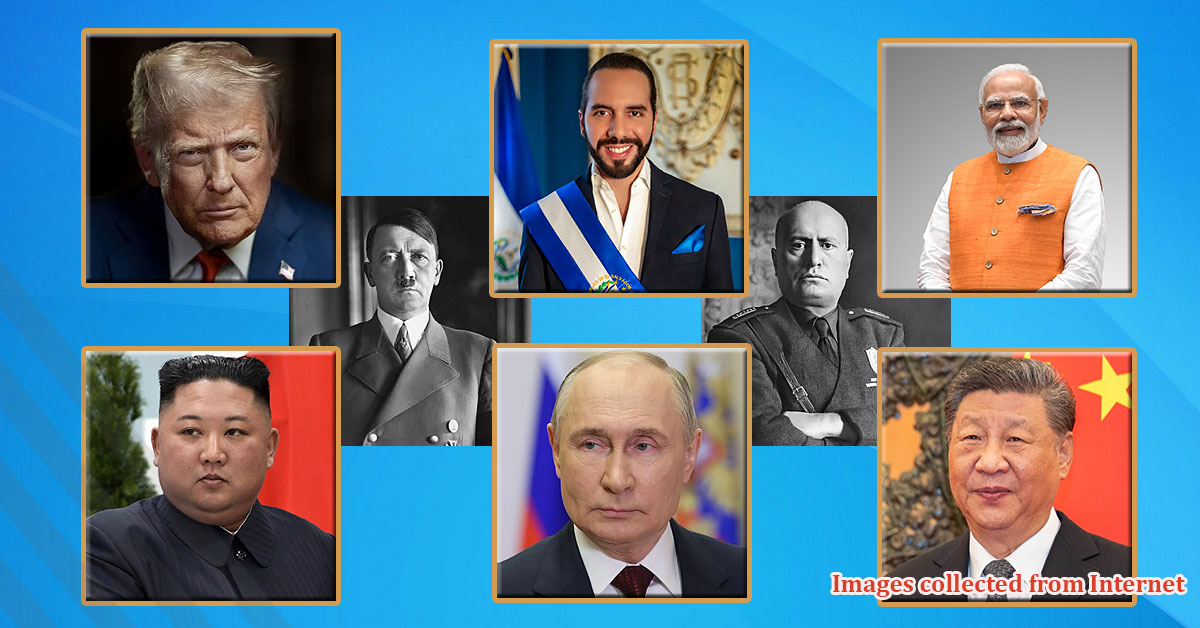
Cult figures in Politics
Cult figures in politics are seldom in history, but in the recent past, we can notice the accelerating growth of cult figures. The international politics boasts of multiple cult figures in politics today.
Donald Trump, Narendra Modi, Vladimir Putin have been ruling the roost in their own countries. The history reveals some stalwarts as cult figures like Adolf Hitler, Joseph Stalin, Benito Mussolini to name a few.
The key common factors among cult figures in politics
- Unquestioning loyalty prevails as one of the key characteristics among all of them.
- They become highly emotionally attached.
- None of these political heroes can tolerate voice of dissent and they are keen to glorify their larger-than-life image.
- The current scenario shows that can successfully manipulated the media so that their propaganda remains reckoned.
Historically, politics has seen several such personalities: Adolf Hitler, Joseph Stalin, and Benito Mussolini are infamous examples of how cult-like leadership can redefine, and often destabilize, a nation’s political trajectory.
Background: Cult Figures in India
The existence of cult figures in politics perhaps started with Indira Gandhi, when she split the original Congress and formed Congress (I). The so called “gungi gudiya“, didn’t take much time to come under the limelight. Indira’s smart and bold move during Bangladesh war made her a cult figure.
Her triumphant victory against the clever Richard Nixon and Henry Kissinger duo exhibited Indira Gandhi, the iron lady’s courage, determination and pragmatism.
The Indo-Pak war ended in a humiliating surrender of Pakistan. But the smart Indira never attempted to win the POK, the most controversial piece of land since independence. She knew where to stop.
Similarly, anti-Indira movement turned Jayprakash Narayan to be a cult figure in politics. Though he never wanted to be provoked by the Chair of the Prime Minister.
The mood in the Congress headquarters became solemn with the tragic defeat of Indira. However, in 1989, VP Singh almost emerged as a cult figure in politics by anti-congress movement on the issue of Bofors scandal. Unfortunately, these coalition Governments could not complete their full-term rulings.
Ironically, the Congress could never come back to power with absolute majority after the defeat in 1989 against VP Singh.
Narendra Modi – Unique among the Cult Figures in Politics
Narendra Modi in 2014 emerged as a cult figure in politics of India. Modi was the chief minister of the State of Gujrat. The frustrated and annoyed people by several scams in UPA 2 Government became desperate to thwart the Government. Modi appeared as a “Mossiha” to the large section of India, mainly in central and northern India.
The media also played a pivotal role by highlighting his successful “Vibrant Gujrat” and other development commitments. Indeed, he could not keep a lot of the commitments. But Narendra Modi, has now reached the third consecutive term with his authoritarian attire and most probably going to create a history in the coming future.
Problems of Cult figures in politics
The problem with such cult figures in politics is that the people reckon him even more than the party. So, any wrong-doing or false step of such cult figures will affect the whole party badly. On the other he carries the responsibility of taking the party to the victory lap on his own shoulder over the years.
That’s why any regimented party like BJP or CPM, never indulges in such cult figures. They try to bring the party in front of the persona. The national party Congress just goes by the reverse philosophy of ruling the party by one family and its descendants.
The result for Congress has been fatal in the recent past and BJP has been acquiring more and more states besides his solid grip in the Centre.
If we look at the state level politics, many regional parties have emerged by splitting the congress. Whether its Sharad Yadav or Mamata Banerjee, the party becomes basically a one-man army. Similarly Look at Samajwadi Party or RJD or BSP.
These parties are headed by the leader and the baton is handed over to the next generation in the family. They cant be termed as cult figures in politics.
Cult figures: Centralized System
If we look at from a different angle, the cult figures always lead to centralized political system, which is termed as High command. They take the decisions, implement, monitor and control, where the demands of grassroot level hardly reaches their ears.
Hence, these demands remain mostly ignored or unattended. Is it really possible to control the whole country with so many diversities and variations from a central place?
The record reveals Congress had become the single largest party in most of the states and won 364 of the 489 seats in the parliament. If we compare the result with today’s Congress, the most loyal supporters will start crying. The problem was that the Congress tried to govern the entire country from Delhi Head Quarters.
If you look at the current context, BJP’s control pattern is logical equal to the way, the Congress got uprooted from several states.
The cult figures in politics can accelerate the momentum for a period of time, but may be fatal in the long run.
[…] deep-rooted economic crises, widespread youth-led protests, and a rising tide of authoritarianism. Authoritarian regimes often give way to nepotism, widespread corruption, money laundering, and broader […]
[…] and Services Tax (GST), was implemented on July 1, 2017, during the first term of Prime Minister Narendra Modi. Much like the saying “Rome was not built in a day,” the GST too underwent several stages of […]
[…] Narendra Modi or Late Indira Gandhi had navigated a challenging political landscape and emerged as icons. Did Abhijit Gangopadhyay ever face such challenging and competitive politics in West Bengal? Rather, he was a potted plant. Subhendu Adhikary had awarded him one of the safest seats in West Bengal and he had left no stone unturned to send him to the parliament. What has been his contribution to the party or in parliament? He had continued to show such a daunting attitude on the floor of the parliament also. It seems Abhijit Gangopadhyay forgot that citizens are informed voters, not mindless fanatics or fools. […]
[…] present, Narendra Modi does not have a clear single-party majority either. However, there is hardly any visible difference […]
[…]Exclusive Myths of Cult figures in Politics Critical deep dive into myths and cult figures in politics. Read the article to uncover hidden dynamics of leader worship, mass influence, and power narratives.[…]
[…]Exclusive Myths of Cult figures in Politics Critical deep dive into myths and cult figures in politics. Read the article to uncover hidden dynamics of leader worship, mass influence, and power narratives.[…]