Bengal Two-Party Poll Battle: Proven Truth
Mar 28, 2026 - By Ashutosh Roy Culture & HeritageElection AnalysisNational PoliticsPolitical IdeologiesPoliticsRegional UpdatesWest Bengal Politics
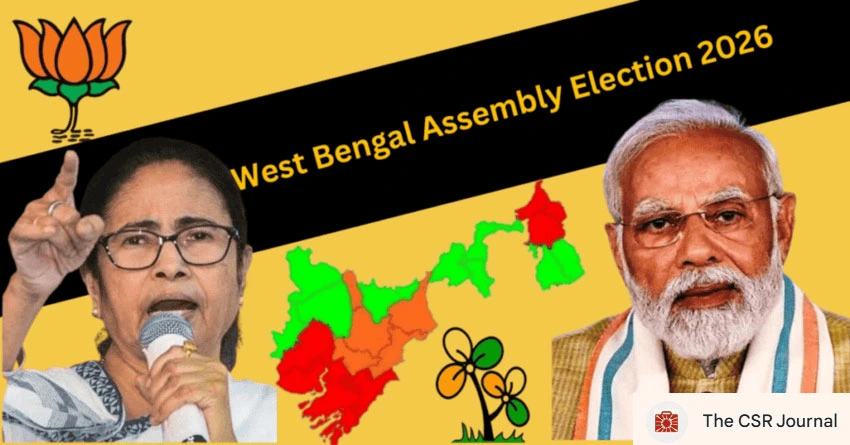
Is Two-Party Poll Battle obvious in Bengal Elections 2026?
The Bengal Two-Party Poll Battle remains an undeniable, historical reality. From the early decades of Congress versus the Communists to the fierce rivalry between the Left Front and the TMC, West Bengal’s electorate has consistently favored a binary choice over a fragmented mandate even in Bengal Elections 2026.
However, this traditional head-to-head dynamic shifted significantly after 2018. The CPM started also struggling to protect its grassroots supporters from political targeting. Hence, a massive administrative and emotional disconnect emerged. Consequently, the vacuum left by the Left was rapidly filled by the BJP, transforming the state’s political map.
Now, the 2026 Bengal Election landscape has solidified into a direct, high-stakes electoral battle between the TMC and the BJP. While some argue for more variety, this clear-cut competition often ensures a more decisive governance outcome.
As a result, the “Proven Truth” is that Bengal continues to reject the chaos of a multi-party scramble in favor of a powerful, two-sided showdown.
Is Two-Party Poll Battle Bengal’s Tradition?
Additionally, People in Bengal have opted for a two-party voting battle traditionally. Over the years, the state has not fully embraced a multi-party democracy.
Nevertheless, this reality may go against the spirit of diverse democratic thinking in West Bengal.
However, this is what Bengal has accepted and this is how politics continues to function today.
On the other hand, many states across India regularly experience multi-party contests. Still, if we analyze the outcomes, some people argue that Bengal’s system has one clear advantage. As a result, it reduces the chances of political “horse-trading” after elections.
At the national level, India has witnessed coalition governments for a long time. During these periods, smaller parties often negotiate strongly to secure benefits for their own states. For example, leaders like Mamata Banerjee and J. Jayalalithaa once played crucial roles in national politics.
Because, their support was essential for the government led by Atal Bihari Vajpayee, which depended on alliances.
Similarly, India has also seen strong positions from parties on major national issues. For instance, during debates around the India–United States Civil Nuclear Agreement, left parties maintained a firm and unyielding stance.
Therefore, while Bengal continues its two-party trend, the broader Indian political landscape shows how multi-party dynamics can shape governance in different ways.
Which System Is Better?
There is no one-word answer to which system is better. Instead, the choice depends on what a voter values more. On one hand, some voters prefer stability and clear choices. On the other hand, others prioritize representation and diversity.
Does Bengal Prefer Two-Party Poll Battle?
Historically, voters in West Bengal have shown a strong preference for stability and clear political options. Therefore, this explains why the state continues to lean toward a two-party system rather than a multi-party structure.
Arguments in Favor of Two-Party Electoral Competition
This is known as the “dual choice” model, under which West Bengal has effectively operated for decades. For example, politics has evolved from Congress vs Left Front, to Left Front vs Trinamool Congress, and now Trinamool Congress vs BJP.
- Stability in Government: First of all, this system often brings political stability. Governments usually win a clear majority. As a result, the risk of “horse-trading” or sudden government collapse becomes much lower.
- Clear Mandate for Voters: Moreover, voters know exactly who will become Chief Minister and what policies they will follow. Therefore, there is no confusion about alliances or power-sharing after elections. Though BJP has not declared any CM candidate as yet for West Bengal Polls 2026.
- Strong Accountability: In addition, when there are only two major choices, the ruling party cannot easily blame coalition partners. Instead, voters can directly judge the government’s performance.
Challenges of a Two-Party System
- Rise of Authoritarian Tendencies: However, long-term rule can create authoritarian attitudes. Over time, the ruling party may start treating citizens as subjects. As a result, misuse of power and political dominance can increase and the opposition space can be squeezed.
- Higher Risk of Corruption: Furthermore, if the opposition is weak, corruption can grow easily within the system. This can affect multiple levels of governance, including local bodies. It is important to note that significant public funds now flow even to grassroots institutions like panchayats.
Arguments in Favor of Multi-Party Electoral Competition
This model is more common in states like Bihar and Maharashtra, where multiple regional and national parties coexist and compete together.
- Broader Representation: First, a multi-party system ensures wider representation. Smaller parties can highlight specific interest groups, communities, or local issues that larger parties often overlook.
- Check on Authoritarian Power: Moreover, this system helps prevent authoritarian control. Since no single party holds absolute power, leaders must build consensus and make compromises. As a result, governance becomes more balanced.
- A Safety Net for Voters: In addition, a multi-party system works as a safety net for voters. If a major party fails to meet expectations, such as when Communist Party of India (Marxist) struggled to maintain grassroots connections after 2018, voters can shift to other alternatives. Therefore, they do not need to completely change their ideological position.
What is the “Bengal Reality”?
Based on this analysis, the political culture of West Bengal often views a two-party contest as more effective.
Direct Accountability: Traditionally, voters in Bengal prefer head-to-head electoral battles. When a party fails to protect its supporters or present a clear vision, voters tend to shift strongly toward the only viable alternative. For example, this shift has often benefited parties like the Trinamool Congress.
Decisive Outcomes: Finally, in a politically intense state like Bengal, multi-party competition can sometimes lead to a hung assembly and administrative instability. However, voters have historically rejected such uncertainty and favored clear, decisive results.
Snapshot: Two-Party Poll Battle and Multi-party Poll Battle
| Feature | 2-Party Poll Contest (Binary) | Multi-Party Poll Contest |
| Voter Choice | Clear & Direct: A “Head-to-Head” battle between two main ideologies. | Diverse: Multiple options representing various niche interests. |
| Government Stability | High: Usually results in a single-party majority with a firm mandate. | Variable: Often leads to coalitions, which can be prone to “horse-trading”. |
| Autocracy Risk | Concentrated Power: High risk of “Winner-Takes-All” autocracy if the ruling party controls all institutions. | Distributed Power: Multiple parties act as checks and balances, making absolute autocracy harder. |
| Corruption Type | Systemic/Elite: Corruption often happens at the top level via special interests and “quid-pro-quo” deals. | Electoral/Tactical: Corruption often appears as “buying” smaller parties or candidates during coalition building. |
| Accountability | Absolute: The incumbent cannot blame partners for failures or scandals. | Diluted: Parties often shift the blame for corruption onto their coalition partners. |
| Grassroot Protection | High Risk: When a party fails to protect its base, as seen with the CPM after 2018, the electorate shifts entirely to the strongest opposing force. | Safety Valve: Displaced voters can find space in smaller parties without switching their entire ideology. |
| Bengal Context | Historical Norm: (Congress vs. Communists, Left vs. TMC, TMC vs. BJP). | Rarely Successful: Traditionally rejected by the Bengal electorate in favor of a strong “Dada/Didi” figure. |
Theory vs Reality in Electoral Systems
On paper, a multi-party system is more democratic because it reflects a wider range of opinions. In other words, more voices and viewpoints get representation in the political process.
However, a two-party competition offers a more “proven reality”. It creates a clear winner and a clear loser. As a result, this clarity often leads to stronger and more effective governance.
Therefore, while a multi-party system promotes diversity, a two-party system ensures decisive outcomes and stable leadership.
In states like West Bengal, this balance between theory and practicality continues to shape voter preferences and political outcomes.
West Bengal Election 2026: Likely Head-to-Head Battle
So far, the West Bengal Legislative Assembly Election 2026 appears to be moving toward a direct, head-to-head contest. In fact, the main drivers of this battle are the Trinamool Congress and the Bharatiya Janata Party.
At the same time, the Communist Party of India (Marxist) may perform well only in a few limited areas. Similarly, the Indian National Congress could see better results in pockets like Malda and Murshidabad.
However, in most parts of the state, these parties may end up acting as vote splitters rather than main contenders.
Therefore, the key question in 2026 is: who benefits from vote division? Generally, when opposition votes are split, the ruling party gains an advantage. However, this time, the situation may be different.
Is the Ground Reality Changing?
Due to issues like voter list revisions (SIR process) and a strong anti-incumbency sentiment, the usual advantage of vote splitting may not fully apply.
In Addition, there have been continuous allegations of corruptions and extortion. Women’s’ Security has also come in the fray. As a result, the final outcome could be more competitive than expected.
Limits of Small Parties in Bengal’s Two-Party Poll Battle
In reality, Bengal’s two-party poll battle often leaves smaller parties and communities with limited impact. Groups like the Matua community, Rajbanshi community, Kamtapuri community, and Kurmi community can strongly express their demands.
However, they usually fail to convert that dissatisfaction into significant electoral power or form a government.
It is worth noting that Jyoti Basu successfully led one of India’s earliest and most stable coalition governments in West Bengal. His strategy was clear: prevent anti-Congress votes from splitting.
Therefore, he included leaders from smaller parties like the All India Forward Bloc Marxists and the Socialist Party (India) in his cabinet to maintain unity.
However, such a united opposition alliance in West Bengal Assembly Polls 2026 is seemingly difficult in today’s context. Ideological differences and pressures from national politics make it hard for parties to come together under one platform.
While ideology once ruled the polls, today’s politics is increasingly defined by financial influence and the raw pursuit of power.
As a result, in the West Bengal Legislative Assembly Election 2026, it is still unclear who will benefit from vote splitting. The situation remains unpredictable, and no clear winner can be identified at this stage.
A Direct Choice for Voters
Ultimately, if smaller parties fail to emerge as decisive forces, the election may turn into a plebiscitary choice: “Yes to Mamata Banerjee or No to Mamata Banerjee“.
Importantly, the people of West Bengal are highly politically aware. Therefore, their final decision will play the most crucial role in shaping the state’s future.
10 Key Takeaways
- Bengal’s politics in West Bengal is largely shaped by a two-party electoral system.
- This system creates clear choices and stable governments, but it can limit broader representation.
- In contrast, multi-party systems offer diversity, but they often lead to alliances and unstable outcomes.
- Smaller communities like the Matua community and Rajbanshi community can raise strong demands, yet they struggle to gain electoral power.
- Historically, Jyoti Basu built a successful coalition model by uniting anti-Congress votes.
- However, today’s ideological and national political divisions make such unity difficult.
- The West Bengal Legislative Assembly Election 2026 is likely to be a direct contest between the Trinamool Congress and the Bharatiya Janata Party.
- Parties like the Communist Party of India (Marxist) and Indian National Congress may only perform well in limited regions.
- Vote splitting will play a crucial role, and it is still uncertain which party will benefit from it.
- Ultimately, voters may face a direct choice involving Mamata Banerjee, and their decision will determine the final outcome.
People Also Ask (PAA)
What is a two-party electoral system?
A two-party system is when two major political parties dominate elections, giving voters a clear choice between two main options. This is a common scenario in West Bengal politics today.
Why does Bengal prefer a two-party contest?
Voters in West Bengal often prefer stability and decisive outcomes. Therefore, a direct contest between major parties feels clearer and more effective.
Which parties are leading in the 2026 Bengal election?
The main contest in the West Bengal Legislative Assembly Election 2026 is expected to be a Head-to-head voter contest between the Trinamool Congress and the Bharatiya Janata Party.
Can smaller parties influence the election outcome?
Yes, smaller parties can influence results by splitting votes, even if they do not win many seats.
Why is vote splitting important in elections?
Vote splitting can change outcomes because it may benefit one major party over another, especially in close contests.
Is a multi-party system better than a two-party system?
There is no single answer. A multi-party system offers better representation, while a two-party system provides stability and clear leadership.
What role does anti-incumbency play in 2026?
Anti-incumbency sentiment can reduce the ruling party’s advantage and make the election more competitive.
Who will decide the final result?
Ultimately, the voters of West Bengal will decide the outcome through their final electoral choice.