Bengal Budget 2026: What's New for you?
Feb 07, 2026 - By Ashutosh Roy Current AffairsGovernance & AdminPoliticsWest Bengal Politics
Key Highlights:
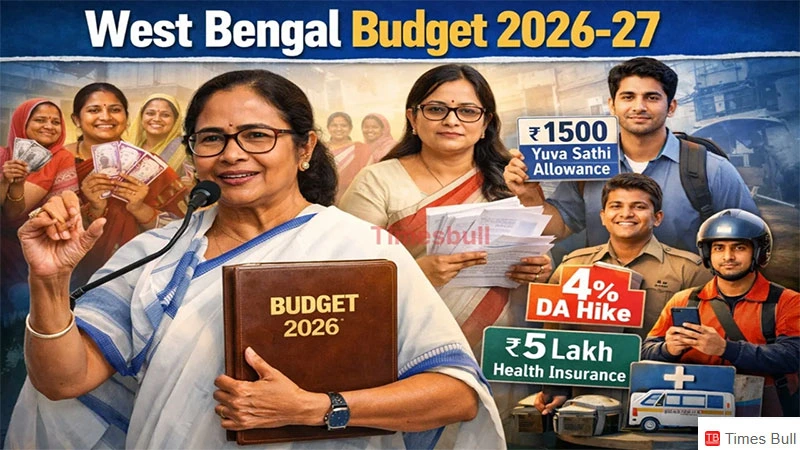
- West Bengal Budget 2026 is an interim, election-focused budget with a strong welfare push.
- The total budget size stands at ₹4.06 lakh crore, one of the largest in the state’s history.
- Banglar Yuva Sathi scheme launched, offering ₹1,500 monthly unemployment allowance for eligible youths.
- Lakshmir Bhandar allocation also increased, continuing the government’s women-centric welfare strategy.
- ASHA, Anganwadi workers, civic volunteers, Green Police, and para-teachers get a ₹1,000 monthly hike.
- 4% DA hike announced, raising total DA to 22%, but a 37–40% gap with Central DA remains.
- No clear provision for clearing pending DA arrears, despite Supreme Court directions.
- Ghatal Master Plan receives ₹1,500 crore, though implementation doubts persist.
- ‘Nodi Bandhan’ project gets ₹200 crore to essentially tackle river erosion in Malda and Murshidabad.
- Overall, the budget offers populism over structural reform, with limited new hope beyond welfare schemes.
Is Bengal Budget 2026 Only a Welfare Push?
What is the harm in adding extra ghee to a dream pulao? Anyone who looks at West Bengal Budget 2026 will surely ask this question. However the interim Budget took places on 05th February, 2026.
Not surprisingly, Mamata Banerjee played the role of a wish-fulfilling leader in this interim budget. After all, elections are near.
Moreover, despite alleged discrimination by the Centre, she had a responsibility to show how much the state can still deliver under pressure. Therefore, the government tried hard to project its commitment to development and welfare.
As a result, Mamata Banerjee presented a massive ₹4.06 lakh crore state budget, aiming to send a strong political and economic message ahead of the polls.
We still do not know whether any government can announce a full budget so close to the 2026 elections. Similarly, it remains unclear whether a government can introduce such large welfare schemes through an interim budget. Thus, only time will answer these complex questions.
Past experience shows that many state governments and even the Central government usually opt for a vote on account when elections are just months away. Nevertheless, this practice follows constitutional ethics and established political conventions.
However, West Bengal presents a different political picture. In contrast, here, conventional wisdom or the constitutional morality losses ‘its way into the dreary desert sand’ of electoral autocracy in West Bengal politics. As a result, established norms appear secondary to political calculations.
So, these decisions may signal something deeper.
Nonetheless, they possibly reflect the growing panic and uncertainty within the ruling establishment as the West Bengal Assembly Election 2026 approaches.
It remains to be seen whether such a last-minute eyewash can actually win the trust and minds of West Bengal voters.
The Bengal Budget 2026 Highlights:
Now, let’s take a quick look at the key highlights of the budget.
Welfare Schemes
- First, the announcement of a new scheme in the name of Banglar Yuva Sathi. It is a new unemployment allowance for youths aged 21 to 40 years who have passed Madhyamik. Under this scheme, eligible youths will receive ₹1,500 per month until they get a job, or for a maximum of five years.
- Secondly, the state government announced a 4% Dearness Allowance (DA) hike for state government employees and pensioners. As a result, the total DA has now increased to 22%.
- Meanwhile, under the Lakshmir Bhandar scheme, the monthly financial assistance for women has been increased by ₹500.
- In addition, the government announced a ₹1,000 monthly allowance hike for ASHA and Anganwadi workers, civic volunteers, Green Police, and Education Bandhu (para-teachers).
- Finally, the state government formally announced the Seventh Pay Commission, a long-standing demand of government employees.
Overall, the budget focuses heavily on youth, women, welfare workers, and salaried employees, clearly reflecting an election-oriented approach.
Development Measures
Apart from welfare measures, the budget also focuses on state development and infrastructure maintenance.
- First, the government announced the “Nodi Bandhan” project to prevent Ganga river erosion in Murshidabad and Malda districts. For this purpose, the budget has allocated ₹200 crore.
- Next, the long-pending Ghatal Master Plan received a major push, with an allocation of ₹1,500 crore to address flooding and improve regional infrastructure.
- Finally, the budget earmarked ₹500 crore for the construction of the Gangasagar Bridge. This 4.75-kilometre-long bridge over the Muriganga River aims to strengthen connectivity and boost economic activity in the region.
Overall, these projects underline the government’s focus on flood control, infrastructure development, and regional connectivity alongside populist welfare announcements.
Why BJP Calls Bengal Budget 2026 an Appeasement Budget?
The opposition, especially the BJP, has branded this budget as a “appeasement budget.” That reaction is hardly surprising. After all, pre-election budgets usually follow this pattern.
Moreover, the West Bengal government rarely puts any direct financial burden on common people. Even when market prices rise tenfold, the state does not increase taxes. In fact, whenever the government tries to raise parking fees, the minister Firhad Hakim had to roll them back.
Therefore, this clearly reflects populist politics.
For instance, most people had already expected a higher allocation for the Lakshmir Bhandar scheme. Now, the government has added another major welfare promise with the launch of Banglar Yuva Sathi.
In short, the budget strengthens the state’s welfare-driven, vote-focused political narrative ahead of the elections.
Does 4% DA Hike Really Help Employees?
Despite the 4% DA hike, the gap with the Central Government DA still stands at around 37–40%. More importantly, the budget makes no provision for clearing pending DA arrears.
Still, this time at least, the Chief Minister did not send a last-minute note to Chandrima Bhattacharya directing her to announce a DA hike.
Meanwhile, the Supreme Court has issued a clear directive. It ordered the state to pay at least 25% of the DA arrears by March and to submit a compliance report.
However, the state government may once again try to buy time through legal procedures. Even so, if the payment is made, it will clearly be an off-budget expenditure.
This situation is similar to what happened earlier with the “Amader Para, Amader Samadhan” scheme. It was also outside the regular budget framework.
As a result, the state’s debt burden continues to rise. Yet, Mamata Banerjee seems to have made up her mind that even if the money comes through borrowing, the ghee must be added.
In other words, when increasing income looks difficult, the strategy shifts to appeasing people through widespread allowances. And if someone can receive even ₹1,000 a month while sitting at home without work, many may feel that it is not such a bad deal after all.
Are Lakshmir Bhandar and Kanyashree Working?
What is the real impact of Lakshmir Bhandar or Kanyashree? Let’s look at the ground reality of Bengal’s so-called Kanyashrees and Ma Lakshmis—a reality that is often deeply distressing.
To qualify for Kanyashree, many girls somehow enroll in college. However, soon after, they drop out. As a result, enrollment rises on paper, but actual education does not continue.
Meanwhile, another shocking fact has emerged from a recent report. Nearly 17% of pregnant women in the state are adolescents, even though adolescent women make up only about 4% of married women in West Bengal. This clearly highlights a serious social failure.
Therefore, on one hand, social security schemes are draining the state exchequer. On the other hand, the real-life condition of women remains grim.
At the same time, repeated incidents continue to expose how fragile women’s safety is in the state, despite official claims of progress. In short, the contrast between welfare spending and social outcomes paints a deeply worrying picture of Bengal’s reality.
Why Ghatal Master Plan Still Stuck?
People have been hearing about the Ghatal Master Plan for nearly 15 years now. At times, The West Bengal Government often places the blame on the Central Government. At other times, the State Government is held responsible.
Ahead of the last Lok Sabha election, actor-turned-MP Dev reportedly did not want to contest again. In Parliament, he almost delivered what sounded like a farewell speech.
However, he later agreed to run again, and eventually won, largely because of assurances linked to the Ghatal Master Plan.
Therefore, despite repeated announcements, no one is really sure whether the allocated funds for the Ghatal Master Plan will ever be used on the ground. The project continues to remain more of a political promise than a completed reality.
In reality, the state budget is only one part of the governance process.
Although, in West Bengal, most major decisions happen outside the budget framework.
New bridges or allowance schemes usually start first, and only later do they find a place in the budget.
Because of this, public interest in West Bengal Budget 2026, especially as an interim budget, was never expected to be very high.
Can Nodi Bandhan Stop River Erosion?
However, the “Nodi Bandhan” project stands out as a notable exception. In fact, the government should have launched this initiative much earlier. Large parts of Malda and Murshidabad have suffered severe damage due to river erosion for years.
At the same time, the problem is not natural alone. Moreover, sand smugglers and illegal miners are deeply involved in worsening riverbank erosion. Unfortunately, the long arm of the law rarely reaches them, as many are allegedly protected by leaders from ruling parties.
Does Bengal Budget 2026 Offer Hope?
In the end, West Bengal Budget 2026 failed to offer any new ray of hope. Of course, there was little expectation of that in the first place.
[…]Bengal Budget 2026: What’s New for you? What’s new in the Bengal Budget 2026? From increased women’s grants to unemployment support and massive infrastructure projects, see the key takeaways for you.[…]
[…]Bengal Budget 2026: What’s New for you? What’s new in the Bengal Budget 2026? From increased women’s grants to unemployment support and massive infrastructure projects, see the key takeaways for you.[…]
[…]Bengal Budget 2026: What’s New for you? What’s new in the Bengal Budget 2026? From increased women’s grants to unemployment support and massive infrastructure projects, see the key takeaways for you.[…]