Bangla Bachao Yatra: The Best Way to Boost
Dec 26, 2025 - By Ashutosh Roy Election AnalysisPoliticsWest Bengal Politics
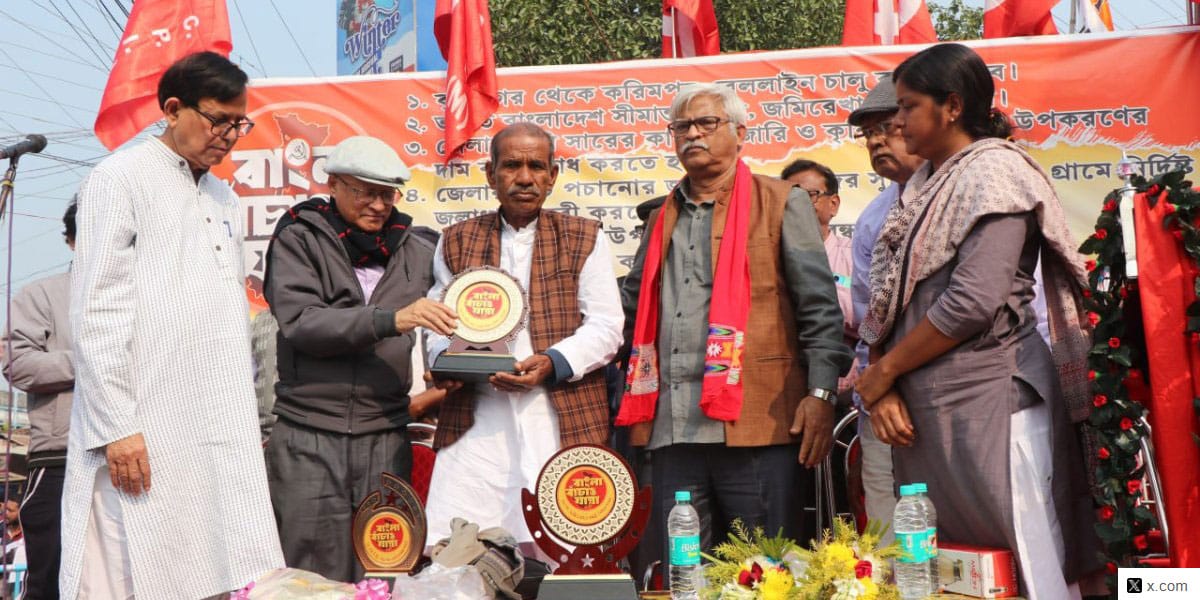
Bangla Bachao Yatra: CPM’s Attempt to Reclaim Political Space in West Bengal
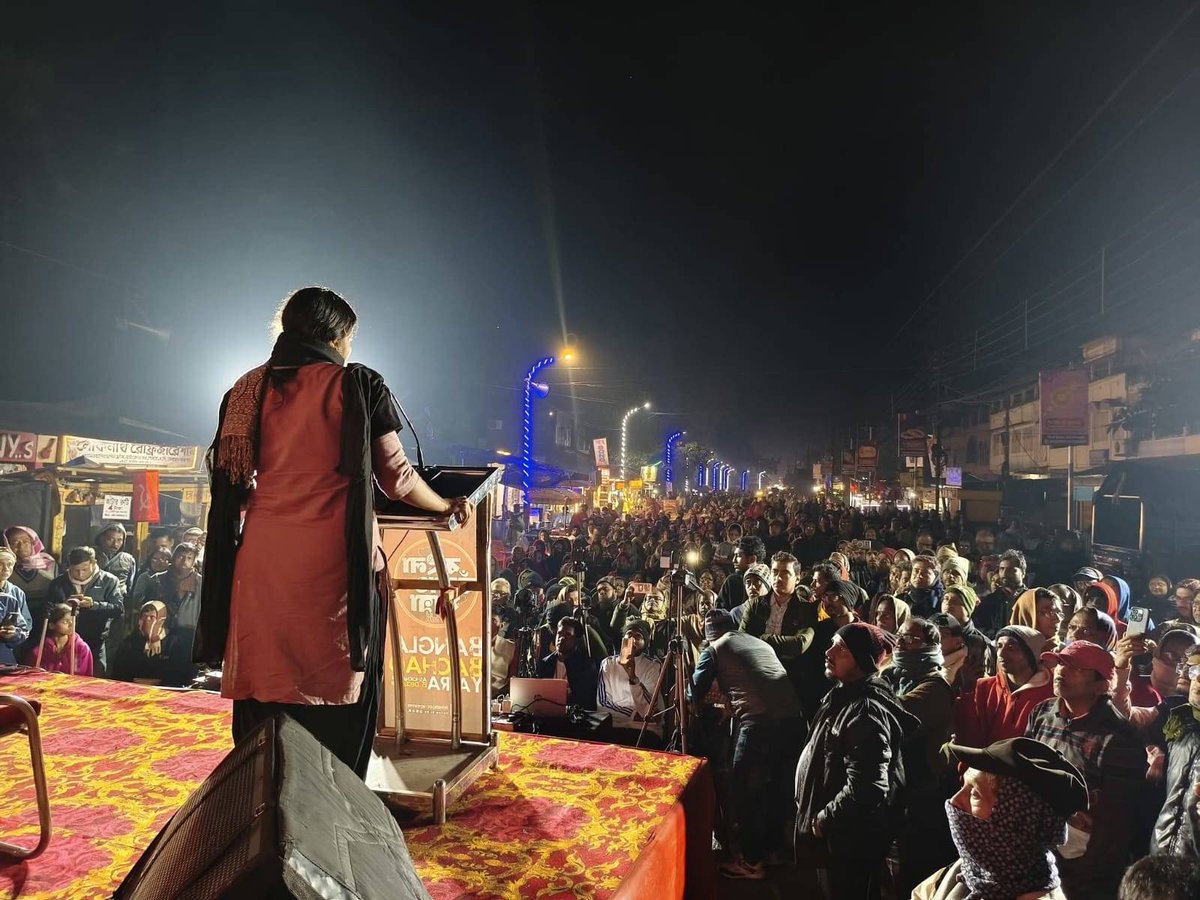
The CPM’s Bangla Bachao Yatra (Save Bengal March), from Cooch Behar to Kamarhati, is an impressive movement. At least, this effort to reach people by raising public issues deserves praise.
Moreover, it sends a clear message that the CP(I)M still has committed and disciplined supporters.
Notably, the spontaneous response from the public, especially from rural and semi-urban areas, is a positive sign. As they had been their stronghold for long.
However, one key question remains: Can this public support be converted into votes at the ballot box?
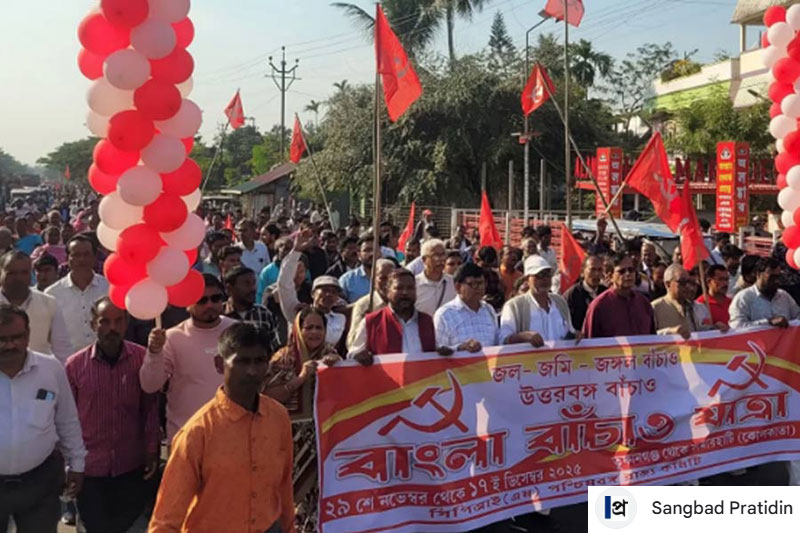
It should be clarified that I did not personally attend any rally or stage event of Bangla Bachao Yatra. Therefore, this article is based on information from social media, YouTube channels, and television clips.
Why Bangla Bachao Yatra Matters in Today’s West Bengal?
In this context, another incident is extremely relevant. Recently, the large SIR phase took place. According to reports, after the Trinamool Congress, the declining CP(I)M managed to deploy the second-highest number of Booth Level Agents.
The message is very clear. Even though many ideas of Marxism have become outdated or controversial, West Bengal politics still has a core group of dedicated CPM workers.
So, the Bangla Bachao Yatra can rejuvenate the party cadres and also provide a vibrant visibility to the public at large.
Dedicated Cadres and Party Discipline on the Ground
Moreover, it is important to note that CPM workers remain far more dedicated to their party. In other words, they are not like BJP agents who enter booths and then work as Trinamool agents. Instead, these grassroots workers continue their duties even at great personal risk. Of course, a few exceptions exist.
A CPM councilor won the election and then openly announced a switch to the Trinamool Congress. Predictably, they repeated the same old excuse and claimed they switched parties to become a “partner in development” under Didi.
However, if we look at the overall pattern, it is better to treat these cases as exceptions rather than the norm.
Bangla Bachao Yatra: Public Response, Issues Raised, and Political Reality
Now let us turn to the core issues of the “Bangla Bachao Yatra”. It is important to examine the issues the party chose to highlight. These include corruption, violence, job losses, women’s safety, rural development, and irregularities in central welfare schemes. In short, they have emphasized on issues that people face in their daily lives.
In Malda and Murshidabad, they highlighted the administration’s inaction in preventing river erosion.
As a result, ordinary citizens suffer constantly. Yet, they often remain silent out of fear and cannot protest openly. In this situation, the meetings and rallies helped people overcome that fear in Bangla Bachao Yatra. Consequently, many stepped forward and participated. Notably, the CPM’s youth brigade stood at the forefront of these movements.
It must be said clearly that the present CP(I)M youth brigade, at least in West Bengal, is more energetic and combative than the youth wings of other parties.
Grassroots Strength and the Role of CPM’s Youth Brigade
Even in these difficult times, this group of dedicated young people stands out. Importantly, they did not join with the hope of personal gain. Instead, they fully understand the obstacles, harassment, and pressure that come with doing politics here.
Therefore, they participate out of ideology and genuine love for the party. The CPM’s senior leadership understands this well. Hence, it would be wise to place these young workers in the front ranks and allow them to lead.
Despite the remarkable success of this Bangla Bachao Yatra, we must mention two important points.
- First, if the goal was to energize party members and supporters who had become inactive, the CPM has succeeded.
- Second, there is a point of criticism. The march had hurled most of the party’s attacks at Mamata Banerjee. Naturally, the CPM must raise its voice against her misrule. This is natural. However, the intensity of its attack on the BJP was comparatively weaker.
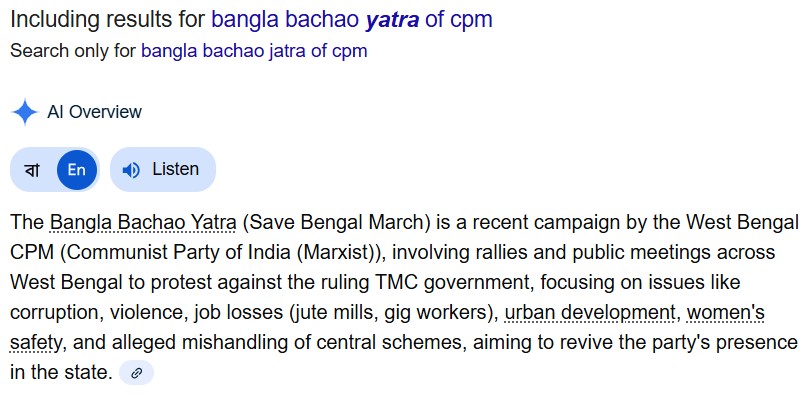
For clarity, I am mentioning below the results of a simple Google search.
Two Rivals, One Battle: CPM’s Strategic Dilemma
When fighting two equally strong opponents, the party must decide which one poses the greater threat. It is worth recalling that in his virtual speech from Ranaghat, the Prime Minister said that the people of Bengal has already thwarted the juggernaut, CPM.
This clearly suggests that the CPM still remains as the real opponent of the BJP. Mamata Banerjee appears to share the same view. In this context we can easily refer to the Maa Durga in RSS news magazine.
The Trinamool Congress ecosystem
In reality, the Trinamool Congress has created an ecosystem where it applies various pressures to force people to switch parties. First, it tries persuasion. If that fails, it uses threats. Then, there are cases like Anubrata Mondal’s Ganja case, which add to the atmosphere of fear.
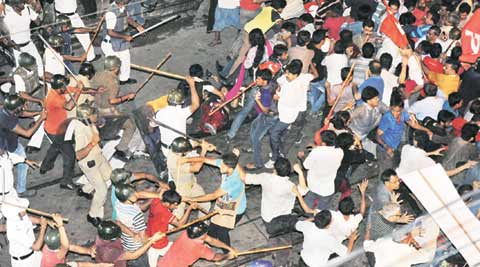
Image Courtesy: The Indian Express
For example, a group of RSP supporters in Balurghat changed parties because of filing several cases including murder charges. I heard this directly from those involved. However, they insisted so that I don’t reveal their names. Therefore, it is best to describe this as information from reliable sources.
At that time, CPM leaders failed to provide adequate protection to their supporters. As a result, the CPM’s vote share has steadily declined since 2016. Unfortunately, during that period, most of the young brigade did not enter politics. To be fair, such allegations did exist during the CPM’s rule as well. However, they were never so widespread.
In other words, the CPM did not follow a strategy of opposition-free politics. That is why opposition parties still won seats, even at the height of the ruling party’s power. Congress or even later Trinamool Congress used to win some seats in Parliament, the State Assembly, district councils, or panchayats.
Can Mass Mobilisation of Bangla Bachao Yatra Translate into Votes?
For the sake of argument, one can certainly say that large crowds at rallies do not automatically mean more votes. For example, in 2011, Buddhadeb Bhattacharya drew massive crowds at his rallies. Yet, few imagined that he would lose to Manish Gupta, a former bureaucrat and political newcomer.
Similarly, after the joint brigade rally of the CPM, Congress, and ISF in 2021, many believed the CPM was making a comeback. However, the party could not open its account in the following assembly election.
Courtesy: X.com
In the same way, Rahul Gandhi’s Bharat Jodo Yatra delivered results only in Karnataka. In most other states, the Congress continued to decline. Likewise, in Bihar, Rahul Gandhi and Tejashwi Yadav’s voter rights march created a strong public buzz.
Still, they could hardly draw any impact in the vote. The BPJ-JDU duo almost wiped them out. So, the crowd in Bangla Bachao Yatra may not be an indication that they will vote for the CPM.
The Challenge of Vote Management in Bengal
Therefore, public turnout and electoral success are not the same thing. Voting is more like a one-day cricket match. What matters most is performance on that specific day. In other words, elections are about vote management.
Bangla Bachao Yatra can hardly conform to that. At one time, the CPM was famous for mastering this skill. Today, the Trinamool Congress has become the expert.
To borrow Tathagata Roy’s words, Mamata Banerjee is, in many ways, the most brilliant student of the CPM school of thoughts.
Between TMC Misrule and BJP Polarization
However, ordinary people with common sense want to preserve West Bengal’s golden legacy.
In other words, in a border state like this, the entry of religious polarization in politics almost inevitably leads to riots.
At the same time, criminalization within the Trinamool Congress already exists. Therefore, the situation creates a clear political space. As a result, the CPM still has an opportunity for a comeback.
People Also Ask (PAA)
What was the core Objective of Bangla Bachao Yatra?
Brushing asides the written agenda, the core objective was to bring the party in the limelight and also to motivate their grassroot level cadres and commoners. The rural base had been the stronghold of CPM for long, till Mamata Banerjee stormed into the power in 2011.
What was the impact of Bangla Bachao Yatra?
In terms of crowd pulling, it was a commendable success for CPI(M). The answer of the million dollar question, whether these crowd will be reflected in the vote box, it’s answer remains in the womb of the future.
What is the key mobilization factor in the upcoming West Bengal Assembly election?
Perhaps the religious polarization or identity politics. In this context, BJP and Trinamool Congress have become the coefficient of each other. While BJP has been focusing on consolidation of Hindu Votes, Mamata Banerjee has left no stone unturned to prove her even to be a better Hindu than BJP leaders. West Bengal is proud of its secular legacy, but the clever political motives of BJP and TMC has turned it into more religious centric than ever before.
Who are the Young Brigade of CPI(M)?
A bunch of young leaders has emerged in the recent past. Some of the remarkable faces are Minakshi Mukherjee, Satarup Ghosh, Srijan Bhattacharya, Ipshita Dhar, Sayandip Mitra, Sayan Banerjee, Aishee Ghosh, Pratik-UR Rahaman and many others.
Why is CPI(M) still failing in securing seats in assembly or parliament?
It is not possible to give a one-word answer. However, we can analyze some possible reasons. Toward the end of the Left’s 34-year rule, people saw unfair strong-arm tactics. Some leaders showed sudden and extreme wealth. In some cases, people also suspected corruption. Even today, many have not forgotten those dark days. Therefore, when people see the same faces again, they feel uneasy. They fear that bringing them back would be another blunder.
Moreover, people have still not accepted the CPM’s “B-J-MUL” theory. In the competitive polarization between the Trinamool Congress and the BJP, people fail to digest the true spirit of secularism.
At the same time, the state has given excessive protection and privileges to Muslim goons. As a result, a section of Hindus has started feeling insecure. Since the BJP openly practices Hindutva politics, some voters turn towards it.
These include people who earlier supported the CPM. They now see the BJP as a way to take revenge.
Finally, when Trinamool supporters and parts of the administration attacked CPM grassroots workers, the party leaders failed to stand by them.
[…]Bangla Bachao Yatra: The Best Way to Boost Discover how this ‘Bangla Bachao Yatra’ reshape CPM and West Bengal’s political landscape and join the discussion on the future of the 2026 Assembly elections.[…]
[…]Bangla Bachao Yatra: The Best Way to Boost Discover how this ‘Bangla Bachao Yatra’ reshape CPM and West Bengal’s political landscape and join the discussion on the future of the 2026 Assembly elections.[…]
[…]Bangla Bachao Yatra: The Best Way to Boost Discover how this ‘Bangla Bachao Yatra’ reshape CPM and West Bengal’s political landscape and join the discussion on the future of the 2026 Assembly elections.[…]