Yuva Sathi in April: A Quick Pre-Poll Trap?
Feb 11, 2026 - By Ashutosh Roy Current AffairsPolitics
Key Highlights
- Yuva Sathi scheme will start from April 1, earlier than the originally announced August 15 date.
- The scheme will cost the state nearly ₹15,000 crore every year, raising fiscal concerns.
- Educated unemployed youth aged 21–40 years will receive ₹1,500 per month, regardless of qualification level.
- The early launch has triggered election timing speculation ahead of the 2026 West Bengal polls.
- Nearly 1 lakh state employees are already engaged in voter list revision, creating a manpower crunch.
- Questions remain over the state’s IT infrastructure and verification capacity.
- Despite court directions, the government has not committed to clearing pending DA arrears for employees.
- Allowance-heavy policies are creating a pendulum effect, with multiple groups raising fresh demands.
- Full-time recruitment has slowed, while the state increasingly relies on part-time and contractual workers.
- Critics argue that cash handouts are replacing productive development and skill creation.
Why did the government advance the Yuva Sathi launch date?
The Yuva Sathi Scheme will start from April 1, even though the Chief Minister announced it on February 10, 2026. Recently, the Government passed the state budget. Earlier, the government had said the scheme would begin on August 15.
However, the Chief Minister explained the change clearly. Since the financial year starts in April, the government decided to launch the scheme earlier.
But this early launch has raised questions. Many political observers sense something unusual.
According to sources, the election may be announced in March.
The scheme will cost the state around ₹15,000 crore every year. It will benefit educated unemployed youth aged between 21 and 40 years. Here, “educated” means at least a Madhyamik (Class 10) pass. Whether someone has passed Madhyamik or completed post-graduation, everyone will receive the same monthly allowance of ₹1,500.
However, such unemployment allowance schemes are not unique to West Bengal. Several other Indian states already run similar programs. These include Haryana, Himachal Pradesh, Uttar Pradesh, Tamil Nadu, and Telangana, among others.
The Process of Yuva Sathi
Now, let us look at the procedures to start this scheme.
- First, Chief Minister Mamata Banerjee has announced that the government will open application submission centers in every Assembly constituency.
- Second, within such a short time, it is not practical to manage online applications and verify them properly.
- Third, Aadhaar authentication can help prove the applicant’s domicile status. At the same time, it can identify and remove duplicate applications.
- Fourth, an Aadhaar-linked bank account will play a major supporting role in ensuring direct benefit transfer.
- Fifth, to confirm whether an applicant is already working in a large organization, authorities must check Provident Fund (PF) or ESI registration records.
- Sixth, self-declaration forms, along with a legal warning, can act as an effective filter against false claims.
- Seventh, verification can also come from local councillors, nearby residents, and panchayat members, who know the ground reality.
- Finally, the government must conduct periodic verification, because five years is a long duration, and employment status can change over time.
Constraints of Yuva Sathi
At present, the biggest challenge is time.
Nearly one lakh state government employees are already busy working as Booth Level Officers (BLOs). Meanwhile, following the Supreme Court verdict on February 9, another 8,505 Group-B officers were supposed to join the Special Intensive Revision (SIR) process from February 10.
The Election Commission of India (ECI) has also announced that they will publish the final voter list on February 28. This leaves very little time.
Therefore, a serious question arises. Does the state government have enough manpower and IT infrastructure to complete this massive exercise smoothly?
On one hand, the Chief Minister is ready to spend ₹15,000 crore on an unemployment allowance scheme. On the other hand, even after the Supreme Court’s direction, the government has made no commitment to release the first installment of ₹10,000 crore in pending Dearness Allowance (DA).
Even yesterday, when journalists asked about it, the Chief Minister avoided a direct answer, calling the matter sub judice.
Ironically, these very government employees, who are waiting for their pending DA, are the ones who can help the state administration succeed in this massive exercise.
Is early launch of Yuva Sathi due to backlash in SIR?
The question will certainly remain: is this a realistic approach? However, there is probably she does not have any time left to think about realism. At this moment, the Chief Minister appears desperate to win the upcoming election.
From the very beginning, she has strongly opposed the Special Intensive Revision (SIR) process. She resisted it at both the political and administrative levels. Repeatedly, she wrote letters to the Chief Election Commissioner, demanding the cancellation of the SIR.
When those efforts failed, she turned to the courts as a last resort. For this, she hired some of the most expensive lawyers in India.
However, after the court’s observation and verdict on February 9, the outcome became clear. The SIR will go ahead without any impediment.
The Chief Minister wanted elections to be held using the 2025 voter list. That list allegedly contained a large number of dead, migrated, and duplicate voters. Critics claim that bogus voting often takes place after 4 PM using such names.
Therefore, the attempt to advance the Yuva Sathi Scheme appears to be a reckless move by a frustrated Chief Minister, driven more by electoral pressure than long-term planning.
Doll Politics to win Elections in West Bengal
In our state, there is no shortage of social welfare schemes in West Bengal. From birth to death, people receive one benefit or another. Naturally, everyone feels happy when cash reaches their hands. Today, in many Indian states, such cash allowances act as strong voter incentives.
However, our state is already burdened with heavy debt. In such a situation, expanding allowance schemes means reducing or stopping development work.
In reality, if these allowances were used for productive purposes, both the government and the people would benefit. For example, the 100-day employment scheme at least creates some level of productivity.
In some states, unemployment allowances are linked to skill development. As a result, they help build future human resources, which later contribute to state growth and individual progress.
But schemes like Lakshmir Bhandar, which provide benefits to everyone without considering family income, involve huge expenditure.
To manage this cost, the government is cutting funds from other development projects.
Are allowance schemes creating a pendulum effect of demands?
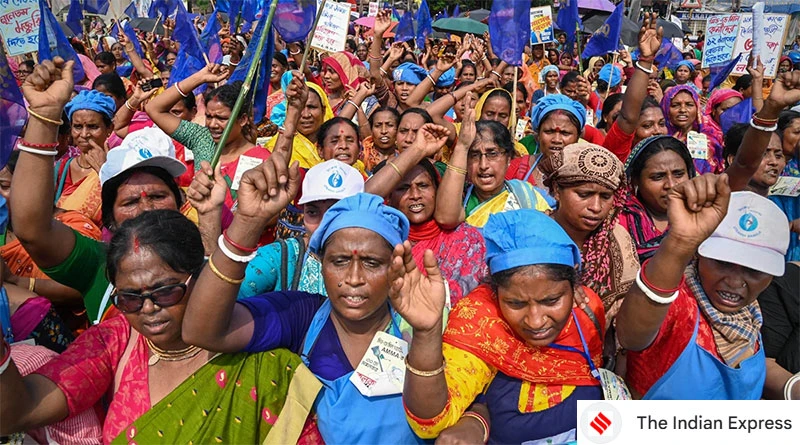
We need to look at the ground reality more closely. Just yesterday, I saw para-teachers from primary schools marching, demanding a higher allowance. At the same time, there was another separate protest by mid-day meal cooks, raising similar demands.
This is what many call the pendulum effect. When the government tries to please one group, another group inevitably raises new demands.
For a long time, politics in the state revolved around Hindu–Muslim issues. Now, the focus is shifting to para-workers and contractual staff. Meanwhile, full-time recruitment has almost stopped in the state. From the police force to the education sector, the government is increasingly running essential services using part-time and contractual workers.
If we trace the root cause of this situation, one fact becomes clear. The state government’s financial condition is extremely weak.
AIs Mamata Banerjee under pressure before 2026?
A government that constantly recites stories of development clearly lacks confidence in its own development work. People are not foolish.
When they see real development, they vote naturally, without incentives.
So the question is unavoidable. Is Mamata Banerjee feeling nervous ahead of the 2026 elections?
If development were truly strong and visible on the ground, there would be no need for repeated cash schemes or political messaging.
Key Takeaways
- Is Yuva Sathi welfare or a pre-election strategy?
- Can debt-hit Bengal afford ₹15,000 crore every year?
- Does the state have enough staff to verify real beneficiaries?
- Are cash allowances replacing jobs and skill development?
- Will voters trust handouts over visible development?
Key Solution:
Interested people of West Bengal may visit the Government Dedicated website for the details and know How to Apply.
Latest Update
15-02-2026
The lack of preparedness triggered violence on the Yuva Sathi camp in Chanchal and Chopra. There had been long queues. Observers have noticed such chaos in various other places also. The leaders of the ruling party Trinamool Congress have been found to monitor and manage the camps.
Such long queues also reveal the serious unemployment problem in West Bengal.
[…]Yuva Sathi in April: A Quick Pre-Poll Trap? Is Yuva Sathi welfare or vote strategy? Early launch, ₹15,000 crore cost, rising debt, and stalled development fuel debate before the 2026 Bengal elections.[…]
[…]Yuva Sathi in April: A Quick Pre-Poll Trap? Is Yuva Sathi welfare or vote strategy? Early launch, ₹15,000 crore cost, rising debt, and stalled development fuel debate before the 2026 Bengal elections.[…]
[…]Yuva Sathi in April: A Quick Pre-Poll Trap? Is Yuva Sathi welfare or vote strategy? Early launch, ₹15,000 crore cost, rising debt, and stalled development fuel debate before the 2026 Bengal elections.[…]