Karmashree vs MGNREGA: A new challenge
Dec 20, 2025 - By Ashutosh Roy PoliticsCurrent AffairsGovernance & AdminRegional UpdatesSocietyWest Bengal Politics

Karmashree Scheme in West Bengal: A Response to MGNREGA Changes
In Bengal, many governmental social benefit schemes end with the word “Shree”. Now, “Karmashree” seems to be the latest addition. The aim is crystal clear. It promises 50 days of work per year to poor but unskilled rural workers. However, they must have an MGNREGA job card to get this work. Meanwhile, yesterday she made another announcement. To show respect to Mahatma Gandhi, she said the scheme’s name would be changed in the name of Mahatma Gandhi Project.
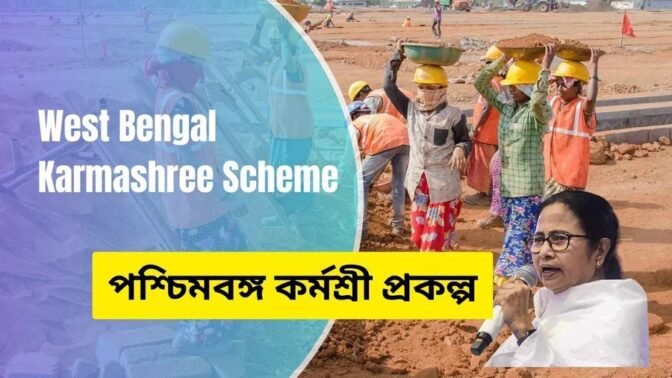
Image Courtesy: WBExpress
In one sense, Karmashree works as an alternative to MGNREGA. At the same time, there is also a political reason behind linking Gandhi’s name. The BJP has tried to remove Gandhi’s name from MGNREGA. Therefore, adding Gandhi’s name here also carries a message.
These unskilled workers will get work under PWD projects or various Panchayat works. In other words, they will work on road construction, small infrastructure projects, or similar activities. Our experience reveals, such work takes places quite often. Usually, the Panchayat or the PWD appoints an agency or contractor for this purpose. For now, let us keep aside the uncomfortable question of how they select these agencies.
What Is the Karmashree Scheme?
Now, coming to the process. Those who want to work must register their names at the BDO office. When work becomes available, officials must hire workers on a first-come, first-served basis. However, there is a clear limit. No one will get work for more than 14 consecutive days. Finally, the Notice No. 1140PRD-33011/1/2024-MGNREGA SEC Dated: 07.03.2024 elaborates all other details and rules are explained in the official protocol.
Let us come directly to point number 11. It clearly says that the agency or contractor will pay the workers’ wages. They must do so according to government rules. So, one question naturally arises. What exactly is the government’s role here? That part is not very clear.
If the main aim is to give priority to local or village workers, then the government could have achieved this more simply. It could have asked the agency or contractor to make such hiring mandatory in their contract. On the other hand, if we look at it differently, the government is not spending any money here. That is an important point.
There is only one distinct advantage. This work is not just charity or a handout. Instead, it is linked to actual production and infrastructure work. Because of this, the initiative is likely to be effective. Even Prashant Kishor made the same argument earlier. Although he did not succeed in the Bihar elections, he had stressed this very point.
Unnecessary Ego Clash between the center and state
Now let us turn to the MGNREGA scheme. First, the Centre stopped releasing funds. Later, the court ordered the scheme to be resumed. Along with that order, the court also said something important. It said the Centre could add any clause needed to control corruption. However, the Chief Minister reacted dramatically. At a public rally, she tore up the document. But this raises a basic question. If there is any objection to a central circular, the court is open. So, what is achieved by tearing the paper?
Here is the reality. Corruption in this central scheme has been proven. The state did not send proper action-taken reports on time. But an even bigger question remains. If this scheme is rightfully due to the state, then why introduce another alternative scheme in its place?
The Centre is not doing any favour. A part of its revenue comes from our tax money. Therefore, why should our state be deprived of its legitimate share? Moreover, the state treasury is already burdened with debt. So why should the state pay this pending amount from its own funds? And more importantly, why create a parallel scheme at all?
In this unnecessary ego clash between the Centre and the state, it is the people of West Bengal who are suffering. Therefore, it is better to set aside stubbornness and resolve the issue through discussion. That would serve everyone’s interest. If talks still fail to bring a solution, the doors of the court are always open.
Knowledge Mart Thoughts:
We at knowledge Mart clearly state that such center-state rivalry is never expected in Federal Structure of India. Indeed, we do feel that if the centre vs state politics hinder the benefits of the citizens, it should be stopped without any delay.
We know that Mamata Banerjee always tries to stop the propaganda of arch-rival BJP and Narendra Modi, but why should the citizens suffer for such unnecessary ego-clash?
We also feel that the state should spend unnecessary money in the name of welfare schemes, which are almost similar to those of centre, the debt-ridden West Bengal will land up in an insolvency state.
Politics must take its own course, but ultimately, it is the people, for whom the Governments of both state and centre should work. We have seen a congenial state-centre relationship in joint ventures in the left regime also. Neither Jyoti Basu nor Buddhadeb Bhattacharya refuses or obstructed and central scheme due to political rivalry.
Should Mamata Banerjee learn a lesson from the history? So, why should Mamata run a parallel scheme Karmashree?
[…]Karmashree vs MGNREGA: A new challenge Read our expert breakdown to stay informed about parallel scheme Karmashree Prakalpa, has emerged in West Bengal due to the Centre–state conflict over MGNREGA.[…]