Muddle of Dynastic politics in Bengal now
Dec 22, 2025 - By Ashutosh Roy National PoliticsPoliticsWest Bengal Politics

History of Dynastic politics in Bengal and India
Family politics has a historical background. So as, Indian politics has faced family politics in many phases, and it will face it again in the future. However, it is constitutional for two members of the same family to follow opposite political ideologies. Hence, India already has such examples. Therefore, this is not the same as dynastic politics. Thus, there is a big difference between the two. When one family controls a political party generation after generation, we call it dynastic politics. As an instance, the Dynastic politics in Bengal has given birth to power struggle in the name of Mamata and Abhishek Conflict.
Moreover, it becomes dangerous when an incompetent or ineligible person takes charge of a party only because of family lineage.

Image Courtesy: The Economic Times
Family Politics or Dynastic politics
In West Bengal, we have seen two members of the same family follow opposite political paths. Ajay Mukherjee and Geeta Mukherjee are clear examples. However, their political beliefs never created a rift in their family relationship. Similarly, Sougata Roy and Tathagata Roy followed different ideologies. Even then, we never saw any personal conflict between them.
In the wider context of Indian politics, the Scindia family is also memorable. On the other hand, we can think of Maneka Gandhi and Varun Gandhi as well.
The problem is grave in regional parties. When a leader forms a party, dynastic politics often takes root in that party. For example, we can think of the Badal family. They completely control the Akali Dal. Similarly, in Uttar Pradesh and Bihar, two Yadav families have continued dynastic politics for generations.
When Dynastic policy breaks because of vested interest
On the other hand, think of the Pawar family or the Thackeray family. However, ideology hardly drives such political conflicts within these families . Instead, narrow self-interest causes splits within both the party and the family.
When Ajit Pawar left the NCP and joined hands with the BJP, it was clearly not for ideological reasons. Discussing family relationships may seem inappropriate. We are not interested also.
However, when these issues affect political parties and the larger landscape of Indian politics, they become serious problems.
Therefore, when two power centers emerge within the same party and the same family, the consequences can be severe.
Today, news reports say that tension exists between Rahul Gandhi and Priyanka Gandhi within the Gandhi family. If this is only a rumor, it is better to dismiss it. However, the power center of Congress politics remains confined to the Nehru–Gandhi family. Therefore, if a power struggle begins there, it will affect the entire landscape of Indian politics.
At present, Congress is in a disastrous condition. It is also facing intense internal conflict. Hence, we can only hope that this problem will be resolved soon. This is because, as a pan-India party, Congress is the only alternative to the BJP. A strong opposition is essential in a democracy.
Moreover, at this moment, no real alternative to this struggling Congress is visible on pan India basis. Narendra Modi and the BJP may strongly criticize dynastic politics. Yet the reality is clear. Outside 10 Janpath, Congress leaders do not recognize any other center of power.
Dynastic politics in Bengal: Mamata and Abhishek Conflict
Let us now look at West Bengal. We had never seen such Dynastic politics in Bengal before the emergence of Trinamool Congress. Here, the ruling party has only one power center, Mamata Banerjee. Abhishek Banerjee entered politics because of Mamata Banerjee. His current rise and influence also come from her support. In Contrast, Now Mamata and Abhishek Conflict becomes headliner.
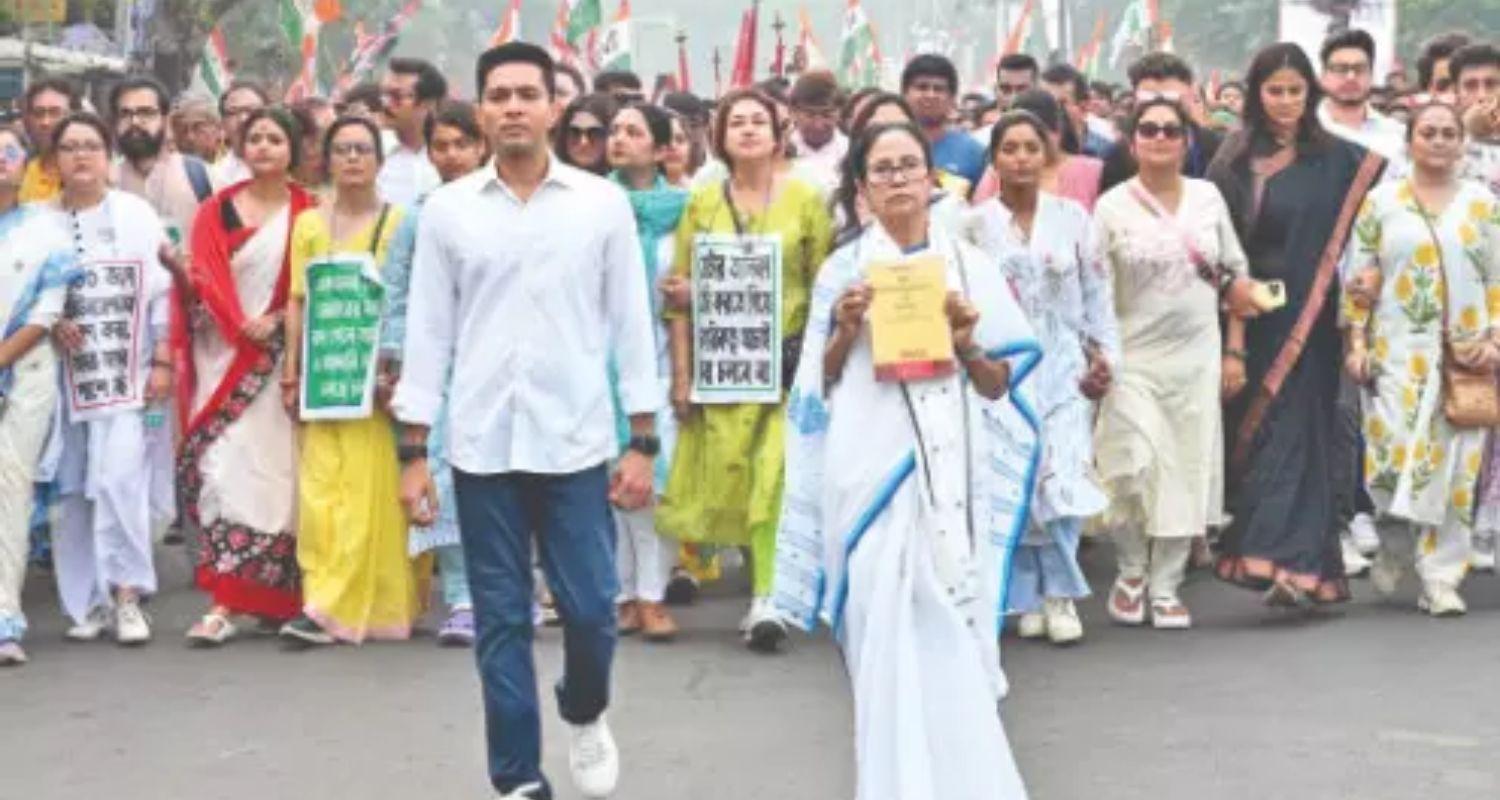
Image Courtesy: News Arena
Meanwhile, reports of tension between Mamata and Abhishek surface from time to time. People widely discuss their love-hate relationship in Bengal politics.. Because of Mamata, guardrails stand in front of Abhishek’s house. He also moves with a large security convoy as a blessing of Mamata.
However, Mamata’s political belief is clear. She believes in absolute control. Therefore, in the Trinamool Congress that she built, she will not allow any parallel center of power to emerge. That is the basic reason of Mamata and Abhishek Conflict
In West Bengal politics, election strategist Prashant Kishor entered the scene through Abhishek Banerjee. Undoubtedly, after the sudden setback of 2019, I-PAC played a crucial role in helping the party regain its footing.
Whenever Abhishek appeared to overstep his limits, Mamata Banerjee created distance from him. The situation became so serious that Mamata had to publicly say at a rally that she alone is the party leader and she alone would take all decisions. Whenever Abhishek faces such trouble, he moves into the background.
Power Struggle because of Dynastic politics in Bengal
When Abhishek stepped into a leadership role within the party, a group of loyal followers formed around him. In his Lok Sabha constituency, he has set up an almost parallel system of administration. Moreover, the “Sebashray” model he introduced functions as a near-parallel structure to the state’s healthcare system. Therefore, many people see this as a silent challenge to his leader. That means, Everything is not hunky-dory in TMC.
Abhishek’s main opposition comes from the old guard surrounding Mamata Banerjee. Many of them see Abhishek as a threat. At times, Abhishek himself makes statements that go against the party line. In other words, he speaks in a tone different from that of the party.
Whether it is the RG Kar issue or the incident involving Messi at Salt Lake Stadium, this Mamata and Abhishek Conflict pattern appears again and again.
So, the Dynastic politics in Bengal often seems to create conflicts. However, it is unclear whether this is a deliberate strategy of the ruling party or genuine opposition to Abhishek. Mamata and Abhishek Conflict has become a seasonal game now.
However, one interesting pattern stands out. Whenever we see Abhishek in the front line, several leaders make desperate efforts to please him. Then, as soon as Abhishek steps back, the same leaders loudly praise Mamata Banerjee.
This culture of Mamata and Abhishek Conflict provides great amusement to ordinary people in Bengal. Newspapers and television channels also highlight these scenes with great drama. This behavior is quite natural. After all, the Trinamool Congress is the ruling party in Bengal. Therefore, the internal balance of power within that party will certainly influence the state.
Conclusion
In conclusion, Abhishek may contest the Assembly election this time and may also become a minister. However, if he tries to build a center of power without gaining enough experience, the outcome will be dangerous. Mamata Banerjee will never tolerate it.
People Also Ask (PAA)
Which kind of security does Abhishek Banerjee enjoy?
Abhishek the National General Secretary of Trinamool Congress enjoys Z+ security, which is available for highly limited number of people in India.
When did Abhishek join the Trinamool Congress?
He is the nephew of Mamata Banerjee. He joined Trinamool Congress, when the condition of the party has been at its peak.
Has Abhishek ever been involved in grassroot level?
No, Abhishek Banerjee, born with a silver spoon, has directly joined as the leader. He has never been involved in grassroot level politics. He does not have any experience to play the role of opposition also. As per Prashant Kishor, he is a plotted plant.
What is Dynastic politics in Bengal?
When the descendant or a close family member of the Chief of the Government or party comes into the power it is called Dynastic politics. West Bengal has never seen such Dynastic politics before Abhishek emerged in politics. West Bengal has also never seen such family tussle, Mamata and Abhishek Conflict