
Cruel Truth: Why Police Serve the Party
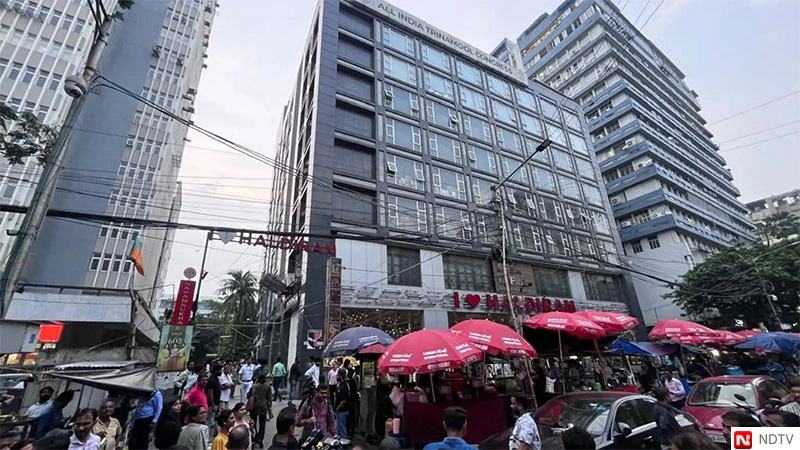
Why Police Serve the Party is not simply a question of political strategy. It is about how police power is used when political control becomes more important than institutional neutrality. The recent confrontation outside Abhishek Banerjee’s Camac Street office offers a striking example of this larger problem.
A change of government does not automatically change the culture inside the police force. Officers may change whom they report to, but the larger system often remains the same.
The throne changes hands, but law enforcement remains tied to authority. Officers who were saluting Abhishek Banerjee just months ago are now tearing down his illegal billboard without a second thought. This illustrates how the political control of police functions in real-time.
What Happened at Camac Street?
The KMC team arrived at TMC national general secretary Abhishek Banerjee’s office at Camac Street with gas cutters and other equipment to remove the unauthorized rooftop billboard. A large police contingent accompanied the civic officials.
They had one job: break down the massive, unauthorized rooftop billboard towering over the street.
Things turned ugly fast. Police and municipal teams pushed through the main doors to execute the tear-down order, but party leaders immediately stepped in to challenge their papers. Abhishek Banerjee himself stepped onto the floor. Senior leaders tried blocking the narrow stairwell with their bodies, sparking frantic physical shoving along the steps. Police reinforcements surged forward, squeezed past the wall of politicians, and cleared access to the roof. Minutes later, the metal frame gave way.
The situation soon became chaotic. Senior leaders, including MP Derek O’Brien, tried to prevent the police from reaching the upper floor. Abhishek Banerjee also confronted the officers and demanded to see the relevant documents. Live-streaming directly to camera feeds, a visibly enraged Abhishek Banerjee cornered police officers on the spot, demanding official memos and signed work permits.
“Where is the order? They have forgotten their salaries are paid by the tax money of the common people!”
– Abhishek Banerjee, speaking live during the Camac Street showdown. Watch it live in News 18.
He accused the police team of acting under political instructions rather than independently enforcing the law. Look at the irony. Today Abhishek Banerjee is accusing of political control of police.
The incident also created an obvious political irony. Opposition parties had spent years accusing successive Bengal governments of using the police to restrict their political activities. Now, a senior TMC leader was making a similar complaint about the police outside his own office.
Now, with police officers forcing their way past his own office stairs, Abhishek Banerjee got a direct taste of the exact administrative culture his party helped solidify.
Suvendu Adhikari’s government now faces the same test: whether it will allow the police to function independently, even when the action goes against the ruling establishment.
When law enforcement serves the ruling party, nobody holds immunity forever. Political equations change. Those who once enjoyed protection can eventually find themselves on the other side of the same system.
You can read the full reporting on the incident from The Statesman’s Camac Street Billboard Coverage or review Anandabazar Patrika’s detailed breakdown.
Bengal’s Long History of Political Policing
If you want to grasp why police serve the party, look into Bengal’s administrative blueprint over the decades. The problem did not begin with the present government. Bengal has a long history of political interference in administration and policing.
This kind of institutional capture isn’t new; it has cast a shadow over Bengal ever since 1947. You can certainly argue that institutional bias hit unprecedented levels during Mamata Banerjee’s 15-year tenure, but that’s the inevitable trap of long-term rule.
Look at the numbers: Congress governed for nearly three decades, the Left Front held power for 34 years, and the TMC ran the state for a decade and a half.
Long periods of uninterrupted rule can create conditions in which administrative institutions become increasingly dependent on the political establishment. Bengal’s political history offers several examples worth examining.
Every administrative era leaves its mark:
- Bidhan Roy Era (1948–1959): CPI banned right out of the gate in 1948; Food Movement marches crushed under police fire by the Great Eastern Hotel in 1959.
- Siddhartha Shankar Roy Era (1972–1977): Anti-Left purges under Prafulla Sen paved the way for open Naxal hunts, widespread custodial killings, and heavy MISA/DIR detentions under Siddhartha Shankar Roy.
- Jyoti Basu & Left Front Era (1977–2011): Systemic enforcement through incidents like Marichjhapi (1979), Bijon Setu (1982), the July 21 police firings (1993), and the land clashes in Singur and Nandigram (2006–2007).
- Mamata & Abhishek Era (2011–2026): Systematic squeezing of opposition spaces, unchecked political skirmishes, and mandatory court battles just to secure rally permits.
Dr. Bidhan Chandra Roy and Prafulla Sen (1948–1967)
The seeds of partisan police control were planted right after 1947. Chief Minister Dr. Bidhan Chandra Roy outlawed the Communist Party of India (CPI) almost immediately in 1948. Eleven years later, on August 31, 1959, police batons and live rounds tore into hungry Food Movement demonstrators near the Great Eastern Hotel.
By the mid-60s under Prafulla Chandra Sen, police detachments regularly hunted Left leadership during renewed food scarcity protests, marking the start of widespread reports surrounding lock-up torture and blatant police cadre collusion.
Siddhartha Shankar Roy (1972–1977)
The 1970s turned state control over police into a weapon of absolute compliance:
State-sanctioned police violence spread through official crossfire stories, systematically wiping out political activists alongside bystanders during the Anti-Naxal Crackdown. We talk about “Encounter” culture today primarily pointing our guns to Yogi Adityanath of Uttar Pradesh. The 1970s witnessed some of the darkest years of political violence in Bengal. The anti-Naxalite campaign involved widespread arrests, allegations of custodial torture and deaths, and the use of laws such as MISA and the Defence of India Rules. These episodes remain an important part of the debate over political control of the police.
The oppositions used to question, Why Police Serve the Party. And the answer used to be the same – the administration and ruling parties don’t have connections. The question of police accountability echoed through out West Bengal.
The Left Front Years (1977–2011)
The Left Front refined how uniformed state authority blended into party machinery:
State power in Bengal has a long, violent footprint. During the Marichjhapi Massacre (1979), armed police boats cut off basic food and water supplies to refugee settlements on the island. Just a few years later, during the Bijon Setu Massacre (1982), 17 Ananda Margi monks and nuns were dragged out and murdered in broad daylight while nearby police posts stood by and did nothing. When citizens took to the streets, the state’s response was brutally harsh – most notably during the July 21, 1993 Kolkata Firing, when police shot directly into a Youth Congress march led by Mamata Banerjee, leaving 13 dead on the asphalt.
Fast forward to 2026, and the legacy of that historic day has turned into a fierce internal political showdown among rival factions. Decades earlier, state police forces marched side-by-side with ruling party cadres directly into farm hamlets during the clashes in Singur & Nandigram (2006–2007).
The TMC Years (2011–2026)
The TMC administration took over this established apparatus and ran hard with it. Opposition parties increasingly accused the government of creating an environment in which political activity outside the ruling party’s control became difficult. Police turning blind eyes to violent attacks on CPM and BJP workers, post-poll arson, and land disputes became standard operating procedure under total ruling party police bias. The political control of police of came into the broad day light during TMC Regime.
Watch the attack on Suvendu Adhikari’s convoy near Chandrakona Road.
Reward and Punishment: The IAS-IPS Dilemma
I sometimes find it astonishing to see how some IAS and IPS officers in West Bengal appear to lose their backbone. After all, these officers are among the country’s brightest minds. They have to clear one of India’s toughest competitive examinations before entering the civil services.
Perhaps the answer to why police serve the party can be found in two contrasting examples of reward and punishment during the Mamata Banerjee regime.
Rajeev Kumar received a Trinamool Congress Rajya Sabha nomination soon after his retirement. On the other hand, IPS officer Damayanti Sen was transferred to what was widely seen as a punishment posting after the Park Street incident.
The contrast is striking. Even towards the end of his career, Rajeev Kumar remained close to Mamata Banerjee and was present during the political confrontations surrounding ED raids risking his career, including the incident involving the alleged visit to Pratik Jain’s residence. Damayanti Sen, meanwhile, did not simply follow the political line. Her investigation concluded that the Park Street incident was a case of rape and Suzette Jordan was the victim.
These two cases raise an uncomfortable question. If an officer who remains close to the political establishment can receive political recognition after retirement or prize postings, while an officer who insists on pursuing an independent investigation faces a transfer, what message does that send to the police and civil services?
That, perhaps, is where the deeper problem lies. The issue is not whether every officer is “spineless”. The real concern is whether the system creates enough incentives for officers to remain independent when their professional decisions may go against those in power.
Political Analyst, Biswanath Chakraborty has nicely explained The Message for IAS and IPS Officers. Watch his frustration.
The Opposition’s Struggle for Political Space
The problem becomes clearer when we look at what opposition leaders faced while trying to organise public meetings and rallies.
For years, holding a simple street corner rally, entering a troubled area, or opening a local office was an uphill legal battle for BJP’s Suvendu Adhikari. Almost every routine request ran straight into local police station rejections or blanket Section 144 orders, reducing administrative permits into outright political gatekeeping.
The pressure was relentless, even his office space came under direct attack and vandalism by TMC cadres. To exercise basic political rights, his team had no choice but to file emergency writ petitions before the Calcutta High Court time after time.
View the police raids in Kolaghat office of Suvendu Ahikari on May 2024. He raised the question of police accountability publicly.
Getting approval for an opposition event follows a familiar script:
- Submission: Organizers drop off formal applications at the local police station well in advance.
- Denial: Police issue swift rejection letters or let the files sit in administrative silence.
- Litigation: Party lawyers run to the High Court to file urgent writ petitions.
- Relief: High Court judges issue clear conditional permits, overriding local police blocks.
It goes far beyond paperwork barriers:
| Opposition Leader Target | Reported Incident | Police Response |
|---|---|---|
| Suvendu Adhikari | Physical ambushes, convoy blockades, vehicular vandalization. | Delayed response, failure to name primary perpetrators in FIRs. |
| Dilip Ghosh | Repeated physical attacks during morning walks and public campaigns. | Bystander role; aggressive crowd control deployed against victim’s convoy. |
| JP Nadda | Convoy pelted with heavy stones on the way to Diamond Harbour. | Security protocol failure despite advance intelligence warnings. |
| Sukanta Majumdar | Repeated house arrests, physical scuffles, police blockades. | Preventive detentions used to stop political assembly. |
| Shamik Bhattacharya | Assaulted, vehicle smashed during field visits to affected zones. | Minimal investigative momentum following formal complaints. |
When opposition convoys get pelted with bricks or smashed on open roads, uniformed officers frequently watch from the sidelines. But the moment civic crews move against ruling party property, politicians immediately sound off about police overreach and corruption.
When Political Power Changes Hands
The Camac Street incident raises an uncomfortable question: what happens when the same administrative machinery that once worked in favour of a ruling establishment is later used against it?”
For years, state machinery squeezed opposition voices out of civic life. When that exact same machinery pulled up outside Camac Street with power saws and helmets to drop a TMC structure, the irony hit hard.
The cycle of state coercion follows a predictable path:
- The ruling party uses police forces to crush opposition activity.
- Over time, officers may begin to believe that following political signals is safer than taking an independent position.
- Political alignments shift or internal feuds spill out.
- When political power changes hands, that same system can eventually be used against its former beneficiaries.
Police forces should not operate on political loyalty. They should operate according to the law. When you nurture a culture where the police serve the party instead of the law, you create a system that will eventually bite back when authority shifts or friction opens up.
Democracy is ultimately tested not when a government tolerates agreement, but when it protects the right to criticize. That principle must apply to every political party in West Bengal. In mature democracies, freedom of speech is actively upheld as a constitutional right, standing above immediate political rivalries.
Unfortunately, West Bengal presents a sharp contrast.
Curious readers need only look closely at the criminal cases slapped on YouTubers and independent journalists – alongside the physical intimidation they faced during the TMC regime – simply for speaking out against rulers.
Their experiences offer a disturbing glimpse into how dissenting voices are systematically squeezed when administrative power serves the ruling party.
Knowledge Mart Final Thoughts
What went down at Camac Street exposes the core reality of governance in West Bengal: Why Police Serve the Party isn’t an accident. It’s a deliberate administrative habit handed down from one decade to the next.
Bengal’s political history shows why police neutrality cannot depend on which party occupies the Writers’ Building or Nabanna. Governments change. Political loyalties change. The police institution, however, remains.
The real test for Suvendu Adhikari’s government is therefore not whether it can control the police. It is whether it can allow the police to operate without political interference.
When Suvendu Adhikari had to run to court every week just to hold a public rally, ruling party leaders backed police actions as routine law enforcement. When figures like Dilip Ghosh, JP Nadda, Sukanta Majumdar, and Shamik Bhattacharya faced physical ambushes while police details stood by, the system counted it as total control.
Now, with gas cutters tearing through TMC billboards on Camac Street and party leaders yelling about police abuse of power, people see the system for what it is: a machine running on its own ruthless logic.
Real institutional reform is the only way out. Without institutional reform, governments may change, but the underlying problem will remain: the police will continue to be judged by whom they serve rather than how independently they enforce the law.
Frequently Asked Questions (FAQs)
1. What triggered the recent tension at Abhishek Banerjee’s Camac Street office?
Municipal workers from the Kolkata Municipal Corporation (KMC), backed by a large police contingent, arrived at the Camac Street office with heavy tools and gas cutters to dismantle a large, unauthorized rooftop billboard. The action led to intense stairwell pushback from senior TMC leaders and a heated live-streamed confrontation between Abhishek Banerjee and police officers over administrative orders.
2. Has “Why Police Serve the Party” always been a problem in West Bengal?
Yes, administrative bias is not unique to any single government. West Bengal has a documented history of political policing stretching back to Independence – ranging from the ban on the CPI and the 1959 Food Movement crackdown under Dr. Bidhan Chandra Roy, to the intense anti-Naxal purges under Siddhartha Shankar Roy, and police actions during Left Front events like Marichjhapi, Bijon Setu, and July 21.
3. How do police actions impact opposition parties in West Bengal?
Opposition leaders routinely face administrative hurdles, such as sudden Section 144 restrictions, denied rally permissions, or delayed police protection during field visits. As a result, opposition figures frequently have to approach the Calcutta High Court to secure basic conditional permits to hold public gatherings.
4. What is the “Reward and Punishment” system among civil servants?
It refers to how administrative officers are incentivized or sidelined based on political alignment. Officers who cooperate closely with ruling party interests often receive post-retirement appointments or prize postings (such as Rajeev Kumar’s Rajya Sabha nomination), while those who pursue independent investigations against political signals (like Damayanti Sen during the Park Street case) face immediate transfers. Perhaps that remains the basic reason for Why Police Serve the Party.
5. Why do political parties complain about police bias only when out of power?
When in power, ruling parties often rely on law enforcement to manage political competition and maintain local control. However, because police institutions respond to executive authority rather than personal loyalty, political shifts or administrative actions can suddenly turn that same police machinery against former ruling leaders – creating the very irony seen during the Camac Street incident.
10 Key Takeaways
- Camac Street: KMC officials, accompanied by police, removed an unauthorized billboard outside Abhishek Banerjee’s office, resulting in direct stairwell confrontations with leaders like Derek O’Brien. They raised the question: Why Police Serve the Party?
- TMC’s Allegations of Overreach: Abhishek Banerjee loudly challenged the raid on live video, demanding paperwork and branding officers political puppets, echoing the exact claims opposition leaders have made for years.
- Political neutrality: The incident highlights the need for police action to remain independent of political affiliation.
- Deep Historical Roots: Partisan policing in Bengal spans decades, starting with post-Independence actions under Chief Ministers Dr. Bidhan Chandra Roy (1948 CPI ban, 1959 Food Movement firings) and Prafulla Sen.
- Siddhartha Shankar Roy’s Escalation: The 1970s saw heavy police crackdowns through Naxal purges, custodial encounters, and selective enforcement of MISA and DIR laws.
- Left Front Cadre-Police Dynamics: Under Jyoti Basu and Buddhadeb Bhattacharjee, police actions directly aligned with party motives during events like Marichjhapi (1979), Bijon Setu (1982), July 21 (1993), and Singur/Nandigram.
- Opposition Operational Hurdles: Opposition leaders such as Suvendu Adhikari frequently rely on Calcutta High Court orders to secure basic permissions for meetings and rallies. Such events triggered, Why Police Serve the Party?
- Targeted Attacks on Opposition Figures: Leaders including Dilip Ghosh, JP Nadda, Sukanta Majumdar, and Shamik Bhattacharya have faced physical assaults and convoy damage while police took minimal protective action.
- The Cycle of Institutional Coercion: Using law enforcement to control political rivals establishes a dangerous precedent that eventually impacts whoever loses control of state machinery.
- The Need for Structural Reform: Without deep structural reforms, police departments will remain bound to whichever political party holds administrative power.