
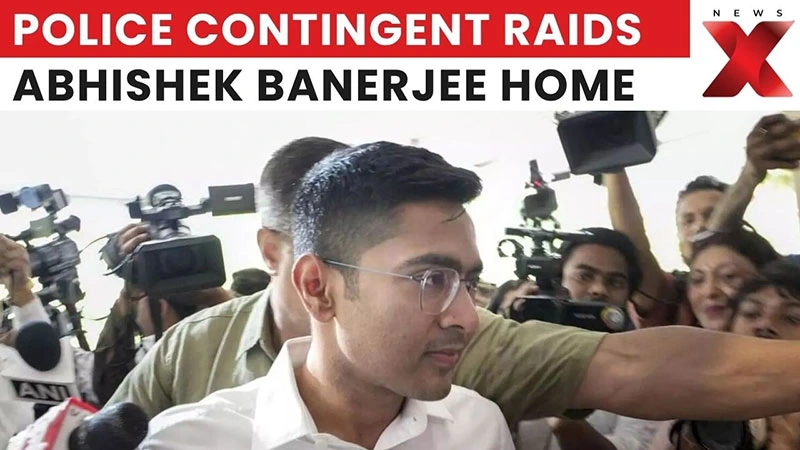
Has CID vs Abhishek Turned into the Fierce Political War?
The rapidly unfolding institutional conflict structurally known across regional networks as the CID vs Abhishek legal battle has officially moved past the boundaries of standard judicial administration. This high-octane standoff in West Bengal has devolved into an intense, prime-time political soap opera that dictates the daily narrative of regional media headlines. While providing viewers with continuous dramatic revelations, the ongoing escalation has offered surprisingly little absolute legal resolution. The high-profile Bhabani Bhawan interrogation loops have opened up a literal Pandora’s box of institutional friction, pulling state apparatuses, central investigative bodies, and top-tier political leadership into a volatile web of public confrontations.
Every single day, digital news portals serve the same highly repetitive recipe of consecutive administrative summonses, routine marathon interrogations, and aggressive security deployments across Kolkata. However, the latest tactical, late-night operational maneuvers executed by state investigative teams have elevated these institutional mechanisms into an explosive public spectacle. Observers are left grappling with a critical question: Are these coordinated actions driven by a genuine, evidence-based legal crackdown, or are they carefully calibrated pieces of a grander political theater? A closer look at the operational tactics reveals a highly complex blend of high-stakes legal pressure and masterful emotional counter-strategies engineered to sway public perception before the regional electorate.
This comprehensive multi-agency legal offensive has decisively captured the headlines of Bengal political news June 2026. Commentators note that the sheer speed of the current West Bengal CID investigation 2026 marks a sharp departure from the relatively inactive posture of state investigative agencies observed during previous administrative regimes. As a result, institutional accountability and political messaging have become entirely inseparable on the ground.
Why Did the CID Conduct a Midnight Raid on Abhishek Banerjee’s Residence?
The structural script governing the CID vs Abhishek standoff took a highly unexpected and aggressive turn in the early hours of June 13, 2026. A massive joint law enforcement contingent—comprising local state police units, dedicated teams from the Criminal Investigation Department (CID), and heavily armed central security forces—converged upon Abhishek Banerjee’s Kalighat residence at approximately 2:00 AM. This dramatic operational escalation instantly ignited a massive political slugfest across the state, fundamentally shifting the boundaries of the ongoing investigative gridlock.
According to comprehensive official operational updates published by The Quint, the sudden pre-dawn raid aimed to track down his personal assistant, Sumit Roy. Roy is currently under intense scrutiny regarding his alleged involvement in an ongoing, high-profile financial embezzlement and land fraud investigation handled by the Paschim Medinipur Salboni Police. Because the occupants inside the secure Kalighat premises did not immediately respond to the repetitive late-night knocks of the law enforcement officers, investigators took the extreme step of summoning specialized disaster management personnel. These units utilized mechanical gas cutters to systematically break open the secure property locks to gain physical entry.
The execution of this pre-dawn operation quickly turned into a high-octane political thriller rather than a standard, measured legal execution. Consequently, the core operational tactics of the West Bengal CID investigation 2026 have invited severe institutional criticism from legal analysts and civil rights defenders alike.
The Midnight Escalation Timeline
| Time Reference | Operational Event on the Ground in Kalighat |
|---|---|
| 2:00 AM | A massive joint force of state police and central security teams completely surround the Kalighat residence. |
| 3:00 AM – 5:00 AM | Investigators knock repeatedly on the doors. With no response from the occupants, teams summon disaster management units. |
| 5:30 AM | Specialized workers use mechanical gas cutters to break open the secure property locks under flashlights. |
| Morning Hours | Investigative teams execute an exhaustive search from the second floor to the terrace, ending with a NIL seizure report. |
The execution of this raid raised severe, unavoidable questions regarding operational timing and strategic necessity. Why did the state machinery authorize an aggressive, forced-entry search at midnight when the primary political subject, Abhishek Banerjee, was entirely absent from the premises? For the Trinamool Congress (TMC), the visual imagery of central forces guarding a broken gate under the glare of media cameras provided the perfect theatrical backdrop to allege institutional harassment. Simultaneously, the accelerating frequency of the Bhabani Bhawan interrogation notices has raised the eyebrows of common citizens who are growing skeptical of the dramatic optics.
Predictably, party supremo Mamata Banerjee rushed to the spot before daybreak, occupying the space for hours while investigators searched every corner from the second floor to the terrace. The ultimate anti-climax arrived when the CID team concluded the search with a completely empty seizure list.
By officially logging a NIL finding, the state agency inadvertently handed the TMC leadership a golden narrative of a politically motivated vendetta. This transformed a high-profile search operation into a massive public relations victory for the ruling regional party. Once again, the strategic maneuvers within the CID vs Abhishek battle completely grabbed the absolute headlines of Bengal political news June 2026, pushing alternative legislative discussions entirely off the map.
Is the Routine Summons Loop Causing Public Burnout?
The primary critique emerging from independent political observers focuses on the structural efficiency of the state’s judicial and investigative apparatus. If an agency possesses rock-solid, concrete evidence in a high-profile corruption case, standard legal procedure dictates swift, decisive, and punitive action. Yet, the ongoing CID vs Abhishek script seems permanently stuck in an endless loop of administrative delays, repetitive multi-hour grillings, and predictable legal counter-moves. This pattern ultimately dilutes the welcoming effort of the West Bengal CID investigation 2026 and transforms serious legal scrutiny into predictable background noise.
Understanding the Legal Counter-Moves
As explicitly detailed in recent legal reports published by The Hindu, the Calcutta High Court ordered Abhishek to cooperate with the ongoing MLA signature forgery case. However, the court simultaneously granted him a temporary, three-week interim shield against coercive actions or immediate arrest. This critical legal window allows the Trinamool Congress leadership to systematically secure anticipatory bail and file procedural challenges, effectively dragging out the timeline of the active probe indefinitely.
The Aggressive Multi-Agency Summons Calendar
To understand the sheer magnitude of the legal siege surrounding the TMC national general secretary, one must analyze the hyper-congested 72-hour interrogation calendar deployed by various state and central branches:
- Sunday, June 14 (State CID): A grueling marathon session regarding the Assembly Signature Forgery Probe, focusing on disputed resolution documents where a face-to-face confrontation during the Bhabani Bhawan interrogation with Kunal Ghosh took place.
- Monday, June 15 (Enforcement Directorate): An intense, multi-hour interrogation at the ED’s Salt Lake office regarding primary school recruitment irregularities and corresponding offshore financial trails.
- Tuesday, June 16 (Cyber Crime CID): A separate six-hour interrogation session investigating alleged provocative campaign speech remarks and controversial post-poll statements targeting opposition cadres.
The Structural Risk of Public Fatigue
This relentless, back-to-back sequence of triple-agency summonses carries significant psychological and political risks for the state’s communication ecosystem:
- Erosion of Shock Value: When a single political figure faces near-daily interrogations across three separate cases without any definitive legal conclusion or judicial resolution, the shock value erodes completely.
- Declining Audience Interest: Mainstream news viewers and digital media consumers gradually lose interest in the repetitive headlines. The visual of a high-profile convoy arriving at an investigative headquarters loses its narrative impact.
- Dilution of Real Corruption: Ultimately, the intense institutional drama morphs into everyday background noise. This process inadvertently dilutes the gravity of the underlying, massive corruption allegations regarding signature scams and job irregularities.
If the investigative machinery genuinely holds definitive evidence against the ruling elite, the constant delay in executing actual arrests begins to look less like a rigorous legal crackdown and more like structured prime-time entertainment designed for news ratings.
How Does Mamata Banerjee Exploit the Victim Card?
While the national general secretary of the TMC faces complex legal counter-offensives across multiple judicial forums, the veteran former Chief Minister remains an undisputed master of emotional politics. Throughout her decades-long career, Mamata Banerjee has brilliantly and consistently converted structural blockades into massive public sympathy waves, turning institutional pressure into potent electoral energy.
Faced with real internal organizational friction, shifting regional loyalties, and severe local anti-incumbency challenges, the veteran leadership recognizes a prime tactical opportunity within this multi-agency siege. The dramatic imagery of a midnight raid featuring mechanical gas cutters serves as the perfect ammunition for their mass messaging campaigns. Instead of addressing the granular legal details of the signature mismatches or primary school financial trails, the party successfully shifts the entire public conversation toward themes of institutional overreach and state-sponsored harassment.
Undoubtedly, she will utilize every single round of the Bhabani Bhawan interrogation as a powerful weapon to build a compelling political narrative. Now, in turn, the entirety of Bengal political news June 2026 will continue to revolve around the emotional fallout of the CID vs Abhishek confrontation.
By framing the empty NIL seizure lists as definitive proof of absolute innocence, the TMC leadership relies heavily on its traditional mass appeal to mobilize the regional electorate. This effectively turns rigorous institutional scrutiny into a tactical political shield. As a result, everyday citizens are forced to view the complete legal and ethical parameters of the West Bengal CID investigation 2026 with a profound pinch of salt.
Why Is the BJP Failing to Capture the West Bengal Media Narrative?
The current state of West Bengal politics presents a glaring, undeniable irony that puzzles national political strategists. On the ground, the ruling regional administration faces immense, structural pressure. Multiple local councilors and Panchayat Pradhans are under arrest, continuous defection rumors regularly plague legislative factions, and frustrated citizens have occasionally confronted local leaders publicly regarding local governance failures.
Yet, the moment citizens tune into regional television networks or browse digital news outlets, the ruling administration completely dominates the airwaves. The relentless, singular focus on the CID vs Abhishek legal battle completely overshadows critical policy discussions, structural reforms, and the alternate administrative measures of the ruling Government. Even though official leaks suggest that the state detectives are entirely dissatisfied with the direct answers provided during the initial rounds of the Bhabani Bhawan interrogation, the narrative momentum remains firmly in the hands of the TMC’s public relations machinery, as highlighted in independent video analyses where experts state that the CID is not satisfied.
Media Airtime Disparity Breakdown
| Political Narrative Focus Area | Estimated Airtime Share | Core Media Visuals Delivered to Public |
|---|---|---|
| TMC Legal Drama, Raids & Interrogations | 85% Airtime Share | Midnight standoffs, gas cutters breaking locks, and high-profile convoy arrivals. |
| BJP Governance and Alternative Policy | 15% Airtime Share | Standard press conferences and indoor party organizational meetings. |
Tactical Communication Failures of the Opposition
This massive disparity highlights a series of distinct strategic missteps by the main opposition block within the state:
- Losing the Digital Spotlight: Even though veteran regional leaders like Suvendu Adhikari possess decades of deep political experience, they struggle to break through the wall of sensational legal drama to establish a clear counter-narrative.
- Overshadowed Governance Metrics: While the opposition attempts to highlight key structural reforms, the mainstream media remains entirely transfixed by the dramatic standoffs at Kalighat and the ongoing Bhabani Bhawan interrogation updates.
- Strategic Miscalculations: Allowing the ruling party to capture the media spotlight through carefully timed legal disputes keeps the public focus completely away from the administration’s concrete local failures. This hands the TMC a consistent platform to play the victim.
To understand the full socio-political impact of these overlapping legal maneuvers, observing the immediate public reactions following each session is crucial. Watch this comprehensive Analysis of the CID Summons Escalation to see how the recent legal drama is fracturing the internal leadership structure of the party while simultaneously redefining the digital media landscape of the state.
Conclusion: Theater Wins, Accountability Loses
The spectacular ongoing conflict structurally encapsulated by the CID vs Abhishek saga exposes deep-seated, structural flaws in West Bengal’s political communication ecosystem. When administrative and investigative agencies prioritize late-night, highly visual spectacles over swift, quiet, and decisive legal resolutions, they unintentionally undermine their own institutional credibility before the public eye.
Gas cutters, midnight deployments, and dramatic pre-dawn raids make for captivating television, but without solid judicial convictions, they yield little more than a NIL seizure report. Why should the holistic validity of the Bhabani Bhawan interrogation loops come under constant public question? Consequently, this tactical miscalculation directly benefits the Trinamool’s veteran leadership, awarding a defensive administration the perfect emotional ammunition to execute its time-tested playbook while masking deep organizational fractures. As long as the opposition allows itself to be pushed to the margins of the airwaves, real accountability will remain completely buried beneath the noise of this intense, carefully managed political war, which continuously dictates the absolute parameters of Bengal political news June 2026.
Frequently Asked Questions: The Bengal Assembly Signgate Case
Analytical FAQ Index | Focus: West Bengal CID investigation 2026 and the CID vs Abhishek Legal Matrix
Q1: What is the core origin of the West Bengal Signgate controversy?
The controversy centers entirely around serious allegations of signature forgery on an official resolution document submitted directly to the West Bengal Assembly Secretariat. The disputed document, which bears the signatures of approximately 70 Trinamool Congress (TMC) MLAs, officially recommended senior leader Sobhandeb Chattopadhyay for the post of Leader of the Opposition following the conclusion of the 2026 West Bengal Assembly Elections.
Q2: Why has the West Bengal CID investigation 2026 taken over this specific case?
The intensive investigation began after rebel TMC MLAs, including Ritabrata Banerjee and Sandipan Saha, filed formal complaints on May 27, 2026. Their primary allegations include:
- No formal legislative resolution meeting took place on the claimed date of May 6, 2026.
- MLAs were only asked to sign a standard attendance register on May 19, not an official political resolution document.
- At least 14 signatures on the final document submitted to the Assembly Secretariat appeared in block letters rather than genuine, cursive handwritten signatures.
Following the discovery of these discrepancies, the Assembly Secretariat lodged an FIR, which was subsequently handed over to the state Criminal Investigation Department (CID) for a comprehensive forensic and administrative probe.
Q3: Why has Abhishek Banerjee been repeatedly summoned for the Bhabani Bhawan interrogation?
As the National General Secretary of the TMC, Abhishek Banerjee is the official authority who formally submitted the disputed resolution to the Assembly Secretariat. The CID is questioning him to establish the exact origin and authenticity of the physical document, the location of the original party resolution book, and how the signatures of legislators who were reportedly absent from the state capital ended up on the final document.
Q4: What specific events took place during the first round of the Bhabani Bhawan interrogation?
Following explicit directives from the Calcutta High Court, Abhishek Banerjee appeared at the CID headquarters at Bhabani Bhawan, Kolkata, on Thursday, June 11, 2026. He underwent nearly six hours of continuous, intensive interrogation. CID sources claimed that investigators issued fresh notices because they were thoroughly dissatisfied with his responses. Officials alleged that Banerjee frequently stated “I do not know” when questioned about the physical location of the party records and briefly grew defensive under intense cross-examination.
Q5: What legal protection does Abhishek Banerjee hold in the CID vs Abhishek standoff?
A single-judge bench of the Calcutta High Court has granted Banerjee interim protection from coercive action or arrest. Furthermore, the High Court explicitly ruled that he cannot be legally compelled by investigators to produce the disputed document himself; the CID must obtain it through standard legal channels of search and seizure from official custody, which limits the coercive leverage of the West Bengal CID investigation 2026.
Q6: What are the exact details surrounding the June 14 CID summons?
The CID issued a second notice requiring Banerjee to appear for a fresh round of questioning on Sunday, June 14, 2026, at 12:00 PM. To cross-verify statements, the CID also summoned TMC leader Kunal Ghosh for questioning at the exact same hour. Investigators confronted both individuals with conflicting testimonies regarding how the paperwork was managed, extending the active narrative of the CID vs Abhishek case.
Q7: Is there an independent second case handled by the West Bengal CID investigation 2026?
Yes. Alongside the forgery case, the CID served a separate notice for him to appear on Tuesday, June 16, 2026. This case stems from an FIR alleging that Banerjee used highly aggressive and provocative language during election campaign speeches in Maheshtala, Arambagh, Haringhata, and Nandigram, which reportedly had the potential to breach public peace and incite post-poll violence.
Q8: How have the primary subjects responded to the ongoing multi-agency pressure?
Abhishek Banerjee has strongly denied all allegations of forgery and incitement, stating: “I have never skipped or fled any investigation… I complied and cooperated before, and I am doing the same now”. However, the party has heavily criticized the political timing of the fast-tracked investigation, pointing out that during the campaign period, law and order fell under the direct jurisdiction of the Election Commission, yet no complaints were registered then. The party alleges that these multiple cases are intentionally fabricated to match the altered political landscape in the state, making it the focal point of Bengal political news June 2026.