
Protest Against Gyanesh Kumar: FIR Against Rahul
The Protest Against Gyanesh Kumar has now produced an FIR, but the real controversy is much bigger than a police case against Rahul Gandhi and Priyanka Gandhi Vadra. On October 6, INDIA bloc leaders marched towards the Election Commission headquarters in Delhi, demanding the resignation of Chief Election Commissioner Gyanesh Kumar.
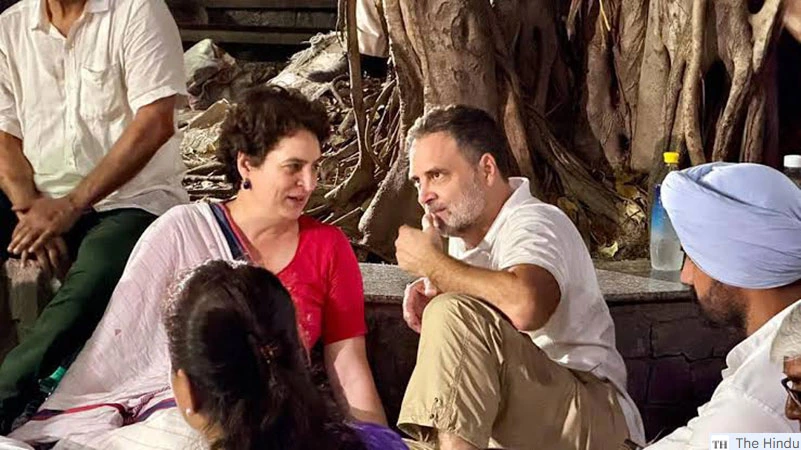
Police stopped the march before it could reach the Commission, several Opposition leaders were detained, and the Gandhis later entered the Akashvani Bhavan premises, where the protest continued for hours. The next day, Delhi Police registered an FIR following a complaint alleging that Rahul Gandhi, Priyanka Gandhi and others entered the premises without permission. So, does Modi finally admit that Rahul Gandhi is no more a “pappu” in Indian politics?
The sequence of events deserves attention because it says something uncomfortable about the current relationship between the political Opposition, the police and the Election Commission. The Opposition may have used strong language against Gyanesh Kumar, and its allegations about electoral-roll revision remain politically contested, but that does not make the underlying questions irrelevant. In fact, the more aggressively the Election Commission is challenged, the more important it becomes for the institution to explain its decisions publicly. My earlier analysis of the Gyanesh Kumar controversy examined the questions being raised within and around the Election Commission. This latest confrontation shows how far that dispute has now travelled.
The Election Commission is supposed to be the neutral referee in India’s political contest, ensuring that every side plays by the same rules. But critics have accused CEC Gyanesh Kumar of failing to maintain that neutrality and of allowing the electoral playing field to tilt towards those in power.
In a hard-hitting discussion, Jawhar Sircar, Bikash Bhattacharya and journalist Sudipta Sengupta question whether the referee has stopped looking neutral and whether the system itself is beginning to favour the ruling establishment.
Their discussion raises a deeply uncomfortable question: when the institution responsible for protecting electoral fairness is itself facing allegations of bias, who will hold the referee accountable? And if democratic fairness comes at such a heavy political cost, what does that say about the state of electoral justice in the country?
Why Was the Protest Against Gyanesh Kumar Stopped?
The INDIA bloc march was not a surprise protest that suddenly appeared on Parliament Street. Opposition parties had announced their intention to march to the Election Commission and demand action against the Chief Election Commissioner. Their principal political complaint concerns the Special Intensive Revision of electoral rolls and allegations that the electoral process has not been handled fairly.
One must also note that the number of exclusions has reportedly reached a humongous figure of more than 13 crores. The Election Commission has rejected such allegations, while the Opposition has continued to demand explanations and accountability. Reuters reported that the protest followed concerns raised over the revised voter lists and noted that the Election Commission and BJP rejected the Opposition’s allegations. It is also worth mentioning that CJP conducted a major protest over the same issue at Mumbai’s Shivaji Park on October 2, 2026, followed by a students’ protest in Delhi.
That is the part of the story that should not disappear behind television images of barricades and police buses. A disagreement over electoral rolls is not a routine political quarrel. Voter lists decide who is able to participate in an election, and questions about their preparation therefore deserve answers that ordinary voters can understand.
The same concern has already become relevant in Bengal, where the Bengal Electoral Roll Controversies have generated a separate political debate. Whether one accepts the Opposition’s allegations or not, the demand for transparent explanations cannot simply be dismissed as political noise.
We must not forget that the right to vote is guaranteed by the Constitution, much like other fundamental rights. When a sitting judge says that taking away voting rights is like taking the soul out of the body, it shows the seriousness of the issue. The judge has even gone to the extent of saying that the Indian Constitution does not allow two different classes of citizens—one with voting rights and the other without them. So, the Protest Against Gyanesh Kumar has genuine reasons behind it.
CJP, students and Opposition parties have all come together on the streets. It is a tough situation, primarily for the BJP headquarters. We have seen before how Dharmendra Pradhan eventually had to submit his resignation.
Gyanesh Kumar Faces a Credibility Test
This is where the criticism of Gyanesh Kumar needs to be sharper. The Chief Election Commissioner does not merely occupy another government chair. The office carries an unusual responsibility because political parties contest elections and governments change, but the Election Commission is expected to remain above those battles.
When a large section of the political Opposition publicly questions the Commission’s conduct, the answer cannot simply be institutional defensiveness. The Commission has to win public confidence through facts, transparency and explanation.
We must not forget the core principle of justice. Justice should not merely deliver judicial messages; its decisions must also appear unbiased because society is influenced by them. Similarly, if a major section of voters is left out because of a faulty AI system, the Protest Against Gyanesh Kumar becomes understandable.
Let me raise a simple question: did the voter even know that their name had been excluded? Do people normally go to the Block office without any basic need?
Look at the turn that the Election Commission has had to take. Delhi citizens are now being treated almost like privileged citizens, with the Election Commission sending BLOs from door to door to correct anomalies. This was also the basic practice during the 2002 intensive revision. I had to stand in queues for that so-called “logical discrepancy” during the SIR process in Bengal. So how did this “logical discrepancy” suddenly become such a major issue during the modification of electoral rolls in Bengal?
Gyanesh Kumar may reject the Opposition’s accusations, and he is entitled to do so. But rejecting an accusation is not the same as resolving the public doubt behind it. The more serious the allegation, the more detailed the explanation should be. This is especially true when the dispute involves voter lists and the Special Intensive Revision. The Election Commission cannot expect citizens to treat every criticism as an attack on the institution itself. Democratic institutions become stronger when they can withstand difficult questions without appearing afraid of them.
There is also a political irony here. The Election Commission has enormous authority over the electoral process, yet the current confrontation is making the institution itself part of the political battlefield. Instead of allowing the debate to remain about the technical and administrative issues surrounding electoral rolls, the country is now discussing barricades, detention, slogans and an FIR. That may be convenient for everyone involved, but it does not answer the original questions.
Gyanesh Kumar should perhaps take note of the day’s rather curious political schedule. Mallikarjun Kharge has invited the opposition leaders to the Sagar Ratna restaurant for lunch and a meeting on 7 October 2026. But before the plates could be cleared, Delhi appeared to be showing a repeat telecast of the 6 October street protest. This time, Priyanka Gandhi and several other women leaders reportedly lay down on the road to obstruct the police. So, on one side there was lunch and a meeting; on the other, another round of confrontation on the streets. For the Election Commission, it makes for an interesting question: is this now becoming the new language of opposition politics in Delhi?
I fail to understand how Gyanesh Kumar, a highly qualified IAS officer who holds a B.Tech from IIT, can remain in this position. Does his own sense of dignity not tell him that it is time to consider resignation
Delhi Police and the Akashvani Bhavan FIR
The Delhi Police now has its own difficult questions to answer. According to reports, the police registered the FIR after receiving a complaint alleging that Rahul Gandhi, Priyanka Gandhi Vadra and accompanying MPs entered the Akashvani Bhavan premises without permission on 6th October. Police have described the case as arising from the alleged unauthorised entry, while the Opposition has portrayed the wider episode as part of an attempt to prevent its march from reaching the Election Commission. Perhaps the repetition of the usual rhetoric!
There is an obvious legal distinction here: an FIR records an allegation and begins an investigation; it does not establish guilt. That distinction should be respected even when the accused are high-profile politicians. But the timing and context of the FIR inevitably invite scrutiny. The police had already stopped the march and detained several Opposition leaders. Rahul and Priyanka Gandhi then remained inside Akashvani Bhavan for hours before being removed and detained. The police action was therefore not taking place in an ordinary criminal-law situation; it was happening in the middle of a major political confrontation over the country’s constitutional electoral establishment—the Election Commission.
That is why Delhi Police must be able to demonstrate that the FIR is based strictly on the facts of the alleged entry and not on the political identity of the people involved.
If the evidence establishes an offence, the law should take its course. If it does not, the case should not become a political instrument simply because the accused are prominent Opposition leaders. The police cannot ask the public to trust its neutrality while avoiding scrutiny of its own actions.
How Could Rahul Gandhi’s Akashvani Move Change Everything?
The protest itself took an unexpected turn when Rahul Gandhi entered the Akashvani Bhavan premises after the march was stopped. Reports from The Indian Express describe a tense sequence in which Gandhi crossed the barricade, moved towards the reception entrance and eventually entered the premises, followed by Priyanka Gandhi and other Congress leaders. What had begun as a march towards the Election Commission subsequently became a prolonged sit-in inside the broadcasting house.
From a political standpoint, the move ensured that the protest did not simply end when the police barricades went up. From a legal standpoint, however, the circumstances of the entry will have to be established through evidence. These two questions should not be mixed together. A politician can make a powerful political point while still being required to obey the law. Conversely, the police can enforce the law while still being expected to act proportionately and without political bias.
The eight-hour confrontation also created an extraordinary political spectacle. Opposition leaders remained inside the premises while police repeatedly asked them to leave. Eventually, Delhi Police removed and detained them. Reports said the leaders were later released. What should concern citizens is not merely who appeared stronger in the confrontation, but whether the entire episode could have been handled without turning an institutional disagreement into another political street battle. But hasn’t it become a blessing for the opposition parties to show their unity beyond the INDIA alliance meeting?
Was the Police Response Proportionate?
This is where Delhi Police deserves serious scrutiny rather than automatic praise or condemnation. Maintaining public order is a legitimate police responsibility, particularly in central Delhi, where large political demonstrations can disrupt traffic and security arrangements. But public order cannot become a convenient phrase for shutting down every inconvenient protest. Opposition parties have a democratic right to demonstrate, just as the police have a responsibility to impose reasonable restrictions where necessary.
The question, therefore, is not whether the police can stop a march. They clearly can impose lawful restrictions. The question is whether those restrictions were proportionate, clearly communicated and applied consistently. When the protest concerned the country’s top electoral institution and involved the Leader of the Opposition, every decision by the police was bound to receive intense public scrutiny.
The optics are also important. Once the march was blocked and leaders were detained, the confrontation became the story. The original dispute about electoral rolls began to disappear behind pictures of Rahul Gandhi at the barricades, Opposition MPs being taken away and the later sit-in at Akashvani Bhavan. That is not necessarily the result of a deliberate plan by the police, but it is an obvious consequence of the way the confrontation unfolded.
The Election Commission Cannot Escape the Bigger Debate
The FIR may now dominate the headlines, but it should not erase the original issue. The Election Commission remains under political pressure over the SIR process, while the Opposition continues to demand answers from Gyanesh Kumar. Recent reporting has also highlighted disagreements within the Election Commission, making the demand for greater public clarity even more important.
This is precisely why Gyanesh Kumar should address the substantive questions rather than allowing the political dispute to become a permanent confrontation between protesters and police. If the Commission’s decisions are defensible, explain them. If the voter-list changes are based on clear legal and administrative criteria, publish the reasoning. If the Opposition’s allegations are incorrect, rebut them point by point.
Silence may protect an institution from one difficult press conference, but it rarely protects its credibility in the long run.
The same principle applies to the Opposition. Rahul Gandhi and other leaders cannot claim that every legal restriction is automatically an attack on democracy. A protest does not provide an unlimited licence to enter any government premises. The allegation concerning Akashvani Bhavan must therefore be investigated fairly, and the law should be allowed to determine whether an offence actually occurred.
FIR Is Not the End of the Story
The most striking feature of this episode is that everyone now has a different battle to fight. The Opposition wants Gyanesh Kumar’s resignation and answers over electoral-roll revision. The Election Commission wants to defend its independence and decisions. Delhi Police wants to justify its handling of the demonstration and the FIR. And the public is left watching an increasingly bitter institutional confrontation.
That is not a healthy place for an electoral democracy to remain for long. Moreover, Gyanesh Kumar has to face the acid test in the Supreme Court very soon.
The Protest Against Gyanesh Kumar should therefore not be reduced to the question of whether Rahul Gandhi crossed a barricade or whether Delhi Police filed an FIR. Those are important developments, but they are consequences of a deeper dispute. The real issue is whether the Election Commission can maintain public confidence while facing serious political criticism and whether the police can enforce restrictions without creating the impression that dissent itself is being treated as a law-and-order problem.
Unfortunately our beloved country has turned into such a stage where the credibility of one constitutionally independent institute, Election Commission of India is facing an acid test.
India’s democratic institutions do not become stronger when nobody questions them. They become stronger when questions are answered convincingly. Gyanesh Kumar has a responsibility to explain the Election Commission’s position, while Delhi Police has a responsibility to demonstrate that its actions were lawful and proportionate. An FIR can investigate an alleged offence, but it cannot settle the much bigger question of institutional trust.
For Knowledge Mart, that is the real story behind the shocking FIR.
What the Gyanesh Kumar Protest Has Exposed
- The INDIA bloc marched towards the Election Commission demanding the resignation of Chief Election Commissioner Gyanesh Kumar and raising questions over the revision of electoral rolls.
- Delhi Police stopped the march before it could reach the Election Commission headquarters and detained several Opposition leaders during the confrontation.
- After the march was blocked, Rahul Gandhi and Priyanka Gandhi Vadra entered Akashvani Bhavan, where the protest continued for several hours.
- An FIR was later registered by Delhi Police following a complaint alleging that Rahul Gandhi, Priyanka Gandhi and others entered the premises without permission.
- It is important to remember that an FIR is only the beginning of an investigation. It does not establish guilt or prove that an offence has been committed.
- The immediate political dispute centres on the Special Intensive Revision of electoral rolls and the Opposition’s demand for greater transparency from the Election Commission.
- The confrontation has placed additional pressure on Gyanesh Kumar to explain the Commission’s decisions and address questions about electoral-roll revision.
- The police response is also under scrutiny, particularly the decision to stop the march, detain leaders and subsequently register an FIR in the middle of a political protest.
- Opposition parties have a democratic right to protest, but that right does not automatically extend to entering restricted government premises.
- Beyond the FIR and the street confrontation lies a much larger question: can India’s electoral institutions maintain public confidence when political parties challenge their decisions?