
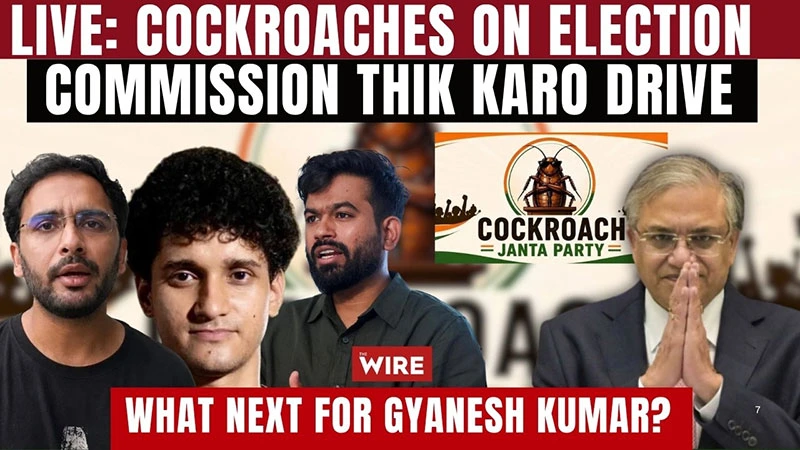
CJP Demands CEC Resignation: High Stakes and Big Risks Before Gandhi Jayanti
Indian youth agitations are taking an increasingly aggressive turn. What started as an online satire movement quickly evolved into a pressure group, and now it is taking aim directly at India’s top poll body.
During a packed press conference in New Delhi, the Cockroach Janta Party (CJP) handed down a strict 48-hour ultimatum demanding the immediate resignation of Chief Election Commissioner Gyanesh Kumar. Flanked by co-conveners Saurav Das and Ashutosh Ranka, CJP national convener Abhijeet Dipke warned that if the chief election officer does not step down, the group will launch a nationwide street agitation starting on Gandhi Jayanti, dubbed “Jantar Mantar 2.0“.
This ultimatum stems from national concern over the Special Intensive Revision (SIR) of electoral rolls. Investigative reports reveal that over 13 crore names, roughly 13 to 14 percent of the country’s registered voters, have been excluded across 30 states and Union Territories during draft roll updates.
Adding to the friction, internal documents revealed that fellow Election Commissioners Sukhbir Singh Sandhu and Vivek Joshi logged formal objections on record at least 14 times over 10 months regarding institutional decisions. Consequently, the Election Commission of India (ECI) finds itself facing an unprecedented crisis of public trust.
Riding momentum from widespread youth support, CJP leaders previously celebrated Union Minister Dharmendra Pradhan’s resignation as a major breakthrough. That early success has clearly emboldened them to roll out Jantar Mantar 2.0.
Is this 48-hour deadline a sharp move for civic accountability, or is it an overextended political gamble for the CJP? To make sense of the standoff, we need to look at the voter data, the internal rift inside the commission, and the real-world risks of taking to the streets.
How SIR Anomalies Triggered CJP’s Nationwide Demands
The foundation of the CJP’s new campaign, titled “Election Commission Thik Karo” (Fix the Election Commission), rests on widespread anomalies reported during the Special Intensive Revision. Originally intended to update voter lists and remove deceased citizens, the exercise has instead sparked allegations of massive voter suppression.
Data cited by civil society groups and reported by outlets like The Indian Express highlight heavy exclusion numbers across major states:
- Over 2 crore names deleted in Uttar Pradesh and Maharashtra respectively.
- Around 1 crore names removed in Karnataka.
- 97 lakh voter exclusions in Tamil Nadu,
- 90 lakh in West Bengal
- Millions more across Telangana, Delhi, and Kerala.
The CJP argues that under Gyanesh Kumar, the burden of proof has been completely flipped. Instead of the ECI proving that an exclusion is legitimate, ordinary citizens are left running around government offices to prove their basic right to vote.
Speaking at the press meet, Abhijeet Dipke argued that when millions of voter records disappear overnight, the Commission fails its constitutional mandate under Article 326 of the Indian Constitution, which guarantees equal adult suffrage.
Internal Dissent: 14 Written Objections in 10 Months
The controversy deepened after news investigations revealed that decisions made under CEC Gyanesh Kumar were far from unanimous. Election Commissioners Sukhbir Singh Sandhu and Vivek Joshi registered formal written objections on record 14 times regarding key operations:
- Form 6 Obstacles: Introducing an extra declaration asking first-time Gen Z voters to declare whether their parents appeared in historic SIR rolls before submitting online applications.
- Centralization of Software: Modifying the central voter database software without full consensus among all three commissioners.
- Bypassing the Panel: Issuing key policy decisions without the prior knowledge or approval of the full commission.
While the ECI issued a press release stating that differing views are normal during administrative deliberations, critics maintain that having two out of three commissioners object on record severely damages institutional neutrality.
Former Election Commissioner Ashok Lavasa recently commented on EC dissent against Gyanesh Kumar on YouTube.
The Core Demands Submitted by the CJP
While CJP demands CEC resignation as their primary headline, they have laid out a comprehensive three-part agenda:
1. Immediate Resignation of CEC and Judicial Inquiry
The group demands that CEC Gyanesh Kumar step down immediately. They are also calling for an independent inquiry into directives issued during the Special Intensive Revision, advocating criminal proceedings if evidence reveals intentional voter suppression.
2. Freezing the SIR and Restoring Baseline Voter Lists
The CJP wants an immediate halt to all ongoing SIR voter roll exclusions, demanding that the January 2025 electoral rolls be restored as the working draft. Furthermore, they want software logs and internal files turned over directly to the Supreme Court of India or an independent judicial panel.
3. Overhauling the Election Commissioner Selection Process
To address long-term structural issues, the CJP is calling to repeal the Chief Election Commissioner and Other Election Commissioners (Appointment, Conditions of Service and Term of Office) Act, 2023. They argue the current selection law grants the ruling executive too much control, advocating for a broader, multi-partisan selection panel.
Demands like these signal a clear pivot from student activism to mainstream political warfare. Whether CJP eventually becomes a formal political party or remains an independent pressure group is still uncertain, but they are playing a high-stakes game. It also raises a crucial question: have they forgotten that Sonam Wangchuk’s hunger strike provided the primary spark for Jantar Mantar 1.0? Will Wangchuk lend his weight to broader constitutional battles this time?
Why Jantar Mantar 2.0 Is a High-Risk Gamble
Taking on a constitutional body like the Election Commission of India carries massive stakes. After gaining national prominence during student protests over exam paper leaks, transitioning into electoral politics and calling for a nationwide agitation against the chief poll officer poses severe operational and political challenges.
Major Obstacles Facing the Movement
1. Strict Constitutional Barriers Under Article 324
A Chief Election Commissioner cannot be removed by public ultimatums. Under Article 324, removing a CEC requires a complex parliamentary impeachment process similar to that of a Supreme Court judge. Issuing a 48-hour deadline risks running into a legal wall, which could make the threat look like political posturing if no resignation occurs.
2. Threat of Rapid Political Polarization
Student issues like exam leaks drew sympathy across party lines, but voter roll disputes quickly turn into partisan fights. While CJP drew spontaneous support from affected youth in past protests, the ruling BJP has defended the ECI, framing deletions as routine cleanup and accusing critics of manufacturing hype. If labeled as an arm of opposition parties, CJP risks losing its standing as an independent youth voice.
3. Ground Mobilization and Logistics
Organizing nationwide rallies starting in Mumbai on Gandhi Jayanti before marching to Delhi for Jantar Mantar 2.0 demands substantial financial and logistical backing. Maintaining peaceful street demonstrations across multiple states requires tight organizational discipline and working relationships with state authorities.
With Jharkhand as the lone exception, CJP’s demonstrations have focused almost entirely on BJP-governed issues. Combined with Abhijeet Dipke’s prior ties to AAP and the BJP’s allegations that AAP is providing logistic backing, CJP’s position becomes significantly more precarious.
Potential Strategic Advantages for CJP
1. Tapping Into Grassroots Voter Anger
Voter deletions hit citizens personally. Discovering your name missing from the voter roll creates immediate outrage. By championing this cause across West Bengal, Maharashtra, and Uttar Pradesh, the CJP connects directly with disenfranchised voters.
2. The Moral Weight of Gandhi Jayanti Protests
Launching street demonstrations on October 2 gives the movement a peaceful, moral framing. Framing the movement around satyagraha and non-violent resistance makes it politically difficult for authorities to employ heavy-handed police action.
3. Forcing Mainstream Opposition Parties to Act
CJP leaders explicitly called out mainstream opposition parties during their press meet, stating that if politicians genuinely believe elections are being manipulated, they must offer more than rhetoric. This puts pressure on established parties to back the movement or risk appearing passive. Opposition leaders like Rahul Gandhi have frequently raised the issue of “Vote Chori”, making it harder for traditional parties to ignore the CJP’s call.
The Legal Reality Behind Voter Deletions
This controversy hits at the core of India’s constitutional guarantees. Article 326 establishes that every citizen aged 18 or older has the right to vote, unless disqualified by law for specific grounds like non-residence or mental incapacity.
Legal scholars emphasize that while updating voter lists under the Representation of the People Act, 1950 is routine, disenfranchising a voter requires strict adherence to natural justice. Affected citizens must receive:
- Advance written notice outlining the grounds for deletion.
- A reasonable window to present proof of residence or identity.
- An accessible appeals mechanism before final deletion takes effect.
CJP co-convener Saurav Das highlighted that unannounced additions to online application forms – such as mandatory questions hidden inside Form 6 – undermine procedural fairness. Deleting millions of voter names without formal individual notices violates constitutional safeguards.
For detailed legal context on this issue, read Why the voter roll revision has become so controversial.
Political Responses Across the Board
The 48-hour ultimatum sparked swift reactions across the political spectrum.
Opposition Endorsements
Opposition figures cited the 14 internal objections logged by Election Commissioners as proof that standard protocols were bypassed under Gyanesh Kumar. They argue that conducting upcoming state assembly elections on unverified voter rolls undermines the legitimacy of the outcome.
Government and ECI Defenses
Conversely, government representatives and election officials maintain that the Special Intensive Revision is necessary routine maintenance to clean up electoral lists. Their defense centers on three points:
- Duplicate entries and deceased voters had accumulated over multiple election cycles.
- Omitted citizens can easily re-register by submitting Form 6 before elections are formally notified.
- Internal debates among commissioners reflect healthy administrative discussion rather than institutional breakdown.
Official spokespersons argue that public attacks on the poll panel erode confidence in democratic institutions.
Future Outlook: What Happens After the Deadline?
As the 48-hour window closes and Gandhi Jayanti approaches, three potential scenarios emerge:
- The Election Commission Stands Firm: The ECI is expected to ignore the demand for resignation. The CJP will then need to demonstrate its organizational muscle on October 2 through public turnouts in Mumbai and regional centers.
- Supreme Court Intervention: Given the formal dissent logged by two sitting commissioners and the scale of voter deletions, public interest litigation (PIL) will likely reach the Supreme Court, potentially prompting a judicially ordered audit of the SIR voter roll data.
- Renewed Push for Electoral Reform: Should public protests gather steam, Parliament will face renewed pressure to review how election commissioners are selected, potentially re-introducing judicial representation to the panel.
Restoring Public Faith in Electoral Integrity
Democratic governance depends fundamentally on public confidence in the neutral execution of elections. Regardless of whether the CJP’s ultimatum forces administrative movement, the campaign has pushed voter rights, data transparency, and election administration back into the center of public discourse.
With October 2 fast approaching, political observers are watching to see if this youth-led pressure group can translate digital satire and press ultimatums into sustained institutional change – or whether the administrative system will simply absorb the pressure.
Knowledge Mart Final Thoughts
Why is the Election Commission still refusing to come out in public and answer these questions? The allegations directly concern Chief Election Commissioner Gyanesh Kumar, so he should explain the issues raised in the Indian Express reports point by point. If the allegations are wrong, the CEC has every opportunity to say so clearly and place the facts before the public.
Staying silent only fuels more questions and gives political critics an easy target. The slogan “CJP Demands CEC Resignation” will spread like wildfire. A direct explanation from the CEC could also reduce the growing demand for his resignation or arrest from the oppositions.
At stake is not merely the reputation of one official, but the credibility of the institution that conducts India’s elections, and the trust of millions of voters.
10 Key Takeaways on CJP Demands CEC Resignation
- The Cockroach Janta Party (CJP) issued a 48-hour ultimatum demanding the immediate resignation of Chief Election Commissioner Gyanesh Kumar.
- Failure to resign will trigger nationwide street agitations starting Gandhi Jayanti under the “Jantar Mantar 2.0” campaign.
- The movement responds to reports that over 13 crore voters were excluded during the Special Intensive Revision (SIR) across 30 states and Union Territories.
- Internal records revealed that Election Commissioners Sukhbir Singh Sandhu and Vivek Joshi logged 14 written objections against unapproved institutional steps.
- Key grievances include unannounced mandatory fields added to online Form 6 that created hurdles for first-time Gen Z voters.
- The CJP demands a complete freeze on SIR voter deletions and the restoration of the January 2025 electoral list as a baseline draft.
- The group calls for the repeal of the 2023 Election Commissioner appointment law to reduce executive influence over poll appointments.
- Removing a Chief Election Commissioner involves steep constitutional hurdles under Article 324, requiring parliamentary impeachment equivalent to a Supreme Court judge.
- Launching protests on October 2 strategically frames the agitation around non-violent satyagraha and civil resistance.
- While opposition parties support independent audits, the ECI maintains that all formal decisions were taken unanimously in accordance with standard internal protocols.