
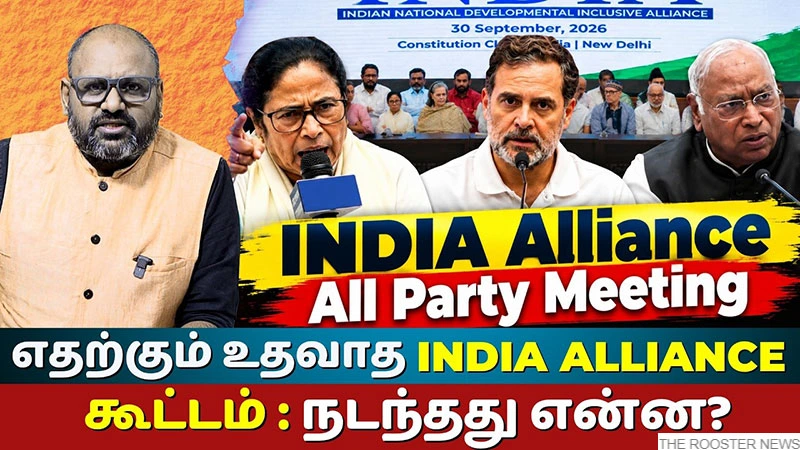
INDIA Alliance Meeting September 2026: What Happened in Delhi?
The INDIA Alliance meeting at the Constitution Club in New Delhi on September 30, 2026, produced the photograph the Opposition wanted. Rahul Gandhi, Mamata Banerjee, Mallikarjun Kharge, Sonia Gandhi and several other leaders sat together and spoke from the same political platform.
But a photograph of opposition leaders sitting together does not automatically mean that their political problems have disappeared.
The meeting came at a particularly important moment. Opposition parties are trying to build a common campaign around the Election Commission, the Special Intensive Revision (SIR) of electoral rolls and allegations concerning the electoral process. Nineteen opposition parties attended the meeting. The Aam Aadmi Party and DMK stayed away. Akhilesh Yadav was also absent, although the Samajwadi Party was represented.
So there was unity in Delhi, but there were also some obvious gaps. Both sides of that story matter.
Why the Constitution Club Meeting Got Attention
The immediate issue was the growing controversy surrounding the Election Commission. But the political background was much larger. Since the INDIA bloc was created, its parties have struggled with one basic problem: how do they cooperate nationally while fighting each other in individual states?
This time they had something specific to unite around. The parties wanted to question what they describe as irregularities in the electoral process and raise concerns about the functioning of the Election Commission. That gave them a common campaign line at a time when maintaining a common political strategy has not been easy.
There is a difference, however, between joining hands over one issue and resolving the disagreements that exist between the parties. The September 30 meeting demonstrated cooperation over the Election Commission issue. The absence of AAP and DMK showed at the same time that the INDIA arrangement is not equally active among all its constituents.
The initial action of the oppositions on 2nd October, 2026 has raised glimpses of hopes.
Election Commission Becomes the Opposition’s Common Issue
The Election Commission controversy gave the INDIA bloc something that opposition alliances badly need: an issue on which different parties can use broadly similar political language.
The Election Commission controversy involving Gyanesh Kumar has already raised questions about the functioning of the poll panel and the relationship between the three Election Commissioners.
The Indian Express reported that Election Commissioners Sukhbir Singh Sandhu and Vivek Joshi had objected to changes involving Form 6, the statutory form used by people seeking inclusion in the electoral roll. According to the report, the two commissioners questioned the addition of a declaration connected with the SIR exercise. The Election Commission later removed that additional declaration from the online Form 6 in states where the SIR process had concluded.
The Opposition has used the episode to attack the functioning of the poll panel. The Election Commission and the BJP have rejected the broader allegations made by opposition parties. Those wider political claims should not be confused with the narrower fact that an internal disagreement over the Form 6 change was reported.
For the INDIA bloc, the political value is obvious. Rahul Gandhi, Mamata Banerjee and other opposition leaders can now speak about electoral integrity from the same platform. The harder part will come when these parties go back to their own states and face their own political battles.
Why AAP and DMK Skipped INDIA Meet
The absence of AAP and DMK was too significant to ignore. AAP had indicated that it viewed the INDIA arrangement mainly in the context of the 2024 Lok Sabha election, while DMK also stayed away from the September 30 meeting. Akhilesh Yadav did not attend personally, although the Samajwadi Party sent representatives.
Still, staying away from a meeting does not necessarily mean rejecting every issue being raised by the wider Opposition. AAP, for instance, has indicated support for an opposition move against the Chief Election Commissioner. Supporting one campaign is different from participating in every meeting of the alliance.
That difference exposes one of the INDIA bloc’s persistent problems. Opposition unity cannot be measured simply by counting how many leaders appear together on a Delhi stage. The more difficult questions concern common programmes, seat-sharing, leadership and the ability of parties to compromise when their electoral interests clash.
Why BJP May Welcome an INDIA Alliance Street Protest
I believe the BJP may actually welcome an INDIA Alliance street protest over the Gyanesh Kumar issue. The reason is simple: a united opposition taking to the streets would bring the BJP back to a political battlefield it knows extremely well.
First, the BJP knows how to fight political parties. It has spent decades taking on Congress and various regional parties through elections, rallies, campaigns and political counterattacks. A conventional opposition protest is therefore a familiar contest for the BJP.
Second, the political condition of several opposition parties is far from comfortable. Congress, TMC, AAP and SP are all dealing with their own political and organisational challenges. Bringing these parties together on one platform does not necessarily mean they have overcome those differences.
Third, the BJP may prefer this kind of confrontation because it is a known political battlefield. The party knows how to respond to rallies, slogans, counter-rallies and attacks from established political opponents.
The more unpredictable challenge has come from a different direction: social media memes, satire pages and newer forms of political communication such as CJP. That is a very different battlefield from conventional party politics, and the usual political playbook does not always work there. In that space, established parties can find themselves on the back foot.
So, if the INDIA Alliance protest over Gyanesh Kumar turns into a conventional street battle between political parties, the BJP may find itself on familiar ground. The bigger question is whether the opposition can turn a joint meeting into a sustained political campaign rather than simply another show of unity.
Election Commission Rift: What Did the Indian Express Report?
What Sandhu and Vivek Joshi Objected To
The Indian Express report about the Election Commission became an important part of the Opposition’s campaign.
The report said Election Commissioners Sukhbir Singh Sandhu and Vivek Joshi had repeatedly raised objections concerning decisions connected with the electoral-roll revision process.
One of the most contentious issues concerned Form 6. The online form had been changed to include a declaration seeking information connected with the previous SIR exercise. The two commissioners reportedly questioned the change and its legal basis.
That is a significant development. But it still has to be kept within its proper limits. A reported disagreement inside the Election Commission is evidence of an institutional dispute. It is not, by itself, proof of every allegation that political parties have subsequently made about the electoral system.
Why the Form 6 Controversy Matters
Form 6 is the route through which a new voter applies for inclusion in the electoral roll. Any new condition attached to that process naturally deserves scrutiny, particularly when an SIR exercise is taking place.
The Indian Express subsequently reported that the Election Commission removed the additional SIR declaration from the online Form 6 in states where the SIR process had already ended. The declaration remained in states where the exercise was still continuing.
The Opposition gained another political argument from that development. But the Commission’s later decision is also part of the story. Anyone examining the controversy seriously has to look at both the original change and what happened after objections were raised.
Why Did the Election Commissioners Approach the Cabinet Secretary?
Another unusual element was the reported correspondence between the two Election Commissioners and Cabinet Secretary T V Somanathan. That naturally raises questions about institutional procedure because the Election Commission is a constitutional body and its internal decision-making is governed by law.
This is an area where the Commission should provide a clear explanation. If commissioners had serious objections to decisions being taken within the institution, the public should know what procedure was followed, why the correspondence was necessary and what happened afterwards.
The controversy has also moved into the courts. The Supreme Court has agreed to hear a petition challenging aspects of the functioning of the CEC and the SIR process. The petition alleges that decisions were taken without the required collective process. Those are allegations before the court, not judicial findings that can presently be treated as established facts.
How United Is the INDIA Alliance in 2026?
The INDIA Bloc’s Internal Rift
The September 30 meeting makes more sense when viewed against the history of the INDIA bloc. The parties have always faced a basic contradiction. They may need each other nationally while remaining bitter competitors in particular states.
Congress and a regional party can share a Delhi platform today and campaign against each other in a state election tomorrow. That is not unusual in Indian coalition politics. State-level political equations rarely follow the same map as national alliances.
The INDIA Alliance has become a wall of losers today is a much sharper political argument, but it should be understood as commentary rather than an established fact about every constituent party.
How West Bengal Changed Mamata Banerjee’s Position
West Bengal makes the problem particularly visible.
Mamata Banerjee had considerable political authority in Bengal when the INDIA bloc was taking shape. Yet TMC contested all 42 Lok Sabha seats in the state independently in 2024, despite being part of the broader national opposition arrangement.
After the 2026 Assembly election, the political landscape changed sharply. TMC lost power in Bengal and subsequently entered an internal factional struggle. That inevitably changed the space available to Mamata Banerjee in national opposition politics.
Yet the Election Commission controversy has brought Mamata and Rahul Gandhi together again. India Today reported that Rahul called for a united fight over SIR, while Mamata called for wider outreach beyond the existing alliance.
Rahul Gandhi and Mamata Find Common Ground on the Election Issue
There is an obvious irony here. Mamata Banerjee has criticised Rahul Gandhi and Congress on several occasions. Rahul has also attacked the TMC’s political record in Bengal. Their parties have fought each other in the state even while remaining part of the broader opposition space nationally.
On the Election Commission issue, however, they have found common ground.
Rahul has made alleged manipulation of voter lists a major part of his current political campaign. Mamata has also raised objections to the SIR process. Their interests therefore overlap on this particular issue, even though their larger political relationship remains unsettled.
That is probably the clearest way to read the September 30 meeting. It showed real cooperation, but it did not erase the political disagreements that existed before the meeting.
Rahul Gandhi must have raised the vital questions: why doesn’t Modi face any anti-incumbency. It becomes more pertinent when he brings Indira Gandhi’s defeat in 1977. Perhaps he forgets the dark history of Emergency, But, Rahul should ask himself first, why does Congress have to fight the internal battles before combating Modi in every election.
West Bengal Election 2026: What Changed After the Poll?
Was the 2026 Bengal Election More Peaceful?
The earlier claim that the 2026 Bengal election witnessed absolutely no violence, firing, booth-jamming or allegations of malpractice would be too broad. There were reports of clashes and isolated incidents during polling.
At the same time, the Election Commission described the voting process as largely peaceful. Large-scale deployment of central forces and other security arrangements were credited with helping to contain trouble.
The distinction is important because Bengal has a long history of election-related violence. The 2026 election was conducted under an unusually heavy security arrangement. So the relevant question is not whether every incident disappeared. It is whether the overall environment was different from what voters had become accustomed to in earlier elections.
There is clear evidence of a substantial security effort. The Election Commission deployed central forces, observers and other personnel, while officials said preventive measures against potential troublemakers contributed to a more peaceful polling environment.
Why Voters Reacted Differently to the Change of Government
The change of government did not produce one uniform reaction across Bengal.
Some voters remained attached to TMC because of welfare schemes and their long political association with Mamata Banerjee. Others welcomed the change after years of complaints involving corruption, local political control, recruitment controversies and administrative problems.
It would therefore be misleading to describe the entire electorate as celebrating Mamata’s defeat. It would be equally misleading to suggest that everyone regretted the change.
What is beyond dispute is the political transition itself. The previous ruling party moved into opposition and the BJP formed the state government. Congress, the Left and TMC all had to rethink their political calculations after that change.
Is There One Public Mood in Bengal?
There is no reason to assume that the people of West Bengal share one political mood.
A voter who benefited from a welfare scheme may look at the previous government very differently from a young person affected by recruitment controversies. Rural voters may have different priorities from urban voters. A political worker’s experience may again be very different from that of someone who simply goes to the polling booth every few years.
Claims about universal relief or universal sympathy should therefore be treated carefully. Both reactions can exist at the same time.
The political change is measurable. The emotional response to that change is not.
What Did the INDIA Alliance Decide in Its September 2026 Meeting?
Save Democracy Rallies and the Election Commission March
The September 30 meeting did produce a concrete programme.
The opposition parties announced district-level Save Democracy marches and demonstrations from October 2 to October 8. Opposition MPs are scheduled to march to the Election Commission on October 6. The alliance also plans to seek a meeting with the President and hold larger rallies, including a major Delhi gathering on November 1.
The parties also said they would seek faster disposal of cases relating to SIR and electoral issues. Another major demand was a return to ballot-paper voting instead of EVMs.
That is the Opposition’s stated political demand. It should not be presented as an established finding that EVMs are incapable of producing reliable election results.
So the September 30 meeting was not merely about photographs. There was an action programme. The question now is how consistently the parties will carry it out once their individual state politics come back into the picture.
Why Mamata’s Position on Rahul Gandhi Needs Careful Reading
There was considerable speculation over whether Mamata Banerjee had accepted Rahul Gandhi as the future prime ministerial face of the INDIA bloc. The public record does not justify presenting that as a settled decision.
When asked about Rahul Gandhi as the alliance’s prime ministerial candidate, Mamata did not give a direct endorsement. The Week reported that she avoided answering the question.
That tells us something useful. Working with Rahul Gandhi on the Election Commission issue is not the same as formally accepting him as the alliance’s national leader or prime ministerial candidate.
Nandigram and Rejinagar Expose the Alliance Contradiction
West Bengal offers perhaps the clearest example of the gap between national opposition politics and state-level electoral competition.
In Nandigram, Mamata’s faction originally fielded Sanchita Pradhan Dey. She withdrew her nomination on September 18. Mamata subsequently announced that her faction would support Congress candidate Milan Pradhan in the bypoll and said the decision was intended to strengthen the INDIA alliance.
The sequence is worth noting. The Congress support came after the TMC-backed candidate withdrew. It was not a conventional pre-poll seat-sharing agreement announced by the two parties from the outset.
The episode can also be viewed alongside the wider Nandigram political contest, where the bypoll has acquired importance well beyond the constituency itself.
Rejinagar produced a different sequence of events. Mamata’s candidate Rabiul Alam Chowdhury initially announced his withdrawal, citing difficulties surrounding the new party identity and other concerns. He reversed that decision within hours and said he would remain in the contest.
So the two bypolls did not produce the same political outcome. In Nandigram, Mamata’s faction eventually backed Congress after its own candidate withdrew. In Rejinagar, Rabiul Alam Chowdhury remained in the contest after briefly announcing that he would leave it.
Both developments took place against the backdrop of the wider TMC symbol and party-identity dispute, adding another complication to the bypoll calculations.
This is why Delhi meetings alone cannot tell the whole story of the INDIA alliance. The difficult decisions emerge when parties return to constituencies where their interests directly collide.
INDIA Alliance vs UPA: Is There a Common Political Programme?
What the 2004 UPA Common Minimum Programme Achieved
India has seen this problem before.
The 2004 UPA is an important example because Congress and the Left managed to cooperate without becoming the same political organisation. After the election, the Left parties supported the UPA government from outside. Their parliamentary arrangement was built around a Common Minimum Programme, signed on May 17, 2004.
The agreement did not erase the ideological differences between Congress and the Left. Nor did it end their competition in the states.
What it provided was a negotiated framework. The parties knew the broad issues on which they could work together.
That negotiated common programme gave parliamentary cooperation a structure that went beyond simply opposing another party.
Delhi Cooperation and State-Level Political Rivalry
The lesson is relevant to the INDIA bloc today.
Congress and regional parties do not have to become ideologically identical to cooperate. They do, however, need enough agreement on national issues to make the arrangement workable.
The 2004 experience also shows that national cooperation does not require state-level political rivals to stop competing. Congress and the Left continued to fight elections against each other in several states while supporting the same government at the Centre.
The INDIA bloc therefore does not necessarily need to eliminate every state-level rivalry. The bigger question is whether it can establish a national framework strong enough to survive those rivalries.
Why Trust Remains a Problem for the INDIA Bloc
Trust becomes much more important once an alliance moves beyond a single issue.
Standing together against a government decision is relatively straightforward. Deciding who gets a seat, whose candidate receives support, who leads the campaign and what happens after an election is much harder.
West Bengal illustrates the problem. TMC and Congress can stand together in Delhi over the Election Commission while pursuing very different political interests in Nandigram or Rejinagar.
The phrase “Delhi mein dosti, Kerala mein kushti” is often used to describe this kind of political arrangement. The wording may be catchy, but the underlying reality is familiar: national allies can remain electoral rivals at the state level.
The challenge for the INDIA bloc is therefore not to eliminate competition among its members. It is to prevent that competition from making national cooperation impossible.
What Is the Future of the INDIA Alliance?
Can National Opposition Unity Survive Regional Rivalries?
The September 30 meeting shows that opposition parties can still come together when they believe they have a common institutional or political issue. The Election Commission controversy has provided that opportunity.
But the campaign against the EC is only one part of the story. After demonstrations and rallies, political parties return to elections, constituencies and their own organisational interests. That is where questions about leadership and seat-sharing become unavoidable.
Mamata Banerjee’s position captures the difficulty. TMC can cooperate with Congress nationally while fighting Congress in Bengal. Congress can argue for wider opposition unity while trying to preserve its own organisation in states where regional parties are stronger.
Neither party is likely to give up its political identity simply because its leaders share a stage in Delhi.
Why Meetings and Joint Rallies Are Not Enough
Meetings create coordination. Rallies create visibility. Joint statements create a common message. None of those things, on their own, settles the difficult questions inside an alliance.
The 2004 UPA experience is useful here because the Common Minimum Programme gave the parties a negotiated set of commitments. They remained separate organisations, but they knew what they were agreeing to do together.
The INDIA bloc’s present programme is much more focused on electoral institutions, SIR, alleged irregularities and opposition mobilisation. That may be sufficient for the current phase of political resistance. A broader governance programme would require much more agreement.
And that is where the alliance will eventually have to answer the difficult question: what exactly would its parties do together if they got the opportunity to govern at the Centre?
Knowledge Mart Final Thoughts
The September 30 INDIA Alliance meeting produced something more substantial than another opposition photograph. The parties announced a coordinated campaign against the Election Commission, a series of “Save Democracy” programmes, an October 6 march to the EC and a larger Delhi rally planned for November 1.
At the same time, the meeting exposed problems that a joint stage cannot hide.
AAP and DMK stayed away. State-level rivalries remain. Mamata Banerjee and Rahul Gandhi can cooperate over SIR while their parties continue to compete in Bengal. In Nandigram, Mamata’s faction backed Congress only after its own candidate withdrew. In Rejinagar, the candidate first announced a withdrawal and then changed his mind.
None of this proves that the INDIA bloc has failed. But neither does one Delhi meeting prove that its internal problems have been solved.
The 2004 UPA experience offers a more useful historical comparison. Congress and the Left managed their differences through a Common Minimum Programme. They remained separate political forces, but they created a framework within which cooperation could continue.
The INDIA bloc now faces a similar structural challenge. Can its parties build something more durable than a platform for opposing the government and questioning the Election Commission? Or will their cooperation remain strongest when they have a common opponent or a common institutional grievance?
That question will not be answered by another photograph from Delhi. It will be answered in the states, during seat-sharing negotiations, on campaign platforms and when each party has to decide how much political space it is actually willing to share with its allies.
What the INDIA Alliance Meeting Really Tells Us
The September 30 meeting was more than another opposition gathering in Delhi. But the photographs and speeches should not obscure what happened underneath the surface. These are the points worth watching.
- The Election Commission has become the common ground. Parties that disagree on many other issues have found common political ground in the controversy surrounding SIR, Form 6 and the functioning of the Election Commission.
- The photograph does not show the entire alliance. AAP and DMK stayed away, while the Samajwadi Party was represented without Akhilesh Yadav personally attending.
- The Form 6 controversy has given the Opposition another issue to raise. The Indian Express reported objections from Election Commissioners Sukhbir Singh Sandhu and Vivek Joshi over changes connected with the SIR process.
- Delhi cooperation and state-level competition can exist at the same time. Congress and regional parties may share a platform nationally while fighting one another for votes in individual states.
- Nandigram showed this contradiction in a particularly visible way. Mamata’s faction supported Congress only after its own candidate withdrew.
- Rejinagar followed a different path. Rabiul Alam Chowdhury announced his withdrawal and then reversed the decision within hours, showing how quickly constituency-level political calculations can change.
- Mamata Banerjee has not formally settled the Rahul Gandhi leadership question. Cooperation with Rahul Gandhi over the Election Commission issue should not be presented as a formal decision to make him the alliance’s prime ministerial candidate.
- The 2004 UPA comparison raises a larger question. Congress and the Left were able to cooperate because they had a Common Minimum Programme. The INDIA bloc has yet to demonstrate whether it can create a comparable framework.
- Joint rallies do not settle seat-sharing or leadership disputes. Those questions become much harder when parties have to decide who contests where and whose candidate receives support.
- The real test comes after the Delhi meeting. If the parties can maintain coordination on the Election Commission issue while managing their state-level rivalries, the September meeting will acquire greater significance. If they cannot, it will remain another example of opposition parties coming together around a temporary common issue.