
Key Snippets: Gyanesh Kumar Voter List Row
The Trigger: Massive street protests, detentions, and internet suspensions erupted across Delhi and Mumbai on Gandhi Jayanti (October 2) as opposition coalitions and youth groups hit the streets against Chief Election Commissioner (CEC) Gyanesh Kumar over electoral roll revisions.
The Core Controversy: Opposition parties and activist groups accuse the Election Commission of India (ECI) of systematically dropping young voters and altering electoral rolls through the Special Intensive Revision (SIR) process.
The Constitutional Hurdle: While protesters are demanding an immediate resignation, a sitting CEC cannot be removed by executive order – removal legally requires a two-thirds special majority in both Houses of Parliament through a formal removal motion.
The Tactical Shift: Mainstream opposition parties have rejected calls to boycott upcoming elections, arguing that refusing to vote hands free victories to the ruling party and that the fight must happen both on the streets and through the ballot box.
Gyanesh Kumar Voter List Row Triggers Protests Across India
Developments marking Gandhi Jayanti (October 2, 2026) have brought the Gyanesh Kumar Voter List Row and the institutional conflict surrounding Chief Election Commissioner (CEC) Gyanesh Kumar to an unprecedented boiling point. Street-level agitations, mass political detentions, and constitutional debates have converged across major urban hubs. What began as internal bureaucratic friction within Nirvachan Sadan has now spilled out into nationwide public outrage, uniting mainstream opposition coalitions, student movements, and satirical youth parties on the streets.
The CJP Movement’s “Jail Bharo” Agitation
At ground zero in Mumbai, the Cockroach Janta Party (CJP), a satirical yet deeply influential grassroots youth movement founded by social media activist Abhijeet Dipke, officially launched its nationwide “Jail Bharo” agitation from the historical grounds of Shivaji Park. The mobilization followed the exact expiration of CJP’s 48-hour ultimatum demanding the immediate resignation and prosecution of the Chief Election Commissioner.
Despite heavy police barricades and security arrangement across Dadar, thousands of supporters gathered carrying vibrant placards and waving the national tricolor. Prominent public figures, including actor Naseeruddin Shah and music composer Vishal Dadlani, joined or extended solidarity to the crowd at Shivaji Park. According to reporting on the Economic Times news coverage, the core demands raised by the CJP movement centered around three non-negotiable points:
- The immediate resignation and criminal prosecution of CEC Gyanesh Kumar over alleged electoral roll management irregularities.
- An immediate freeze on the ongoing Special Intensive Revision (SIR) exercise and the complete restoration of January 2025 voter lists.
- A complete overhaul of the 2023 appointment process for Chief Election Commissioners, replacing executive dominance with a transparent, civil-society-inclusive selection panel.
Demonstrations organized by regional CJP coordinators erupted simultaneously across key urban centers, including Chennai, Bengaluru, and Kolkata. The organization has announced plans to extend these public demonstrations to six additional cities throughout October, concluding with a massive joint convergence at Jantar Mantar in New Delhi.
Some celebrities like Naseeruddin Shah and Shabana Azmi also extended their moral support to the protest. The massive crowd at Shivaji Park in the CJP Protest against Gyanesh Kumar may encourage them to think of formation of a Political Party.
Opposition and Student Protests at Jantar Mantar
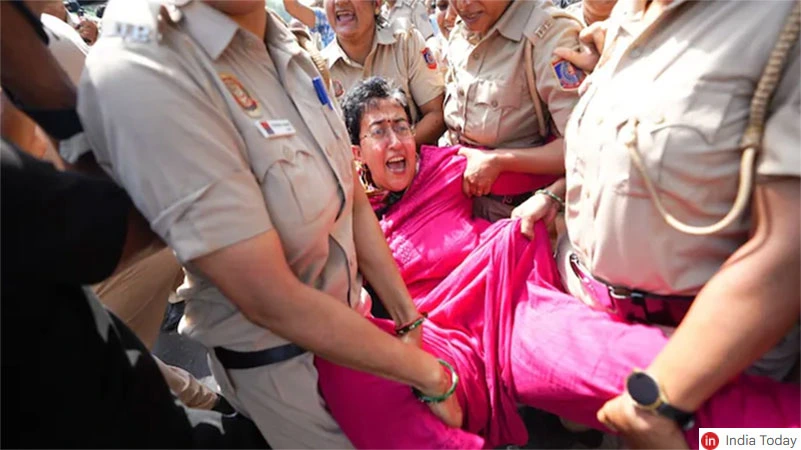
Simultaneously in New Delhi, the law enforcement apparatus responded with strict measures. Delhi Police invoked Section 163 of the Bharatiya Nagarik Suraksha Sanhita (BNSS, formerly Section 144) and temporarily suspended mobile internet services around the periphery of Jantar Mantar to prevent crowd pooling.
Despite the crackdown, over 700 political workers and youth activists were detained. Prominent leaders present included former Delhi Chief Minister Atishi, key representatives from the Aam Aadmi Party (AAP), the Indian Youth Congress (IYC), and student organizations such as AISA, SFI, and NSUI. Watch the YouTube Video of Times Now.
| Time | Event / Escalation | Location |
|---|---|---|
| 10:00 AM | Section 163 Imposed & Mobile Internet Suspended | Jantar Mantar, New Delhi |
| 12:30 PM | CJP “Jail Bharo” Agitation Launched by Abhijeet Dipke | Shivaji Park, Mumbai |
| 02:15 PM | Mass Detentions of Over 700 Activists & Opposition Leaders | New Delhi |
| 04:00 PM | INDIA Bloc Strategy Floor Meeting Announced | New Delhi |
The INDIA bloc opposition alliance has leveraged these street-level protests to push their parliamentary strategy. Leaders accuse the Election Commission of India (ECI) of systematically deleting millions of legitimate voters, particularly young “Gen Z” first-time voters and marginalized communities, under the guise of the SIR process, allegedly benefiting the ruling Bharatiya Janata Party (BJP).
Live video updates broadcast on the NDTV Live Coverage showcased massive police presence, temporary holding pens, and bus loads of detained protesters being removed from central Delhi.
Even Lucknow saw a huge turnout for the Samajwadi Party’s rally. If the point was to create a powerful political spectacle and pressure the leadership, October 2 was undoubtedly a success.
Government Pushback and Constitutional Realities
In response to the escalating nationwide protests, Maharashtra Chief Minister Devendra Fadnavis and senior ruling alliance leaders dismissed the agitations as a manufactured “fake narrative”. Ruling party leaders referred back to official press statements issued by Nirvachan Sadan, which insisted that all administrative decisions surrounding electoral roll updates are executed strictly according to statutory norms.
However, behind the high-decibel street protests lies a complex constitutional question: Can public demonstrations or political pressure directly remove a sitting Chief Election Commissioner?
Under Article 324(5) of the Constitution of India, the Chief Election Commissioner is granted constitutional protection equivalent to a judge of the Supreme Court of India. A CEC cannot be arbitrarily dismissed by an executive order or a cabinet resolution.
| Feature | Executive Order / Resignation Demand | Parliamentary Impeachment |
|---|---|---|
| Legal Basis | Public & Political Pressure | Article 324(5) / Article 124(4) |
| Required Vote | None (Voluntary Action) | Special 2/3rd Majority in Both Houses |
| Grounds | Moral / Political Accountability | Proven Misbehavior or Incapacity |
| Feasibility | Depends on Individual CEC | Extremely High Legislative Threshold |
Removing Gyanesh Kumar requires passing a formal removal motion (impeachment) in both the Lok Sabha and the Rajya Sabha. This process mandates a special majority, a majority of the total membership of each House AND a majority of not less than two-thirds of the members present and voting, on grounds of proven misbehavior or incapacity.
While activist groups like the CJP can stir public sentiment and demand immediate resignations, mainstream political parties recognize that an impeachment motion requires complex parliamentary arithmetic. With current numerical distributions in Parliament, securing a two-thirds majority in both Houses presents a massive political challenge for the opposition.
This dynamic raises a long-term question: Will grassroots activist movements like the CJP maintain an independent pressure-group identity, or will they eventually transition into formal political entities?
Strategic Debate: Boycott vs. Active Participation
The ongoing crisis has exposed a fundamental tactical division within the wider movement challenging the Election Commission: Should opposition movements boycott upcoming assembly elections, or should they contest them with full force?
Early in the controversy, certain activist factions within the CJP advocated for a complete boycott of elections held under the disputed SIR process. However, mainstream political parties have firmly rejected this approach. Trinamool Congress (TMC) MP Derek O’Brien and Congress leadership publicly argued that boycotting elections hands an unearned victory to the ruling party on a silver platter.
From an editorial perspective, refusing to vote is ultimately self-defeating. An election boycott can never resolve the voter list controversy. Voting is a cherished constitutional right, and active electoral participation is the ultimate lifeblood of a constitutional democracy.
Historically, left-leaning political parties like the CPI (ML) and factions within the CPI initially experimented with election boycotts during periods of ideological friction. Over time, however, they realized that boycotts only isolated their voter base and weakened public institutions. They subsequently entered the electoral fray, using the ballot box to defend civil liberties and strengthen democratic accountability from within. Demanding democratic purity while refusing to participate in the voting process creates an unavoidable contradiction for any movement operating within a constitutional framework.
Knowledge Mart Thoughts: Opposition Unity and the Road Ahead
Regardless of total turnout figures at individual rallies, today’s developments signal a decisive turn in Indian politics: the opposition has successfully transitioned from press releases to organized, street-level coordination on a single institutional issue.
Whether or not every demonstration breaks attendance records is secondary to the broader structural outcome. What matters most for democratic checks and balances is that political parties, youth movements, and civil society groups are actively pressing public institutions for transparency, demanding open voter rolls, and raising serious questions regarding electoral administration.
A strong opposition is the key to survival of democracy. The coming weeks in Parliament and the courts will ultimately determine whether this street-level agitation translates into binding policy changes or remains a high-stakes political standoff.
Key Video Coverage
- To watch the live announcements and street-level marches organized by the opposition alliance regarding the poll panel controversy, view the INDIA bloc nationwide protest announcement.
This video is directly relevant as it documents the official press briefings and joint statements made by opposition leaders outlining their nationwide strategy against the Election Commission.