
Is BJP Popularity Declining in 2026?
Is BJP popularity declining? After the 2019 Lok Sabha election, asking such a question would have sounded almost ridiculous. The BJP had won 303 seats on its own, Narendra Modi had returned with a clear majority, and the opposition was struggling to find a political formula that could seriously challenge the party.
Five years later, the picture is different. The BJP is still the central force in national politics and still leads the government, but the 2024 election showed that its earlier level of electoral comfort cannot simply be taken for granted.
The BJP went into the 2024 election with the “Abki Baar, 400 Paar” slogan but came out with 240 Lok Sabha seats. The NDA crossed the majority mark with 293, so Modi returned as Prime Minister, but the arithmetic inside the government changed significantly. TDP and JD(U) became much more important because the BJP could no longer form a majority on its own. The Election Commission’s official 2024 statistical reports provide the underlying seat and vote data.
That 63-seat fall from 2019 should neither be exaggerated nor ignored. It does not prove that BJP voters disappeared, and it certainly does not establish that the party lost its national political dominance. What it does show is that the BJP’s independent strength in the Lok Sabha became considerably weaker than it was five years earlier. The result also raised questions about whether anti-incumbency and voter dissatisfaction had begun to affect the BJP’s electoral performance.
There is an important difference between winning enough seats to lead a government and having the kind of parliamentary cushion that allows a party to operate without depending on allies. The BJP had that cushion in 2014 and 2019. It did not have it in 2024.
What Changed for the BJP After the 2024 Lok Sabha Election?
Yogendra Yadav’s pre-election projection of roughly 240 BJP seats attracted attention after the result because it came close to the final tally. That is interesting, but it should not be treated as proof of why the election produced that result. A projection can come close to the final number without explaining the many different reasons voters made their choices. The more significant development was visible in Parliament itself. With the BJP below the 272-seat majority mark, parties such as the TDP and JD(U) suddenly had greater importance in the government’s political calculations.
That was a noticeable change from 2019. During the previous term, the BJP did not need regional allies to supply the numbers required to form the Union government.
After 2024, alliance management became an unavoidable part of the Modi government’s political arithmetic. Reuters reported that the BJP’s reduced tally had strengthened the bargaining position of its allies during the formation of the government.
That does not mean the BJP became politically weak overnight. It means the party had less room to operate on its own. India has witnessed alliance governments for long including Modi’s predecessor, Atal Behari Bajpayee.
This is the more useful way to understand the 2024 result. The election did not remove the BJP from power, but it removed some of the certainty surrounding its independent parliamentary strength. The question after 2024 was therefore not simply whether the BJP was still popular. It was whether the party could continue to convert its national popularity into the same level of electoral dominance.
Does the BJP Still Have Strong National Support in 2026?
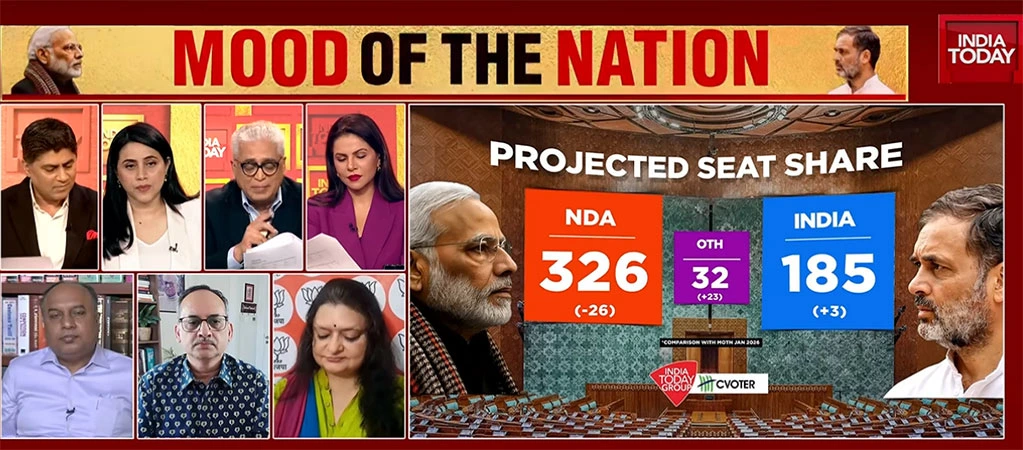
The latest India Today-CVoter Mood of the Nation survey provides an important counterpoint to the decline argument. Conducted between July 1 and August 25, 2026, the survey found Narendra Modi preferred by 48.7% of respondents when they were asked whom they wanted as the next Prime Minister. Rahul Gandhi was at 27.1%. The survey directly questioned 25,184 people, while another 91,795 CVoter tracking interviews were used in the broader analysis.
India Today: Narendra Modi remains India’s preferred PM at 48.7%
The same survey projected 261 seats for the BJP and 326 for the NDA if a Lok Sabha election were held at that time. These are survey figures, not election results and certainly not a forecast of what will happen in 2029. What makes them relevant to the present debate is the direction of the numbers. India Today reported that the NDA’s projected tally had fallen from 352 in the January 2026 survey, while Modi’s preference figure had also declined from the previous survey.
That produces a much more complicated picture than either side of the political debate may want to admit. There is evidence of some erosion in the numbers, but there is also clear evidence of continuing national support for Modi and the BJP-led alliance. In other words, the available data does not show the BJP losing its national position; it shows that the party’s earlier electoral cushion may be getting narrower.
Why Youth Unemployment Could Become a BJP Challenge
One of the more important questions for the BJP may be how younger voters judge the government over the next few years. A voter who entered adulthood during the Modi years is not necessarily going to make the same comparison as someone who remembers the UPA period or the political conditions of the 1990s.
For a large section of younger voters, the immediate concerns are much simpler and more personal: whether there is a job after college, whether the salary is enough, whether a family can afford housing and whether years spent preparing for competitive examinations actually lead to a fair opportunity.
The August 2026 Mood of the Nation findings brought these concerns into focus. India Today reported that 53% of Gen Z and millennial respondents identified jobs and employment as the issue that mattered most to them. Another report from the same survey said 32% of young respondents considered a shortage of jobs the biggest problem, while 18% pointed to low salaries and 17% said available jobs did not match their qualifications.
India Today: Youth employment concerns in the 2026 Mood of the Nation survey
None of this automatically means young voters will turn against the BJP. Voting behaviour is rarely driven by one issue. A young voter can be concerned about unemployment and still support Modi because of leadership, welfare schemes, nationalism, security or other political considerations.
But that does not make unemployment politically irrelevant. Youth unemployment is different from a distant policy debate because it is experienced directly by the voter and the voter’s family. If the gap between education and employment continues to frustrate young people, it can become a much larger political issue than it is today.
NEET Controversy and BJP’s Education Politics
The NEET-UG controversy made the education and examination issue even more sensitive. Student protests continued for weeks, and Union Education Minister Dharmendra Pradhan resigned on July 25, 2026. The Indian Express reported that his resignation came amid the protests and was one of the principal demands raised by youth protesters at Jantar Mantar.
Watch: Dharmendra Pradhan resigns amid NEET-UG protests — The Indian Express
A minister’s resignation by itself cannot establish that BJP popularity is declining. Politics does not work through such a simple chain of cause and effect. But the episode matters because examinations are directly connected to the aspirations of students and their families.
When students spend years preparing for a competitive examination and begin questioning whether the process is fair, the issue quickly moves beyond education policy and becomes a question of trust in the system. Couldn’t the government gauge the gravity of the situation earlier? When students are protesting over examinations that can determine their careers, waiting for the controversy to become a full-blown political problem can itself become a problem. Whatever the reason, the government’s response came under pressure after the issue had already gathered momentum.
The latest Mood of the Nation findings reported that 67% of respondents had little or no confidence in the fairness of India’s entrance and government recruitment examinations. That figure should not be converted into an anti-BJP vote, because the survey does not establish such a connection. It does, however, show why examination integrity can become politically uncomfortable for the government. The BJP’s challenge is not simply to defend its education record; it also has to convince students that the system through which they compete for scarce opportunities is credible.
Is BJP Facing Growing Criticism in 2026?
There has also been criticism from people who have previously occupied important positions within the system. Kannan Gopinathan, Yashwant Sinha, Ashish Joshi and Jawahar Sarkar have publicly criticised different aspects of government policy or political functioning at various times. Former Finance Secretary Subhash Chandra Garg has separately questioned the government’s calculation of 7.8% real GDP growth for the first quarter of FY 2026-27.
The government has defended the methodology behind the revised GDP series, and the statistics ministry rejected criticism of the 7.8% figure. The Indian Express reported the government’s response and its defence of the revised calculation.
The Indian Express: Centre responds to criticism over 7.8% GDP growth
These interventions should not be described as evidence that the entire bureaucracy or establishment has turned against the BJP. They are statements by individuals and former office-holders, often concerning very different issues. Their significance lies elsewhere. They add to a wider political conversation in which questions about policy, administration and institutions are being debated more openly. Such criticism does not automatically become votes against the government, but it can affect the environment in which voters assess its performance.
Election Commission Dispute and Public Trust
The Election Commission controversy has added another sensitive issue to that wider debate. The Indian Express reported in September 2026 that Election Commissioners Sukhbir Singh Sandhu and Vivek Joshi had recorded objections on several matters during the previous ten months, including issues connected with the Special Intensive Revision of electoral rolls. The report referred to 14 recorded objections.
The Indian Express: 14 recorded objections by two Election Commissioners
The Commission has disputed the suggestion that these objections amount to a final institutional split. Its position is that decisions, including those concerning SIR, were taken unanimously and that focusing on internal notes gives only part of the picture. That response is an important part of the story and should not be left out when discussing the controversy.
When two Election Commissioners record objections on such sensitive matters, however, it is understandable that questions about the government’s response and the Commission’s internal functioning will arise.
At the same time, the dispute shows why institutional credibility can become politically important. The Election Commission is not an ordinary government department; it conducts the country’s elections and oversees the machinery through which voters exercise their franchise. Once disagreements inside the institution become public, political parties will inevitably interpret them through their own interests. For the BJP, as the ruling party at the Centre, any prolonged controversy around electoral institutions can become another question it has to answer, even if the underlying dispute does not itself prove a change in voting behaviour.
Why BJP Expansion in South India Remains Difficult
There is another reason why a simple national decline narrative does not work: the BJP’s performance has never been uniform across India. Karnataka has been a major BJP state in the south, and Telangana has also seen significant growth. Andhra Pradesh has a different alliance equation, while Tamil Nadu and Kerala remain much harder territories for the party. The 2024 Lok Sabha figures illustrate that regional difference clearly. The BJP won 17 seats in Karnataka, eight in Telangana, one in Kerala and none in Tamil Nadu.
Hindustan Times: BJP’s state-wise Lok Sabha election performance
These numbers show why a national political brand cannot simply be transferred from one state to another. Local leadership, regional identity, alliances, caste and community equations and state-level issues can all change the result. A party may have strong national support and still struggle to convert that support into seats in particular states.
For the BJP, that creates a continuing expansion problem. It has to protect its existing strength while building a stronger organisation in states where the national Modi factor alone has not been sufficient. The question is therefore not only whether BJP support is declining nationally, but also where that support is growing, where it is holding and where it is failing to translate into electoral gains.
How West Bengal Changed the BJP’s Political Map
West Bengal makes the simple argument that BJP popularity is declining in 2026 even more difficult to sustain. The BJP’s 2026 victory allowed it to form a government in a state where it had never previously done so. Business Standard reported that the BJP won 207 Assembly seats in the 2026 Bengal election, while the Trinamool Congress won 80.
Business Standard: West Bengal Assembly Election 2026 results
The significance of Bengal is not simply the size of the BJP’s victory. For years, the party had tried to build an organisation in a state dominated first by the Left and then by the Trinamool Congress. In 2026, it crossed the barrier and formed the government. That means the BJP’s political map actually expanded even while its parliamentary strength had fallen nationally in the previous Lok Sabha election.
This is an important distinction. A party can lose seats in one election and gain political territory in another. It can face pressure among one section of voters while making gains among another. Indian elections are too diverse to be explained by a single national popularity line. The Bengal result therefore has to be considered alongside the 2024 Lok Sabha setback rather than treated as irrelevant to it.
Can Economic Growth Strengthen BJP Support?
Economic performance may become another important test for the BJP. India recorded 7.8% real GDP growth in the first quarter of FY 2026-27 under the new GDP series. Former Finance Secretary Subhash Chandra Garg questioned the calculation and argued that the underlying growth rate was substantially lower, while the government rejected that criticism and defended the revised methodology.
The argument is unlikely to be settled simply by pointing at one GDP number. Most voters do not experience the economy through a statistical growth rate. They experience it through salaries, employment, food prices, rent, school fees, loan repayments and the monthly household budget. A government can point to strong macroeconomic growth while a family can still feel that its expenses are rising faster than its income. Both realities can exist at the same time.
That creates a political challenge for the BJP. Strong growth figures can support the government’s economic argument, but they do not automatically answer questions about employment or household finances. If economic growth is not felt in the form of better opportunities and greater financial security, opposition parties will have room to argue that headline growth has not translated into everyday prosperity. The strength of that argument will ultimately depend on economic conditions and voter experience, not simply on political slogans.
What Does the Evidence Actually Say About BJP Popularity?
The evidence does not fit neatly into either a “BJP decline” or a “BJP remains unstoppable” narrative. The 2024 Lok Sabha result reduced the party’s independent parliamentary strength, while the 2026 India Today-CVoter survey shows both continued support for Narendra Modi and some movement in BJP-NDA numbers compared with January. The BJP’s breakthrough in West Bengal also shows that its political reach has not stopped expanding.
These developments point to a party that remains nationally significant but faces a different electoral environment from the one it enjoyed after 2019.
The pressure points are equally important. Youth employment, examination integrity, household finances and questions about institutional functioning have created issues that directly affect how voters experience government performance. None of them can be treated as an automatic vote against the BJP. But they can influence how voters judge its record, particularly if economic growth does not translate into jobs, income security and better opportunities.
This is where the debate over BJP popularity declining becomes more meaningful: not as a claim of political collapse, but as a question of whether the party can retain the same electoral advantage while facing greater scrutiny from different sections of the electorate.
Knowledge Mart Final Thoughts
The BJP’s political position in 2026 is more complicated than its 2019 position. Its parliamentary majority has disappeared, alliance management has become more important, yet Modi continues to enjoy substantial support in the latest survey and the party has expanded into West Bengal. Looking only at one of these facts can produce a misleading picture. The real story lies in the contrast between reduced parliamentary comfort and continued political reach.
The more important test now lies outside the seat count. Jobs, examination fairness, household expenses, economic opportunity and institutional trust are issues that voters can experience in their everyday lives.
If these concerns grow, they can make political competition more demanding for the government. If the BJP can address them while retaining its existing support, the present pressure may not translate into a broader electoral shift.
So the central argument is not that the BJP has suddenly become unpopular. The evidence does not establish that. Nor does it justify assuming that the party can simply reproduce its earlier electoral performance. The BJP remains a powerful national political force, but with less room for complacency than it had after 2019. The next phase of Indian politics will show whether the party can convert its continuing national support into the same level of electoral advantage while dealing with a more questioning electorate.
10 Key Takeaways
- The BJP won 240 Lok Sabha seats in 2024, down from 303 in 2019, while the NDA won 293.
- The BJP’s reduced standalone strength made TDP and JD(U) more important to the government.
- Yogendra Yadav’s pre-election estimate of around 240 BJP seats drew attention after the result, but one accurate projection is not proof of a wider trend.
- Modi remained ahead of Rahul Gandhi in the August 2026 India Today-CVoter preference survey, although his rating was lower than in the previous survey.
- Youth employment and examination integrity emerged as major concerns in the latest Mood of the Nation findings.
- Dharmendra Pradhan resigned as Education Minister amid student protests over the NEET-UG controversy.
- Former Finance Secretary Subhash Chandra Garg publicly questioned the 7.8% GDP growth calculation, while the government defended the methodology.
- Recorded disagreements among Election Commissioners have added a new layer to the debate over institutional functioning.
- The BJP’s performance remains uneven across southern India, while its 2026 Bengal victory showed continued scope for geographical expansion.
- The central political question is no longer simply about past BJP victories. It is about whether the party can retain its existing support while meeting changing voter expectations before 2029.