
WB BJP Vandalism: Is Shamik’s Denial Acceptable?
Bengal politics has apparently found a shortcut to criminal investigation.
Something gets vandalised. Someone gets attacked. A few men disappear into the crowd. CCTV footage surfaces. Opposition parties start shouting. And before the police can identify anyone, the political certificate is already ready: “They are not the real BJP”.
What efficiency!
Once upon a time, the police had to investigate. Now it sometimes looks as if the party office can do the job first. No need to wait for CCTV, witnesses or evidence. Look at the incident, shake your head and announce: “This is not our culture”. Case almost closed.
The phrase “not BJP culture” has become remarkably flexible. If someone joins a rally, waves a saffron flag and shouts slogans, he is proudly counted among the party’s supporters. But when the same political ecosystem produces an allegation of vandalism, extortion or hooliganism, the story suddenly changes. The person becomes an unidentified creature from somewhere outside the BJP universe.
Despite Syama Prasad Mookerjee’s Bengali roots, the broader culture of the BJP remained alien to West Bengal for decades.
One might almost ask whether the BJP has developed a new membership system: full membership during election season, temporary disassociation during criminal allegations.
There is, of course, a serious point underneath the joke. An allegation is not proof. Nobody should be declared guilty simply because a political opponent makes an accusation. The reverse is also true. A political denial is not proof of innocence either. That is where a proper police investigation comes in.
This is the uncomfortable backdrop to the latest WB BJP Vandalism controversy.
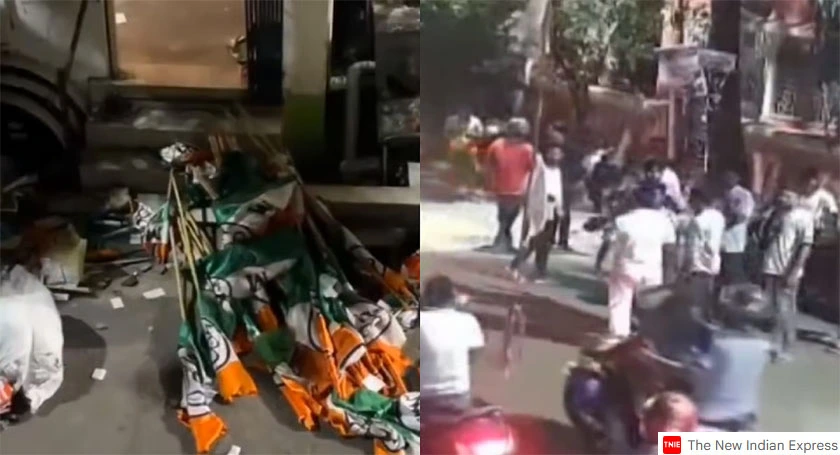
Bengal BJP president Shamik Bhattacharya has rejected allegations of BJP involvement in incidents including the September 3 vandalism at Abhishek Banerjee’s Camac Street office and the September 20 violence in Jadavpur-Bijoygarh. In the Camac Street case, Kolkata Police arrested six people. Police said they had not found any political affiliation among those arrested at that stage. Indian Express reported on the six arrests and the police findings.
And that leaves a fairly obvious question: if they are not the BJP, then who are they – and who is going to find out?
WB BJP Vandalism and the “Not BJP Culture” Defence
There is nothing unusual about a political party rejecting an allegation. No party is expected to accept every charge thrown at it by an opponent. The trouble begins when a political denial starts sounding like a substitute for an investigation.
That is where the repeated use of BJP Culture becomes interesting. When an incident involving alleged BJP supporters creates embarrassment, the explanation can sound remarkably familiar: they are not genuine BJP workers, they are outsiders, or they have nothing to do with the party. Shamik has even gone to the extent of saying that some people joined the BJP after 12 noon of 4th May.
Perhaps that will prove correct in individual cases. But the party itself cannot establish it simply by making the announcement.
The Camac Street incident is a useful example. Abhishek Banerjee alleged that BJP supporters vandalised his office and released CCTV footage. The BJP rejected the allegation. Kolkata Police arrested six people and said no political affiliation had been established among them at that stage.
Watch the Camac Street CCTV controversy and political reactions.
That is what an investigation is supposed to do. It separates political claims from established facts. Until the process is complete, neither an accusation nor a political clean chit should be treated as the final word. But, the problem arises, when the ruling party president declares even before the investigation starts, they are not the real BJP.
Jadavpur Vandalism: BJP Denies Involvement
The September 20 violence in Jadavpur-Bijoygarh has brought the argument back into the spotlight. TMC and Left leaders accused BJP workers of involvement after TMC and CPM offices, the residence of former TMC MLA Debabrata Majumdar and other political properties were attacked. The BJP denied any role and described the violence as the result of an internal TMC dispute. Majumdar, meanwhile, alleged that some of those involved were recent entrants to the BJP. Those competing claims remain disputed. Read the New Indian Express report on the Jadavpur vandalism and BJP’s response.
The political script is familiar. The opposition sees an opportunity to attack the ruling party. The ruling party sees an opportunity to accuse the opposition of creating political drama. In between, damaged offices and homes are left behind while the parties argue over who should get the blame.
The facts matter more than that political theatre. Whoever carried out the vandalism should be identified, and anyone found responsible should face the consequences prescribed by law. For now, however, the public is still dealing with competing political claims rather than a settled finding about who was responsible.
Watch a sarcastic criticism of veteran political Journalist, Sumon Chattopadhyay.
BJP Culture: Extortion Allegations and Party Discipline
There is another awkward part of this story for the BJP leadership. Some of its own leaders have been warning about people misusing the party’s name.
Jitendra Tiwari has spoken publicly about alleged extortion by sections of BJP workers and the misuse of political connections. In August, he said the administration would ensure that extortionists were sent to jail. The same report noted that the BJP had also shared toll-free numbers for people to report extortion complaints. Read the Times of India report on BJP warnings against extortion and errant members.
Memari BJP MLA Manab Guha has also taken a strong position against alleged extortion using his name. He accused some people of collecting money from residents and shopkeepers while claiming connections with him, and called for police action. Read the report on Manab Guha’s anti-extortion warning.
None of this proves that the people accused in the vandalism cases are BJP workers. That would be an unjustified leap. It does, however, point to another problem the BJP itself has acknowledged: political expansion can bring in people who try to use a party’s name, influence or connections for their own purposes. We have seen similar examples in Bengal’s politics over the past few decades.
Shamik Bhattacharya’s Response to WB BJP Vandalism
Shamik Bhattacharya occupies a somewhat unusual space in Bengal BJP politics. His speaking style is generally more measured than the street-level rhetoric that often dominates political confrontation. His fluency, Bengali cultural references and polished public presentation have helped him appeal to sections of the state’s middle-class and educated audience.
That makes his response to these incidents worth examining. Shamik is not obliged to accept allegations simply because they come from the TMC or the Left. A political party has every right to demand evidence before accepting an accusation against its workers.
But defending an organisation and closing the discussion are two different things. Saying that an allegation is unproven leaves room for an investigation. Declaring that the accused are not “real BJP” goes further, especially when the facts have not yet been fully established.
For a leader known for a relatively measured public style, there is more value in saying that the matter should be investigated properly than in offering an immediate political clean chit.
Bengal Political Culture and BJP’s Law-and-Order Test
Bengal does not need anyone to explain what political bossism looks like. For decades, the state has seen allegations involving local strongmen, extortion, political patronage and police inaction. Governments have changed. Party colours have changed. Slogans have changed. The public concern, however, remains familiar: can political connections sometimes put people above ordinary rules?
That history gives the present controversy a wider context. In 2011, the Trinamool Congress-led alliance ended 34 years of Left Front rule. In 2026, the BJP formed the first BJP government in West Bengal, ending 15 years of TMC rule. Indian Express compared the political changes of 2011 and 2026.
The two elections were hardly identical. The 2011 campaign was shaped by the long Left Front rule, Singur, Nandigram and the demand for political change. The 2026 election unfolded in a very different environment, with governance, law and order, corruption and other issues shaping the contest. Media also noted a significant difference in the political dynamics of the two elections, including the stronger role of Hindu consolidation in 2026 compared with the electoral movement that brought the TMC to power in 2011.
There was also a visible difference in the role of the intellectual class. In 2011, prominent intellectuals were highly visible in the political movement against the Left Front. In 2026, that kind of organised intellectual intervention was far less prominent.
But that does not mean political awareness was absent outside Kolkata’s educated middle class. A rural voter with limited formal education can understand political choices just as clearly as a university-educated urban voter. The political class would do well to remember that voters do not need a television studio to form an opinion about how a government behaves.
BJP Discipline vs Criminal Investigation
This is where the administration enters the picture. If people wearing saffron headbands are accused of attacking an opposition office, the police have to establish who they are, what they did and whether there is enough evidence to connect them to the crime. CCTV footage, eyewitness accounts and other available evidence should be examined properly.
Political affiliation may become part of the investigation. It cannot replace the investigation itself. The same standard should apply when BJP offices or supporters are attacked.
During Mamata Banerjee’s tenure, opposition parties repeatedly accused the administration of political protection and alleged police inaction. Those are political allegations and should be examined case by case rather than treated as established facts. They are nevertheless part of the political background against which the BJP government will now be judged.
The party spent years arguing that Bengal needed a different approach to law and order. Now that it runs the state government, that argument has moved beyond campaign speeches and into the much harder territory of governance.
This is also where True BJP becomes more than a slogan. Party discipline has its place, but it cannot be confused with administrative justice. A show-cause notice, suspension or removal from an organisational post is an internal party decision. Such action may show that the party does not approve of a member’s behaviour. It does not replace a police investigation when vandalism, assault, intimidation or extortion is alleged.
Sukanta Majumdar has said that errant members who refuse to fall in line could be driven out of the party.
That is an organisational response. Criminal allegations require something else. A ruling party cannot investigate its own supporters and decide whether they are guilty, just as an opposition party cannot establish guilt through political statements. Those decisions belong to the police, the courts and the established legal process.
The BJP has also spent years criticising the previous government over alleged political interference in administration. Its supporters have argued that a BJP government would bring a different standard of governance to Bengal.
The real test of that claim will come when someone politically connected to the ruling party is accused of crossing the line. Applying the same law to everyone would say far more about the new political culture than another television debate.
When Jawhar Sircar, the Indian former top civil servant and a public intellectual based out of Kolkata, West Bengal, criticizes BJP’s governance, it has to be taken seriously. Watch his interview.
Shamik’s Shocking Denial: What the Investigation Must Establish
Shamik Bhattacharya may ultimately be correct that the people involved in these incidents are not BJP workers. That possibility should remain open. So should the possibility that some people associated with the party may have crossed the line. Until the evidence is clear, both possibilities have to remain on the table.
The BJP has every right to reject allegations that it considers politically motivated, particularly when they come from political opponents. At the same time, its own leaders have acknowledged that people can misuse political names and connections.
That makes the issue bigger than one particular incident. As the BJP’s organisation has expanded across Bengal, it has taken in new entrants, local leaders and grassroots workers from very different political backgrounds. Managing that expansion without losing organisational discipline is now part of the party’s political responsibility.
Shamik’s response therefore deserves scrutiny. He can defend the BJP without deciding the case in advance. If an accused person has no connection with the party, the investigation can establish that. If someone does have a connection and is found responsible for a crime, the same process should establish that too. Neither outcome needs to be settled at a press conference.
Bengal BJP’s Political Culture Under Scrutiny
The latest WB BJP Vandalism controversy is about more than a damaged office or a clash in one locality. It raises a broader question about how a new ruling party handles the uncomfortable consequences of political power.
Bengal has seen governments change before. Changing the government, however, does not automatically change the political habits that have developed over decades. Political bossism, allegations of extortion, local strongmen and accusations of selective policing have all featured in the state’s political discourse under different governments.
The names and party colours may change, but the basic public concern remains the same: whether political connections can provide protection from ordinary rules.
That is why BJP Culture should be judged by what happens when something goes wrong, not simply by what leaders say when everything is under control. If supporters behave properly, there is little need for repeated declarations about political culture. When someone is accused of serious misconduct, the response becomes much more revealing.
Does the party allow the investigation to proceed? Does it take internal action where appropriate? Does the administration apply the law without looking at political affiliation?
For Shamik Bhattacharya, that may be the more difficult part of defending the BJP. He has to defend the organisation against allegations that may prove unfounded while leaving enough room for the facts to emerge. Those positions are not contradictory. A party confident in its own conduct should have little reason to fear an impartial investigation.
Knowledge Mart Final Thoughts
A new government inherits power, but it also inherits the public’s memory. Bengal has already experienced political bossism, extortion allegations and accusations of selective policing. The BJP’s arrival in government has changed the political equation, but it has not erased those expectations.
People will naturally watch how the new administration responds when someone connected to the ruling party faces a serious allegation.
The answer will not come from slogans. It will come from the process: whether the police investigate properly, whether evidence is considered fairly, whether internal party discipline is used where appropriate and whether criminal allegations are left to the legal system instead of being settled through political declarations.
For Shamik Bhattacharya, the strongest defence of the BJP may therefore be a less dramatic one. Let the police investigate, let the courts decide and let the evidence settle the political argument.
If those accused have no connection with the BJP, the investigation can establish that. If they do and are found responsible for wrongdoing, the law should apply to them just as it would to anyone else.
After all, Bengal has heard enough promises about a party with a difference. The real difference will become visible not when the BJP talks about political culture, but when it has to deal with an uncomfortable case involving people who claim its name.
10 Key Takeaways
- The WB BJP Vandalism controversy raises questions about political accountability, but allegations should not be treated as proof without evidence.
- Shamik Bhattacharya has denied BJP involvement in the recent incidents, while police investigations and competing political claims continue.
- In the Camac Street case, Kolkata Police arrested six people and said no political affiliation had been established among them at that stage.
- The Jadavpur-Bijoygarh violence has produced another round of accusations, with the BJP rejecting claims that its workers were involved.
- Calling alleged offenders “not BJP” does not by itself settle the question of their political links. That is for evidence and investigation to establish.
- Extortion allegations have also become an internal concern for the BJP, with party leaders warning against people misusing political connections and names.
- BJP Culture will be tested not by speeches alone, but by how the organisation responds when supporters or alleged supporters face serious accusations.
- The BJP’s rise to government brings a different responsibility: accusations of political protection and selective policing must now be addressed through actual governance.
- Party discipline and criminal investigation are not the same thing. Internal action cannot replace the legal process when a crime is alleged.
- The larger question is whether Bengal’s political culture changes with a change of government – or whether old habits simply acquire a new political colour.