
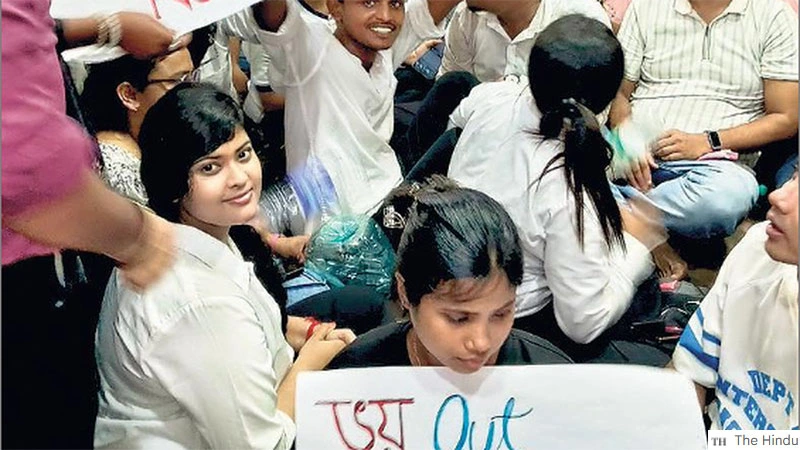
Why did ABVP protest at Surendranath Law College?
- Attendance Controversy: The dispute of ABVP Attack at Surendranath Law College originated over strict Bar Council attendance criteria for semester examinations, escalating into a prolonged 23-hour student gherao.
- Administrative Standpoint: Vice Principal Mohammadi Tarannum stated she did not voluntarily resign, alleging she was coerced following an overnight siege without basic amenities.
- Political & Cultural Impact: The involvement of ABVP-led protests and the subsequent “purification” ritual using Ganga water and incense raised serious concerns regarding institutional autonomy and campus polarization.
ABVP Attck: What happened at Surendranath Law College?
The ABVP Attack controversy at Surendranath Law College started with a dispute over attendance. In a normal college, that should have meant checking the attendance register, hearing the students and finding out where the problem lay. Instead, the dispute dragged on for nearly 23 hours, the Vice Principal alleged that she was pressured and prevented from leaving, and the matter eventually spilled into a strange “purification” ceremony involving incense and Ganga water.
So this is no longer only about attendance or examination eligibility. It is about whether an academic institution can settle an administrative dispute without allowing political pressure to take over.
Surendranath Law College Vice Principal Mohammadi Tarannum initially said that she had been forced to resign after being gheraoed by students. She alleged that she was denied food and water during the prolonged protest. The major report outlets have reported that the dispute centred on the attendance requirement and complaints about the way attendance had been recorded. Can we call it as an ABVP Attack?
There is, however, a significant update. Tarannum has since clarified that she did not resign and will continue in office. She has also accused governing body president and BJP MLA Kaustav Bagchi of misleading students and aggravating the situation. Those are serious allegations and should be investigated rather than settled through political claims from either camp.
News reports show that the incident has drawn criticism from several educationists and teachers’ organisations, including Sagarmay Ghosh of CUTA, Nilay Kumar Saha of WBCUPA and Gautam Maiti of ABUTA.
How Did an Attendance Dispute Become a Campus Crisis?
Students have every right to question an attendance record if they believe it is wrong. If classes were held at different times, if attendance was recorded inconsistently or if students were given conflicting information, the college administration should produce the records and explain the system.
Attendance controversies are nothing new in West Bengal’s education system. Even when we were students, we faced the problem of falling short of the required attendance in our pass classes. But in those days, such issues rarely turned into protests or demonstrations. A shortage of attendance was usually treated as a matter for students to address-often with reasonable leniency from the administration-rather than a justification for bringing an entire institution to a standstill.
The solution is straightforward: the college should produce the attendance records, explain how they were maintained and allow the students to challenge any genuine error.
The problem begins when an administrative dispute turns into an overnight confrontation. The ABP Ananda video report covered the prolonged protest and the dispute over students being prevented from appearing for examinations because of attendance. ABP Ananda video report on the 23-hour Surendranath Law College protest
Another ABP Ananda programme reported allegations that the Vice Principal was pressured to resign and showed the celebrations by ABVP supporters, including the use of incense and Ganga water. ABP Ananda programme on the Vice Principal resignation controversy
A student protest can be completely legitimate. But a legitimate grievance does not automatically justify keeping an administrator inside an office for hours. Once that happens, the nature of the protest changes.
Who Was Responsible for the Attendance System?
The question of who was responsible for maintaining the attendance system deserves much closer scrutiny.
Kaustav Bagchi, the governing body president, has reportedly questioned aspects of the attendance system while maintaining that the attendance requirement itself was valid. If the rule was valid but the method of maintaining attendance was flawed, somebody has to answer for that failure. And Kaustav cannot avoid his responsibility.
The first step should be to produce the attendance records and establish exactly what happened.
If attendance was maintained properly, let the students see the evidence. If mistakes were made, identify them. If teachers followed different methods, find out why. An attendance register should not require a political battle to establish what happened.
The college’s attendance notices and records should therefore be placed before any inquiry. Facts should decide the matter, not the loudest group outside an administrator’s office.
Gangajal & Incense: Symbolism or Targetted Polarization?
The most disturbing part of the episode came after the confrontation.
Students reportedly entered the Vice Principal’s office with incense sticks and Ganga water and carried out what was described as a “purification” exercise. The Times of India reported on the use of Gangajal in the aftermath of the controversy. Times of India report on the “Gangajal” purification controversy.
There is nothing objectionable about faith. There is nothing objectionable about Ganga water, incense or religious belief. The issue is why those symbols were brought into an administrative dispute inside a law college.
The Vice Principal is a Muslim woman. That fact makes the symbolism even more sensitive. It raises an uncomfortable question about whether religious identity was being dragged into a dispute that had originally been about attendance. If the organisers say it was only a symbolic protest, they should explain the symbolism.
If they say it had nothing to do with the Vice Principal’s religion, they should explain why a religious “purification” ritual was considered necessary at all.
And yes, another question is bound to arise. Would the same exercise have taken place if the Vice Principal’s surname had been Chatterjee, Banerjee or Jaiswal?
There may be a perfectly innocent explanation. But when religion enters an institutional dispute in this manner, people are entitled to ask what message was actually being sent.
What is happening in Bengal now? A religious preacher from Madhya Pradesh, Bageshwar Baba, is telling Bengalis how they should eat during Durga Puja, a festival we have celebrated in our own way for generations.
At the same time, students in a law college are reportedly using Ganga water and incense to “purify” the office of a Vice Principal in a law college. These incidents may appear unrelated, but they point to a worrying change in the way religion is entering public and institutional spaces.
We certainly voted the BJP into power. But did we vote for all the baggage that comes with it? That is the question the new government and its supporters need to answer.
Is Bengal now witnessing a kind of counter-polarisation in the name of religion, replacing one form of political use of religious identity with another? For 15 years, Mamata Banerjee’s government was openly accused of using religious appeasement and identity politics for electoral gains.
If the response is simply to reverse the direction of that politics, Bengal will not have moved forward. The political colour may change, but the politics of religious division will remain the same.
From Left to TMCP and ABVP: Bengal’s History of Campus Intimidation
This ABVP Attack controversy did not appear out of thin air. Bengal’s campuses have a long history of political interference, and the colour of the flag has changed more than once.
During Santosh Bhattacharya’s tenure as Vice Chancellor of Calcutta University from 1984 to 1987, he faced pressure from Left-backed teachers, non-teaching employees and SFI activists through dharnas, blockades and gheraos. Bhattacharya refused to surrender to that pressure. Times of India report on Santosh Bhattacharya and Left-era campus pressure
One political party replacing another does not make campus intimidation acceptable.
On January 5, 2012, the acting principal of Raiganj College was attacked and beaten by political student activists and subsequently resigned. NDTV report on the attack on the acting principal of Raiganj College
There were similar confrontations during the Trinamool Congress period. In 2014, repeated TMCP demonstrations at Calcutta University disrupted administrative work and led to teachers being gheraoed. Times of India report on TMCP demonstrations at Calcutta University
The following year, the situation became even more serious. The Times of India reported an assault on teachers and non-teaching staff at Calcutta University involving TMCP supporters. The Indian Express separately reported allegations of heckling and attacks on protesting teachers. Indian Express report on TMCP members heckling Calcutta University teachers
Calcutta University has seen similar episodes. In 2024, TMCP members gheraoed interim Vice-Chancellor Shanta Dutta for several hours over a dispute involving a syndicate meeting.
The following year, the controversy returned. In 2025, TMCP supporters again protested against Dutta over examination-related demands, including the scheduling of undergraduate examinations. Reports said the protests continued for hours, while Dutta refused to give in to the demand to reschedule the examination.
The history is worth remembering because Bengal has changed the political leadership of its campuses several times, while the underlying habit of political interference has often survived.
Mamata Banerjee’s government opened several new universities across West Bengal, but questions remained over whether infrastructure, faculty and other essential manpower kept pace with that expansion. The answer is blunt: Not at all.
At the same time, student union elections were kept suspended in most of the colleges and universities for years, even though union rooms and the campus structures associated with student politics continued to exist.
Over time, allegations emerged that some former student leaders were using these spaces and their political connections to control admission-related activities, organise Saraswati Puja and collect money through various forms of extortion. Whether every such allegation is true is a matter for investigation, but the larger problem cannot be ignored. When elected student bodies disappear while politically connected groups continue to exercise influence on campus, accountability becomes almost impossible.
The result has been a serious deterioration of the academic environment in many of Bengal’s higher educational institutions. A university can be expanded with buildings and new courses, but without proper infrastructure, adequate teachers and transparent campus governance, expansion alone does not create quality education. Instead, it can leave behind institutions where academic priorities are pushed aside by political influence.
If the ABVP is now facing questions over its conduct on campus, it is worth remembering that Bengal has seen similar allegations against TMCP during the past 15 years.
Will the BJP Break Bengal’s Cycle of Political Interference?
That history should make the BJP particularly cautious now that it has political power.
The BJP has every democratic right to have a student organisation. ABVP has every right to organise, campaign and raise genuine student issues. But winning an election does not give any political party ownership of a college.
Bengal has seen what happens when ruling parties become too comfortable inside educational institutions. Student organisations gradually stop behaving like student bodies and start behaving like political extensions. The party changes, the slogans change and the justification changes. The pressure on academic institutions can remain remarkably similar.
Anilayan to Mamatayan. Now will it be Jagannathayan?
The BJP should be careful not to fall into the same pattern that it once criticised in other parties.
This is not an argument that every ABVP student is responsible for everything that happens on a campus. Such a claim would be unfair. The real issue is responsibility. When a student organisation is politically associated with a party in government, its conduct will naturally be judged more closely.
If the BJP wants to prove that it represents a different political culture, it has a simple opportunity here. It can say that students have the right to protest but teachers and administrators cannot be subjected to intimidation.
If the party takes that position consistently, it would mark a meaningful departure from Bengal’s older campus politics.
Jadavpur University Clashes: A Pattern of Growing Campus Muscle Power
The recent tensions involving ABVP at Jadavpur University are another reminder that campus politics is becoming increasingly aggressive. There is nothing wrong with ABVP expanding its presence. The same democratic space should be available to SFI, TMCP, DSO, CJP and every other lawful student organisation. The ABVP-related tensions at Jadavpur University have again brought the question of aggressive campus politics into focus.
Expanding a student organisation’s presence on campus is legitimate, but that does not give it ownership over the institution or its administration. Nor should a party flag become a license for intimidation, vandalism or disruption.
Bengal’s education system has already suffered from recruitment controversies, vacancies, administrative disputes and campus violence. The last thing it needs is another generation of students learning that political muscle is a more effective tool than institutional procedure.
The controversy over the University Teacher Transfer Bill has already raised serious questions about academic administration and institutional autonomy. Before that storm could even blow over, did ruling party MLA Koustav Bagchi really need to get himself dragged into yet another controversy? Against that background, the conduct of a ruling-party MLA who also heads a college governing body deserves scrutiny. Political leaders who accept institutional responsibilities must also accept responsibility when those institutions face a crisis.
Students Must Not Become Political Foot Soldiers
Having been a member of a student union in the past, I know how difficult it can be for young students to control their emotions when they believe that an injustice has been done. Student politics can be intense. Anger can spread quickly, particularly when political groups are involved.
But that cannot become a justification for keeping a Vice Principal surrounded for 23 hours without water and light, as has been alleged in this case.
Moreover, the purification process cannot be a spontaneous impulse of the students of that age group without a political intention of mainstream political parties.
There are enough legitimate ways for students to challenge an unfair decision. They can demand to see the attendance records, ask for an inquiry, meet the governing body, approach the university authorities or seek legal remedies. They can also protest peacefully and put their grievances before the public.
None of these options requires students to surround an administrator through the night.
A student may be angry with an authority and still have to respect the institution in which that authority works. Once a protest becomes a question of how many people can surround an office or how long an administrator can be kept there, the original grievance begins to get lost.
That distinction matters because students are young and many are influenced by political organisations, which makes it even more important for those organisations to ensure that a protest does not cross the line into intimidation. A college cannot function properly if the strength of a political group determines whose complaint will be heard and whose decision will be overturned.
There is also a practical danger in allowing this culture to grow. If one student organisation learns that numbers and pressure can force an administrator to change course, another organisation will eventually use the same method. The organisations may carry different political colours, but once intimidation becomes an accepted method, the damage to the institution is much the same. In the end, it is the student without a political connection who is likely to feel most vulnerable because he or she has neither the numbers nor the organisational backing to put pressure on the administration.
That is particularly troubling in a law college. Students are being trained to understand rules, procedures, evidence and the functioning of institutions. They should instead learn that even a serious grievance can be pursued through evidence, representation, protest and law rather than through prolonged pressure on an administrator.
Lessons from South Calcutta Law College: When Party Influence Overrules Campus Safety
The South Calcutta Law College controversy of 2025 should not be forgotten.
The alleged gang rape of a 24-year-old student inside the college premises exposed disturbing questions about political influence and campus control. The Indian Express reported that the principal accused had earlier been associated with the TMCP college unit and continued to wield influence on campus even after completing his studies. Indian Express report on political influence at South Calcutta Law College
Another Indian Express report carried allegations from a student who said he was assaulted after refusing to join TMCP activities, with his father also allegedly beaten during the confrontation.
These incidents belong to the previous political regime. They should not be turned into a blanket accusation against every Trinamool supporter. But they do provide a warning.
Once a political organisation becomes too powerful inside a college, academic authority can gradually become secondary. The same institution that should protect students can become dependent on political connections.
Bengal should not allow that kind of political influence to become normal again.
Where Should the Line Be Drawn?
There is a clear difference between protest and intimidation. There is also a difference between personal faith and using religious symbolism during a political or institutional confrontation.
Students have rights. Teachers have rights. Administrators have rights. Political organisations have rights. None of these rights gives anyone a free pass to silence the others.
The Surendranath Law College episode therefore needs a proper inquiry. Check the attendance records. Establish what happened during the 23-hour gherao. Examine the allegations made by the Vice Principal. Hear the students. Establish the role of the governing body. And find out why the “purification” ritual was organised.
The proper institutional response is therefore an inquiry based on records, testimony and evidence.
The matter should be settled through an institutional process rather than another round of political posturing.
A Test for the BJP: Proving a New Culture in Higher Education
The BJP does not have to defend every action of every ABVP supporter. In fact, refusing to do so could send a stronger message.
The party can acknowledge that students may have had a genuine grievance while making it equally clear that intimidation of academic administrators is unacceptable. That would distinguish political leadership from political interference.
The same principle should apply to governing bodies. If an elected politician takes responsibility as the head of a college governing body, that position cannot be treated as ceremonial when everything is going well and forgotten when questions are raised.
Bengal has lived through too many versions of the same story. A ruling party gets influence over campuses. Its student wing becomes stronger. Academic administrators become cautious. Opposition groups protest. Then the government changes and the cycle starts again.
Governments and political organisations may change, but the institutional damage caused by this culture can continue for years.
Knowledge Mart Take: Reclaiming Bengal’s Educational Institutions
The dispute at Surendranath Law College started over attendance, but it has quickly moved into a much wider question about the way educational institutions are allowed to function. Tarannum has now clarified that she did not resign and will continue her duties. The clarification should now allow the college authorities to move away from the immediate confrontation and establish what actually happened.
The attendance records need to be checked properly. If students were marked absent despite attending classes, their complaints deserve to be heard. At the same time, the allegations made by the Vice Principal about the manner in which she was treated cannot simply be ignored. If the attendance system was poorly managed, the governing body also has questions to answer. Any responsibility should be established from the records and evidence, rather than from competing political claims.
This is also where the BJP faces a larger political test. The party has spent years criticising the culture of political interference in Bengal’s colleges and universities. Now that it is in a position of political power, it cannot allow its own student organisation to be seen as following the same path. ABVP students, like students belonging to TMCP, SFI or any other organisation, have every right to raise genuine grievances. That right, however, does not extend to turning an educational institution into a battlefield where administrative decisions are settled through prolonged pressure.
Bengal has already seen what happens when student politics becomes too closely tied to the interests of the ruling establishment. The Left had its period of campus dominance, followed by years in which the Trinamool Congress and its student wing faced repeated allegations of political interference. If the BJP wants to claim that it represents a different political culture, it cannot reproduce the same campus practices under a different party flag. Anilayan became Mamatayan; the question now is whether Bengal is heading towards another version of Jagannathayan.
The reported use of Gangajal and incense to “purify” the Vice Principal’s office raises an additional concern. Religion has its place in public life, but when religious symbols are brought into a dispute involving a Muslim woman administrator, questions about the message and intent of that act are unavoidable. The same conduct would deserve scrutiny regardless of whether the administrator’s surname was Tarannum, Chatterjee, Banerjee or Jaiswal.
The immediate priority should therefore be straightforward: examine the attendance records, hear the students, investigate the Vice Principal’s allegations and determine whether the governing body or any other authority failed in its responsibilities. Political organisations should allow that process to work instead of trying to settle institutional disputes through street power.
If the BJP genuinely wants to establish that Bengal’s political culture has changed, this is an opportunity to demonstrate it inside the campuses as well. Its credibility will depend not on whether every ABVP action is defended, but on whether the party is prepared to draw a clear line between legitimate student politics and political pressure on educational institutions. Otherwise, Bengal may simply replace one form of campus political interference with another.
10 Key Takeaways
- ABVP Attack controversy: The episode involves a prolonged protest, allegations of pressure on the Vice Principal and a controversial “purification” ritual; it should not automatically be described as a proven physical assault.
- Attendance dispute: The immediate conflict centred on attendance requirements and complaints about how attendance was recorded.
- Tarannum’s latest position: The Vice Principal says she did not resign and will continue her duties.
- Governing body accountability: If the attendance system was defective, responsibility must be established through an institutional inquiry.
- Religious symbolism: The use of Ganga water and incense to “purify” an office during an academic dispute raises questions about dignity and religious identity.
- Old campus culture: Political pressure on Bengal’s educational institutions did not begin with the present government.
- Same standard for everyone: Left, TMC and BJP-linked student organisations should be judged by the same democratic standards.
- Student protest has limits: A genuine grievance does not justify intimidating or confining an academic administrator.
- South Calcutta warning: The 2025 law-college controversy showed the dangers of excessive political influence inside an educational institution.
- BJP’s test: If the BJP promises a different political culture, it should demonstrate that difference on Bengal’s campuses as well.