
5 Important Questions
- Has the government been able to come up with a clear, long-term education policy that can genuinely benefit West Bengal and help break the cycle of the Bengal Education Crisis?
- Did the appointment of BJP MLAs and MPs as Governing Body Presidents really shock us, or had we expected the government to come up with something more path-breaking?
- Does the RSS want to influence or control the education system in the same way political forces did during the Mamata Banerjee or Anil Biswas eras?
- Even if BJP public representatives were not appointed to the Governing Bodies, can politics really be separated from education in a deeply politicised society like West Bengal?
- When will the long-stalled student elections finally take place in West Bengal so that campuses can regain a more democratic system of representation?
Leaving all that aside, what really concerns me is the fact that the government has changed its orders on college administration three times within such a short span. Does this reflect a lack of experience, or is there some uncertainty in decision-making?
Jagannath Chattopadhyay is undoubtedly an eminent journalist, but does being a successful journalist necessarily make someone adequately equipped to handle the complexities of higher education? Or is there a stronger RSS lobby behind his continuation as Education Minister? These are questions worth asking.
Has Politics Triggered Bengal Education Crisis?
West Bengal has a proud educational tradition. From Vidyasagar to Tagore, from Presidency College to Jadavpur University, Bengal has long treated education as more than a route to a job. It has been part of the state’s intellectual identity.
Still that tradition now faces a serious question: what happens when politics becomes more important than education?
The Bengal Education Crisis is not simply about examination results, teacher vacancies or university administration. It is also about the growing influence of political interests inside institutions that should ideally protect merit, academic freedom and open debate.
The problem did not begin with one party, one government or one campus. Bengal has a long history of student politics, political influence over educational institutions and ideological battles inside campuses. What has changed is the intensity, the institutional reach and the cost to ordinary students.
The latest developments at Jadavpur University have again brought that question into focus. In August 2026, clashes between ABVP and Left-leaning student groups resulted in injuries, vandalism and heavy police deployment. Reports also said outsiders were allegedly involved, while rival groups blamed each other for the escalation.
The larger question is uncomfortable but unavoidable:
Has Bengal allowed political competition to overwhelm the primary purpose of education?
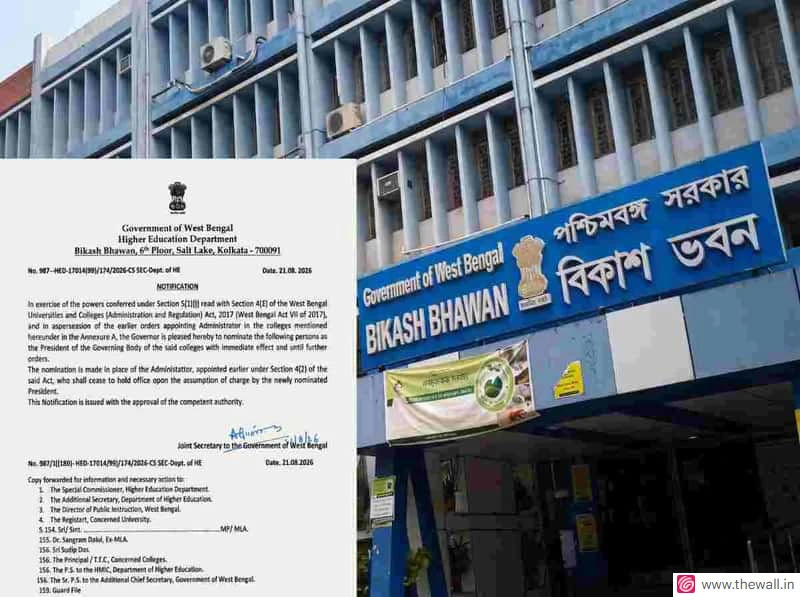
As soon as Education Minister Jagannath Chatterjee released the list of presidents of college governing bodies, the Opposition lost no time in attacking the BJP. Their main complaint was that the list included only BJP MLAs and MPs.
While speaking to the media, he defended the decision by saying that at least a graduate degree has been set as the minimum qualification for administering colleges. But that argument sounded rather hollow. Today, graduation is hardly an extraordinary qualification; it is, in many cases, the basic educational threshold. Perhaps that is why CJP is calling for higher-educated politicians to be appointed as ministers.
Yes, I remember that one of the BJP’s pre-election promises was to free educational institutions from politics. But honestly, I do not see anything wrong here. From my perspective, Jagannath Chatterjee has largely carried forward a political tradition that Bengal’s education system has witnessed for decades.. Isn’t that so?
Unfortunately, everyone seems interested in debating the list of Governing Body Presidents, but hardly anyone is asking the more fundamental question: Does Bengal have a strong, long-term education policy to pull the state out of its ongoing education crisis?
What is behind the Bengal Education Crisis?
The phrase Bengal Education Crisis should not be reduced to one controversial incident. It describes a wider institutional problem.
Education needs stability. Students need classrooms, teachers, laboratories, libraries, examinations and a predictable academic calendar. Universities need administrators who can take decisions without constantly looking over their shoulders. Teachers need professional independence. Students need the freedom to disagree without fearing political retaliation.
When these basic requirements become secondary to political calculations, the education system begins to lose its direction.
This does not mean that politics has no place in universities.
Universities should encourage debate. Students should understand different political philosophies. Young people have every right to participate in democracy. A campus without disagreement would hardly be a university.
There is a difference between students being politically aware and politics taking control of the campus.
The first can strengthen education.
The second can damage it.
A 2025 report reproduced in a university election notification cited earlier government committee observations that political activity could be healthy when it encouraged debate, but warned that disruptive political activity could interfere with examinations and academic work.
That distinction is crucial for Bengal today.
Has political influence become an old tradition?
This is where the debate becomes more complicated.
Let’s be honest: finger-pointing at whichever party is currently in Nabanna ignores decades of history. Bengal’s educational institutions have witnessed political influence under different political eras.
Even in 2012, shortly after the Trinamool Congress came to power, contemporary reporting raised questions about the presence of politicians in college governing bodies. The issue was not entirely new; the political composition of governing bodies had been debated before as well.
The concern, therefore, is not simply TMC versus BJP, or Left versus TMC, or Left versus ABVP.
The real issue is whether political parties of any colour should have disproportionate influence over academic institutions.
If one party controls a campus today and another party controls it tomorrow, merely changing the flag does not solve the problem.
The beneficiary may change, but the underlying problem remains.
That is why the debate should move beyond partisan arguments.
This time too, the education minister’s announcement of the list of Governing Body Presidents has sparked controversy.
Why governing bodies matter
One of the less visible aspects of the politicisation of education in Bengal is the composition of college governing bodies.
A college governing body is not supposed to function as a political party office. It deals with important administrative and institutional matters.
But political appointments can create a perception – or sometimes a reality – of political influence over academic administration.
A 2025 investigation by The Indian Express examined the presence of political leaders in governing bodies of several colleges in West Bengal. It reported that TMC leaders held governing-body positions at multiple colleges and noted that student representatives were absent because student-union elections had not been held for years.
That raises a fundamental question:
Should political experience be treated as a qualification for running an academic institution?
There may be legitimate administrative reasons for involving public representatives. But the system must have strong safeguards to ensure that academic decisions are not subordinated to political interests.
Otherwise, principals and teachers can find themselves caught between institutional responsibilities and political expectations.
That is not healthy governance.
Political analyst Biswanath Chakraborty regrets that the Suvendu-led BJP government has missed an opportunity to set a new precedent by appointing educationists as key administrators of higher educational institutions, which could have helped address the Bengal Education Crisis.
We respect his sentiment, especially given his own experience as a professor at a reputed Kolkata university. But with due respect, we would also like to point out that politicians are unlikely to put aside their political identity when making such decisions. For them, political considerations will almost always remain ahead of other priorities.
The hard reality is that even eminent teachers can eventually succumb to political pressure when they enter public office. The tragic suicide of Ashish Banerjee has also raised a disturbing question about the despair educationists may face when they become entangled in politics.
Student elections: democracy or political control?
The long-running controversy over student union elections in West Bengal provides another example.
The Calcutta High Court has dealt with petitions concerning student elections in state-affiliated universities and colleges. A 2025 court order recorded that processes relating to student-union elections had been kept in abeyance from 2013 onwards, with Jadavpur University being a notable exception for a period.
This is not a small administrative issue.
Student elections teach young people how democracy works. They learn how to campaign, debate, negotiate, organise and accept defeat.
But elections can also become problematic when political parties treat student organisations as extensions of their own structures.
The solution, therefore, should not be to eliminate student politics.
It should be to create transparent student democracy.
Students should be able to contest elections without intimidation. Political discussion should remain legitimate. Violence, coercion and the use of outsiders should not.
That is the difference between a university that teaches democracy and a campus that becomes a battlefield for political organisations.
Kolkata has also witnessed how political influence and alleged corruption can disrupt the lives of students and medical professionals.
Jadavpur University is the latest warning
The recent Jadavpur University violence is particularly disturbing because of the institution involved.
Jadavpur is one of Bengal’s most respected universities. Its reputation has been built over decades through teaching, research, engineering, science, humanities and independent intellectual culture.
Yet in August 2026, political tensions involving ABVP and Left-leaning student groups escalated into clashes. Reports described injuries, vandalism and police intervention. The university administration subsequently filed a complaint concerning alleged unauthorised entry by outsiders.
The controversy also spilled outside the campus, with rival rallies and confrontations leading to heavy police deployment.
There is an important lesson here.
It does not matter whether the political colour is saffron, red, green or any other colour.
A university should never become a place where political power is demonstrated through physical force.
The immediate victims are students.
Classes are disrupted. Examinations become uncertain. Parents become anxious. Teachers are forced to deal with security issues instead of academic work. The reputation of the institution suffers.
And the political organisations eventually move on.
Students are left behind.
The danger of replacing merit with loyalty
Perhaps the most damaging consequence of political interference in education is the erosion of merit.
A university or college should reward academic performance, research, teaching ability and professional competence.
If students begin believing that political connections are more useful than academic performance, the psychological damage can be enormous. This may not be the only reason, but it is certainly an important part of Bengal’s education problem.
Why work hard if influence matters more?
Why publish research if political loyalty determines recognition?
Why compete fairly if access to power provides shortcuts?
Once such perceptions become widespread, the damage extends beyond campuses.
Employers begin questioning qualifications.
Students lose confidence in institutions.
Parents start looking outside the state for educational opportunities.
Talented young people may choose universities elsewhere.
The education system then enters a vicious cycle.
Weak institutions produce weaker confidence. Weak confidence pushes talent away. The loss of talent further weakens institutions.
Teacher recruitment has also damaged public confidence
The Bengal Education Crisis cannot be discussed without addressing teacher recruitment.
The teacher recruitment controversy has become one of the most serious challenges facing public confidence in Bengal’s education administration.
The issue is not merely about legal cases or individual appointments. It is about the credibility of the recruitment system itself.
If a student studies for years to become a teacher and then believes that recruitment can be manipulated, the message is devastating.
A teacher is supposed to be one of the most trusted figures in society.
The recruitment process must therefore be exceptionally transparent.
Recent developments show that teacher recruitment remains an ongoing administrative challenge. In August 2026, the West Bengal School Service Commission and West Bengal Board of Secondary Education sought more time from the Supreme Court in relation to teacher recruitment deadlines.
The state needs to move beyond crisis management.
It needs a recruitment system that students, teachers and parents can trust.
Is everything wrong with Bengal education?
No.
That would be an unfair conclusion.
West Bengal continues to have excellent teachers, committed principals, talented students, strong universities and respected research institutions.
The state also has a deep educational culture that cannot disappear because of political controversy.
The official SCERT West Bengal portal, for example, lists studies examining educational outcomes, mathematics performance, dropout rates and out-of-school children. These studies show that the education debate involves much more than politics.
The ASER 2024 materials also provide a useful national and state-level evidence base for examining learning, enrolment and school conditions. The report includes a dedicated West Bengal section.
The real problem is when political interference is defended in the name of protecting free thought.
For visual background on the earlier Jadavpur University controversy, this 2025 report covers student protests involving the West Bengal education minister. Jadavpur University Chaos – Students Protest Against West Bengal Education Minister
These sources are important because education policy cannot be based entirely on political speeches.
It needs data.
How many children can read at their expected level?
How many can perform basic arithmetic?
How many teachers are available?
How many posts are vacant?
How many students drop out?
How many schools lack adequate facilities?
How much money is spent per student?
These are the questions that should dominate education policy.
What happens when politics becomes the priority?
The consequences are visible in several ways.
1. Academic calendars suffer
Protests, administrative disputes and campus conflicts can disrupt classes and examinations.
2. Institutional autonomy weakens
If administrators constantly anticipate political reactions, decision-making becomes cautious and compromised.
3. Student representation becomes distorted
When legitimate student elections are delayed while informal political influence continues, students lose a transparent mechanism for representation.
4. Merit loses credibility
Even the perception of political favouritism can undermine confidence in recruitment and appointments.
5. Violence becomes normalised
Once political groups learn that intimidation can produce results, the threshold for violence falls.
6. Parents lose confidence
Parents ultimately judge an institution by whether their children are safe, taught properly and given a fair opportunity.
7. Bengal loses talent
Students who have options may leave for institutions where they perceive greater academic stability.
These consequences are interconnected.
The BJP’s rise will change campus politics – but will it solve the problem?
The political landscape of Bengal has changed dramatically.
After the BJP’s 2026 electoral victory, reports indicated rapid expansion of RSS-linked organisations, including ABVP, across educational institutions. One report said ABVP leaders claimed their presence had expanded sharply across colleges after the election.
That development deserves attention.
But it also presents a test for the new political order.
If the argument has been that earlier governments politicised education, then the new administration must avoid repeating the same pattern with a different political organisation. Otherwise, the education crisis in Bengal may never come to an end, and we will never get back our glorious legacy.
Swapping a red flag for a saffron or green one isn’t reform – it’s just political rotation masquerading as change.
The real test is whether the government can create institutions where ABVP, SFI, TMCP and every other student organisation can operate within transparent rules without controlling academic administration.
That is the kind of change Bengal’s education system actually needs.
What should Bengal do now?
The state does not need another political promise.
It needs institutional reform.
Restore regular student elections
Student-union elections should follow clear rules, fixed schedules and transparent procedures.
Political parties should not be allowed to convert student bodies into recruitment centres for their own organisations.
Keep governing bodies professionally independent
Public representatives may have legitimate roles, but academic governance should include strong safeguards against partisan domination.
Make teacher recruitment completely transparent
Recruitment should be based on merit, publicly auditable procedures and clear timelines.
Protect campus security
No outsider should be able to enter a campus and create violence.
At the same time, security measures must not become an excuse to suppress peaceful student expression.
Protect academic freedom
Teachers and students must be free to disagree with governments, political parties and university administrations.
A university that cannot tolerate criticism cannot produce independent thinkers.
Publish institutional data
Universities and colleges should regularly publish information on vacancies, recruitment, finances, examinations, results and disciplinary actions.
Transparency reduces the space for political manipulation.
Education cannot be governed like a political office
This may be the most important point.
Political outfits run on cadre mobilization and loyalty tests; universities, on the other hand, run on research, skepticism, and student intellectual growth. Mixing the two ruins both.
A political campaign rewards loyalty.
Education must reward merit.
Confusing these objectives is dangerous.
The problem is not that students have political opinions. In fact, a politically aware student can be an asset to democracy.
The problem begins when political identity becomes more important than academic identity.
A student should be able to say, “I support this ideology”, without being forced to prove political loyalty to obtain a place in campus life.
A teacher should be able to criticise the government without being labelled an enemy.
A principal should be able to take an administrative decision without asking which political group might be unhappy.
That is what academic freedom means in practice. Do the politicians agree that unnecessary political intervention has triggered Bengal Education Crisis?
The Bengal Education Crisis is bigger than one party
It is tempting to turn every education controversy into a partisan argument.
One side blames the Left. Another blames the TMC. Another blames the BJP. Another points towards bureaucratic failure.
Some of these criticisms may have merit. But the larger problem is institutional.
If Bengal wants to rebuild its education system, it must create rules that survive changes of government.
Otherwise, every election simply produces a new version of the same problem.
The political colour changes. The system does not.
That is why the debate over the politicisation of education in Bengal must become a debate about institutions rather than personalities.
Can Bengal reclaim its educational legacy?
Yes, but only if education is placed above political convenience.
Bengal does not lack intellectual talent. It does not lack students willing to work hard. It does not lack teachers with knowledge and commitment.
What it needs is institutional discipline.
The state must restore the idea that a university is not an extension of the party office.
A college governing body should not become a political reward – rather, a parental body that remains dedicated to the students’ progress.
A student election should not become a recruitment exercise for a political party.
A teacher’s appointment should not depend on influence – political or financial.
A classroom should not become an ideological battlefield.
And a university gate should never become the stage for political violence.
The recent Jadavpur University events should therefore be treated as a warning, not merely another political confrontation. The university community itself has called for institutions to remain free from political interference following the recent violence.
The Bengal Education Crisis will not disappear through slogans.
The crisis will begin to ease only when institutions become stronger than the political networks around them.
That requires patience, transparency and political courage.
Most importantly, it requires every political party to accept one uncomfortable principle:
Education belongs to students, teachers and society – not to political parties.
If Bengal can restore that principle, its educational legacy can recover.
If it cannot, the political battle may continue inside campuses, but the real casualty will be education itself.
Knowledge Mart Final thought
The real measure of an education system is not how loudly political groups can occupy a campus.
It is how quietly a student can enter a classroom, learn from a good teacher, question an idea, sit for an examination and walk out believing that merit still matters.
That is the Bengal that generations inherited.
The challenge before the state is whether it can preserve it.
10 Key Takeaways
- At the heart of the Bengal Education Crisis is a simple concern: education is increasingly being pulled into political battles.
- Bengal’s problem cannot be blamed on one political party. Political influence in educational institutions has a much longer history.
- Student politics has a legitimate place on campus. But violence, intimidation and the involvement of outsiders cross a very different line.
- Regular student elections could give students a genuine democratic voice instead of leaving campus representation to informal political networks.
- College governing bodies should be guided by academic and administrative priorities, not political convenience.
- Recruitment must remain firmly rooted in merit. Without public trust in appointments, the credibility of the entire education system suffers.
- The recent Jadavpur University clashes offer a reminder of how quickly political confrontation can disrupt academic life.
- Teachers and students need the freedom to question those in power. That freedom is an essential part of any serious university.
- A change of government will not automatically change the system. Replacing one political influence with another would simply repeat the old pattern, but the underlying education crisis remains unresolved.
- Ultimately, Bengal needs stronger institutions, transparent processes and a clear separation between political competition and academic administration.