
Is TMC Twin Flower Locked a Blow for Mamata?
Politics sometimes has a wicked sense of humour. A party can spend years fighting its opponents, winning elections and building a powerful political brand, only to discover that the real battle has eventually moved inside its own house.
That is where the Trinamool Congress finds itself today.
After several hearings and the submission of documents by rival camps, the Election Commission has frozen the use of the All India Trinamool Congress name and its familiar “Flowers & Grass” symbol for the forthcoming West Bengal bypolls. Both factions have been asked to submit alternative names and free symbols. The order covers the Nandigram and Rejinagar bypolls. The New Indian Express reported the EC decision here.
So, for the coming bypolls, TMC Twin Flower Locked.
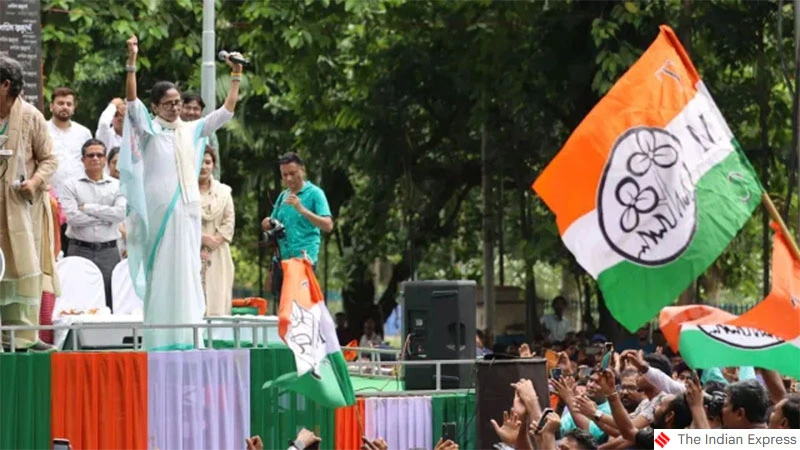
The Commission has not handed the symbol to the Ritabrata camp. But that does little to soften the blow for Mamata Banerjee. The twin flowers have been tied to her political identity ever since she broke away from Congress and built the Trinamool Congress as a separate political force.
The rebel camp wanted to challenge Mamata’s control over the TMC name, organisation and symbol. It has not got the symbol. Still it has achieved something significant: Mamata’s faction cannot carry the old TMC identity into these bypolls.
Stunning Event: Mamata Camp Loses Its Candidate
Mamata Banerjee’s TMC had fielded Sanchita Pradhan Dey as its candidate for the Nandigram bypoll, and she had already submitted her nomination papers. But after meeting Chief Minister Suvendu Adhikari on Friday, Sanchita went to the Haldia SDO office and withdrew her nomination. The sudden move has created a major political shock for the Mamata camp.
So, in practical terms, the Mamata All India Trinamool Congress will not have its own candidate in Nandigram. The faction has instead decided to support the Congress candidate. That leaves Mamata’s camp without a direct electoral presence of its own in the constituency.
For the BJP, this changes the contest considerably. Suvendu Adhikari has already appealed for a victory margin bigger than the BJP’s Falta margin, setting a clear target for his camp.
The contest, however, is not simply a BJP-CPI fight. Congress is now in the field with Mamata’s support, while the Ritabrata-led rebel TMC faction has also put up a candidate. The real political question is how these votes will be divided – and what the collapse of the Mamata camp’s own candidature means for the TMC’s organisational strength in Nandigram.
Should Mamata Visit an Astrologer?
Mamata Banerjee is going through a remarkably difficult political phase. Should she visit an astrologer? Perhaps that would not be the worst suggestion at this point.
Mamata has always been known for her long walks. Perhaps it is time for another long walk – this time for some political introspection before placing Abhishek Banerjee even more firmly at the centre of the party.
The setbacks have kept coming. And this time, the problem is bigger than an election symbol. What is being tested is the political certainty that once surrounded Mamata and the TMC – the assumption that the party’s name, organisation and electoral machinery would ultimately move in one direction.
The change was already visible during the Special Intensive Revision process. Mamata Banerjee and her party opposed the exercise and challenged the Election Commission’s approach. She went to the Supreme Court and argued that the 2024 electoral rolls should be used for the 2026 election. But the process moved ahead anyway, and officials continued to follow the Commission’s directions.
For someone who had spent fifteen years with enormous influence over Bengal’s government and administration, this was a very different political environment. Power has a strange way of bringing even unlikely people together.
The Bhabanipur Challenge
The pressure increased when Suvendu Adhikari decided to contest Bhabanipur against Mamata Banerjee in the 2026 Assembly election. The BJP fielded him from both Bhabanipur and Nandigram, turning the Kolkata seat into another direct Mamata-Suvendu contest. The Economic Times reported on his Bhabanipur nomination.
Mamata has spent decades reading Bengal’s political mood, so she would have understood what that challenge meant.
Then came the result. Suvendu defeated Mamata in Bhabanipur, and the BJP went on to form the government in Bengal. Mamata questioned the legitimacy of the mandate, adding another layer to an already bitter post-election battle.
The situation eventually reached an unusual constitutional point. After the Assembly’s term ended, Governor R N Ravi dissolved the West Bengal Legislative Assembly with effect from May 7. Reports at the time said Mamata had refused to resign despite the election result. The Indian Express reported the Assembly’s dissolution.
Some sympathy came from within the wider INDIA alliance. But sympathy cannot replace political power. The national equation had changed too. Mamata, once one of the strongest regional voices in opposition politics, now had to deal with a landscape in which Congress and Rahul Gandhi remained important players.
It was hardly the political position Mamata would have wanted. Now “TMC Twin Flower Locked” has become the worst possible blow to Mamata.
The TMC Split Came at Lightning Speed
The internal crisis then moved much faster than many expected. Mamata had built the TMC around a highly centralised leadership model. For fifteen years, that model worked because party power and government power were moving together. Winning elections strengthened the organisation; controlling the government strengthened the leadership.
Take away the government, and that balance changes quickly.
The bureaucracy and police, which had worked under her government for fifteen years, now had a different political master. That alone changed the atmosphere around the former ruling party.
Rebellion followed. The Ritabrata camp became the most visible challenge to Mamata’s authority, while the NCPI episode added another layer to the fragmentation. What had once looked like one tightly controlled political organisation began to resemble several groups claiming the same legacy.
And then came the question nobody inside the party could avoid forever: what happens after Mamata?
As Abhishek Banerjee moved closer to the party power, unease grew in parts of the organisation. The question was no longer simply whether Mamata would remain the undisputed leader. A harder question was emerging: who would control the TMC after Mamata, and would the old guard accept that transition?
The changing equations involving long-time leaders and aides made that tension more visible.
That is what makes the revolt so painful for the TMC. This is not an outside enemy trying to break the party. The fight is between people who spent years under the same roof, worked for the same organisation and helped build the same political machine.
From Political Authority to Court Battles
The change is visible even in Mamata’s public engagements. She has faced hostile slogans at Halisahar, while Abhishek Banerjee encountered similar resistance at Sonarpur. Such incidents cannot establish the mood of an entire electorate, but they do show that the political environment around the TMC leadership is no longer as predictable as it once was.
The courts have also become part of the story. Different TMC factions organised programmes around Martyrs’ Day and TMCP Foundation Day amid restrictions and legal conditions. Mamata’s proposed Serampore meeting also required court intervention, with the Calcutta High Court permitting the rally subject to conditions. The Telegraph reported on the Serampore order.
The irony is hard to miss. A party that spent fifteen years running Bengal now finds some of its political programmes being shaped by court orders and institutional conditions.
That does not by itself prove political decline. But it is certainly a striking change from the past.
Congress: Another Sign of the Changed Equation
Congress provides another small but revealing piece of the puzzle.
Reports suggested that the Mamata faction approached Congress over possible coordination in the coming bypolls, but the Bengal Congress chose to contest separately. The Times of India reported on the proposed bypoll understanding.
It would be too early to say that TMC and Congress can never work together again. Bengal politics has seen too many reversals for that kind of certainty. But the episode does show that their relationship is no longer what it once was. Any future understanding will have to be negotiated on new political terms.
Kalyan Banerjee’s earlier statement adds another layer to the story. After the September 12 EC meeting, he said the faction would fight the bypolls on the TMC symbol as long as the Commission had not removed Mamata as chairperson. The Week reported his comments after the EC meeting.
Only days later, the Commission froze the symbol for both camps. Will the news TMC Twin Flower Locked become a virtual victory for Ritabrata camp?
The timing tells its own story. On the afternoon of September 17, the faction was still talking about fighting under the TMC symbol. Within hours, the Commission had frozen it for both camps.
Why the Twin Flower Symbol Matters
The TMC’s twin flowers were never just an election mark. They became part of Mamata Banerjee’s political identity. For years, the flowers appeared everywhere – on flags, walls, posters and campaign material – until the symbol itself became almost inseparable from Mamata’s politics.
That is why the sight of Mamata’s faction fighting an election without the twin flowers will be politically striking.
For the coming bypolls, voters will have to identify rival factions through new names and symbols rather than relying on the familiar TMC brand.
The Commission has not yet decided the larger question of which faction is entitled to the Trinamool Congress name and reserved symbol. Its present order is an interim arrangement for the bypolls. Both factions have been asked to submit alternative names and free symbols while the larger dispute continues.
For Ritabrata, however, this creates a political opening. His camp had been challenging Mamata’s control over the party identity, and the old certainty that Mamata’s faction would campaign under the twin flowers has now disappeared, at least for these bypolls.
Symbol Finalized
The Election Commission has finalised the names and symbols for the two rival camps led by Mamata Banerjee and Ritabrata Banerjee.
In a directive issued on Friday, the Election Commission said Mamata’s faction will contest under the name “Mamata All India Trinamool Congress”. Its election symbol will be the Football Player. Ritabrata’s faction will contest as the “Democratic Trinamool Congress” and use the Envelope as its election symbol.
The real danger is not just the unfamiliar names and symbols. The bigger test will be whether the factions can make voters recognise them at the grassroots. Without a strong booth-level organisation, a new name and symbol can easily become invisible on polling day.
Nandigram and Rejinagar Become the First Test
The timing could hardly be more dramatic. The Nandigram and Rejinagar bypolls are scheduled for October 6, and rival TMC factions had already announced candidates while claiming the party identity.
Now they must enter the contest under separate names and symbols. Voters will have to distinguish between camps that were, until recently, part of the same organisation. India Today also reported on the EC’s decision.
Nandigram carries obvious political history for Mamata because of her association with the anti-land-acquisition movement and her 2021 contest against Suvendu Adhikari. Rejinagar has a very different local political equation.
The two bypolls will give voters the first real chance to see what these rival claims are worth at the ballot box, without the familiar TMC name or twin flowers on either side.
Political analyst Biswanath Chakraborty sees the TMC Twin Flower Locked episode as a serious political blow to Mamata Banerjee. But, the real test is still to come: will Mamata step out and campaign for a faction that cannot even use the party’s familiar symbol?
That decision could say a great deal about the strength of Brand Mamata without the twin flowers beside it. If Mamata takes the campaign to the ground, it will show whether her personal political appeal can still stand on its own. If she stays away, we believe it could signal that the confidence once placed in Brand Mamata has been seriously shaken.
Does TMC Have an Ideological Glue?
This may ultimately be the hardest question for the party.
A party can lose an election and survive. The harder test comes when power is gone and the workers have to decide why they should stay.
Sometimes the answer is ideology. Sometimes it is a social movement, a regional identity or simply a strong organisation. The TMC now has to show what its own glue is.
Consider regional parties such as the Samajwadi Party, Rashtriya Janata Dal or DMK. Their politics and histories are very different, but each has developed identifiable social or ideological foundations around which its organisation has operated.
The TMC was built around a different kind of political mission. Mamata’s central target was the CPI(M)-led Left Front, and in 2011 she finally achieved what had once looked almost impossible: ending 34 years of Left rule in Bengal. But defeating the Left and building an ideology are two very different things.
For fifteen years, government power, political organisation and Mamata’s personal popularity reinforced one another. With government power gone, some of those weaknesses are now much harder to hide.
So the real question is simpler and more uncomfortable: can the TMC hold together when there is no government behind it?
Will TMC Really Disappear?
Here the claim made by BJP state president Samik Bhattacharya needs to be treated as a political claim, not as an established fact. Nevertheless TMC Twin Flower Locked is a temporary decision.
Samik has repeatedly argued that the TMC has become “nirmool” or eradicated. In an ABP Ananda report, he said that Trinamool had gone and that its leaders were attempting to return under different names. ABP Ananda reported his remarks here.
He has made similar comments in video interviews and public appearances, arguing that there is effectively no TMC left in the old political sense. ABP Ananda’s video report carries another version of his argument.
But does that mean the TMC will disappear? Not necessarily. Parties split. Parties weaken. And Indian politics has seen parties return from much worse positions than this. The current EC order certainly does not prove that Trinamool is finished.
But his claim cannot simply be dismissed either. The TMC is now facing the very test that matters: what is left of the organisation when government power is no longer there to support it?
Knowledge Mart Final Thoughts
Mamata Banerjee has survived political storms before. She defeated the Left Front, built the TMC into a major political force in Bengal and remained at the centre of state politics for more than a decade.
But this crisis is different because the challenge is no longer coming only from outside.
The fight has entered the TMC’s own house.
The TMC Twin Flower Locked episode is therefore about more than a symbol. The Election Commission has not given the twin flowers to Ritabrata, but it has taken them away from both sides for the coming bypolls. That alone changes the political picture.
At the same time, the party is dealing with rival factions, a difficult relationship with Congress, questions over succession and the organisational consequences of losing power.
For years, TMC meant Mamata, and the twin flowers meant TMC. That connection is now being tested in public.
For now, nobody can say whether this is a temporary disruption or the beginning of something much bigger inside the TMC. The October bypolls will provide the first hard evidence. Without the familiar name. Without the twin flowers. And without the comfort of government power behind them.
10 Key Takeaways
- TMC Twin Flower Locked: The Election Commission has frozen the TMC name and Flowers & Grass symbol for the coming bypolls, affecting both rival factions.
- The EC decision is not a victory awarding the symbol to Ritabrata, but it does prevent Mamata’s faction from using the familiar identity in these contests.
- Mamata Banerjee is facing several political pressures at the same time – from the TMC split and institutional battles to the loss of government power.
- The Ritabrata camp’s challenge has moved the dispute from an internal party fight into a formal battle over the TMC’s name, organisation and electoral identity.
- The Congress episode and Kalyan Banerjee’s earlier comments show how quickly the political situation around the TMC has changed, even though future alliance arrangements remain uncertain.
- For decades, the twin flowers were closely associated with Mamata’s political brand. Their absence from the bypoll ballot makes Mamata without the Twin Flower Symbol an unusual electoral situation.
- Nandigram and Rejinagar will provide an early electoral test of how the rival factions perform when they cannot rely on the traditional TMC name and symbol.
- The TMC’s internal crisis also raises a larger question about whether the party has an organisational or ideological foundation strong enough to survive outside government.
- BJP state president Samik Bhattacharya has repeatedly claimed that the TMC has become “nirmool”. That remains his political assessment, not an established fact about the party’s future.
- Ultimately, the bigger story is not just the frozen symbol. The TMC is being forced to prove what remains of its organisation when Mamata’s personal authority, government power and familiar electoral identity are all under pressure.