
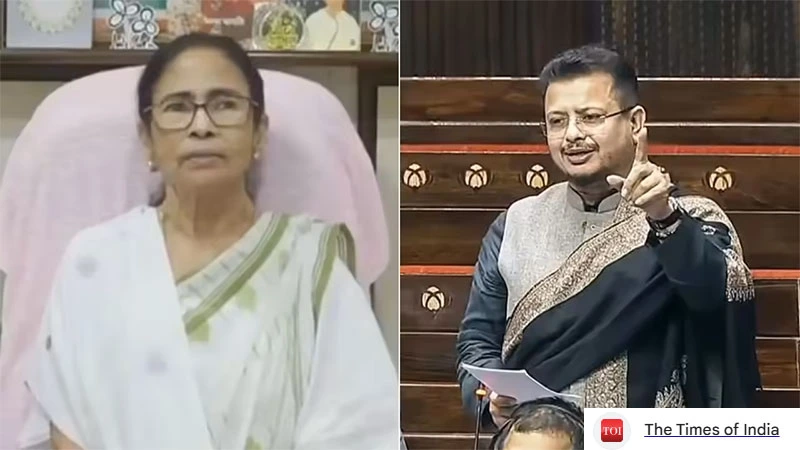
Latest Update on TMC Symbol Fight
The Election Commission of India has called both factions for separate meetings on 12 September 2026. The Commission has also asked both sides to submit their final set of additional details, particulars and documents by 3 PM on 16 September. If required, another round of hearings may be held on 17 September.
The TMC Symbol Fight has become even more important with the Election Commission announcing the Nandigram and Rejinagar by-elections for 6 October 2026. The timing could put further pressure on the Commission to settle the dispute over the party’s name and election symbol.
Who Wins The TMC Symbol Fight?
Oh, whose twin-flower or the iconic Joraphool of the soil art thou?
Does thy true stem belong to Mamata’s unyielding brow,
Or shall it bend to Ritabrata’s rebellious vow?
From the pristine hour when the crimson sun first ascends the eastern skies,
To the dead of night when the silver moon sits supreme in her midnight highs-
A singular tempest rages, a battle-cry that never dies:
The great and terrible war for the Trinamool’s sacred prize.
This burning debate has taken over everything from heavy political talk-shows to casual chats at local tea stalls.
As the TMC symbol fight trends across TV channels, YouTube videos, and social media reels, ordinary citizens are asking just one thing: who will ultimately win this battle? For visual coverage of this escalating political crisis, you can watch the NDTV Report on the Trinamool HQ Showdown or follow the ANI Video Coverage of the ECI Hearing.
Did Mamata’s Facebook Live Signal Defeat?
Chief Minister Mamata Banerjee’s latest Facebook Live broadcast left many political analysts stunned. In fact, her defensive tone suggested that she might be on the back foot in this ongoing Trinamool party dispute.
According to recent reports on the Economic Times EC Hearing Update, the poll panel has demanded strict documentation from both rival camps to resolve who holds true executive authority.
| Core Political Question | Public Sentiment |
|---|---|
| Whose Joraphool is it? | Moving from curiosity to frustration |
| Who will win the symbol? | Massive public anxiety |
While the ECI symbol dispute initially sparked high curiosity, the endless drama is now testing public patience. Many citizens find this wave of unprincipled politics deeply exhausting. For an in-depth breakdown of the legal arguments, read the full national coverage on the Times of India TMC Crisis Analysis.
Key Takeaways from the ECI Symbol Row
- The Power Shift: The ongoing TMC symbol fight has moved from drawing-room speculation straight to the doors of the Election Commission.
- Declining Patience: Voters are increasingly irritated by the shifting loyalties and tactical delay tactics of rival leaders.
- Defensive Tone: Mamata Banerjee’s uncharacteristic defensive stance online indicates massive internal pressure.
Why are Leaders Deserting the Ruling Party?
Every single day, another politician claims their “conscience” has suddenly woken up. Consequently, they distance themselves from Mamata Banerjee.
However, let’s be realistic. According to independent analysts at Knowledge Mart, this has nothing to do with morality. Instead of hiding behind excuses, these leaders should just admit the truth: a secure political shelter is far more attractive than staying on a sinking ship.
Details surrounding the mass desertion of lawmakers are outlined in the India Today Trinamool Bhavan Seizure Report, showing that a critical mass of MLAs has shifted allegiance.
Ultimately, we live in an era where even family relationships have become purely transactional. Therefore, lecturing voters about ethics and political conscience during this brutal TMC symbol fight makes very little sense.
Who Holds the Real Power? The Final Verdict Lies with the EC
The Election Commission of India (ECI) holds the ultimate authority to make the final decision regarding this historic political crisis. Crucially, the poll panel has already conducted comprehensive hearings to evaluate arguments from both rival factions.
To settle the intense TMC symbol fight, the EC must carefully weigh three core parameters:
- Organisational Control: Which faction holds actual authority over the primary party committees? Detailed developments can be tracked through the The Hindu’s coverage of Ritabrata’s faction meeting the EC.
- Legislative Majority: Which group commands the backing of the majority of elected public representatives, including MLAs and MPs? For a look at the physical showdown on the ground, view the ANI Live Broadcast of the TMC Symbol Battle.
- Constitutional Validity: Which camp strictly adhered to the rules laid down in the official party constitution? Review the legal complexities via the News9 Video Analysis on the Trinamool Power Struggle.
Let’s Delve into the history as it never betrays us, rather it works as a guiding star.
Party Symbol Retention After Splits (India)
| Year | Party | Split Between | Leader Retaining Symbol | Symbol | ECI Decision Basis | Outcome |
|---|---|---|---|---|---|---|
| 1969 | Indian National Congress | Congress (O) vs Congress (R) | Indira Gandhi | (Later) Hand | Mass support + electoral dominance | Original symbol frozen; later Indira’s faction became main Congress |
| 2017 | Samajwadi Party | Mulayam Singh Yadav vs Akhilesh Yadav | Akhilesh Yadav | Cycle | Majority support (MLAs + party members) | Akhilesh faction recognized as real SP |
| 2017 | JD(U) | Nitish Kumar vs Sharad Yadav | Nitish Kumar | Arrow | Organizational + legislative majority | Nitish retained party control and symbol |
| 2017 | AIADMK | EPS vs OPS | Unified faction (later EPS-led) | Two Leaves | Initial dispute → later merger | Symbol frozen initially, later restored |
| 2021 | Lok Janshakti Party | Chirag Paswan vs Pashupati Paras | Split outcome | Bungalow (earlier) | Division in MPs | Party split; symbol effectively lost to restructuring |
| 2022 | Shiv Sena | Uddhav Thackeray vs Eknath Shinde | Eknath Shinde | Bow & Arrow | Majority MLAs + MPs | Shinde faction declared real Shiv Sena |
| 2023 | NCP | Sharad Pawar vs Ajit Pawar | Ajit Pawar faction | Clock | Legislative majority | Ajit faction got official NCP status |
Comparing the Trinamool Row to Maharashtra’s Shiv Sena Split
Not long ago, we witnessed the Election Commission award the official party name and symbol to Eknath Shinde and Ajit Pawar during similar political crises in Maharashtra.
However, independent commentators at Knowledge Mart point out a massive flaw in trying to compare Eknath Shinde’s rebellion with Ritabrata Banerjee’s actions.
| Leader Profile | Eknath Shinde (Maharashtra) | Ritabrata Banerjee (Bengal) |
|---|---|---|
| Public Support | Commands an immense, independent grassroots voter base. | Lacks a proven personal mass base among the public. |
| Political Identity | A deeply rooted, mass-oriented grassroots leader. | Seen widely as a tactical political opportunist. |
A Political History Marked by Controversies
In the game of shifting loyalties, Ritabrata has seemingly tried to outplay the greatest tacticians. In fact, few contemporary politicians share his unique track record of being expelled from two completely different political organizations.
In addition, his claim of enjoying genuine public support falls flat after recent events in Baruipur. Local updates published in the Times of India Baruipur Ground Report highlight how he had to be surrounded by security personnel just to navigate hostile crowds.
Protesters branded him a traitor, and he was seen hurriedly fleeing the area under an umbrella to escape public anger.
You can read additional details about this public backlash in the Indian Express Report on the Baruipur Agitation. Therefore, claiming that he commands a deep grassroots following in Bengal is nothing short of an embarrassment.
Can the Assembly Speaker Override the Election Commission’s Authority?
The strategic maneuvers within the state legislature have drastically complicated the ongoing TMC symbol fight. By aligning with the Nationalist Citizens Party of India (NCPI), Kakoli Ghosh Dastidar and her breakaway group have rapidly pushed a previously obscure political party into mainstream daily headlines.
This sudden realignment leaves the remaining loyalists of Mamata’s camp in a mathematically vulnerable position, making it exceptionally difficult to prove a solid organizational majority on paper.
The legislative landscape further emphasizes this numerical disparity:
- The Parliamentary Shift: Following high-profile resignations by Lok Sabha and Rajya Sabha lawmakers, Ritabrata’s camp has lost the ground required to establish a commanding majority.
- The Assembly Equation: Ritabrata and his associates are operating with a clear reliance on their numbers in the state legislative assembly.
- The Current Strength: Inside the house, the power balance places the dissident faction comfortably ahead with an estimated 65 legislators, compared to just 15 remaining loyal to Mamata’s faction.
However, an essential constitutional question must be addressed: can the local rulings of an Assembly Speaker dictate the final outcome of a completely distinct, independent national body like the Election Commission of India (ECI)?
According to legal experts at Knowledge Mart, there is a fundamental difference between handling anti-defection proceedings inside a state assembly and determining the ownership of a registered party symbol.
An Assembly Speaker’s decision is confined to floor management, whereas the EC holds the exclusive mandate to award official party names and symbols nationally.
Are India’s Top Independent Constitutional Institutions Truly Unbiased?
Skeptics and political observers frequently question whether independent administrative bodies can retain complete neutrality under intense political pressure.
Critics argue that central and state institutions often lean toward satisfying their respective ruling governments.
To evaluate this ongoing debate, the structural and administrative differences between central and state-level regulatory panels can be observed:
| Regulatory Body | Controversial Administrative Changes & Precedents |
|---|---|
| Central Election Commission (ECI) | Critics point heavily to recent central legislation that altered the selection panel for the Chief Election Commissioner. The new framework systematically replaced the Supreme Court judge with a government representative, raising concerns about institutional autonomy. |
| State Election Commission (WB) | Observers consistently highlight the past tenure of former West Bengal State Election Commissioner Rajiva Sinha. Despite severe reprimands and strict censures from the High Court, his administrative actions were widely viewed as a direct attempt to appease the state’s ruling power. |
Why Institutional Neutrality Remains a Burning Question
The history of institutional bias continues to fuel severe skepticism among voters.
For a closer look at the administrative actions that severely dented public faith in state-level election bodies, you can read the Peoples Democracy Report on the Bengal Election Controversy or track the judicial pushback via the Indian Kanoon Record of the High Court Legal Battle against Rajiva Sinha.
Furthermore, to understand how deeply entrenched this distrust is, you can watch the News18 Video on the Governor-SEC Standoff which exposed major institutional cracks.
Consequently, as the high-stakes TMC symbol fight plays out before the national poll panel, the ultimate test is whether the ECI will rule purely on rigid constitutional metrics or if structural political alignments will quietly influence the final verdict.
Who is the Real Face of the Party? The Ultimate Showdown
When you strip away the legal jargon, an essential question remains: who actually represents the soul of the party? Trying to compare a veteran mass leader like Mamata Banerjee with a tactical floor-crosser like Ritabrata Banerjee is almost comical.
Even the harshest critics of the former Chief Minister openly admit that her charismatic mass appeal remains unmatched in Bengal politics.
The stark difference between the two leaders becomes obvious when looking at recent numbers and ground realities:
- The Vote Factor: The core base of support that the party retained in the recent assembly elections is entirely a result of Mamata Banerjee’s personal popularity.
- The Ground Reality: While Mamata still commands a dedicated following, observers ask whether Ritabrata would even have the courage to organize a single political rally in his own home constituency without heavy police protection.
- Organizational Power: Ritabrata completely lacks the grassroots machinery or personal organizational weight required to pull off a large public gathering on his own.
The Internal Friction: How Nepotism Weakened the Ranks
Despite her undeniable charisma, political analysts at Knowledge Mart point out that Mamata Banerjee’s current political isolation is a crisis of her own making.
Her continuous efforts to elevate her nephew, Abhishek Banerjee, to the absolute top of the party hierarchy became a major point of resentment. For years, this nepotistic push made the nephew an eyesore for many seasoned party veterans, ultimately driving them straight into the rebel camp.
| Political Entity | Grassroots Mass Appeal & Strengths | Primary Vulnerabilities & Core Weakness |
|---|---|---|
| Mamata Banerjee Faction | Retains deep personal popularity among a large portion of rural voters. | Severely crippled by internal resentment against Abhishek Banerjee’s leadership. |
| Ritabrata Banerjee & Co. | Holds a massive two-thirds legislative majority inside the state assembly. | Completely dependent on legislative numbers; lacks an independent, loyal voter base. |
Can Legislative Numbers Outweigh a Mass Leader?
To understand the mechanics behind this dramatic split and how the internal rebellion unfolded, you can read the Times of India Report on the Defection Crisis or review the detailed Economic Times Breakdown of the ECI Notices.
Additionally, veteran journalists discuss the national fallout of this power struggle in the Barkha Dutt Mojo Story Interview on the Trinamool Collapse.
Ultimately, this TMC symbol fight presents a unique dilemma for the Election Commission. Ritabrata might hold the structural majority of lawmakers on paper, but out on the streets of Bengal, the identity of the party is still deeply intertwined with the name of Mamata Banerjee.
Is Political Opportunism Clouding Long-Term Leadership in Bengal?
When examining political morality, the irony of the current situation is striking. It is well-remembered that Ritabrata Banerjee initially entered the core circles of the ruling party by holding the hand of Abhishek Banerjee. Yet, today, he spearheads the internal rebellion against that very setup.
The ground realities for the dissident MPs in New Delhi tell a very telling story. During their recent visits to Baruipur, prominent leaders like Dr. Kakoli Ghosh Dastidar and Saayoni Ghosh faced severe public fury first-hand. Hostile crowds cornered them, chanting slogans like “thieves” and “traitors”, which forced them to hurriedly retreat from the spot.
| Leader Profile | Political Background & Public Recognition | Voter Perception & Legacy |
|---|---|---|
| Dr. Kakoli Ghosh Dastidar | A seasoned medical professional and a long-time veteran of Mamata’s original street-fighter brigade. People recognize her independent political identity. | Viewed as an established political figure despite facing current public anger. |
| Ritabrata Banerjee | A leader heavily dependent on strategic floor crossings and tactical realignments within the legislature. | Largely remembered by the electorate as a highly opportunistic political figure. |
The Harsh Reality Check for Tollywood Celebrities in Politics
According to independent political analysts at Knowledge Mart, this massive friction highlights a deep divide between public recognition and grassroots loyalty.
While veteran leaders like Kakoli Ghosh Dastidar have spent decades building public familiarity, newer entrants are learning that drawing crowds to an entertainment venue is completely different from managing highly charged political environments.
The prominent Tollywood stars who became MLAs and MPs are now facing a brutal reality check.
The cinematic world of calculated scripts and simulated adoration does not translate smoothly into the raw, unforgiving arena of grassroots West Bengal politics, where shifting loyalties are met with immediate public backlash on the streets.
The Real Worth of a Political Symbol: Can Assets and Icons Win Elections?
Let us consider a hypothetical situation for our readers at Knowledge Mart. Imagine the Election Commission of India (ECI) officially declares the rebel faction led by Ritabrata Banerjee as the rightful owners of the original party identity.
Practically overnight, the dissident camp secures access to frozen bank accounts containing hundreds of crores, along with absolute rights over the iconic Joraphool symbol.
The core question is simple: what does Ritabrata and his associates plus the frozen assets and the symbol add up to mathematically? In reality, the net political value will amount to absolutely zero.
Consider the absolute dependency of the party’s leadership structure on a single face:
- The Loyalty Factor: Excluding a very few of seasoned organizational giants like Firhad Hakim, how many sitting legislators can actually win a direct election without utilizing the photograph of Mamata Banerjee? The realistic answer is none.
- The Ground Reality: A rose remains a rose by any other name. Similarly, if Mamata Banerjee is stripped of her official party symbol and hits the streets as an independent mass leader, public loyalty will not shift to a corporate boardroom.
The Resilience of Street Politics vs. Institutional Control
History stands as a powerful testament to Mamata Banerjee’s independent political endurancenc. Observers at Knowledge Mart frequently recall the tumultuous period of 2004, when her party was virtually wiped out, managing to secure just a single Lok Sabha seat in New Delhi.
Though, within five short years, she completely revolutionized the political landscape of West Bengal by spearheading the historic grassroots agitations in Singur and Nandigram.
| Political Epoch | Organizational Strength & Status | Grassroots Impact & Result |
|---|---|---|
| The 2004 Debacle | Reduced to a solitary parliamentary seat; widely written off by national media. | Laid the foundational groundwork for massive anti-land acquisition movements. |
| The Current 2026 Crisis | Facing severe institutional battles, internal rebellions, and the weight of 15 years in power. | Retains her core individual connection with the rural electorate, independent of official symbols. |
Why Writing Off Veteran Leaders Remains a Major Risk
Admittedly, the current administration faces severe headwinds. The accumulating stains of a continuous 15-year tenure alongside natural age factors present unprecedented vulnerabilities.
However, history proves that sounding the final political death knell for a seasoned street-fighter like Mamata Banerjee is an incredibly dangerous miscalculation for her rivals in the ongoing TMC symbol fight.
Exclusive for Knowledge Mart Viewers
The ultimate resolution of the TMC symbol fight will undoubtedly shape the future of Bengal’s political landscape.
While the rebel faction under Ritabrata might temporarily secure bureaucratic victories, institutional assets, or official legal titles, history shows that deep-rooted mass loyalty cannot be frozen in a bank account or transferred by a court decree.
For the electorate, the true identity of a populist movement remains tethered to its grassroots origin.
As a result, the real test of power will not unfold within the quiet offices of the Election Commission, but out on the unforgiving streets of West Bengal during the next electoral showdown.
10 Crucial Takeaways From the High-Stakes Trinamool Power Struggle
- The Ultimate Deciding Authority: The Election Commission of India (ECI) holds the exclusive constitutional mandate to resolve the intensifying TMC symbol fight and award the party’s official identity.
- The 3 Core Metrics of Evaluation: To determine ownership, the EC will strictly examine organizational control, legislative majorities (MLAs and MPs), and adherence to the official party constitution.
- A Flawed Maharashtra Comparison: While the EC previously awarded symbols to breakaway factions in Maharashtra, comparing a mass leader like Eknath Shinde to Ritabrata Banerjee is politically inaccurate due to the latter’s lack of a grassroots base.
- The Numerical Assembly Disparity: The rebel faction currently commands a massive legislative advantage inside the state assembly, holding an estimated 65 legislators compared to just 15 remaining loyal to Mamata Banerjee.
- Speaker vs. Election Commission: Legal analysts at Knowledge Mart emphasize that an Assembly Speaker’s floor management rules under the anti-defection law cannot dictate the national EC’s final verdict on symbol ownership.
- The Threat of Institutional Bias: Public skepticism surrounding the autonomy of central and state election bodies continues to rise, fueled by structural changes to selection panels and past administrative controversies in Bengal.
- Unmatched Individual Mass Appeal: Despite her current political vulnerabilities, Mamata Banerjee’s personal charismatic appeal remains the primary reason the party retained its core voter base in recent elections.
- The Cost of Internal Nepotism: The continuous political elevation of nephew Abhishek Banerjee served as a primary catalyst for the rebellion, turning him into an eyesore for long-time party veterans.
- A Severe Reality Check for Tollywood: High-profile celebrity lawmakers are facing unprecedented public anger, discovering that cinematic popularity fails to translate into street-level political loyalty during a crisis.
- The Power of the Street Over Assets: Even if the rebel camp captures the official Joraphool symbol and hundreds of crores in frozen bank accounts, their net electoral value could still amount to zero without Mamata Banerjee’s face on their banners.