
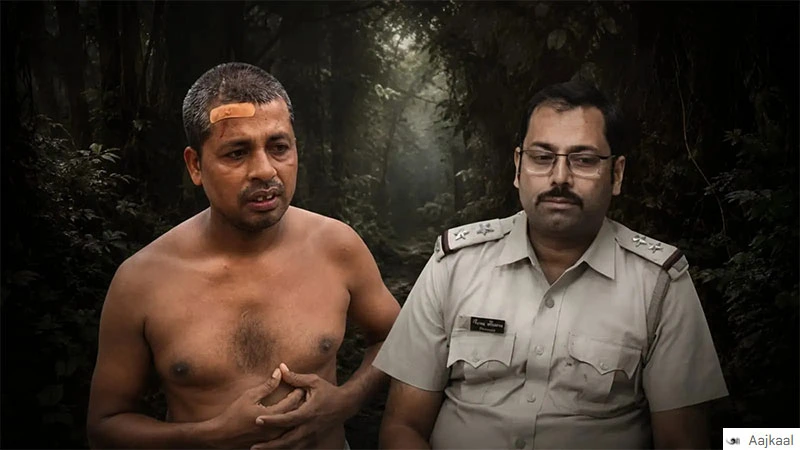
Shocking Baruipur Encounter: Was it a real crackdown or a staged event?
The clock struck 12:45 AM. The streets of Baruipur, West Bengal, were dead silent. A heavy police van tore through the darkness, carrying a man accused of a monstrous crime. He was being taken for a crime scene reconstruction.
Minutes later, gunshots shattered the night. The main suspect lay dead in a pool of blood.
The police called it self-defence. The opposition called it a staged execution. The internet erupted.
The Shocking Baruipur Encounter has forced a dark question into the public domain: Has the rule of law been replaced by instant street justice?
What Really Happened During the Shocking Baruipur Encounter?
According to the official police statement, the law enforcement team took the prime accused, Prabhas Mondal, to Surjyapur to reconstruct the sequence of events of a brutal minor rape and murder case.
The structural flow of what the police claim happened, balanced against mounting public skepticism and the intense local political backdrop, is laid out below:
Official Police Narrative vs. Public Skepticism
| Official Police Account | Critical Questions & Public Skepticism | Campaign Context & Political Landscape |
|---|---|---|
| The accused snatched a loaded firearm from an escorting constable. | Why wasn’t a dangerous suspect properly handcuffed during a late-night transport? | During the recent election campaigns, opposition leader Suvendu Adhikari openly stated that if the BJP comes to power in West Bengal, they will actively implement the Yogi Model to clean up crime. |
| The suspect fired at the police team and tried to sprint into the dark. | How could an untrained, single individual overpower multiple armed and trained professionals? | Critics argue this campaign promise creates a dangerous atmosphere where law enforcement feels politically backed to bypass standard legal procedures. |
| Cops were forced to fire back directly in self-defence, killing him. | Why were the shots fired directly at vital organs (chest and waist) instead of non-lethal areas like the legs to incapacitate him? | The incident is being viewed by many not as an isolated event, but as an unofficial testing ground for the aggressive policing strategies promised on the campaign trail. |
The state government has since handed over the case to the Criminal Investigation Department (CID) to conduct an independent CID probe. Concurrently, a parallel judicial inquiry is underway to check for gaps in the story.
For deep analytical updates on how these investigations unfold, independent digital forums like Knowledge Mart track administrative accountability of Shocking Baruipur Encounter closely.
Is the UP Yogi Model Spreading Its Tentacles Across India?
The incident in West Bengal is not an isolated event. Observers note that the controversial Yogi Model of Uttar Pradesh – famed for its aggressive, bullet-first approach to law enforcement – is fast becoming a national template.
We are witnessing a dangerous trend where multiple state governments are subtly adopting this heavy-handed system. The tentacles of instant police justice have spread far beyond UP:
- Uttar Pradesh: Bulldozer action and frequent encounter killings aimed at crushing organized crime syndicates.
- Assam: Shooting fleeing suspects in the legs during custody under the justification of preventing the escape of drug lords and cattle smugglers.
- Maharashtra: A historic “encounter specialist” culture reviving in high-profile cases to quickly eliminate underworld threats.
- West Bengal: Sudden custody deaths framed as sudden shootouts to quiet intense public outrage.
When state machinery mimics a vigilante mob, democratic foundations begin to crumble. This expanding footprint across India suggests that structural checks and balances are failing.
The Shocking Baruipur Encounter has erupted political slugfest in West Bengal.
Encounter Deaths in UP (Since 2017)
| Category | Details |
|---|---|
| Period | 2017 – Present (Yogi Adityanath tenure) |
| Total Encounters | 17,000+ |
| Total Deaths | 289 alleged criminals killed |
| Total Injured | 11,800+ |
| Average Encounters/Day | 5 per day |
| Peak Years | 2018, 2025 (40+ deaths annually) |
| Recent Trend | Decline in encounter deaths (Yogi 2.0 phase) |
Why Is Trigger-Happy Policing a Threat to the Constitution?
The Indian Constitution is built on a fundamental principle: a person remains innocent until proven guilty in a court of law. When police officers pull the trigger and terminate a suspect, they completely bypass the judiciary.
“If the police become the judge, the jury, and the executioner all at once, the democratic fabric of our country dies”. – Knowledge Mart Legal Analyst Team.
There are three critical reasons why summary justice undermines the legal system:
- Defying Jurisdictional Structure: The police are strictly an investigative body. Their job is to gather forensic evidence, catch suspects, and present them before a magistrate. They have no legal authority to pass a death sentence.
- Denial of Self-Defence: Even the worst, most cruel criminal has a constitutional right to legal representation and self-defence. Denying this right is a direct violation of Article 21 (Right to Life and Due Process).
- The Risk of Error: What happens if the police shoot an innocent person? In the chaos surrounding this very case, an angry mob lynched another man named Indrajit Mondal on mere suspicion. Police later confirmed he was completely innocent. Instant justice leaves no room to correct mistakes.
The Supreme Court has repeatedly issued strict guidelines to curb fake encounters. The apex court has clearly stated that extrajudicial killings are an insult to the rule of law.
They have called for mandatory independent probes, preservation of call records, and immediate suspension of officers if foul play is detected.
Government vs Criticism
| Aspect | Government View (Yogi Model) | Criticism / Concerns |
|---|---|---|
| Approach | Zero tolerance on crime | Extra-judicial actions alleged |
| Targets | Mafias, gangsters, repeat offenders | Risk of selective targeting |
| Outcome Claimed | Reduced crime, fear among criminals | Violation of due process |
| Legal Angle | Self-defense by police | Lack of independent probe |
| Public Perception | Strong governance | Dangerous precedent |
Isn’t Shocking Baruipur Encounter a direct humiliation to our jurisprudence?
What Is Driving the Massive Public Support for Encounters?
To understand this crisis fully, we must analyze the other side of the coin. Why does the general public celebrate when a suspect is shot dead in custody?
The answer lies in a broken, agonizingly slow judicial system. Influential criminals with financial power use countless legal loopholes to delay trials for decades. Victims’ families spend lifetimes waiting for a final verdict that may never come.
When a horrific crime against a minor occurs, society experiences collective trauma and rage. People lose faith in courts. Instant police actions feel like fast, guaranteed closure.
In this specific Shocking Baruipur Encounter case, even the family of the accused refused to claim his body, stating he deserved his fate.
This public desperation is a loud wake-up call for judicial reform. However, using a broken system to justify a lawless police state is a dangerous trade-off.
Corde Debate Snapshot
| Supporters Say | Critics Say |
|---|---|
| Fast justice | No due process |
| Crime control improved | Rule of law weakened |
| Deterrence created | Police overreach risk |
Knowledge Mart Final Thoughts: The Cost of Bloodlust
We must not let our justified anger blind our commitment to civilization. The minor victim in Baruipur deserved absolute justice. The monsters responsible deserved the highest punishment allowed by law.
Knowledge Mart strongly stands against the romanticization of encounter killings. When we applaud a trigger-happy police force, we give them the power to point that same gun at anyone tomorrow.
If we allow the police to discard the law books, we replace a civilized democracy with the rule of the jungle. Let us fix our broken courts, accelerate our judicial timelines, and ensure swift conviction.
But we must never allow the state to become as lawless as the criminals it seeks to punish. On the other, we can not also afford to incidents like Shocking Baruipur Encounter.
Ironically, society has swung from an era of unchecked lawlessness straight into the arms of a hyper-aggressive administration and a trigger-happy police force.
Moving forward, the critical challenge is striking a sustainable balance between strict law enforcement and democratic due process.
Want to explore more about this developing story?
- Watch the detailed local video reports on the Anandabazar Patrika Official Page.
- Read the legal breakdowns of previous custodial deaths on the Supreme Court of India Case Archive.
10 Key Takeaways
- The Midnight Reconstruction: A high-security police van transported the primary suspect into the dark at 12:45 AM for crime scene reconstruction – minutes later, he was dead under highly controversial circumstances .
- The Official Self-Defence Stance: Authorities assert that the suspect snatched a loaded service weapon from an officer and opened fire, forcing the police to retaliate with fatal shots to his chest and waist .
- The Blind Spot in Security: Critics and analytical platforms highlight a glaring security loophole: how an unhandcuffed, high-profile suspect managed to physically overpower multiple trained, armed escort professionals .
- The Political Campaign Angle: The event serves as a major talking point following election campaigns where leaders like Suvendu Adhikari openly advocated for implementing a strict, aggressive “Yogi Model” to address local crime dynamics .
- A Rapidly Spreading Trend: The expanding footprint of instant custodial justice like Shocking Baruipur Encounter shows that trigger-happy policing tactics are spreading across states, moving from Uttar Pradesh to Assam, Maharashtra, and now West Bengal .
- The Tragedy of Mob Rule: Highlighting the danger of subverting due process, public bloodlust led to the tragic lynching of an entirely innocent local man based on mere suspicion prior to the shootout .
- Constitutional Integrity Shattered: Extrajudicial actions directly violate Article 21 and the basic jurisdictional structure of the Indian Constitution, which mandates that every individual is innocent until proven guilty by a court of law.
- Independent Investigation Activated: Facing immense structural scrutiny, the state machinery has bypassed standard local channels to activate an independent investigation led by the Criminal Investigation Department (CID).
- Why Public Desperation Celebrates: A deeply broken, sluggish judicial framework paired with influential criminals exploiting loopholes pushes an exhausted public to romanticize instant street justice as real closure.
- The Ultimate Civilizational Cost: Independent analysts warn that replacing formalized legal trials with state-sponsored bullets creates a dangerous precedent that transforms a functional democracy into absolute jungle law .