
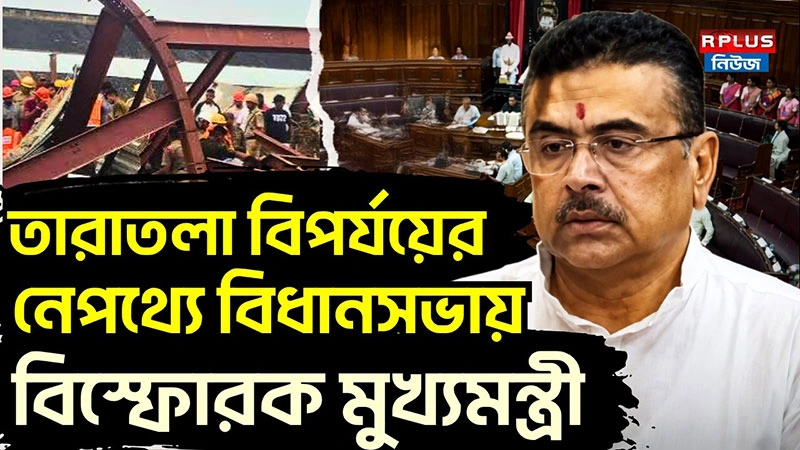
Who Handled the Taratala Crisis Better?
When the tragic building collapse happened at Taratala, the air filled with the cries of grieving families. However, the political response highlighted a massive contrast in leadership styles. This incident clearly defines the Suvendu vs Mamata approach to governance.
How Did the Leaders Respond on the Ground?
The table below breaks down their contrasting actions during the crisis:
| Actions on the Ground | Mamata Banerjee’s Approach | Suvendu Adhikari’s Approach |
|---|---|---|
| Entourage Size | Brought loyal journalists and top bureaucrats for a major public display. | Accompanied by only a few essential ministers and officials. |
| Media Interaction | Focused heavily on giving extended TV soundbites on the spot. | Requested privacy from the media; held a brief, structured press meet later. |
| Site Inspection | Prolonged the visit for heavy media coverage. | Completed a quick, silent, and swift observation. |
| Institutional Respect | Announced compensations immediately to the media, bypassing the Assembly. | Insisted on placing official statements and facts inside the ongoing Assembly. |
Why Did Suvendu’s Strategy Stand Out?
Instead of hunting for cameras, Suvendu Adhikari maintained strict administrative decorum. First, he admitted his limitations openly. He humbly told reporters with folded hands that he is not an expert in disaster management.
Consequently, this honesty saved him from making careless remarks. Furthermore, he did not give social media any chance to create mock memes out of his leadership.
Did Mamata Bypass Democratic Protocols?
Yes, critics argue that the Chief Minister ignored the ongoing Assembly session. Instead of addressing the house, she rushed to announce financial packages directly to TV channels.
On the flip side, Suvendu Adhikari prioritized institutional protocol. He refused to make hasty, populist declarations outside the legislature.
Instead, he relied completely on the official Kolkata municipal corporation report for accurate facts. This highlights the core difference between the two leaders:
- Mamata’s Approach: Centers around “I” and personal public relations projection.
- Suvendu’s Approach: Centers around “We” and institutional, collaborative work.
Ultimately, this crisis exposed a deep governance fail in how public tragedies are managed. For a deep-dive look into the technical and political updates of this incident, you can read the comprehensive report published by The Economic Times.
At Knowledge Mart, we closely monitor these administrative shifts to provide you with unfiltered realities.
This video shows the rescue operations at the warehouse site and details how the administrative response unfolded right after the disaster.
Kolkata Building Collapse Live Rescue Operations
Is the Suvendu vs Mamata Rivalry a Recent Development?
The intense political battle between these two figures is not new. Years ago, Mamata Banerjee started prioritizing Abhishek Banerjee within the party. Consequently, she ignored her most loyal and highly effective commander.
She completely overlooked how Suvendu Adhikari secured key districts like Malda, Murshidabad, and Nadia for her, one after another. Eventually, he left the Trinamool Congress (TMC) and joined the Bharatiya Janata Party (BJP).
What Happened in the Ultimate Nandigram Prestige Battle?
Ironically, Mamata Banerjee rose to power using the historic Nandigram movement. Yet, in that exact same Nandigram constituency, she suffered a historic electoral defeat against Suvendu Adhikari himself. To read more about how this political earthquake unfolded, check out the comprehensive coverage on the Nandigram Election Wiki Page.
How Do Their Styles of Opposition and Governance Differ?
Their fundamental political approaches reveal a stark contrast. When Mamata Banerjee was the opposition leader, she engaged in destructive politics, which included the infamous vandalism inside the State Assembly.
On the flip side, Suvendu Adhikari took a different path. Despite immense pressure from the TMC administration, he systematically organized the party cadres both inside and outside the assembly. Moreover, he constantly sharpened his political attacks against the ruling party.
How Did Suvendu Change After Becoming the Chief Minister?
Following a historic election victory, Suvendu Adhikari assumed the Chief Minister’s chair. Interestingly, his administrative behavior changed completely after taking power:
- Institutional Respect: He explicitly directed the police administration to protect the official security and dignity that Mamata Banerjee deserves as a former Chief Minister.
- Past Direct Hostility: Conversely, during her tenure, Mamata Banerjee repeatedly blocked his rallies and public meetings. He also faced multiple physical attacks on his convoys.
- Media Attacks: Multiple TMC spokespersons continuously launched deeply personal and toxic smear campaigns against him on regional television channels.
Before taking office, Suvendu Adhikari aggressively raised the “Chor Mamata” (corrupt Mamata) slogan outside the assembly. However, sitting in the Chief Minister’s chair today, he has completely transformed into a mature statesman.
While Mamata Banerjee remained trapped in her aggressive “opposition image” forever, Suvendu successfully elevated himself into a responsible ruler. This transition marks the ultimate difference in the Suvendu vs Mamata political saga, exposing a deep institutional governance fail of the past era.
For more updates on recent administrative decisions regarding her security, read the report on Anandabazar Patrika.
This video analysis highlights the major shifting points in Bengal’s political landscape following the electoral outcomes.
West Bengal Election Analysis: Suvendu Adhikari vs Mamata Banerjee
Has Suvendu Adhikari Sparked Any Social Media Controversies Since Becoming Chief Minister?
So far, Suvendu Adhikari has maintained an unblemished public track record in his brief tenure as Chief Minister.
Unlike past leaders, he has not made a single reckless remark that could trigger negative social media memes or controversies. Instead, his focus remains entirely on strict administrative governance.
How Did the New Administration Handle Post-Election Office Takeovers?
A striking example of his administrative control occurred right after the election results. When some turncoat Trinamool Congress (TMC) workers shifted sides to the BJP and tried to forcibly occupy authentic TMC party offices, the Chief Minister took immediate action.
Rather than supporting his party cadres blindly, he ordered the state police to intervene actively. Furthermore, newly elected BJP MLAs like Sajal Ghosh stood on the ground themselves to ensure those party offices were safely returned to the TMC.
How Did Mamata Banerjee React to Crimes and Misconduct?
Historically, the previous administration took a completely different path during local crises. Critics often point out that Mamata Banerjee frequently downplayed serious crimes to shield her party elements. She routinely dismissed grave public issues by labeling them as “small incidents”, “staged events”, or mischief done by “naughty boys”.
During the infamous Park Street case, when TMC leader Kakoli Ghosh Dastidar insensitively claimed the incident was merely a dispute between a client and a commercial worker, Mamata Banerjee chose to remain completely silent. This selective silence deeply exposed an institutional governance fail.
Has the Obsession with Personal Branding Disappeared?
Yes, a massive cultural shift is currently visible inside the West Bengal government. Today, no minister in the Suvendu Adhikari cabinet is forced to constantly repeat the scripted phrase, “inspired by the honorable Suvendu Adhikari”.
Under Mamata Banerjee’s rule, this phrase was an absolute mandatory norm for every government announcement. This transition highlights a fundamental difference in the Suvendu vs Mamata era:
- The Past Era: Centered around the grand projection of personal ego (“I”).
- The Present Era: Shifted entirely toward institutional teamwork (“We”).
How Has the Assembly Dynamic Changed Under Suvendu Adhikari?
For the first time in 15 years, West Bengal is witnessing true democratic traditions on the floor of the house. The new government is actively inviting opposition leaders to official administrative meetings, respecting their fundamental democratic rights. In stark contrast, Mamata Banerjee never extended this courtesy during her tenure.
Previously, whenever Suvendu Adhikari stood up to speak as the Leader of the Opposition, TMC MLAs would create a massive ruckus, shouting over him to completely suppress his voice.
However, the current Assembly operates under strict parliamentary decorum.
Recently, during the Chief Minister’s official reply, when opposition MLA Kunal Ghosh wanted to intervene and speak, Chief Minister Suvendu Adhikari voluntarily paused his own speech and allowed him the floor.
To observe these changing dynamics firsthand, you can follow the live updates on the official website of the West Bengal Legislative Assembly.
Was Opposition Voices Suppressed in the Past?
The numbers speak for themselves. The historical rate at which Suvendu Adhikari and fellow BJP MLAs were repeatedly suspended over the last five years remains unprecedented.
The ruling party systematically tried to create an “opposition-free” political space within the democratic house.
While Mamata Banerjee stayed trapped within an aggressive opposition mindset even while ruling, Suvendu has successfully elevated himself into a mature constitutional administrator.
Suspension Record of Suvendu Adhikari as LoP (2021-2026)
| Year | Incident / Issue | Duration of Suspension | Reason Cited by Assembly | Remarks |
|---|---|---|---|---|
| 2021 | Post-election Assembly protests | 1 day (temporary removal) | Disruption during proceedings | Early phase of BJP opposition aggression |
| 2022 | Governor’s address disruption | 7 days | Obstructing House proceedings | Major opposition protest moment |
| 2023 | Budget session protests | 30 days (entire session) | Unruly behavior & slogan shouting | One of the longest suspensions |
| 2024 | Panchayat-related protests | 10 days | Disruption & defiance of Speaker | Linked to rural poll violence allegations |
| 2025 | Ongoing protests in Assembly | Variable / short-term removals | Repeated disorderly conduct | Pattern of frequent clashes |
This news video details the recent high-level interactions between the opposition and the treasury benches within the state assembly corridors.
Watch: Kunal Ghosh and Suvendu Adhikari Meet in West Bengal Assembly
How Does the Taratala Rescue Operation Highlight a Change in Governance?
The recent tragic warehouse collapse in Taratala exposed a massive transformation in West Bengal’s administrative mechanism.
Historically, during the Posta flyover disaster, the previous administration’s police forced the Indian Army to pull back from rescue operations due to political friction. However, the Taratala incident displayed unprecedented coordination on the ground.
Which Agencies Worked Together at Taratala?
Instead of political turf wars, multiple state and central agencies collaborated seamlessly to save lives. This teamwork significantly minimized casualties during the crisis:
- The Indian Army (Eastern Command)
- National Disaster Response Force (NDRF)
- State Disaster Response Force (SDRF)
- Kolkata Police and Fire & Emergency Services
- Kolkata Municipal Corporation (KMC)
To watch how these teams executed the multi-agency operation on the ground, you can check the live coverage via the Tribune India Taratala Rescue Update Video.
Why Has Suvendu Adhikari Embraced Central Schemes?
The current administration recognizes that West Bengal is a vital part of the Indian Union. While Mamata Banerjee rarely started a government meeting without aggressively attacking the Central Government, Suvendu Adhikari has systematically rolled out all central welfare projects across the state.
This operational transition marks a dramatic turning point in the Suvendu vs Mamata political timeline.
Did the Previous “Bengal Model” Harm State Finances?
Yes, avoiding central cooperation severely strained West Bengal’s economy. Instead of utilizing the central housing scheme, the previous regime rebranded it under a state-exclusive banner.
Consequently, this unnecessary financial burden pushed the state’s public debt to a dangerous level. This systemic aversion to central funds created a massive governance fail that penalized ordinary citizens.
| Project / Sector | Mamata Banerjee’s Approach | Suvendu Adhikari’s Approach |
|---|---|---|
| Central Welfare Schemes | Blocked or rebranded projects to engage in federal conflict. | Implemented all central schemes directly to maximize public benefit. |
| Metro Infrastructure Support | Refused traffic permissions at Chingrighata despite court mandates. | Cleared permissions immediately and successfully expedited execution. |
| Disaster Management Protocol | Engaged in territorial friction with central forces like the Army. | Allowed active joint operations between the Army, NDRF, and state teams. |
How Did Left-Front Chief Ministers Handle Federal Relations?
Interestingly, despite intense ideological differences with Delhi, former Left-Front Chief Ministers like Jyoti Basu and Buddhadeb Bhattacharjee never blocked central development projects in Bengal.
In fact, Buddhadeb Bhattacharjee regularly held constructive high-level meetings with central leaders like L.K. Advani to secure administrative and financial benefits for the state.
Unfortunately, the negative and confrontational politics practiced by Mamata Banerjee inflicted deep, long-term damage on West Bengal’s growth trajectory. Rectifying this deep-rooted structural damage might take the state another 15 years to fully recover.
For a detailed breakdown of the infrastructure suspension and audits ordered after the recent disaster, read the report by The Economic Times. At Knowledge Mart, we keep a sharp eye on these economic and political transitions to deliver accurate perspectives.
Can We Fully Evaluate the New Government So Early?
Truthfully, this is just the beginning. It is impossible to accurately evaluate the performance of a new government or a Chief Minister in such a short period. However, as the famous saying goes, “morning shows the day”.
So far, the strong political will of the current administration is clearly visible. Therefore, there is no harm in staying optimistic about West Bengal’s future. A complete, fair evaluation will naturally take more time.
Why Is It Time for Harsh Decisions in West Bengal?
Historically, the people of West Bengal have allowed long, continuous ruling tenures for past regimes. Consequently, this is the perfect moment for structural change. To achieve long-term growth and permanent economic development, an administrator must implement tough and strict decisions today.
This transformation marks a departure from the previous systemic governance fail that held the state back for years.
What Is the Primary Demand of Bengal’s Citizens?
Above all, the citizens of West Bengal desire a secure environment and the unbiased enforcement of law and order. Implementing strict policing is crucial to establishing stable growth across the state.
This demand remains central to the ongoing Suvendu vs Mamata political transition. For deeper institutional perspectives on how administrative policies are taking shape, you can read the public updates on the official portal of the Government of West Bengal.
At Knowledge Mart, we keep a sharp track of these critical transitions to present unfiltered insights.
Knowledge Mart Keynotes
The sharp contrast in the Suvendu vs Mamata administrative style underlines how federal cooperation directly impacts real-world governance.
Moving away from defensive, hostile politics has enabled smoother infrastructure delivery and efficient disaster rescue operations.
While a definitive verdict on this new administration requires more time, early indicators reflect a promising shift in governance style. Overcoming a historical governance fail requires firm structural reforms, strict law enforcement, and a consistent commitment to constitutional teamwork.
Ultimately, the current administrative trajectory proves that West Bengal’s long-term progress depends entirely on taking necessary, tough choices rather than relying on populist political narratives.
Suvendu vs Mamata: Governance Scorecard
| Parameter | Suvendu Adhikari (CM – Early Phase) | Mamata Banerjee (Long Tenure) | Verdict |
|---|---|---|---|
| Political Momentum | Massive mandate shift, broke TMC dominance | Declining control, anti-incumbency visible | Suvendu Leads |
| Administrative Action | Quick, decisive orders (project reviews, crackdowns) | Often reactive, slower crisis handling | Suvendu Leads |
| Corruption Stand | Strong anti-corruption messaging, aggressive stance | Frequent allegations, defensive posture | Suvendu Leads |
| Governance Style | Assertive, high-control, result-oriented | Centralized, personality-driven | Suvendu Edge |
| Law & Order Narrative | Focus on restoring control, tough messaging | Criticized over political violence issues | Suvendu Edge |
| Development Delivery | Too early, but strong intent signals | Welfare-heavy, mixed infra outcomes | Mixed / Early Stage |
| Public Perception | Rising as decisive alternative | Fatigue after long rule | Suvendu Leads |
| Crisis Management | Immediate visible intervention | Criticized delays in key incidents | Suvendu Leads |
| Political Messaging | Aggressive, accountability-focused | Welfare + populism narrative | Different Models |
| Overall Governance Impact | Strong start, high expectations | Long rule, growing criticism | Suvendu Ahead (Early) |
Bottom Line
Suvendu Adhikari dominates the early governance narrative with speed, aggression, and anti-corruption positioning, while Mamata Banerjee faces criticism of fatigue, control, and administrative lapses after prolonged rule.
10 Key Takeaways
- Institutional Overhaul: The Suvendu vs Mamata rivalry marks a massive transition from a personal, ego-driven administration (“I”) to an institutional, team-oriented leadership model (“We”).
- The Taratala Exposure: The tragic Taratala warehouse collapse directly exposed a historical governance fail rooted in faulty structural designs approved under the previous Trinamool Congress (TMC) regime.
- Federal Cooperation Restored: Breaking away from years of hostile central-state conflict, the new government successfully deployed a joint rescue operation involving the Indian Army, NDRF, and state forces.
- Assembly Protocol Prioritized: Defying past populist norms of immediate media declarations, Chief Minister Suvendu Adhikari preserved democratic decorum by making all official crisis announcements directly on the Assembly floor.
- Crackdown on Maladministration: The state government took immediate punitive actions, arresting key figures connected to the tragedy, including Kalicharan Banerjee (OSD to the former Kolkata Mayor).
- Massive Construction Freeze: To protect public safety, Chief Minister Suvendu Adhikari ordered a strict halt and safety audit of all commercial construction projects sanctioned under the previous TMC era.
- Embracing Central Development: West Bengal is finally moving past economic isolation by systematically rolling out delayed central welfare schemes and infrastructure projects like the Metro expansion.
- Restoring Democratic Opposition: For the first time in 15 years, the ruling power is extending institutional respect to opposition leaders, actively inviting them to high-level administrative updates.
- Strict Maintenance of Law & Order: Rather than shielding party cadres, the new administration deployed state police to actively stop post-election party office takeovers by political turncoats.
- Focus on Long-Term Progress: Transitioning from a permanent “opposition mindset” to responsible governance, the current leadership is prioritizing tough, structural reforms over populist narratives to ensure the state’s secure future.