
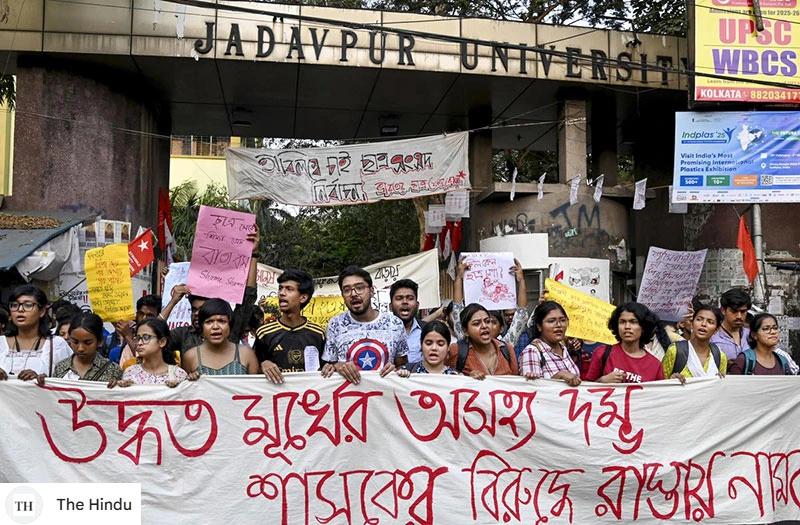
Students Election Stalled: Is Campus Democracy Under Threat?
Trying to figure out why students election have remained stalled in West Bengal for over a decade is like finding your way through the Bhool Bhulaiya inside Lucknow’s Bara Imambara. Truthfully, nobody has a clear, definitive answer. Please do not raise awkward questions asking when campus polls will actually happen.
The government has focused heavily on industrial investments. Never forget that it has barely completed a hundred days in power.
Minister-in-Charge of Urban Development and Municipal Affairs is highly occupied as urban infrastructure degrades, buildings collapse, and fatal fires break out across the state.
The Education Minister, Jagannath Chattopadhyay, concentrates on fixing administrative machinery. He is also trying to equip them with adequate manpower across colleges and universities. We have seen some drastic changes in appointment of College Administrators or Governing Body Presidents in the mean time. The government is barely three months old, yet its approach to college administration has already changed three times.
- Joint Directors of Public Instruction (JDPI) and senior education directorate officials as Administrators on May 22, 2026
- Sub divisional Officers and other Senior bureaucrats as administrators on July 29, 2026
- Administrators replaced by the Governing Body Presidents (Mainly MPs and MLAs) on August 21, 2026
Simultaneously, the party’s state president acts as an internal whistleblower to caution cadres against extortion and shaping political narratives to deflect from internal wrongdoing. Shamik Bhattacharya with his dramatic tone often comes in front of the press.
When all the top shots are busy in these jobs, how can they focus on Students Election?
The question of students election has become even more pertinent in the wake of the Jadavpur violence.
Some people have been utterly shocked to see BJP MLAs and MPs appointed as Governing Body Presidents. I am genuinely amazed – did we dream of having educationists lead the Governing Bodies?
Students Election Trapped in Excuses: Decades of Union Exploitation
Every major student organization demands an immediate students election. Under the previous political administration led by Mamata Banerjee, no democratic elections were conducted for years. She wanted to protect those who forcibly occupied the student union rooms. Most of these occupiers faced serious allegations, including extortion, illegal activities, and running commercial businesses out of campus premises. In one state-aided college, a fully furnished bedroom inside the premises was even discovered.
However, her administration didn’t bother to act upon them. In fact, if you closely follow her policy, she used to build up a strong nexus where everyone would be a stakeholderr. That was the secret of her politics where sticking to the power remains the only motto.
Students paid the price not just financially, but also through horrific safety incidents and sexual harassment reported across higher education institutions. The name of Monojit Mishra popped up as the prime accused.
This was not simply an administrative arrangement. Over time, it became a way of keeping political control firmly in the hands of the ruling establishment. No ruling party genuinely wants a transparent campus election because they prefer to seize union power by sheer force. This trend has been observed in the state since 2017.
The current administration lacks the resolve to change this dynamic. Top leaders remain fully occupied poaching opposition politicians to expand their own party size – a model of opposition-free politics originally pioneered decades ago by Mamata Banerjee.
The new government came with promises of change. But on this issue, they step right into old habits, offering nothing more than old wine in a new bottle. Certainly, Chief Minister Suvendu Adhikari has been working very hard to keep his commitment of Sonar Bangla. But I feel he lacks well-equipped team.
Timeline of Last Students Election in West Bengal
| Period | Status of student elections |
|---|---|
| Before June 2017 | Student-union elections were held regularly, though some campuses witnessed political clashes. |
| Early 2017 | Last broad round of student-union elections across Bengal colleges and universities. |
| June 2017 | Government introduced the Students’ Council framework and restrictions on traditional student-union elections. |
| 2017–2019 | Student-union elections largely remained suspended across the state. |
| February 2020 | Jadavpur University held elections after a three-year gap. |
| After 2020 | Regular student-union elections did not resume statewide; Jadavpur’s 2020 polls remain the last confirmed university-wide student-union election there. |
Students Election Debate: Institutional Model vs. Political Inaction
First, state officials must clearly decide whether they truly want campus politics in educational institutions. They need to clarify if institutions should follow the students council model seen in premier institutes like ISI, IIM, IIT, and IISER, or stick to traditional students union structures across other colleges and universities in West Bengal.
Only after that decision is taken can the state move towards a proper election system, where student wings of different political parties can contest openly and put their ideas before students.
For instance, former officiating Vice-Chancellor of Jadavpur University and member of the RSS-backed Akhil Bharatiya Rashtriya Shaikshik Mahasangh (ABRSM), Buddhadeb Sau, does not view student unions as strictly mandatory.
Conversely, ABVP state leaders strongly advocate for immediate campus polls, while student bodies like the SFI and DSO have actively demanded elections for years. Regardless of ongoing debates, state authorities have yet to formulate a clear framework or policy regarding campus elections.
Students Election Leadership: Building Next-Gen Leaders or Copying Old Models?
For decades, the students election in West Bengal served as a stepping stone for future state leaders. It may be called a mere coincidence, but the fact of life remains that three consecutive chief ministers of West Bengal in a row, Buddhadeb Bhattacharjee, Mamata Banerjee, and Suvendu Adhikari all launched their political careers from college campuses.
Student politics has also produced leaders who later moved onto the national stage, including Kanhaiya Kumar and Sitaram Yechury. The CJP protests, too, showed how students and recently graduated young people can drive a movement without being formally attached to a mainstream political party.
Rabindranath Tagore strongly advocated for free thought, yet without a functional students election, students lose their voice in institutional decision-making.
In Bengal, campus polls traditionally fed fresh talent into mainstream politics, unlike southern states that often rely on film personalities. Students and youth continue demanding immediate campus polls to secure elected representation on college governing bodies. The details regarding ongoing legal proceedings and judicial directions on college administration are reported by The Hindu and Education World .
The Escalating Crisis of Campus Governance and Student Rights
The ongoing delay of the students election creates an administrative void across educational hubs. Without elected representatives, students face severe hurdles when addressing basic infrastructure needs, library funding, hostel accommodation, and fee hikes. College governing bodies or administrators often make unilateral decisions without consulting the student body. In many instances, non-elected student leaders – frequently ex-students or political outsiders – continue to wield unchecked influence over campus affairs.
When there is nobody elected to question these decisions, accountability naturally becomes weaker. When students have no formal channel to voice grievances, peaceful protests frequently escalate into campus standoffs. The absence of a recognized student council also cripples mandatory campus committees, such as anti-ragging cells and internal complaints committees (ICC), leaving general students vulnerable to intimidation and misconduct.
Political Fear: Why Ruling Parties Avoid Campus Polls
A free campus election can be uncomfortable for any ruling party because students do not always vote the way the government expects. College campuses reflect the immediate reaction of young voters to state policies.
The students are quiet aware of the unemployment rates and administrative performance. We have seen in CJP protests, how the rulers had to face the uncomfortable questions regarding examination irregularities and paper leaks.
A defeat in major university elections, such as those at Jadavpur University, Presidency University, or Calcutta University, may work as an embarrassing public indicator of shifting political tides.
To avoid negative publicity, governments choose indefinite delays. By preventing campus politics from taking an official, democratic form, ruling parties ensure that opposition student wings cannot build momentum or establish organizational bases on campus.
But when there is no legitimate space for political expression, the frustration does not simply disappear. It often comes out in other forms. We have seen the ultimate reactions in 2026, how the anger of commoners can burst into fury.
On the contrary, governments before 2015 did not seem concerned about such perceived defeats or their impact on mainstream politics. Student unions were often far from being aligned with the ruling parties, yet successive governments allowed student elections as a democratic right of the students.
Judicial Interventions and Legal Bottlenecks
The legal battle surrounding the students election in West Bengal remains active in the courts. Public interest litigation (PIL) filed in the Calcutta High Court highlights how the absence of student elections violates campus governance norms. The court has repeatedly asked state authorities to clarify their stance on resuming student union polls.
| Stage | Action / Event | Impact / Status |
|---|---|---|
| Step 1 | Public Interest Litigation (PIL) Filed in Calcutta High Court | Demands resumption of students election and anti-ragging committees. |
| Step 2 | State Cites Administrative Bottlenecks & VC Vacancies | Government delays action due to academic changes and leadership gaps. |
| Step 3 | Court Directs Action on Unoccupied Union Rooms | Orders closure of union rooms to curb illegal entry and safeguard campus democracy. |
State representatives often point to administrative challenges, including vacant Vice-Chancellor positions, changing academic calendars, and security concerns, as reasons for the delay. In between, judicial orders have directed colleges to lock up unrepresented union rooms to prevent misuse by unauthorized individuals. Despite court inquiries, the policy impasse between institutional authorities and political leadership keeps the process locked in limbo.
The Impact on Academic Quality and Research Infrastructure
The issue is not limited to campus politics. The absence of elected student representatives can also affect how colleges deal with everyday academic and financial priorities.
Without elected student representation on key decision-making panels like the Executive Council or Academic Council, student perspectives remain ignored when university boards or College Governing Bodies allocate internal funds. Take the library as an example. Who tells the purchase committee which books students actually need? An elected student representative can at least put that demand on the table. It’s the duty of the elected student representative to negotiate the best possible budget for the students’ benefit.
There is another side to this issue. Campus governance and student welfare are part of the broader institutional assessment process. So the state cannot treat student representation as completely separate from the quality of higher education. As state-aided colleges and universities continuously delay campus polls, their institutional governance scores drop. Hence, they lose academic and research grants. We must take a note that quantum of Rusa fund issued to colleges and universities depends upon the NAAC grade. As a result, the Higher Education Institutes lack fresh students during admission and suffer from severe fund crunch, practically pushed into a hand-to-mouth situation.
Financial Corruption and the Loss of Student Funds
In many public universities and colleges, every enrolled student pays a mandatory annual fee toward the student union fund. In the absence of an officially elected students election body, these massive financial reserves remain entirely unmonitored or fall under direct administrative control. Millions of rupees intended for annual cultural festivals, inter-collegiate sports meets, academic journals, and student welfare relief sit unused or get redirected without student oversight.
Audit reports and public inquiries frequently reveal instances where unauthorized political syndicates or un-elected local factions accessed union funds illegally. Regular students who contribute financially to campus life end up completely deprived of cultural, athletic, and co-curricular opportunities. Re-establishing transparent campus elections guarantees that elected student representatives audit, manage, and deploy student union fees responsibly to benefit the general student community.
Nevertheless, the current government has issued notifications directing institutions not to collect student union fees.
Comparing Campus Governance: West Bengal vs. Other Major Indian States
Bengal is not the only state struggling to balance student politics with campus discipline. Other states have tried different models, and some of them are worth examining.
For instance, central universities in Delhi conduct highly structured, televised student elections under strict judicial frameworks. These models prove that student elections can run smoothly alongside complex academic schedules when administrative and political will exists. Conversely, states like Maharashtra and Kerala have experimented with non-political student councils or merit-based academic nominations to eliminate campus violence while preserving student representation.
As an example, The Indirect Council Election system – or Class Representative (CR) mode – is used by administrations to reduce violence, high spending, and political interference in student politics in Haryana. Instead of voting directly for a central president, students elect Class Representatives, who then vote among themselves to choose the central leadership. The Himachal Pradesh University (HPU), Shimla has adapted the similar method. Some colleges of Central Universities also follow the same model.
Bengal has so far chosen neither model completely. It has not fully embraced elected student unions, nor has it settled on a clear alternative such as a non-political student council. Perhaps it is the lack of decision making ability that triggers the problem.
Steps Required to Restore Campus Democracy in Colleges and Universities
Bringing back elections will not be enough by itself. The government first needs to make the campuses safe, clear the disputed union rooms and set simple rules for candidates and campaigns. While the students unions demand students election immediately, the administration has to look after the nitty-gritty that could provoke local turf conflicts. Indeed, the ruler will try for a reality check before announcing the elections.
University and college authorities must clear unauthorized occupants from all campus premises and secure student union offices under direct administrative watch, following explicit orders issued by the Calcutta High Court.
It’s more important to restore the trust of the people through stringent implementation of law and order in the state irrespective of political groups. Unfortunately, the Jadavpur Violence witnessed a surprised police inaction and intrusion of MLA, Sarbari Mukherjee with her angry bytes.
The administrations of Higher Education Institutes must establish transparent electoral codes of conduct, strictly enforcing age limits, attendance criteria, and merit score to keep the direct entry and illicit expenses of mainstream political parties.
Knowledge Mart Final Thoughts: Restoring Campus Democracy in West Bengal
The decade-long freeze on the students election in West Bengal damages both current students and the state’s broader political future as colleges and universities are treated as the budding grounds for the mainstream politicians.
Without transparent campus elections, higher education institutions may suffer from administrative corruption, lack of accountability, and an absence of genuine student leadership.
Political parties should stop treating campus elections merely as another battle for organisational control. Students need the freedom to choose their representatives, question the administration and learn politics through participation. That is how the next generation of leaders should emerge.
10 Key Takeaways:
- The students election across West Bengal has remained stalled for over ten years under successive administrative delays and political excuses.
- The prolonged suspension allowed non-elected factions, close to the ruling party, to occupy union rooms, leading to widespread reports of extortion and illicit activities.
- The lack of elected bodies resulted in severe safety compromises for students, including high-profile cases of misconduct and sexual harassment.
- State authorities have failed to settle whether institutions should operate under an academic students council model or traditional political students unions.
- Halting campus polls breaks West Bengal’s traditional pipeline for nurturing major state and national political leaders.
- Public Interest Litigations (PIL) in the Calcutta High Court continue to press the state government for a clear timeline on resuming campus elections.
- Annual student union fees collected from enrolled students remain unmonitored or unutilized without elected student auditors.
- Major ruling political parties avoid holding campus elections out of concern that negative campus results will signal broader political discontent for more than a decade.
- Without elected student representatives on executive boards, university academic standards, infrastructure development, and national rankings suffer.
- Restoring campus democracy requires appointing permanent Vice-Chancellors, clearing illegal union occupants, and establishing strict election codes of conduct.