
SFI ABVP Clash College Street: Bengal Campuses at Risk
The latest SFI ABVP Clash College Street is not just another confrontation between two student organisations. It raises a much bigger question about the future of educational institutions in West Bengal. Are colleges and universities places for debate, discussion and the exchange of ideas, or are they slowly becoming battlegrounds for political organisations?
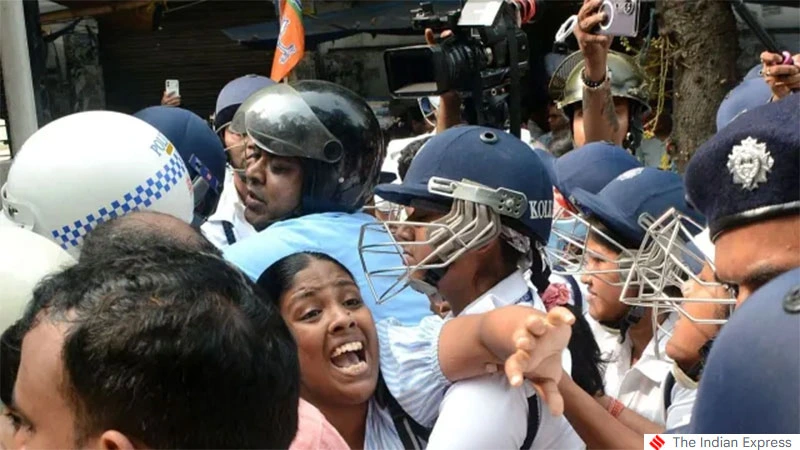
On November 18, 2026, a confrontation between the Students’ Federation of India (SFI) and the Akhil Bharatiya Vidyarthi Parishad (ABVP) over rival bookstalls near College Street in Kolkata disrupted normal life in the area. There were allegations of vandalism, damage to books and banners, and attempts to set books on fire. The two organisations offered different accounts of the dispute. SFI alleged that its stall and materials were targeted, while ABVP challenged the permission for the stall and objected to the nature of the books being sold.
The incident deserves serious attention. But it should not be viewed in isolation. From Surendranath Law College to Jadavpur University, and from campus confrontations to alleged attacks on CPI(M) bookstalls during Durga Puja, a disturbing pattern of political hostility has emerged.
The BJP has repeatedly spoken about changing Bengal’s political culture. Yet, when organisations associated with its wider political ecosystem are accused of intimidation and vandalism, the party leadership cannot simply look away.
The question is not whether SFI, ABVP or any other student organisation has the right to organise political activities. Every organisation has that right, subject to the law. The question is whether that right is being respected equally.
What Happened in the College Street SFI-ABVP Clash?
College Street is not an ordinary commercial area. It is one of Kolkata’s most important centres of books, education and intellectual activity. It has a history of student movements, political debate and public discussion. A confrontation over bookstalls in this area should therefore concern everyone who values academic freedom.
According to reports published on November 18, SFI had set up a bookstall near College Street. ABVP members arrived and objected to the stall, reportedly questioning the permission and the books being sold. SFI alleged that its banners were torn, books were damaged and an attempt was made to set books on fire. ABVP disputed SFI’s account and raised objections about the material being sold.
The confrontation escalated, police barricades were put up and traffic was disrupted. Reports also described ABVP supporters pushing against the barricades. The police intervened to control the situation.
Read the reports from The Indian Express and The New Indian Express.
There may be a legitimate dispute over permission for a stall. There may also be genuine disagreement over the contents of a book. But neither disagreement gives anyone the right to threaten people, damage property or use physical force.
If a book contains objectionable material, the answer is to challenge it with facts, arguments and lawful complaints. If a stall has been set up without permission, the authorities must deal with the matter under the same rules that apply to everyone.
Political disagreement is not a licence for violence. A bookstall cannot become a target simply because its political views are disliked.
Is ABVP’s Political Identity Really Irrelevant?
Whenever ABVP comes under criticism, a familiar argument appears: ABVP is an independent student organisation and not the formal student wing of the BJP.
Shamik Bhattacharya, the BJP’s West Bengal president, has made the point that the BJP does not have a student wing. The distinction may be relevant from an organisational or legal point of view. But does it answer the larger political question?
ABVP is widely associated with the wider Sangh Parivar ecosystem and shares an ideological space with the BJP. Its political activities and public positions are often discussed in that context. The BJP leadership cannot expect people to ignore this association whenever an incident involving ABVP becomes controversial.
Of course, an association does not automatically establish that the BJP ordered or directed a particular act. Responsibility for an individual incident must be established through evidence. But political accountability is not limited to proving who issued an instruction.
If the BJP wants to present itself as a party committed to discipline, democratic values and a different political culture, it must be prepared to speak clearly when organisations sharing its ideological space face serious allegations.
Shamik Bhattacharya cannot have it both ways. The BJP cannot claim the political benefits of ideological proximity and then use organisational distance as a shield whenever questions are raised.
The real test is simple: will the BJP leadership condemn intimidation and vandalism regardless of who is accused? Will it demand a fair investigation? Will it insist that educational institutions remain free from political coercion?
A statement that the BJP has no formal student wing does not answer these questions.
Surendranath Law College: What Happened to Academic Freedom?
The controversy at Surendranath Law College in September 2026 raised another serious concern about political interference in educational institutions.
The episode reportedly involved a dispute over attendance and a prolonged gherao of the college’s Vice Principal, Mohammadi Tarannum. She alleged that she faced pressure and was prevented from leaving during the confrontation, which continued for around 23 hours. She later clarified that she had not resigned and would continue in her position.
The episode also raised questions about the role of the college governing body and its president, BJP MLA Kaustav Bagchi. Allegations about political pressure and the circumstances surrounding the incident deserve proper investigation. They should not be treated as established facts without evidence.
But one issue is beyond political argument: no teacher or college administrator should be forced to surrender professional independence because a group of students or political activists is unhappy with an institutional decision.
A college cannot function if its teachers and administrators are expected to obey political pressure rather than institutional rules. Attendance policies, academic decisions and administrative disputes must be resolved through established procedures.
The controversy also raises an uncomfortable question for the BJP. If the party promises a new political culture in Bengal, why should incidents involving its elected representatives or organisations associated with its ideological space be treated as somebody else’s problem?
Read our detailed report: ABVP Attack: Law Vice Principal Forced Out.
Jadavpur University Violence: Have We Learned Nothing?
Jadavpur University has repeatedly witnessed political confrontations between student organisations. The violence reported in August 2026 involving ABVP and Left student groups, including SFI, once again exposed the dangerous atmosphere that can develop when campus politics turns into a contest of physical strength.
There were allegations of assault, the presence of outsiders, vandalism and arson. Different groups offered competing accounts of what happened. These claims need to be examined carefully, and responsibility must be fixed on the basis of evidence.
But the larger issue cannot be dismissed as a routine clash between rival student groups.
A university is supposed to encourage disagreement. Students must be free to support the Left, the BJP, the Congress or any other political ideology. They must also be free to reject all of them. What they should not have to fear is physical intimidation because of their political beliefs.
The presence of outsiders in campus conflicts, wherever established, is especially alarming. A university cannot become a playground for political musclemen. The administration must protect students, teachers and staff, irrespective of their political affiliations.
The police must also act impartially. They cannot wait for a situation to become violent before taking meaningful action. Nor should they allow political influence to determine whose complaints are heard and whose are ignored.
Our earlier report examines the confrontation and the questions it raised: Jadavpur Violence: Brutal ABVP-SFI Clash.
CPI(M) Bookstall Attacks During Durga Puja: Why the Silence?
The College Street confrontation becomes even more significant when viewed alongside allegations of attacks on CPI(M) bookstalls during Durga Puja.
Reports and allegations of attacks on Left bookstalls emerged from different places, including Jadavpur, Rashbehari, Dhakuria, Nagerbazar and Shibpur. The CPI(M) and Left supporters accused BJP supporters of targeting their stalls and damaging their materials. The BJP has disputed allegations of involvement in such incidents.
It is important to establish the responsibility for each incident through proper investigation. Political accusations should not be treated as proof. But equally, allegations of organised intimidation cannot be brushed aside simply because they are politically inconvenient.
A bookstall is not a threat to democracy. A political organisation may disagree with the books, posters or opinions displayed there. It may campaign against them, distribute its own literature or challenge their arguments. That is how democratic politics should work.
But damaging a bookstall or intimidating its organisers is an attack on the freedom to express political ideas.
There is also a question for those who claim to defend cultural values. Durga Puja is a public celebration in which people from different political and social backgrounds participate. Why should a political bookstall become a target during a festival? Does disagreement with the CPI(M) justify restricting its right to distribute books and literature?
The BJP leadership should not remain silent when such allegations emerge. If the party believes that its workers are innocent, it should demand an impartial investigation and cooperate with it. If anyone associated with the party is found responsible, the party should condemn the act without hesitation.
We have already examined these incidents in our report, CPI(M) Bookstall Attack: Another Shock.
The issue is not whether the CPI(M) deserves political sympathy. It does not need anyone’s permission to hold political views. The issue is whether a political organisation has the right to function without being threatened by its opponents.
The same democratic standard must apply to everyone.
Why Does Police Inaction Remain a Serious Question?
The police response to the College Street confrontation deserves close scrutiny. It would be inaccurate to say that the police did absolutely nothing. Reports indicate that barricades were placed and officers intervened as the confrontation escalated.
But that does not end the discussion. Even senior communist leader Biman Bose had to face “Go Back” slogan.
The more important question is whether the police acted early enough, impartially and consistently. Were the complaints of both organisations taken seriously? Were those accused of damaging property or attempting to disrupt the event identified? Was the law applied equally, irrespective of political affiliation?
There were also allegations that SFI members had faced detention on the previous day. The circumstances surrounding those detentions and the police response to the subsequent confrontation need to be examined.
If one group is stopped quickly while another is allowed to push barricades or intimidate its opponents, the public will naturally question the fairness of law enforcement. If the police act only after a situation becomes unmanageable, that too raises questions about preparedness and accountability.
The police are not supposed to protect the political interests of the ruling party. Their duty is to protect the law, public order and the rights of citizens.
West Bengal has a long history of allegations that political influence shapes policing. A change of government should mean a change in that culture, not a change in the identity of those who enjoy political protection.
The BJP came to power promising better governance and a departure from the political practices it had criticised under the Trinamool Congress. It must now demonstrate that promise through the conduct of the police and the administration.
A government cannot claim credit for law and order when everything is peaceful and blame political independence whenever its supporters or ideological allies face questions.
Is Bengal Repeating the Political Culture It Rejected?
The BJP won power in West Bengal by promising change. Many voters expected a government that would put an end to political intimidation, partisan administration and the culture of treating public institutions as the property of the ruling party.
That promise now carries a responsibility.
The BJP must understand that replacing one political organisation with another does not automatically change the political culture. If intimidation, pressure and selective enforcement continue, the colour of the flag will make little difference.
The Trinamool Congress was repeatedly criticised for allowing political influence to spread into educational institutions and public administration. The BJP cannot condemn those practices when they are committed by its opponents and remain defensive when similar allegations involve organisations close to its ideological space.
The point is not to suggest that every ABVP member is responsible for violence or that every allegation against the organisation is automatically true. That would be unfair. The point is that allegations must be investigated seriously, and political leaders must not use technical distinctions to avoid accountability.
The BJP’s own credibility is at stake. Shamik Bhattacharya’s assurance that the BJP will not become another Trinamool Congress will mean little if the government fails to protect democratic rights on campuses and in public spaces.
We have discussed the broader question of political responsibility and governance in West Bengal Governance: Where Did We Fail?.
Educational Campuses Must Remain Free From Political Intimidation
There is nothing wrong with student politics. In fact, student organisations have played an important role in India’s democratic history. They have raised questions about education, employment, inequality, corruption and public policy. They have also helped develop future political leaders.
But student politics loses its purpose when arguments are replaced by threats and physical confrontation.
ABVP has every right to organise, campaign and criticise SFI. SFI has the same right to criticise ABVP. The same freedom must be available to student organisations across the political spectrum.
No organisation should be allowed to claim exclusive ownership of a campus. No group should be able to decide which books can be sold, which posters can be displayed or which political opinions students may express.
If a book is objectionable, challenge its content. If a stall violates a rule, follow the legal process. If an individual commits an offence, investigate and prosecute that person. Do not turn political disagreement into a street fight.
The state government must also make its position clear. Educational institutions cannot be governed by the wishes of whichever political organisation is most aggressive on a particular day.
The police must act before violence escalates, and college and university administrations must be allowed to function without political pressure. Most importantly, the law must apply equally to all.
Key Takeaways: Why Bengal Needs Freedom on Its Campuses
- The SFI-ABVP clash at College Street raises serious questions about political intolerance and the freedom to organise bookstalls.
- Allegations of vandalism and attempts to damage books must be investigated impartially. Neither political accusation nor political denial should replace evidence.
- The Surendranath Law College controversy highlights the need to protect teachers and administrators from intimidation and political pressure.
- The Jadavpur University violence shows why educational campuses must be protected from outsiders, physical intimidation and partisan interference.
- Alleged attacks on CPI(M) bookstalls during Durga Puja deserve proper investigation, regardless of the political identity of those accused.
- Shamik Bhattacharya’s argument that the BJP has no formal student wing does not remove the party’s responsibility to speak against violence and intimidation.
- The police must demonstrate impartiality through their actions, not merely through statements.
- A change of government will mean little if the political culture of intimidation continues under a different flag.
Bengal Needs Debate, Not Political Muscle
The College Street clash should be a warning to the BJP government. The people of Bengal did not vote for a new set of political enforcers. They voted for a government that promised a different style of governance. Inevitably, SFI ABVP Clash College Street has raised controversies.
If the BJP wants to prove that it is different, it must show that difference when its own political ecosystem faces uncomfortable questions. It must condemn violence without calculating who benefits. It must allow the police to act without political pressure. It must protect the freedom of student organisations, including those that oppose the government.
And Shamik Bhattacharya must understand that saying the BJP has no student wing is not an answer to the public’s concerns. The question is not merely who owns an organisation on paper. The question is whether the ruling party has the courage to uphold democratic standards when the accused are politically close to it.
Bengal’s colleges and universities do not belong to the BJP, the Trinamool Congress, the CPI(M), SFI or ABVP. They belong to students, teachers and the wider academic community.
A book should be answered with another book, an argument with a better argument, and an opinion with a counter-opinion. When political organisations begin answering books with threats and vandalism, democracy is the real casualty.
Bengal needs more libraries, more debate and more freedom of thought – not more political battlegrounds.