
Why Mamata’s 2026 Hawker Row Turn into a flop show?
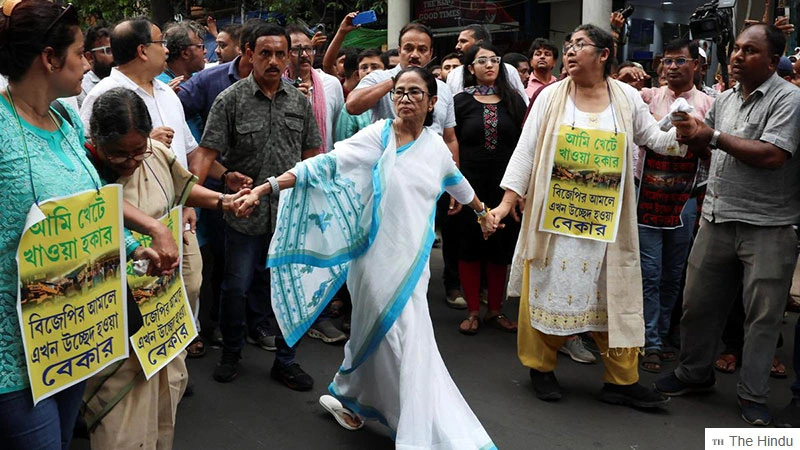
Mamata’s 2026 Hawker Row reached a historic low on June 17, 2026, when the former Chief Minister took to the streets of Kolkata to stage a sudden anti-encroachment protest.
The political landscape of West Bengal has completely turned upside down following the high-stakes West Bengal Assembly Election 2026. For a leader who once commanded millions with a simple wave of her hand, this sudden plunge into political isolation is nothing short of theatrical.
The latest chapter in this unfolding drama saw the Trinamool Congress (TMC) supremo attempting a classic page from her old playbook: street-level agitation.
However, her recent rally targeting the ongoing footpath eviction drives turned out to be less of a roaring political comeback and more of a quiet, embarrassing whimper.
Marching from Esplanade to Wellington Square (Subodh Mullick Square) along Lenin Sarani, the event exposed a stark reality that political analysts are calling a structural TMC rebel crisis.
Why Did the Esplanade Rally Cut Such a Sorry Figure?
If you had predicted a few months ago that a Kolkata street protest led by Mamata Banerjee would fail to fill a single sidewalk, political circles would have laughed you out of the state. Ironically, the reality on the ground was utterly absurd.
The highly publicized march against the new government’s relentless bulldozer policy managed to gather a grand total of roughly 100 people, according to local police estimates.
To make matters more ironic, the very people she claimed to be fighting for, the informal sector vendors, were barely visible in the crowd.
Most roadside traders chose to stay far away from the event, leaving the former Chief Minister to protest the Kolkata hawker eviction practically by herself. This sudden drop in mobilization power has highlighted the severity of the expanding TMC split 2026.
| Rally Metric | Expected Scale (Past Era) | Actual Attendance (June 2026) |
|---|---|---|
| Crowd Size | Tens of thousands filling Dharamtala | 100 people total |
| Primary Beneficiaries | Massive hawker union mobilization | Minimal hawker participation |
| Star Power | Massive Tollywood contingent | Completely vanished |
| Key Leadership | Full cabinet & KMC municipal team | Only 2 prominent loyalists |
Where Have All the Tollywood Stars and TMC Leaders Vanished?
The most pathetic aspect of the march was the total absence of the usual sycophants. The era of the star-studded, glamorous TMC political rally is officially dead.
The Tollywood actors and actresses who once jostled for a square inch of space near her on the podium have completely vanished into thin air. Even her closest inner circle, including prominent faces like Sayani Ghosh and Kakali Ghosh Dastidar, have abandoned the sinking ship to avoid the political fallout.
The visual isolation of the TMC chairperson was stark:
- The Bare Minimum: Only the ultra-loyalist duo of Beleghata MLA Kunal Ghosh and former MP Dola Sen walked alongside her, trying their best to look enthusiastic.
- The KMC Boycott: Even the Kolkata Municipal Corporation (KMC) councillors gave the event a complete miss.
- The Heavyweights Absent: Power players like Firhad Hakimand Kajari Mukherjee were conspicuously absent from the streets of central Kolkata.
When the political power gravy train stops, the passengers are always the first to jump off. The administration and absolute power attract a specific breed of opportunists.
Mamata Banerjee built her entire career on a relentless, uncompromised ground-level fight against the Left Front, which rightfully elevated her to a formidable mass leader.
In those days, thousands surrounded her without the promise of government contracts or administrative perks. The sudden disappearance of these crowds begs the question: what happened to that historic grassroots loyalty?
Is the TMC Split 2026 a Direct Result of Autocracy and Corruption?
The dramatic and rapid unraveling of the Trinamool Congress has quickly become the hottest debate topic on national television networks and political analysis panels.
The speed of the TMC split 2026 is completely unprecedented in modern Indian political history. Many point fingers at the centralized, autocratic style of functioning and the relentless wave of structural corruption scandals that plagued the previous regime.
Others blame the tactical blunders of Abhishek Banerjee and the corporate political management strategies of I-PAC. However, the root cause cannot be reduced to a couple of individuals. Trinamool loyalists themselves are beginning to drop hints about the internal rot.
For instance, several senior figures have noted that a political party completely devoid of an underlying ideology is bound to face an absolute, catastrophic freefall the moment it is ousted from state power. This rapid desertion proves that personal relationships and decades of shared political struggles hold zero value in today’s harsh transactional reality.
The situation was perfectly encapsulated by the veteran politician and former Transport Minister Snehashis Chakraborty. After losing his seat in the 2026 elections, Chakraborty took political sanyas (retirement from active politics).
He explicitly stated in an interview that a political party completely devoid of an underlying ideology is bound to face an absolute, catastrophic freefall the moment it is ousted from state power.
TMC Exit Timeline 2026
| Timeline | Leaders / Groups | Position | Type of Exit | Key Trigger / Remark |
|---|---|---|---|---|
| Mid May 2026 | 100+ Councillors; Kakoli Ghosh Dastidar; Santanu Sen; Arup Chakraborty & others | Grassroots + MP + Spokesperson | Mass resignations | First wave of exits; organisational collapse begins |
| Late May 2026 | Dissident MLAs; Several MPs | MLAs + MPs | Rebellion / dissent | Formation of rebel bloc; internal challenge to leadership |
| Early June 2026 | Ritabrata Banerjee + 58 MLAs; Firhad Hakim | MLAs + Mayor | Major split + resignation | Legislative breakaway; crisis deepens |
| June 2026 | Prakash Chik Baraik; 3 Rajya Sabha MPs | MPs | Resignations + role exit | Parliamentary instability; internal conflict peaks |
| Mid June 2026 | Kunal Ghosh; Sobhandeb Chattopadhyay | MLAs | Marginalisation | Visible factional divide within party |
| Overall Phase | Mamata Banerjee vs Abhishek Banerjee camps | Top leadership | Power struggle | Core reason behind sustained exits |
How Did a Mass Leader Blunder into Complete Grassroots Detachment?
The most baffling element of this political tragedy is how a seasoned street fighter became entirely detached from both her grassroots workers and her top-tier leadership. Reports from inside Kalighat suggest that she regularly ignored or failed to reply to text messages and urgent correspondence from her own party leaders on time.
For a veteran politician who knows that survival depends on continuous personal contact across all organizational levels, this was an astonishing blunder.
| Governance Pillar | The Strategy (What Went Wrong) | The Fallout in 2026 |
|---|---|---|
| Grassroots Contact | Swapped personal feedback for administrative reports | Complete loss of ground-level reality |
| Internal Communication | Delayed or ignored messages from regional party leaders | Mass defections and internal rebellion |
| Electoral Machinery | Heavily dependent on local police and state machinery | Left defenseless when the ruling party changed |
Did she develop an absolute over-dependence on the state administration and local police to win democratic elections, completely discarding the hard work of personal human interaction? It certainly appears so.
When the state machinery shifted into the hands of the new government under Chief Minister Suvendu Adhikari, the fragile illusion of her massive organization shattered instantly, as seen in the broader public space debate gripping Kolkata.
Can She Clear Footpaths and Keep Her Voter Base Intact?
The core policy issue driving this entire political dispute is the regulation of street vending and pedestrian movement on Kolkata’s famously congested roads. The new state administration has taken a firm, uncompromising stance on public spaces, explicitly targeting high-traffic zones like New Market, Gariahat, and Jadavpur.
The current administration has publicly defended these anti-encroachment actions as a fundamental necessity of urban governance, asserting that citizens have an absolute right to clean, accessible footpaths.
“Humanity matters, but not at the cost of others’ right to public space. Pedestrians cannot be forced to walk in the middle of heavy traffic because pavements are entirely blocked”.
By transforming Mamata’s 2026 Hawker Row into a grand human rights issue, the opposition is desperately trying to regain its footing among informal sector voters.
However, demanding comprehensive rehabilitation before eviction is a tough sell when your own organizational foot soldiers and party MLAs refuse to turn up to support the cause, leaving you stranded during a critical demolition drive protest.
Is This the End of Her Era or the Start of a New Street Campaign?
Despite the pathetic turnout at Wellington Square, history teaches us never to completely write off a cornered street politician.
An intense street campaign has always been her preferred arena for staging a dramatic political comeback. While the path ahead remains incredibly steep and treacherous, she currently has no other viable options left on the table.
The coming months will clarify whether we are actively witnessing the final political epitaph of her career in 2026, or if she possesses the residual energy to pull off yet another historic resurrection.
One thing is absolutely guaranteed: the politically conscious people of West Bengal will be watching this drama play out with their eyes wide open.
10 Key Takeaways:
- The June 17 Rally: Trinamool Congress (TMC) chairperson Mamata Banerjee returned to the streets of central Kolkata on June 17, 2026, leading an anti-encroachment protest march from Esplanade (Dharmatala) to Wellington Square (Subodh Mullick Square).
- The Core Grievance: The protest directly targeted the bulldozer politics and sudden footpath eviction drives launched across the state by the newly elected government led by Chief Minister Suvendu Adhikari.
- The Demands: Mamata Banerjee demanded that comprehensive rehabilitation and alternative accommodation plans must legally precede any eviction or demolition of roadside stalls.
- A Shrinking Mass Base: Despite being a seasoned street fighter, the rally cut a historically sorry figure with minimal attendance, a sharp contrast to the massive crowds she used to pull during her tenure.
- Hawker Boycott: To make matters more embarrassing, the informal sector vendors and roadside traders themselves largely skipped the event, refusing to stand as her political shield.
- Striking Leadership Isolation: The rally lacked major political weight, as the former Chief Minister was accompanied by only a few ultra-loyalists, primarily Beleghata MLA Kunal Ghosh and former MP Dola Sen.
- The Great TMC Boycott: Highlighting a severe internal TMC rebel crisis, major party heavyweights, Kolkata Municipal Corporation (KMC) councillors, and prominent MLAs conspicuously skipped the street protest.
- The Tollywood Exodus: The glamorous entourage of Tollywood actors and actresses who historically crowded her podium has completely vanished following the party’s ousting from power.
- The Structural Collapse: Political analysts note that the rapid TMC split 2026 stems from years of autocratic functioning, massive corruption scandals, and an over-reliance on state police machinery rather than genuine grassroots contact.
- The Last-Ditch Comeback Strategy: Facing an existential political crisis, Mamata Banerjee is attempting to reclaim her original political identity through street agitation to reconnect with the urban poor, though the path to a historic resurrection looks increasingly steep.