
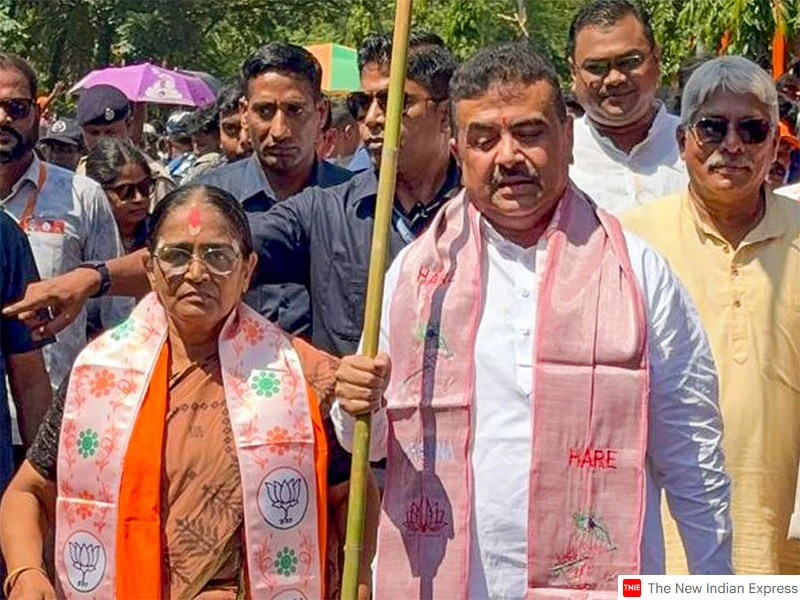
Chandranath’s Mother: BJP’s Nandigram Gamble
Nandigram has never been an ordinary Assembly constituency in Bengal politics. It became the battlefield that helped end the Left Front’s long rule, and it later became the seat where Suvendu Adhikari defeated Mamata Banerjee in the 2021 Assembly election by 1,956 votes. In 2026, Suvendu won even by a higher margin in Nandigram.
Now Nandigram is back in the spotlight. The BJP has chosen Hasirani Rath, Chandranath’s mother, as its candidate for the Nandigram by-election. The party announced her candidature on September 15, ahead of the October 6 bypoll. Chandranath, a close aide of Suvendu Adhikari, was killed in Madhyamgram on May 6, just two days after the 2026 Assembly results.
The decision is politically understandable. But it also raises a difficult question. Is Hasirani Rath entering Nandigram as a political candidate in her own right, or is the BJP asking voters to remember the murder of her son when they enter the polling booth?
Why Nandigram Matters to Suvendu Adhikari
The political importance of Nandigram goes back to the land acquisition movement of 2007. The agitation became one of the biggest challenges to the Left government and helped turn Nandigram into a symbol of political resistance. Suvendu Adhikari emerged from that movement as one of its most visible political faces.
His political journey later took a dramatic turn. He left the Trinamool Congress, joined the BJP and defeated Mamata Banerjee in Nandigram in 2021. The constituency therefore carries a very personal political history for him. The Business Today account of Suvendu’s political rise through the Nandigram movement also traces that connection.
That is why the choice of Chandranath Rath’s mother cannot be separated from Suvendu’s own political story. Hasirani Rath is not simply another BJP candidate being sent into a difficult constituency. Her family connection directly links the bypoll to a murder case involving one of Suvendu’s aides.
Hasirani Rath Enters the Nandigram Byelection
Hasirani Rath does not come into the election with a long political career behind her. She comes with a personal tragedy. Her son Chandranath Rath was killed in Madhyamgram, and the investigation later moved to the CBI. The Indian Express report on the CBI investigation details some of the evidence examined by investigators.
That makes this election different from a normal candidate-selection exercise. Political parties have always used personal stories, family histories and public sympathy during campaigns. But when the candidate herself is the mother of a recently murdered political aide, the emotional element becomes much stronger.
There is nothing unusual or unlawful about Hasirani contesting an election. She has every right to enter electoral politics. The question is about how the campaign presents her. Voters are entitled to judge her as a candidate. They are also entitled to question whether grief is being turned into electoral capital.
Suvendu Adhikari even attended the nomination filing process of Hasirani Rath, Chandranath’s mother.
Did Mamata Banerjee Set the Political Precedent?
The BJP can point to Bengal’s own political history if critics question the use of a victim’s family in an election. This is not a new political method.
In the 2009 Nandigram by-election, Trinamool Congress fielded Firoza Bibi, whose teenage son had been killed during the March 14, 2007 firing in Nandigram. Her candidature carried the memory of the violence directly into the election campaign. The Indian Express report from January 2009 described how sympathy around her family tragedy became part of the political contest.
Firoza Bibi eventually won. The political message was clear: a victim’s family could become a powerful electoral symbol.
That history matters today because the same political culture can now be seen from another side of the divide. The BJP is putting forward the mother of a murdered man. The party may argue that this is about justice, recognition and the right of a grieving mother to enter politics. Critics may see it differently.
Either way, the precedent was not created yesterday.
From Firoza Bibi to the RG Kar Victim’s Mother
The pattern has appeared in Bengal politics in other forms too. The mother of the RG Kar rape-murder victim entered electoral politics in 2026, campaigning on issues of justice and women’s safety. The Indian Express campaign report recorded how her personal grief became part of her political message.
She later won the Panihati Assembly election.
Again, the larger question remains. When a mother enters politics after losing a child in a politically sensitive or criminal case, should voters see her primarily through that tragedy? Or should the election gradually move towards her views, record and ability as a candidate?
Those are not easy questions. They also cannot be asked only when the candidate belongs to the other political camp.
Sabina Yasmin: Another Victim’s Mother in Bengal Politics
Another example came from Kaliganj. Sabina Yasmin, mother of Tamanna, who was killed during post-poll violence in 2025, entered the 2026 Assembly election as a CPI(M) candidate. Her candidature too carried the memory of a family tragedy into an electoral contest.
This is worth remembering because political parties across the spectrum have used the personal stories of victims and their families. It is not a BJP-only phenomenon, nor is it something invented by the current political establishment.
The question, therefore, should be broader. Are political parties becoming increasingly dependent on victimhood and personal tragedy to create emotional connections with voters?
Kishwar Jahan and Bengal’s Victim-Family Politics
There is an even older example. Kishwar Jahan, mother of Rizwanur Rahman, became associated with a major political controversy after her son’s death. In 2011, Mamata Banerjee invited her to speak at the Trinamool Congress’s July 21 programme. The official Trinamool Congress account of the 2011 programme records the event.
That example shows how quickly personal grief can become part of political language. A family’s pain can become a symbol of injustice. A mother can become the face of a campaign. And once that happens, separating the individual from the political message becomes difficult.
Is Using a Victim’s Mother for Votes Ethical?
This is perhaps the most uncomfortable question in the entire Nandigram contest.
Legally, there is little mystery. An adult citizen who fulfils the election requirements can contest. Being the mother of a murder victim does not disqualify anyone from becoming a candidate. Hasirani Rath has the same democratic right as any other candidate.
Ethics is different. A political party may highlight a candidate’s personal story, but where should the line be drawn? At what point does remembering a victim become using the victim? And does the answer change depending on which party is doing it?
There is no simple formula here. If a victim’s family member voluntarily enters politics and speaks about justice, voters may reasonably consider that story part of the candidate’s public life. But political parties also have a responsibility not to reduce a candidate to a photograph, a funeral story or a slogan. The irony is painful: Ratna Debnath and her husband are still waiting for justice for their daughter’s murder.
Hasirani Rath deserves to be seen as more than Chandranath Rath’s mother. At the same time, the BJP cannot realistically expect voters to ignore why she has become the candidate.
Chandranath Rath Murder: What Does the CBI Chargesheet Say?
The murder case itself cannot be allowed to disappear behind the election campaign. The CBI chargesheet reportedly describes a conspiracy extending over several months and refers to digital evidence, CCTV footage, call records and other material collected during the investigation.
The CBI investigation report published by The Hindu has provided details about the investigators’ theory, including alleged involvement of Sagar Sonkar and contract shooters.
But there is an important distinction that political campaigns should not blur. A chargesheet contains allegations and the investigating agency’s case. It is not the same thing as a final judicial finding of guilt.
That distinction becomes even more important when the murder is being discussed during an election campaign.
Suvendu Adhikari’s “Bhaipo Gang” Allegation Needs Evidence
Chief Minister Suvendu Adhikari has linked the murder to what he described as the “Bhaipo Gang”. He has also made allegations about payments, call records and links extending towards Diamond Harbour. The News 18 Bangla has got a live coverage of Suvendu’s statements.
Political allegations, however, are not evidence by themselves.
If the Chief Minister has information that points towards a larger conspiracy, the proper place for that material is the investigating process and, ultimately, the court. If investigators establish such a connection, it should be presented with evidence. Until then, political accusations should remain accusations.
This is particularly important because the case concerns a murder and not merely a political dispute.
Why the Chandranath Rath Case Matters for the Chief Minister
Suvendu Adhikari now occupies a very different position from the one he held when Chandranath Rath was working as his aide. He is the Chief Minister. That brings a higher level of responsibility.
As a political leader, he can raise questions about the murder. As Chief Minister, he also has to ensure that the investigation follows evidence rather than political convenience. Those two roles may overlap, but they should not become indistinguishable.
The same standard should apply to every political party. If TMC makes an allegation, it should produce evidence. If BJP makes an allegation, the same rule applies. A murder case should not become a permanent campaign slogan before the legal process has reached its conclusion.
Nandigram Byelection 2026: Why This Contest Matters
The Nandigram Byelection 2026 is not just another election to fill an empty Assembly seat. Nandigram carries too much political history for that.
It was central to the fall of the Left government. It became the stage for Mamata Banerjee’s confrontation with Suvendu Adhikari in 2021. And now, under a BJP government led by Suvendu, the constituency is again preparing for a contest with a deeply personal political background.
The Anandabazar Online report on the Nandigram bypoll details the BJP’s decision to field Hasirani Rath.
That makes the campaign worth watching not simply for the result, but for the kind of politics that develops around it. Will the contest remain focused on governance, law and order and local issues? Or will the murder of Chandranath Rath dominate the campaign?
Chandranath’s Mother or Political Candidate?
This may ultimately be the central issue.
Hasirani Rath is entitled to contest Nandigram. She is entitled to speak about her son. She is entitled to seek justice and ask voters for support. But voters should also have the opportunity to judge her independently of her family tragedy.
That is where political parties need some restraint. Sympathy can influence an election, but sympathy cannot become a substitute for a candidate’s political programme. A mother who enters politics after losing her son should not be denied political space. Nor should her grief become the only reason voters are asked to support her.
Nandigram has seen this kind of politics before. Firoza Bibi’s candidature in 2009 showed how powerful a victim’s family could become in an election. The RG Kar victim’s mother, Sabina Yasmin and Kishwar Jahan show that the wider pattern is not confined to one party or one decade.
Now Hasirani Rath becomes the latest name in that long and complicated story.
The real test is whether the political system allows her to become a candidate rather than keeping her permanently trapped in the identity of a grieving mother.
Knowledge Mart Key Take
The Chandranath’s Mother candidature brings together almost every major theme of Bengal’s recent politics: Nandigram, Suvendu Adhikari, political violence, victim families, sympathy voting and the use of criminal cases in election campaigns.
Hasirani Rath has every right to contest. But that right does not prevent voters from asking hard questions about the campaign around her.
The BJP is not creating this political method from scratch. Bengal has seen political parties use the families of victims before. The uncomfortable part is that the practice becomes controversial only when the other side starts using the same method.
There is also a more serious matter beneath the politics. The Chandranath Rath murder investigation must be allowed to proceed on evidence. Allegations made by political leaders, whether from the ruling party or the opposition, cannot replace the findings of investigators or courts.
Nandigram will therefore be carrying two burdens in this bypoll. One is electoral. The other is ethical.
10 Key Takeaways on Chandranath’s Mother and Nandigram
- Hasirani Rath is the BJP candidate for the Nandigram by-election and the mother of murdered political aide Chandranath Rath.
- Nandigram remains politically important because of its role in Bengal’s anti-land-acquisition movement and the 2021 Mamata-Suvendu contest.
- Hasirani Rath has the democratic right to contest, but her candidature inevitably brings her son’s murder into the campaign.
- Firoza Bibi had earlier entered electoral politics as the mother of a Nandigram violence victim.
- The mother of the RG Kar victim also entered politics in 2026, showing that victim-family politics continues across party lines.
- Sabina Yasmin entered the Kaliganj contest after the death of her daughter Tamanna in post-poll violence.
- Kishwar Jahan became an earlier example of how a victim’s mother could become part of Bengal’s political narrative.
- The ethical question is not whether a victim’s mother can contest, but whether political parties reduce such candidates to their personal grief.
- The CBI chargesheet in the Chandranath Rath murder must be distinguished from a final judicial finding of guilt.
- Suvendu Adhikari’s “Bhaipo Gang” allegation remains a political allegation unless supported and established through the proper investigative and judicial process.
Knowledge Mart Final Thoughts: Nandigram has a habit of turning individual political battles into larger questions about Bengal’s politics. Hasirani Rath’s candidature is no different. The campaign will test not only electoral calculations but also how far political parties are willing to use personal tragedy as an electoral language.