
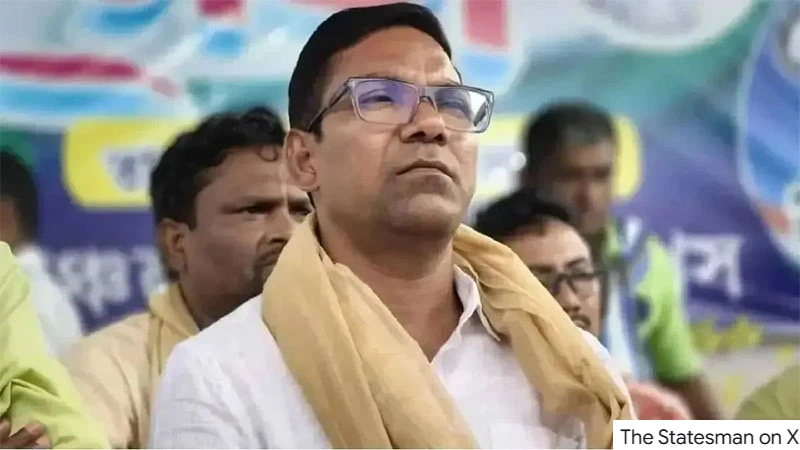
TMC Rebellion: The Explosive Return to Mamata
Oh, what a spectacle! This looks like a marriage ending in divorce even before the honeymoon is over. That, more or less, is the condition of the rebel TMC legislators today.
Hamidul Rahman, Kajal Sheikh and Rathin Ghosh are among the names associated with the latest political developments. And then there is Paresh Ram Das, who was arrested by the police at Kolkata airport on November 9. Reports have described him as having moved away from the Ritabrata-led faction and towards Mamata Banerjee’s camp. Abdul Aziz has also been mentioned in discussions about possible returns.
Only a few months ago, several legislators had walked away from Mamata Banerjee’s leadership and joined the camp led by Ritabrata Banerjee. They had posed for photographs, displayed their new political allegiance and appeared confident about their decision. Now, one after another, some of them are trying to find their way back to Mamata’s Kalighat residence.
What happened in such a short period? Was the TMC rebellion built on political conviction, or was it merely an arrangement of convenience?
The Great Political U-Turn
Kunal Ghosh had earlier claimed that a substantial number of rebel legislators were in touch with the Mamata camp and wanted to return. He even suggested that around 40 legislators were maintaining contact with his side. Whether all these claims translate into actual political returns remains to be seen. But the developments certainly raise questions about the stability of the breakaway group.
Remember Suvendu Adhikari’s confident declaration that, apart from the BJP’s 209 legislators, another 66 opposition MLAs could extend their support, taking the number to 275? That was a political claim. Nevertheless, the changing equations within the TMC have made the situation considerably more complicated.
Several reports have described legislators reconsidering their association with the breakaway group. Some have publicly reaffirmed their support for Mamata, while others have reportedly contacted her camp. These are not all confirmed returns, but the political uncertainty is unmistakable.
Now, some of those very legislators appear to be reconsidering their positions. The question is not simply how many will return. The more important question is why they left in the first place and what made them reconsider so quickly.
When Party-Hopping Becomes Political Culture
During Mamata Banerjee’s years in power, West Bengal witnessed a political culture in which changing political allegiance became almost routine. If a question appeared in an examination asking which party a particular MLA belonged to, even the child’s parents might have needed to consult Google before answering!
One morning, a leader would be seen with one political camp. By evening, the same person might be standing beside another set of leaders with another flag. Political loyalties appeared to change with the direction of the wind. The ordinary voter was left wondering whether these elected representatives had any lasting political convictions at all.
And what was the consequence? Party-hopping gradually became normalised. Instead of explaining their political positions to the electorate, some politicians seemed more interested in calculating which camp could offer them better prospects.
This is precisely the problem with the present TMC Rebellion. If legislators can leave one camp today and return tomorrow, what exactly are the political principles behind their decisions? Did they rebel because they genuinely disagreed with Mamata Banerjee’s leadership? Did they have a clear alternative political programme? Or were they simply trying to secure a more favourable position in an uncertain political environment?
People do not elect MLAs to watch them play musical chairs with political parties. They elect representatives to work for their constituencies and remain accountable for their decisions.
This is not an isolated problem. The wider issue of criminalisation of politics, political intimidation and the erosion of public accountability has been discussed in our article Criminal Politics in Bengal: The Growing Danger. The present political drama is another reminder of why Bengal needs a more accountable political culture.
Mamata’s Political Legacy Cannot Be Ignored
There is another aspect that deserves attention. Kunal Ghosh may describe Paresh Ram Das’s arrest as an example of vindictive politics. He may question why the police became active only after the MLA reportedly expressed an interest in returning to Mamata Banerjee’s camp.
But, with due respect to Kunal, perhaps it is time to revisit the political history of the party he has defended for years.
Who helped turn political defections into an art form in Bengal? Who repeatedly welcomed leaders from rival political parties when it suited the ruling party’s interests? Who made political accommodation, bargaining and the management of rival factions such familiar features of Bengal politics?
The Mamata Banerjee regime cannot simply distance itself from the political culture that developed during its years in office. The Trinamool Congress built a political organisation that frequently accommodated leaders from different ideological backgrounds, including those who had once opposed it. Political convenience often appeared to take precedence over ideological consistency.
We have seen leaders from the Left and Congress move towards the TMC, and others move in the opposite direction when the political climate changed. The party that once benefited from defections cannot now pretend that the practice itself is an entirely new invention.
Of course, the BJP is not automatically entitled to claim that it will behave differently. Nor can Suvendu Adhikari escape scrutiny simply because he is now leading a different government. If the BJP starts adopting the same methods that it once criticised, the people of Bengal will have every reason to question its claims of political change.
Political parties cannot demand loyalty from others while treating political loyalty as a disposable commodity themselves.
Our analysis of the West Bengal Election 2026 also examines the political consequences of the changing public mood and the challenges confronting the state’s political parties. The present factional battle should be understood against that larger background.
Paresh Ram Das: The Arrest Raises Questions
The arrest of Paresh Ram Das at Kolkata airport has added another dimension to this political drama. The Canning Paschim MLA was arrested on November 9 in connection with multiple cases, including allegations of rape, extortion and post-poll violence.
According to police reports, he was wanted in connection with cases registered earlier and was apprehended at the airport while preparing to board a flight to Mumbai. The allegations are serious, but allegations must not be treated as convictions. The accused is entitled to defend himself, and the courts must determine the facts.
However, Kunal Ghosh has questioned the timing of the arrest. He alleged that the police became active after Das expressed an interest in returning to Mamata Banerjee’s camp. Leaders from the rival faction have disputed this interpretation and defended the police action.
There is a legitimate public-interest question here: Is law enforcement being applied consistently, irrespective of political affiliation? If the police had information and evidence against an elected representative, why did the action take place at this particular moment?
Equally, if the arrest was based on an ongoing investigation, political allegations should not be allowed to undermine the legal process.
For a government that has repeatedly spoken about the rule of law, consistency and transparency are essential. The same standards must apply to political friends and political opponents.
Read the reports from The Indian Express and The New Indian Express for the reported details of the arrest and the political reactions.
Has Ritabrata’s Leadership Lost Its Appeal?
The sudden movement of legislators towards Mamata’s camp also raises questions about Ritabrata Banerjee’s ability to hold the rebel group together.
A political rebellion cannot survive merely on dissatisfaction with an existing leader. It needs an alternative vision, a credible organisation and a clear understanding of what it wants to achieve. Otherwise, it becomes a temporary gathering of individuals with different ambitions.
- Did the legislators who joined Ritabrata believe they were creating a genuinely independent political platform?
- Did they expect to retain their local political influence while distancing themselves from Mamata?
- Or did they assume that the new arrangement would provide them with greater bargaining power?
These are questions the rebel leadership must answer.
Some legislators may have discovered that their political identity was still closely connected with the TMC organisation and Mamata Banerjee. Others may have realised that their supporters were not prepared to accept such a dramatic change in allegiance. Reports have suggested that some rebel legislators were facing questions from their own local workers and supporters about distancing themselves from Mamata.
There was also confusion about the precise political objective of the rebellion. Was Ritabrata merely supposed to lead the TMC legislative group in the Assembly, or was he attempting to build an independent political organisation? These are two very different propositions. A rebellion without clarity about its own destination was bound to face questions sooner or later.
Whatever the explanation, a rebellion that witnesses repeated changes of allegiance within a few months raises serious questions about its original purpose.
Shishya or Guru? Suvendu’s Political Lessons
There is an old political observation attributed to former Governor and BJP State President, Tathagata Roy. He once described Mamata Banerjee as the most talented student of the CPI(M) school of politics.
That remark is worth remembering in the present context.
If someone now argues that Suvendu Adhikari is applying the very political lessons he learnt while working alongside Mamata, would that be entirely unfair?
There is an old expression in Indian political strategy: Saam, Daam, Dand, Bhed — persuasion, inducement, punishment and division as different means of achieving political objectives.
Political parties have used different versions of these methods for decades. The TMC, too, has faced allegations of using political inducements and pressure to expand its influence. If the BJP now benefits from similar political manoeuvres, why should it be surprised when people draw comparisons?
After all, political methods do not become acceptable simply because the party using them has changed.
But there is an important distinction. Suvendu’s claims about the support of opposition legislators must be tested through actual political developments, not merely through public statements. The BJP must also be judged by its own conduct in government, not by the failures of the previous regime.
The Voter Is Not a Political Pawn
The most disturbing part of this entire episode is the apparent disregard for the electorate.
When a candidate seeks votes, the party symbol, leadership and political identity matter. Voters make their choices based on a combination of these factors. Unfortunately, after winning, some representatives seem to believe that they can change their political allegiance whenever circumstances demand.
What happens to the voters who supported them? Were those voters consulted before the change of camp? Did the legislators explain their reasons to the people who elected them?
There is a fundamental difference between changing one’s political opinion and treating an electoral mandate as personal property. A representative is free to disagree with party leadership. But such a decision should come with political accountability.
Party-switching also raises constitutional questions. The anti-defection law under the Tenth Schedule of the Constitution places restrictions on legislators who voluntarily give up their party membership or vote against the party’s direction in specified circumstances. The legal position depends on the facts, the applicable provisions and decisions by the competent authority. A political announcement alone does not settle every question of legislative membership.
West Bengal has already paid a considerable price for years of political confrontation, party-based intimidation and the weakening of institutional trust. The state does not need another generation of politicians who regard party membership as a temporary arrangement.
The TMC Rebellion may continue to produce new twists and turns. Some legislators may return to Mamata. Others may remain with Ritabrata. A few may explore entirely different political arrangements.
But the bigger question remains unanswered: What do these leaders actually stand for?
And perhaps the most important question of all is this: If politicians can change their political homes so frequently, should voters not demand an explanation before accepting them back?
Key Takeaways: The Cost of Political Opportunism
- Political loyalty is under question: The repeated movement of legislators between rival camps raises doubts about the political convictions behind their decisions.
- The TMC split needs an explanation: Ritabrata’s camp must explain why legislators who once supported the rebellion are now reconsidering their positions.
- Mamata’s political legacy matters: The political culture developed during her years in power cannot be separated from the present crisis.
- Police action must remain impartial: The allegations surrounding Paresh Ram Das’s arrest deserve scrutiny, but the legal process must determine the facts.
- The BJP must face the same scrutiny: Suvendu Adhikari’s government cannot justify questionable political methods by pointing to the previous regime.
- Voters deserve accountability: An electoral mandate is not a personal licence for elected representatives to change political allegiance whenever convenient.
Conclusion: Politics Is Not a Game of Musical Chairs
One cannot help wondering whether these legislators ever seriously considered the consequences before leaving Mamata Banerjee’s camp. And if they did, what has changed so dramatically within just a few months?
The problem is not simply that politicians change parties. Political disagreements, ideological differences and organisational conflicts are part of democracy. The problem begins when political allegiance becomes a matter of convenience and elected representatives forget that they are accountable to the people.
Mamata Banerjee cannot escape questions about the political culture that developed under her leadership. Ritabrata Banerjee must explain the instability within his camp. And Suvendu Adhikari must demonstrate that his government will not simply reproduce the practices it once criticised.
For the people of Bengal, the names of the camps may change, the flags may change and the political slogans may change. But the expectation remains the same: elected representatives must serve the people, not their own political calculations.
As we have argued in Why Mamata Banerjee Lost Power, political leadership ultimately has to answer to public expectations. No political organisation can survive indefinitely by treating voters as an afterthought.
Politics is not a game of musical chairs. Unfortunately, some of our politicians still seem to think otherwise.