
Indo-Bangladesh Relationship, Hindu Vote Politics, and Mamata Banerjee’s Political Test
Political Protests in West Bengal and Indo-Bangladesh Relationship
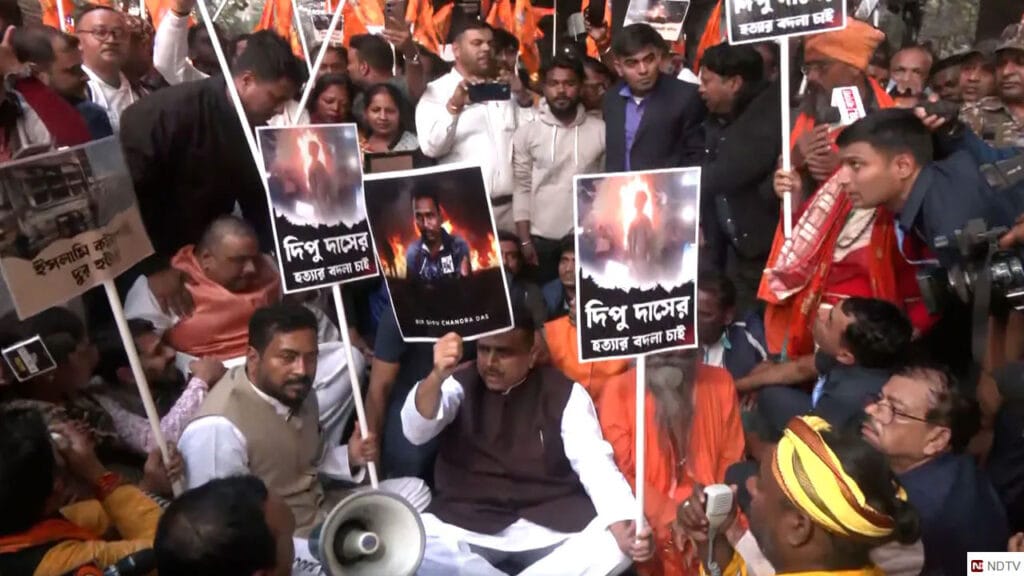
Suvendu Adhikari took Hindu saints to the office of the Bangladesh Deputy High Commissioner. He organised a sit-in protest there. He also met the officials. Such demonstrations and protests escalate Indo-Bangladesh relationship.
The main objective was to know the progress of justice in the mob lynching case of Dipu Chandra Das. At the same time, he raised the demand for the release of Chinmoy Krishna Das. Nonetheless, he protested against the continuous attacks on Hindus during the tenure of the interim government.
This is important at this stage of declining Indo-Bangladesh diplomatic tension.
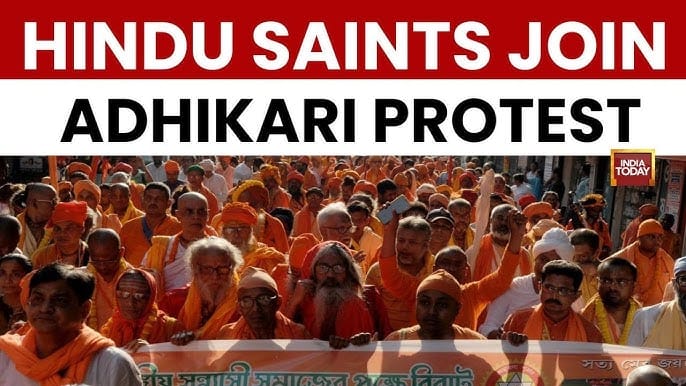
As a result, the programme also highlighted the call for Bengali Hindu awakening. Notably, around 100 Naga sadhus participated in the protest. There was heavy pushing and scuffling due to police obstruction. As a result, the police arrested several people.
Indo-Bangladesh Diplomatic Tension and relationship issues
These protests reflect a significant rise in Indo-Bangladesh diplomatic tension within West Bengal. This is because local leaders are increasingly linking the internal security of minorities in Bangladesh with India’s domestic political situation.
However, political analysts see this only as a pressure-building strategy, nothing more. This is because no state can take decisions on foreign relations on its own. Therefore, the central government alone must take any such action.
Later, Suvendu Adhikari told the media that he would stop onion exports to Bangladesh. However, the Government of India has not yet announced any plan to suspend trade relations. Indeed, Indo-Bangladesh Relationship is under tremendous strain.
Meanwhile, Suvendu Adhikari strongly targeted Mamata Banerjee. In his allegations, he said Mamata’s police used force even against a peaceful march. He compared the action to the Yunus government in Bangladesh. Notably, the delegation led by Suvendu Adhikari had five members.
Additionally, he announced that he would return after the saints come back from Gangasagar. He also warned that if there is no action by then, he will come again. This time, he said, he will bring five lakh sadhus.
Hindu Vote Consolidation in the Assembly Election 2026
In reality, political parties try to create a strong narrative among Hindus during the election season to win votes. There is no doubt that the fully committed BJP will fuel this effort to consolidate Hindu Votes in Assembly Election 2026.
At the same time, Mamata Banerjee is equally active. Her aim is to prevent Hindu votes from going entirely to the BJP. Therefore, the government is focusing on building temples one after another.
Moreover, the Administration and Judiciaries completed the Samserganj trial process quickly and announced the punishment. Earlier, all political parties mainly focused on securing Muslim votes. However, the current situation suggests a shift. Now, the primary objective appears to be the consolidation of Hindu votes.
On one side, there is the pressure of the SIR issue. At the same time, Mamata Banerjee is facing the challenge of Hindu vote consolidation. As a result, she appears to be going through a difficult phase. Overall, Mamata Banerjee seems to be under serious political stress.
Indo-Bangladesh Relationship and the Minority Security Issue

Courtesy: Highland Post
Now, let us look at what the Government of India has actually done in this matter.
- First, it strongly condemned the killing of Dipu Das.
- Next, India summoned the Bangladesh High Commissioner, Riaz Hamidullah, and lodged a firm protest in strong diplomatic language. So, the center remains concerned about Indo-Bangladesh diplomatic tension. It also asked Bangladesh to ensure the safety of Hindus, Buddhists, and Christians.
- However, India rejected Bangladesh’s claim that the issue is only an internal matter or mere propaganda. To counter this narrative, India presented facts and evidence.
- Nevertheless, India suspended visa applications from Dhaka and Chattogram. It also strengthened border security.
- Finally, India tried to build international pressure. It used its relationship with the United States and bilateral diplomatic channels to raise the issue.
Any hasty act against Bangladesh may cast a long-term impact in Indo-Bangladesh Relationship.
The UN chief sent a message through his spokesperson. He said that all Bangladeshis must remain safe in their country. Meanwhile, the Human Rights Commission stated that politics based on revenge is only destructive. It also said that immediate action is necessary. As a result, strong international pressure has emerged.
Bangladesh Election
However, it does not appear that the Yunus government is very concerned. Instead, the government seems to be continuing its rule with the support of China and Pakistan. Notably, elections are scheduled for February.
Therefore, an elected government is expected to take charge after that. At that point, Yunus will no longer remain the head of the caretaker government. Political Observers expect the Indo-Bangladesh diplomatic tension to come down.
Meanwhile, Tarique Rahman, the son of Khaleda Zia, has recently returned. He is also expected to contest the election. So far, he has spoken about inclusivity. However, it is still unclear whether any understanding exists between Tarique Rahman and Yunus.
In the meantime, India–Bangladesh relations have reached a historic low. This is significant because India played a crucial role in Bangladesh’s independence in 1971, even at the cost of blood.
People Also Ask (PAA)
Why is the relationship between India and Bangladesh important in South Asia?
The relationship is strategically important for regional stability, economic integration, border security cooperation, and connectivity development. Strong bilateral ties help improve trade flows, counter-terrorism coordination, and diplomatic balance in South Asia.
How does trade influence India-Bangladesh diplomatic relations?
Trade is a major pillar of bilateral engagement, with Bangladesh emerging as one of India’s key trading partners in the region. Increasing market access, infrastructure connectivity, and logistics cooperation continue to strengthen economic interdependence.
What are the major connectivity projects between India and Bangladesh?
Key initiatives include railway restoration projects, inland waterway agreements, cross-border road corridors, and port access arrangements. These projects aim to improve transport efficiency, reduce costs, and promote regional economic growth.
What are the main challenges in India-Bangladesh relations?
Some challenges include river water-sharing disputes, border management concerns, migration issues, and domestic political sensitivities. Diplomatic dialogue and joint institutional mechanisms are used to address these matters.
How does border management affect bilateral cooperation?
Effective border management helps maintain security, reduce illegal trade activities, and ensure smooth legal movement of goods and people. Joint patrols and policy coordination play an important role in maintaining stability.
How do cultural and historical ties shape India-Bangladesh relations?
Shared linguistic, cultural, and historical connections contribute to people-to-people engagement, tourism growth, educational exchange, and mutual understanding between the two countries.
What role does energy cooperation play in Indo-Bangladesh ties?
Energy cooperation, including cross-border electricity trade and fuel supply arrangements, supports Bangladesh’s development needs while strengthening strategic and economic partnership between the two nations.
Latest Updates
Energy cooperation deepens amid fuel crisis
India is reviewing Bangladesh’s fresh request for diesel supply as Dhaka faces rising energy demand and global supply disruptions. The decision will balance India’s domestic availability with regional diplomatic priorities.
At the same time, India has already begun supplying diesel through a bilateral pipeline arrangement, with long-term targets for larger annual fuel deliveries. This reflects growing strategic cooperation in the energy sector.
Bangladesh’s broader energy shortage—triggered partly by higher LNG prices and Middle-East supply tensions—has pushed it to seek additional refined oil from neighbouring countries, including India.
Security and legal cooperation continues
Authorities from both countries are working together under the bilateral extradition framework regarding suspects linked to a political killing case. This indicates that security coordination remains an important pillar of diplomatic engagement.
Geopolitical shifts influencing bilateral ties
Analysts suggest Bangladesh’s evolving foreign policy and domestic political transition could reshape regional alignments and influence its engagement with India. Strategic competition from other major powers is also emerging as a key factor.