
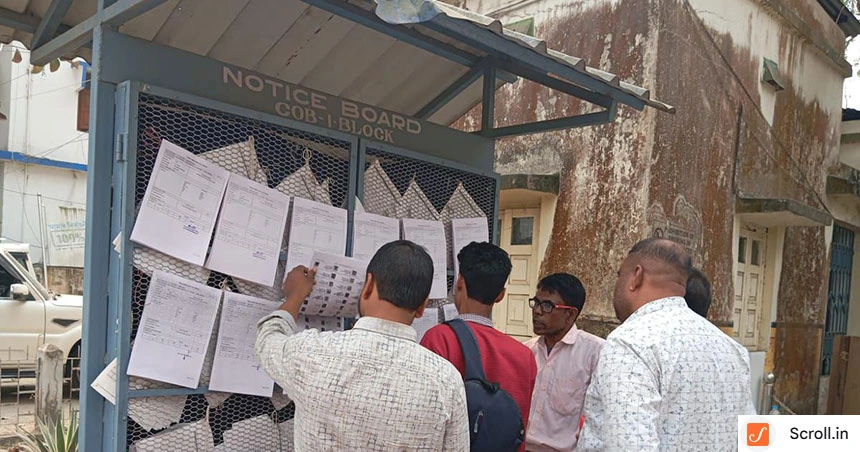
Bengal Voter Roll Debate: A Big Question
The Bengal Voter Roll Debate began quite some time ago. Now, a report by The Indian Express has brought it back into the spotlight. But this time, the allegations have taken a different turn.
We have already witnessed enough drama during the Special Intensive Revision (SIR) of electoral rolls in West Bengal. The term “logical discrepancies” made its appearance in the state. Then came an unprecedented intervention by the Supreme Court. Judicial officers were asked to leave their regular judicial work and take up the task of deciding whether the names of voters were valid.
The result was a serious disruption of regular judicial work in West Bengal. The number of judicial officers available in the state was not sufficient for this extraordinary exercise. Judges had to be brought in from neighbouring Jharkhand and Odisha as well.
Then came the horrifying incident at Mothabari in Malda, where judicial officers were attacked and held hostage. It was an ugly episode in an already troubled electoral exercise.
I have discussed the wider background in my earlier article, Bengal Electoral Roll Row: Shocking Truth!. But the controversy has now entered another chapter.
After all this, when the judicial officers had completed their scrutiny, appeals were filed against the inclusion of around 16 lakh names. According to the Election Commission’s figures submitted before the Supreme Court, 16,10,311 appeals challenged the inclusion of voters whose names had been cleared during adjudication.
Now, the obvious questions arise. Who filed these appeals? Under whose instructions? And why?
Who Ordered the 16 Lakh Appeals?
The questions become even more serious when we look at the developments within the Election Commission itself.
The Indian Express reported that Election Commissioner Sukhbir Singh Sandhu raised questions in an internal communication dated August 12. He wanted to know who had authorised the filing of these appeals on behalf of the Election Commission and who had actually filed them.
The report also said that neither Sandhu nor fellow Election Commissioner Vivek Joshi nor the then Chief Electoral Officer of West Bengal had been informed about the basis or process behind the appeals.
This is not an insignificant administrative detail. We are talking about 16.10 lakh appeals against voters whose names had been cleared by judicial officers. The Bengal Voter Roll debate becomes more vulnerable in such acts.
The then Chief Electoral Officer of West Bengal is now the state’s Chief Secretary and is reportedly continuing on an extension. The new Chief Electoral Officer, Krishna Gupta, reportedly indicated in October, the explanation was that the appeals had originated from the Kolkata office itself. Subrata Gupta, the special roll observer during SIR, has informed in August that he had no knowledge of the matter.
But that still leaves the most important questions unanswered. Who in the Kolkata office took the decision? Who authorised the filing? Was there any formal approval? And why were the other members of the Election Commission apparently unaware of the process?
A report by The Wire examined the filing of these appeals and the questions surrounding their origin. Its subsequent investigation, A Centralised Batch System Challenged Bengal Voters Who Were Cleared by Judicial Officers, also examined the appeal records and the pattern in which they were generated.
These reports make the matter even more serious. If the allegations about the lack of knowledge among senior Election Commissioners are correct, questions about the Commission’s internal functioning and accountability are bound to arise.
The Election Commission’s Explanation Before the Supreme Court
There has, however, been a further development that must be considered.
On October 26, the Election Commission filed a counter-affidavit before the Supreme Court explaining that the appeals had been filed by officers of the West Bengal Chief Electoral Officer’s office in their capacity as statutory authorities under the Representation of the People Act. The Commission also referred to the Supreme Court’s earlier orders concerning appeals against decisions taken by judicial officers.
According to the Commission, these matters were not brought before the Commission itself because the officers concerned had the authority to file the appeals.
The Print reported that the Commission also clarified that the 16 lakh voters whose inclusion had been challenged were eligible to exercise their voting rights in the West Bengal Assembly election held earlier this year.
But does this explanation settle everything?
Not necessarily. The legal authority of the officers, the procedure followed, the basis for selecting the voters and the manner in which the appeals were generated all deserve examination.
In fact, The Wire has published a further analysis questioning the Election Commission’s explanation and identifying inconsistencies in its affidavit.
The Commission has placed its position before the Court. The questions raised by the reports and the petitioners must now be examined against the relevant legal provisions and documentary records.
The Election Commission’s subsequent course corrections have only deepened the doubts. Watch this interesting discussion on India Today’s Democratic Newsroom, where Rajdeep Sardesai has expressed his agonies.
Why Challenge Names Cleared by Judges?
The most important question, however, is slightly different.
The Supreme Court had entrusted judicial officers with the responsibility of examining disputed voter entries. They went through the cases and decided which names should remain on the electoral roll.
After such an elaborate exercise, why did someone feel the need to challenge the inclusion of around 16 lakh voters?
Of course, the right to appeal is an essential part of the legal process. No judicial or administrative decision should be beyond scrutiny. But the scale of these appeals, together with the questions surrounding their authorisation and filing, cannot simply be ignored.
Think about the sequence of events. Judicial officers were brought in from three states. Their regular work was affected. They had to examine a huge number of cases under extraordinary circumstances. Some even faced a horrifying attack in Malda.
And after all that, appeals were filed against the inclusion of 16.10 lakh voters.
Does this not raise a question about the confidence placed in the decisions of the judicial officers? Is this merely an exercise of the right to appeal, or does it also reflect a lack of confidence in the adjudication process?
These are not unreasonable questions.
My earlier article, Final Voter List 2026 Out: A Big Win of EC, discussed the publication of the final voter list and the subsequent adjudication exercise. The latest developments show that the story did not end with the publication of that list.
Mamata Banerjee May Be Delighted, But What About Voters?
Mamata Banerjee is understandably delighted by these developments. They give her another opportunity to attack the Election Commission and question the entire SIR exercise. She has demanded even the arrest of Gyanesh Kumar.
But there is something that should not be forgotten amid all this political drama.
The ultimate victims are ordinary Indian citizens. They are the ones whose names are questioned, examined, cleared and challenged again. They are the ones who have to live with the uncertainty of whether they will be allowed to exercise their voting rights.
In my earlier article, SIR Deletions: The Shocking Truth in India, I had made my position clear. I have no objection to removing the names of deceased voters, duplicate entries, people who have permanently shifted elsewhere or those who are legally ineligible to vote.
But removing ineligible names and protecting genuine voters are two sides of the same responsibility.
The purpose of cleaning an electoral roll cannot be to make eligible citizens run from one authority to another. Nor should a voter have to face repeated uncertainty after a judicial officer has already examined the case.
We have also discussed the wider issue of electoral rights in Form 6 Controversy: A Voter Rights Crisis. Whether it concerns registration or the retention of an existing name, the central question remains the same: how do we protect the rights of eligible voters?
Key Takeaways: The Questions That Remain
- The 16.10 lakh appeals concern voters whose names were cleared during judicial adjudication. The appeals challenged their inclusion and sought their removal.
- Judicial officers from West Bengal, Jharkhand and Odisha were involved in the extraordinary adjudication exercise.
- The attack on judicial officers at Mothabari in Malda was one of the most disturbing episodes of the entire exercise.
- Election Commissioner Sukhbir Singh Sandhu reportedly questioned who authorised the appeals and who actually filed them.
- The Election Commission subsequently told the Supreme Court that officers in the West Bengal CEO’s office had filed the appeals under their statutory authority and in accordance with the Court’s orders.
- The Commission’s explanation does not remove the need to examine the authorisation, records and process behind such a large number of appeals.
- The right to appeal must be respected, but the scale and circumstances of these appeals raise legitimate questions about the adjudication process and fuels Bengal Voter Roll debate.
- Ultimately, ordinary Indian citizens bear the burden of this prolonged uncertainty over their voting rights.
The Real Victims Are Indian Citizens
The matter is now before the Supreme Court, and we must wait for the legal process to take its course. But that does not mean the Election Commission can avoid answering legitimate questions, mainly when Bengal Voter Roll debate has reached the hilt.
Who initiated the appeals? Who authorised them? Why were they filed on such a massive scale? And why did the inclusion of so many voters, cleared by judicial officers, have to be challenged?
These are not unreasonable questions. They go to the heart of the credibility of the entire exercise.
One thing must be remembered. The right to vote is a constitutional right in India’s democratic framework, exercised subject to the eligibility requirements laid down by law. It is not a favour granted by the Election Commission, a political party or any government.
We have already seen enough political drama. We have witnessed judicial intervention, administrative confusion, protests, attacks and endless arguments over voter lists. Now we have another round of appeals.
But who is actually paying the price?
Not the political leaders who make speeches. Not the officials who exchange letters. Not the lawyers who argue in court.
It is the ordinary Indian citizen who has to worry about whether his or her name will remain on the voter list.
A voter should not have to fight an endless battle merely to exercise a democratic right. Whatever the political consequences and whatever the final judicial decision, the burden of this controversy should not fall on eligible citizens.
That is why the Bengal Voter Roll debate is no longer merely an administrative dispute. It has become a battle over the rights of ordinary Indian voters.