
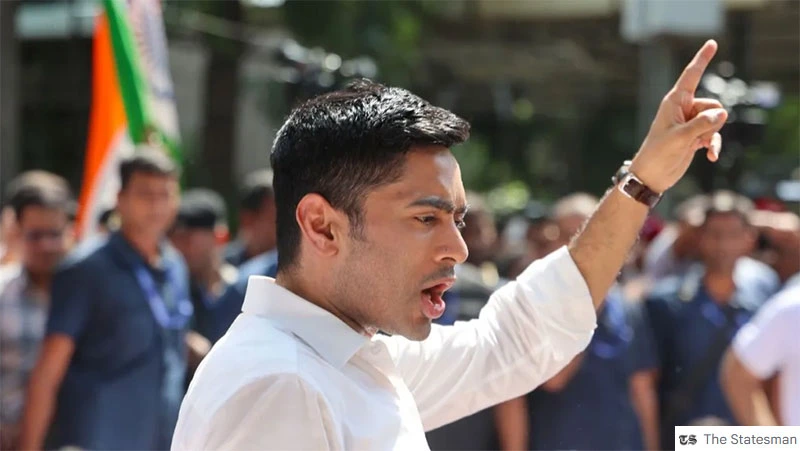
Abhishek Attacks Judges: Why This Is Dangerous for Democracy
Abhishek Banerjee has once again turned his anger towards the judiciary. This is not the first time that a Trinamool Congress leader has publicly questioned judges or attacked the credibility of the courts. From the controversy involving Justice Rajashekhar Mantha to the latest remarks about a section of the judiciary allegedly favouring the BJP, the pattern deserves serious attention.
The immediate controversy began after Abhishek complained about the delay in hearing his petition concerning the reduction of his security cover. He alleged that a section of the judiciary was acting under political pressure and suggested that some judges were not performing their constitutional responsibilities.
A political leader has every right to express dissatisfaction with a court’s decision. He can challenge an order, approach a higher court or seek another legal remedy. But accusing judges of political allegiance without producing evidence is a different matter altogether.
The question is simple: can a democracy function if political leaders begin treating judges as supporters or opponents of their parties?
The remarks became a subject of discussion in the Calcutta High Court on November 12, 2026. Justice Krishna Rao asked Abhishek’s lawyer to ask his client to identify the judges who supposedly belonged to the BJP and those who did not. The judge also observed that an educated person and an elected MP could not be treated like an ordinary layperson when making such statements.
The court reserved its order on Abhishek’s security petition. Importantly, it clarified that the controversy over his media remarks would not influence the decision on his security-related grievance. That distinction matters: criticism of Abhishek’s remarks must not be confused with the court deciding his petition against him.
Read the report on Justice Krishna Rao’s observations.
Mamata Banerjee and TMC’s History of Confrontation with the Judiciary
Abhishek’s remarks should not be viewed in isolation. Over the years, several incidents involving the Trinamool Congress leadership have raised questions about its attitude towards the judiciary.
The controversy surrounding Justice Rajashekhar Mantha is one such example. In January 2023, protests by a section of lawyers outside the judge’s chamber disrupted the normal functioning of the Calcutta High Court. Posters and allegations concerning the judge also became part of the controversy. The episode raised serious questions about whether judges could discharge their duties without intimidation or public pressure.
Read the report on the protests outside Justice Mantha’s chamber.
There was also the incident involving Justice Abhijit Gangopadhyay, whose courtroom was reportedly obstructed by a group of lawyers. Whatever the political disagreement with a judge, a courtroom cannot become a battleground for party supporters or political activists.
Mamata Banerjee herself has made controversial remarks about the judiciary in the past. In 2012, her comments about court verdicts drew strong criticism. The controversy was serious enough to become a national talking point.
Read the report on Mamata Banerjee’s remarks.
TMC spokespersons and other party leaders have also repeatedly criticised judges and court decisions in public. Kunal Ghosh, among others, has often been outspoken about judicial proceedings.
Of course, no political party has a monopoly on criticism of the judiciary. Leaders from every party should be free to question a judgment through lawful and responsible public debate. But when criticism repeatedly shifts from the judgment to the judge’s supposed political identity, it creates an atmosphere in which judicial independence can come under pressure.
Has this culture of confrontation made some leaders believe that judges can be publicly attacked whenever a ruling goes against their political interests? That is a question the Trinamool leadership must answer.
Judicial Independence: Criticise the Judgment, Not the Judge
There is a fundamental difference between criticising a judgment and questioning a judge’s integrity.
The Constitution does not prevent citizens, politicians or political parties from discussing court judgments. If someone believes that a judgment is legally incorrect, the proper response is to explain why. The aggrieved party can appeal to a higher court. It can seek a review or pursue any other remedy available under the law.
The Trinamool Congress government itself has approached higher courts in several matters, including disputes concerning OBC reservations, dearness allowance and the Special Intensive Revision of electoral rolls. It has every right to do so. The courts are there to hear such challenges.
Read: Bengal Electoral Roll Row: Shocking Truth!
But if approaching a court is legitimate when the government disagrees with an order, why should a judge be accused of political bias simply because a decision or hearing does not meet a leader’s expectations?
A judge is not expected to deliver a favourable order to the ruling party, the opposition or any individual politician. A judge is expected to apply the law.
The same principle applies to Abhishek Banerjee. If he believes that his security petition has not received adequate attention, he can seek an urgent hearing, approach another appropriate forum or move the Supreme Court. What he cannot reasonably expect is that public allegations against judges will substitute for legal arguments.
Judicial independence is not a favour granted by politicians. It is a constitutional safeguard for every citizen, including those who oppose the government.
Abhishek Banerjee Has Also Benefited from Judicial Protection
There is another aspect of this controversy that deserves attention. Abhishek Banerjee has approached the courts in several matters involving investigations, questioning and personal legal relief. He has been able to challenge decisions and seek protection through the judicial process.
That is precisely how the system should work. Even a politician facing serious allegations is entitled to due process, legal representation and a fair hearing. No one should be denied these rights because of political identity.
But the same respect must be shown to the institution that provides those protections.
A politician cannot celebrate judicial intervention when it helps him and then question the integrity of the judiciary whenever a hearing is delayed or an order is unfavourable. The principle of judicial independence cannot be selective.
Abhishek is a three-time elected MP and the national general secretary of a major political party. He has access to experienced lawyers and the means to pursue legal remedies. His political position gives him a larger public platform, but it also brings greater responsibility.
If an ordinary citizen can be expected to respect the legal process while waiting for justice, why should a powerful political leader be treated differently?
Judicial Delay in India: Is Abhishek Above Ordinary Citizens?
Abhishek has complained that his security-related petition has been pending for months. His concern about personal safety should not be dismissed. If there is a genuine threat, the state has a responsibility to assess it properly and provide protection according to law.
The court itself questioned why the state had not convened a fresh security review after further incidents were brought to its attention. It also reserved its order after hearing the arguments.
But the larger question remains: is Abhishek aware of how long ordinary citizens wait for justice in India?
Millions of litigants spend years, sometimes decades, waiting for their cases to reach a conclusion. Many cannot afford senior advocates or repeated visits to courts. Some lose their livelihoods, savings and even hope while waiting for a hearing.
Abhishek can engage senior lawyers and pursue remedies available to him. That is his legal right. But a powerful politician should also understand that the judicial system is burdened with cases involving people who have far fewer resources and far less public influence.
The problem of judicial delay is real. It deserves serious reform, not selective outrage. If Abhishek wants faster justice, he could use his position as an MP to demand improvements in the justice delivery system for everyone in the parliament.
TMC Government vs Judiciary: A Record That Deserves Scrutiny
The relationship between the Mamata Banerjee government and the judiciary has been marked by repeated confrontations. Several high-profile cases have exposed tensions between the executive and the courts.
The disputes over dearness allowance, OBC reservations and electoral-roll revision are examples of the government challenging judicial or legal processes. Such challenges are part of the constitutional system. But the government’s public response to adverse orders also matters.
The Chingrighata Metro extension dispute and the proceedings concerning implementation of dearness allowance orders have drawn judicial scrutiny of the state government’s position and compliance. When a government disagrees with a court, it must use the legal process. It cannot treat judicial directions as optional political advice.
The controversy surrounding the Special Intensive Revision in West Bengal has also produced sharp political exchanges. The state and the TMC have challenged aspects of the process, while the Election Commission and the courts have their own constitutional responsibilities.
Read Knowledge Mart’s analysis of the Bengal SIR controversy.
There is a wider lesson here. The executive, legislature and judiciary have separate constitutional roles. None is above the Constitution. A government may disagree with a court, but it must comply with binding judicial orders unless they are stayed or overturned.
Judicial Intimidation and the Attack on Democratic Institutions
The issue is not limited to one leader or one court hearing. It concerns the atmosphere in which judges are expected to work.
In Malda’s Mothabari, judicial officers involved in the voter-roll adjudication process were reportedly surrounded and prevented from leaving a location by a crowd. The incident raised serious concerns about the safety of officials carrying out judicial responsibilities. There were also political allegations concerning the presence and role of local TMC leaders during the incident.
But the broader point cannot be ignored: judicial officers must be able to perform their duties without fear, threats or mob pressure. If those entrusted with judicial and constitutional responsibilities cannot work safely, ordinary citizens will be even more vulnerable.
Knowledge Mart has also examined the wider problem of political violence and the criminalisation of politics in Bengal.
Read: Criminal Politics in Bengal — A Growing Danger.
A democracy cannot survive on elections alone. It also needs independent institutions, respect for the rule of law and the freedom of public officials to perform their duties without political intimidation.
Abhishek’s Z-Plus Security and Political Entitlement
The immediate court case concerns Abhishek’s security cover, which was reduced from Z-plus to X category after the change of government in West Bengal in May 2026. Abhishek challenged the decision, arguing that his threat perception had not been properly assessed.
The state disputed his claim. During the hearing, the court questioned why a fresh security review had not been conducted after further incidents were reported. It ultimately reserved its order.
There is no reason to deny security to anyone who faces a genuine threat. A public representative’s protection should be decided on the basis of a proper threat assessment, not political favour or hostility.
But security arrangements must also be proportionate and should not unnecessarily inconvenience ordinary residents. The public road and footpath outside a politician’s residence do not become private property simply because the person living there holds a powerful position.
The recent controversy outside Abhishek’s Kalighat residence brought this issue into focus. On November 12, municipal workers removed a temporary bamboo structure and an iron gate outside the property, which officials said were obstructing pedestrian movement. Abhishek’s aides said the structure had been erected as part of his security arrangements. The removal followed a dispute and commotion outside the residence during his birthday celebrations on November 7.
Read the report on the removal of the structure outside Abhishek’s residence.
Read Abhishek’s Amtala Office: Bulldozer Attack.
The question is not whether a politician deserves security. The question is whether public roads and footpaths can be occupied for extended periods without considering the inconvenience caused to residents and pedestrians.
Can a political leader’s birthday celebration justify blocking a public road? Can ordinary people be expected to accept disruption simply because a powerful politician lives nearby? In a democratic and civilised society, the answer should be obvious.
Jahangir Khan’s Mansion Demolished: The Diamond Harbour Connection
Abhishek’s political rise has often been associated with the Diamond Harbour Model, his Sebasray health camps and his highly centralised political organisation. These initiatives have attracted public attention as well as political criticism.
One name that repeatedly comes up in discussions about the Diamond Harbour political network is Jahangir Khan. He has been described in media reports as a close and influential local aide of Abhishek. Critics have alleged that his local organisational influence played an important role in maintaining the TMC’s electoral hold in the area.
Jahangir’s role became a subject of renewed discussion after he withdrew as the TMC candidate for the Falta repoll in May 2026. His political influence and the party leadership’s handling of the episode raised questions within the TMC itself.
Read The Wire’s report on Jahangir Khan and the Diamond Harbour Model.
Now, the demolition of Jahangir Khan’s house in Falta has brought the issue back into the spotlight. The South 24 Parganas administration began demolishing the unauthorised portion of the former TMC MLA’s house in Srirampur on November 11, 2026. According to The Times of India, the administration had issued several notices and summoned him for hearings. After he failed to appear or remove the unauthorised structure within the stipulated period, the administration proceeded after obtaining court approval.
The house was in a narrow lane where a bulldozer could not enter. Officials first removed furniture and household belongings before demolition work began using machinery and hand tools.
Read The Times of India’s report on the demolition of Jahangir Khan’s house.
There are also serious allegations about the land on which the property stood. The Telegraph reported claims that the building involved encroached land and violations of building rules. Anandabazar Patrika reported a local resident’s allegation that the house had been constructed on government vested land.
Read The Telegraph’s report on the demolition and land allegations.
The timing is striking. When an allegedly unauthorised structure outside Abhishek’s Kalighat residence was being removed, demolition work was also underway at the house of Jahangir Khan, a figure described in reports as once close to Abhishek and influential in the Diamond Harbour political network.
One cannot automatically hold Abhishek responsible for every alleged act of a political associate. But if Jahangir was indeed an influential part of the local political machinery, questions about accountability cannot simply be brushed aside. Who knew what was happening? Who benefited from the political network? And why should powerful local associates be beyond scrutiny?
The Diamond Harbour Model may be presented as an example of political organisation and public outreach. But no political model should be beyond scrutiny. Public health camps, electoral success and personal loyalty cannot replace transparency and accountability.
Democracy Requires Accountability, Not Political Entitlement
The controversy surrounding Abhishek Banerjee is part of a larger question about political culture in West Bengal. For years, the TMC leadership has projected itself as the defender of democracy and the Constitution. Still, the party must also answer questions about its own conduct, its relationship with public institutions and its response to criticism.
The same standard must apply to the BJP and every other political party. A change of government does not give the new ruling party permission to misuse state power. Nor does being in opposition give a political leader the right to make unsupported allegations against judges.
The rule of law must apply equally to the powerful and the ordinary citizen. Political leaders should not expect special treatment from courts, police, municipal authorities or public institutions.
Abhishek Banerjee is entitled to challenge the reduction of his security cover. He is entitled to a fair hearing. He is entitled to criticise a judgment with reasoned arguments. But he must also accept that an elected MP has a responsibility to protect public confidence in constitutional institutions.
Key Takeaways: Abhishek Banerjee and Judicial Independence
- Judicial independence is non-negotiable: Judges must be free to decide cases without political pressure or intimidation.
- Criticise judgments, not personal integrity: Disagreement should be expressed through reasoned debate and legal remedies.
- Public office brings responsibility: An elected MP must be careful when making allegations about constitutional institutions.
- Legal remedies are available: Anyone dissatisfied with a court’s action can approach an appropriate higher forum.
- Security must be assessed fairly: Genuine threats deserve protection, but public spaces must remain accessible.
- Political accountability matters: The Diamond Harbour Model and the role of local political associates deserve transparent scrutiny.
- The same standards apply to every party: Neither the ruling party nor the opposition is above the Constitution.
Enough Is Enough: Respect the Judiciary
Justice Krishna Rao’s observations have brought an important issue back into public discussion. Abhishek Banerjee may disagree with the court’s handling of his petition. He may believe that his security concerns deserve urgent attention. He has every right to pursue those concerns through the law.
But publicly suggesting that judges belong to political parties is a serious allegation. If he has evidence, he should place it before the appropriate authority. If he does not, he should exercise restraint.
The judiciary is not infallible. Judges can make mistakes, and judgments can be challenged. But the institution itself must be protected from political intimidation. Otherwise, the damage will not be limited to one judge, one party or one case. It will affect every citizen who depends on the courts for justice.
Mamata Banerjee and Abhishek Banerjee must understand that constitutional institutions are not extensions of their political battles. The judiciary does not exist to satisfy the ruling party or the opposition. It exists to uphold the law.
A democracy needs strong political leaders, but it needs independent judges even more.
Enough is enough. Respect the judiciary, accept the rule of law and stop turning every unfavourable judicial development into a political conspiracy.