
Key Highlights
- West Bengal healthcare system crisis deepens after RG Kar movement backlash.
- ₹4,010 out-of-pocket health cost—2nd highest in India.
- Kolkata hospitals overcrowded, districts struggle for care.
- 210 mobile hospitals, but staff shortage cripples services.
- Swasthya Sathi card faces mass hospital refusals.
- Ayushman Bharat still absent in West Bengal, despite entitlement.
- Rural Bengal lacks specialists, worsening health inequality.
- Healthcare failures may impact 2026 Assembly elections.
What Is the Real State of Healthcare System?
The term healthcare system itself is controversial. It raises many questions and follows many models. However, the core issue is simple—what kind of healthcare system do we actually have?
Health is a constitutionally guaranteed fundamental right in India. Therefore, the real question is how good the healthcare services are in West Bengal. Are people getting the care they deserve?
Meanwhile, Donald Trump may decide to withdraw from the World Health Organization (WHO). This decision could create some financial trouble for the WHO. However, the world still needs a strong global health body.
Yes, the WHO may have flaws. But instead of fixing those flaws, what is the benefit of stepping away from it? Only Trump can answer that question.
As a result, we will keep our focus limited to West Bengal and examine the healthcare system within the state.
Did the RG Kar Movement Expose Systemic Failure?
Firs of all, let us admit the fact that West Bengal Health Care System lags behind many other states like Kerala, Tamilnadu, Maharastra.
West Bengal’s healthcare system lost its credibility during the RG Kar movement. In reality, public anger had been building for a long time. That hidden frustration finally exploded during that period.
However, this does not mean that healthcare was very good during the earlier Left Front era. At least one thing must be acknowledged clearly. Surya Kanto Mishra served not just as a minister, he was a physician also.
He built his career on professional discipline and public service. People never questioned his personal honesty. No one dared to raise doubts about his integrity. Even Shamik Bhattacharya, the current BJP State President had duly appreciated him.
He maintained a clean public image throughout his tenure. His conduct remained consistent with his principles.
Even today, the simple lifestyle Surya Kanta Mishra leads can serve as a benchmark for the politicians of the present generation. His life stands as an example that power and personal integrity can coexist.
Corruption has existed within the health system for years. But due to the lack of strong government vigilance, it has continued to grow. Earlier, authorities at least took action when complaints surfaced. Now, even when names come out in public, no action follows.
Several names have emerged before us like Sandip Ghosh, Birupaksha, Abhik Dey, Sudipta Roy, and many others. Yet, we have not heard of any concrete action taken against any of them.
As a result, public trust in West Bengal’s healthcare system continues to erode.
State Focus on Healthcare System
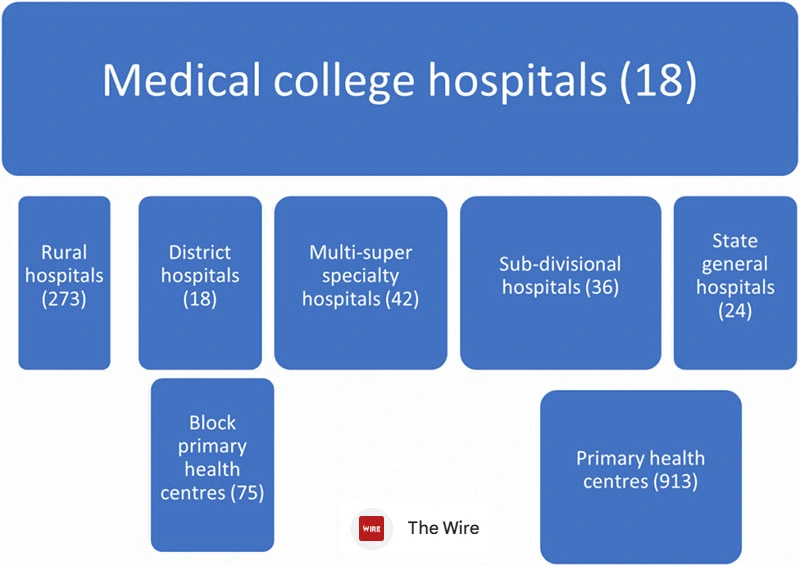
Now, let us take a closer look at West Bengal’s healthcare system.
- The state has set up 210 mobile hospitals. As a result, healthcare services now reach people at their doorsteps under the Duare Chikitsa model.
- The number of super-specialty hospitals has increased. Therefore, patients no longer need to travel outside the state for advanced treatment in many cases.
- Meanwhile, in this year’s budget, the government has included gig workers under the Swasthya Sathi health card scheme. This step aims to expand health insurance coverage to workers in the informal and platform-based economy.
Overall, these measures highlight the state’s focus on expanding healthcare access, although questions remain about transparency and implementation.
Are Mobile Hospitals Helping or Hurting Services?
However, these initiatives are creating serious problems in staff deployment. The system often fails to place the right people in the right roles.
For example, if a hospital pharmacist is sent to run a mobile hospital, the hospital’s own outpatient services collapse. Other states also run mobile hospitals. But they first create separate, dedicated teams for that purpose.
The same issue applies to super-specialty hospitals. Shiny buildings exist, but trained medical staff are missing. Infrastructure has expanded, but manpower has not kept pace.
Meanwhile, television reports have shown rural health centres being used as storage warehouses for outside goods. As a result, essential healthcare services in those areas suffer.
Therefore, without proper planning and staffing, even well-intentioned healthcare projects fail to deliver real benefits to the people.
Weaknesses of Healthcare System in West Bengal
Now, let us focus on the core problems of West Bengal’s healthcare system.
- First, out-of-pocket healthcare spending (OOPE) in West Bengal stands at ₹4,010. This is the second-highest in India. As a result, medical treatment puts a heavy financial burden on common people.
- Next, overcrowding in hospitals is extremely high. Therefore, patients often face long waiting times and poor service quality.
- In addition, most patients depend on Kolkata-centric hospitals for treatment. This creates excessive pressure on a few urban hospitals, while district and rural facilities remain underused.
- West Bengal has only one ID (Infectious Diseases) hospital, located in Beliaghata. This is clearly inadequate for a state of this size.
- Meanwhile, the central referral system has not been implemented uniformly. As a result, patients are forced to move from one hospital to another, wasting time and money.
- There is also almost no effective grievance redressal system. Therefore, patients have little support when problems arise.
- Moreover, medicines and consumables are often unavailable in government hospitals. Consequently, patients must buy them from outside at their own cost.
- Many private hospitals refuse to accept the Swasthya Sathi card. This limits the scheme’s real usefulness for patients.
- In rural areas, critical specialists such as anesthetists, gynecologists, and radiologists are frequently absent. At the same time, the number of doctors is far lower than required.
- Although a Medical Council exists, it is often inactive. In many cases, even RTI applications fail to get responses.
- Finally, most working doctors face extreme workload and mental pressure. As a result, they struggle to deliver optimal care despite their best efforts.
Overall, these structural and systemic failures continue to weaken West Bengal’s healthcare system, affecting both patients and healthcare workers alike.
Why Is Public Trust in Healthcare Eroding?
A doctor works at the line between life and death. Therefore, corruption cannot remain limited only to hospital services. Allegations have also reached medical education itself.
As a result, people often feel that before visiting a doctor, they should know which college the doctor studied at and in which year they passed. But this is neither practical nor fair.
In fact, a former Trinamool Congress Rajya Sabha MP, Shanatanu Sen, publicly admitted that even her daughter had faced the threat during her studies at R. G. Kar hospital. This revelation exposed the depth of the problem.
Can the Chief Minister Oversee Health Effectively?
Traditionally, health ministers are doctors by profession. During the Left Front era, Suryakanta Mishra, a practicing doctor, held the post. However, in present-day West Bengal, the health department is directly under the Chief Minister.
The Chief Minister’s poetry, songs, and artistic talent are well known. But no one has ever claimed that she has expertise in medical science.
Moreover, the Chief Minister also handles many other major departments, including Home Affairs. Therefore, it is reasonable to question how closely she can personally monitor the healthcare system.
Ultimately, when healthcare leadership lacks medical expertise and institutional focus, the entire system suffers while affecting both doctors and patients.
Why Has Ayushman Bharat Not Reached West Bengal?
It is still unclear why the Centre’s Ayushman Bharat scheme has not been implemented in West Bengal. This is not a charitable benefit. It is a legal and constitutional right of the people.
Instead, the state introduced the Swasthya Sathi card to compete with the central scheme. However, common citizens gained little from this move. On top of that, many hospitals refuse to accept the card. As a result, patients get trapped in a serious crisis, with no clear option for treatment.
Of course, no government can build a 100% perfect healthcare system overnight. That is understandable. But people expect to see at least a clear intention and concrete steps toward reform.
Will Healthcare Become a Key Issue in 2026 Elections?
Today, the people of West Bengal are watching closely. Before the 2026 Assembly elections, they are looking for real action, not just announcements, in the healthcare sector.
Key Takeaways
- Should the state take responsibility of Health care system or should we allow privatization?
- Can the medical insurance be a substitute of a state sponsored health care system?
- Is corruption and money laundering are the two key pitfalls of West Bengal Health Care System?
- Can the mobile hospital replace the outdoor health care in hospitals?
- How can we ensure the quality of the graduating medical professionals?