
Key Highlights
- Yuva Sathi Scheme: 7.7 million applications as on 25 February exposes the severity of Bengal job crisis
- Massive SSC Applications: Around 28–36 lakh candidates apply for a single SSC exam, exposing intense job competition.
- Overqualified Candidates Applying for Basic Posts: Even PhD holders apply for sweeper jobs, showing a serious education–employment mismatch.
- Unemployment Is a Long-Standing Issue: From Jyoti Basu’s unemployment allowance to Mamata Banerjee’s Yuvashree and Yuva Sathi schemes, governments have tried temporary relief measures.
- Industrial Decline After Singur: The exit of Tata Group from Singur marked a major setback for large-scale industrial growth in West Bengal.
- Shrinking Government Jobs: Permanent government recruitment has slowed significantly. The State Government increasingly depend on contractual or part-time hiring.
- Rising Financial Stress: The state’s weak financial condition raises doubts about the long-term sustainability of welfare allowance schemes.
- Questions Over Central Scheme Benefits: Limited awareness and participation in schemes like Prime Minister’s Employment Generation Programme (PMEGP) highlight implementation gaps.
- Political Branding vs Development: Welfare initiatives often become tools of political messaging, including examples during the tenure of Narendra Modi.
- Voters Will Decide in 2026: Ultimately, citizens will assess unemployment, development, and governance performance before casting their votes.
Does Yuva Sathi reveal extreme Bengal Job Crisis?
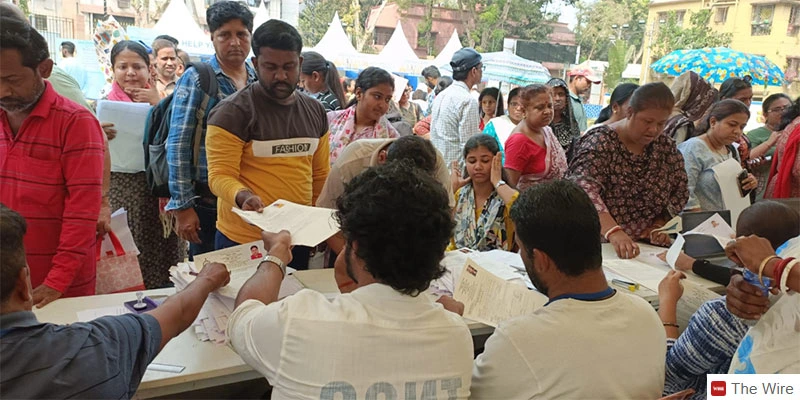
The Yuva Sathi scheme has clearly exposed the acute Bengal job crisis. The long queues in front of the camp portrayed a pathetic image of unemployment problem in West Bengal.
As of February 25, the number of applications has crossed 7.7 million (77 lakh). This is a huge figure.
West Bengal has around 70 million (7 crore) voters. However, the Yuva Sathi scheme is only for people aged 21 to 40 years who have at least passed Madhyamik (secondary examination).
Therefore, this number reflects only a section of unemployed youth. The Total figure of Bengal Job Crisis can look humungous.
Limited Eligibility, Bigger Unemployment Reality
Importantly, many uneducated unemployed people cannot apply for this scheme. In addition, those above 40 years of age are also excluded.
As a result, the actual unemployment number could be much higher than 77 lakh. The State Budget had kept a provision of approximately 27.8 lakh unemployed youths are expected to benefit. The scheme does not cover everyone who is jobless.
Strict Declaration Reduces Fake Applications
Notably, the application form requires a strict declaration. It clearly states that if anyone is associated with any government or private job, legal action will be taken against them.
Therefore, the possibility of fake applications among these 7.7 million applicants appears very low.
Will Yuva Sathi create a Reversal impact on Mamata?
Now, a key political question arises. Will the hurried launch of the Yuva Sathi scheme by Mamata Banerjee turn into a political boomerang in the 2026 West Bengal Assembly elections?
Only time will tell. However, the massive response to the scheme has already sent a strong signal about the growing unemployment concern in the state.
Is West Bengal’s 3.6% Unemployment Rate the Full Picture?
However, just a few days ago, the Periodic Labour Force Survey (PLFS) published by NITI Aayog claimed that West Bengal’s unemployment rate dropped to 3.6%, which is even lower than the national average.
Leaders of the All India Trinamool Congress proudly repeat this figure on television debates.
Yet, we are currently discussing only the 7.7 million applications under the Yuva Sathi scheme. That number alone raises serious questions.
Do Migrant Workers Tell a Different Story?
Beyond these applications, a massive number of Bengalis work as migrant labourers in other Indian states and even abroad.
Official data suggests around 2.24 million (22.4 lakh) migrant workers. However, many estimates indicate the real number could be closer to 3.8 million (38 lakh). Reports reveal that West Bengal is the fourth biggest source of Migrant Workers.
Every day, large numbers of people leave districts like Malda, Murshidabad, Dinajpur, and North & South 24 Parganas in search of work. The flow is continuous.
For example, the Amrit Bharat Express regularly runs from Malda to Bengaluru. Notably, this train largely serves migrant workers heading to southern cities.
Similarly, passengers travelling by the Coromandel Express or the Falaknuma Express often share stories of young Bengalis moving to southern states for better income opportunities.
During the COVID-19 lockdown, special trains had to be arranged to bring migrant workers back home. At that time, senior Congress leader Adhir Ranjan Chowdhury played a key role in arranging transport for workers from Murshidabad.
Therefore, the scale of migration is not a hidden fact. It became visible during the crisis.
Will severe Bengal Job Crisis Problem have political implications?
Despite these clear signs, many still hesitate to admit the severity of the unemployment crisis. Instead, we often choose to ignore it, like hiding from reality rather than confronting it.
Ironically, when migrant workers face attacks outside the state, protests erupt in the name of Bengali identity.
Another important aspect is that a significant portion of migrant workers come from minority communities. Meanwhile, the state government has long faced allegations of minority appeasement.
This raises a fundamental question: Have we lost the ability to distinguish between appeasement and real development?
The debate is not just political. It is about employment, dignity, and long-term economic stability in West Bengal.
When 28 to 36 lakh candidates apply for a single SSC exam, many choose to stay silent. The numbers themselves reflect the depth of the Bengal Job crisis.
Similarly, even PhD degree holders apply for sweeper posts in municipal corporations. Without disrespecting any profession, it is important to say that a doctorate holder is trained to do research and create intellectual assets for the country.
Therefore, such trends clearly highlight the mismatch between education and employment opportunities.
Unemployment Trend in Bengal
However, this unemployment crisis did not start today.
In the past, Jyoti Basu introduced unemployment allowance schemes. Later, Mamata Banerjee launched Yuvashree to support jobless youth.
So, the issue has existed for decades.
Did the Singur Tata Exit Damage Bengal’s Industrial Growth?
The deeper problem lies elsewhere. Heavy industries in the state have gradually shut down.
After the exit of the Tatas from Singur, industrial investment in Bengal suffered a major setback. The withdrawal of the Tata Group from the Singur project became a symbolic turning point. Many believe that large-scale industrial growth never fully recovered after that episode.
As a result, private sector job creation slowed down significantly.
Are Government Jobs in West Bengal Drying Up?
At the same time, government recruitment has almost stopped in many departments. Instead, authorities increasingly rely on part-time or contractual appointments.
Meanwhile, the financial condition of the state government has worsened. In earlier election years, at least roads were repaired before polls. However, even that activity now appears limited.
The new Yuva Sathi scheme is being launched with much publicity. Yet, questions remain about whether the scheme will continue beyond May. Sustainability is a real concern.
What About Central Schemes Like PMEGP?
Another key question is implementation of central employment schemes. For example, how many people in West Bengal are benefiting from the Prime Minister’s Employment Generation Programme (PMEGP)? How many are even aware of it?
Critics argue that excessive political confrontation with the Centre sometimes slows down cooperation. As a result, eligible citizens may miss out on central schemes meant for their benefit.
At the same time, political branding is common across governments. For instance, during COVID-19 vaccination drives, certificates carried the image of Narendra Modi. Clearly, publicity remains part of modern politics.
Will Bengal Job Crisis Decide the 2026 West Bengal Elections?
Politics will always exist. Campaigning will also continue. However, citizens should not lose access to welfare schemes due to political rivalry or messaging battles.
Ultimately, voters will evaluate all these factors before the 2026 Assembly elections. The Bengal Job Crisis and the hapless family members of 26ooo job losers will certainly influence the voters.
Finally, we hope that central security forces will ensure that every citizen can exercise their most valuable democratic right, the right to vote, freely and peacefully.
Frequently Asked Questions (FAQ)
1. Why are 28–36 lakh candidates applying for a single SSC exam in West Bengal?
Such a high number of applications reflects severe job scarcity. It shows that stable government jobs remain limited, while the number of educated unemployed youth continues to rise.
2. Why are highly qualified candidates applying for low-skill jobs?
Even PhD holders are applying for basic posts due to the lack of suitable employment opportunities. This highlights a serious mismatch between higher education output and job creation.
3. Is unemployment in West Bengal a new issue?
No. The problem has existed for decades. Former Chief Minister Jyoti Basu introduced unemployment allowances. Later, Mamata Banerjee launched schemes like Yuvashree and Yuva Sathi to provide financial support to jobless youth.
4. Did the Singur episode impact industrial growth?
Many analysts believe that the exit of the Tata Group from Singur significantly affected investor confidence. As a result, large-scale industrial expansion slowed down in the state.
5. Why are government jobs decreasing?
Permanent government recruitment has reduced in many departments. Instead, authorities increasingly rely on contractual and part-time hiring due to financial constraints.
6. What is PMEGP and how does it help?
The Prime Minister’s Employment Generation Programme (PMEGP) is a central government scheme that promotes self-employment by offering financial assistance to entrepreneurs. However, awareness and participation levels vary across states.
7. Is political rivalry affecting development schemes?
Critics argue that political confrontation between state and central governments can sometimes delay cooperation. As a result, eligible beneficiaries may not fully access available schemes.
8. Will unemployment be a key issue in the 2026 elections?
Most likely, yes. Employment, industrial growth, and economic stability are expected to be major factors influencing voter decisions in the upcoming 2026 West Bengal Assembly elections.
Latest Update:
News Reports Reveal the number has reached a gigantic 84 lakhs as on 27 February 2026