
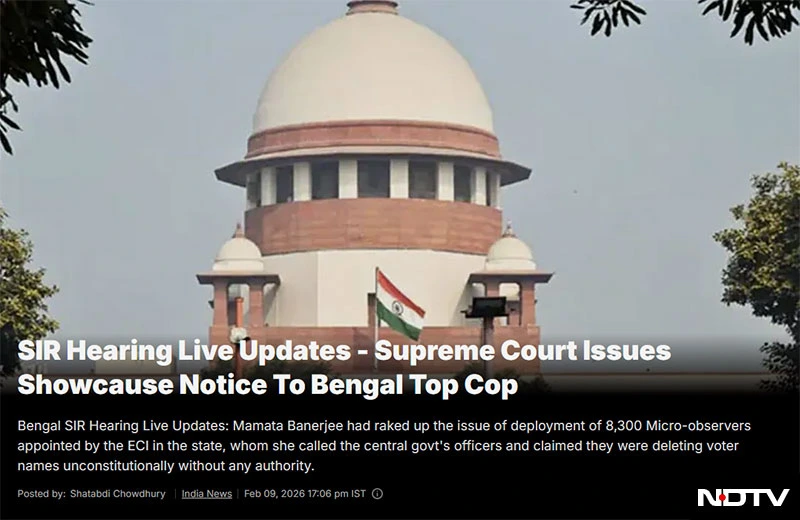
Key Highlights
- The Supreme Court held a detailed hearing of nearly 90 minutes on the WB SIR case.
- The Court made it clear that the SIR process must continue and that no obstruction will be tolerated.
- The Election Commission holds full authority over SIR, and the state government is legally bound to comply.
- Micro observers will only assist EROs and AEROs and cannot take final decisions, giving limited relief to the state.
- The Court directed 8,500+ officers to report by 5 PM, raising concerns as the state failed to submit the officers’ name list.
- The Election Commission has the power to replace or retain EROs and AEROs, but final decisions will rest with EROs.
- The Supreme Court took serious note of burning of SIR-related forms and issued a show-cause notice to the State DGP, asking for a personal affidavit.
- The Court asked the state government to review earlier suspension and FIR directives issued by the Election Commission.
- The Supreme Court extended the SIR timeline by seven days, ensuring procedural continuity.
- Overall, the hearing marked a major legal win for the Election Commission, while the state government secured only marginal relief.
WB SIR Case update: Key Takeaways
As the Supreme Court Order is yet to come out, we will narrate as per our understandings regarding WB SIR case on 09 February, 2026.
- The Supreme Court extended the SIR timeline by seven days.
- The Supreme Court heard arguments for nearly one and a half hours on the West Bengal SIR case. Based on the discussion, here is a clear summary of the key points.
- The Court made its stand very clear. It said that it will issue directions whenever required. However, it will not tolerate any impediment in the SIR process. Moreover, the Court stressed that all states must clearly understand this position.
- The Court clarified the role of micro observers. Their duty is only to assist the ERO and AERO. They do not have the authority to take any final decision.
- The Court directed that the 8,500 appointed officers must report to the concerned DEO or ERO by 5 PM tomorrow.
- The Court stated that the Election Commission has the power to replace EROs and AEROs if necessary. At the same time, the Commission may continue with the existing officers if they are found competent. However, the final decision-making authority will remain with the EROs.
- The Court took serious note of the incidents involving the burning of SIR-related forms in the state. Since no FIR has been registered so far, the Supreme Court issued a show-cause notice to the Director General of Police of the state.
- The Court asked the state government to review the earlier directive of the Election Commission regarding the suspension of certain officials.
Supreme Court on West Bengal SIR Case: Clear Message to the State
In other words, the Election Commission holds full authority, and the state government is bound to comply with its directions. More importantly, the Supreme Court made one thing very clear in the West Bengal SIR case.
The Supreme Court wants the SIR process to continue smoothly and does not want any kind of obstruction. The Supreme Court also clearly informs that they want a complete cooperation from all the state Governments.
However, the Court also noted that the state government tried to create several hurdles. In fact, some of these issues came up clearly during today’s hearing in the Supreme Court. The Government has to show due diligence to the FIR or suspension direction of the Election Commission.
For example, the state claimed it would provide 8,505 officers. Yet, it failed to submit the list of names. This raised a serious question. If the list of officers is not even ready, how will they report to their respective authorities by 5 PM tomorrow?
At the same time, the Court took a strict view of the incident involving the burning of Form 7. As a result, the Supreme Court asked the state’s Director General of Police to submit a personal affidavit and show cause on the matter. Perhaps this is the strongest slap that West Bengal State Government had to digest today.
This is really unfortunate that the Supreme Court had clearly mentioned about the responsibility of the DGP on January 19, 2026 verdict. But the contemporary DGP Rajeev Kumar has already retired and Peeyush Pandey has to face the show-cause.
Overall, the tone of the Court today appeared noticeably tougher towards the state government in WB SIR Case.
Had the state of West Bengal been cooperative from the beginning, today’s WB SIR case would not be required at all.
Supreme Court on WB SIR Case: Sharp Analysis
- The West Bengal government secured relief on only one issue: micro observers will not have the authority to take final decisions.
- Beyond this limited point, the Election Commission largely emerged as the winner in the Supreme Court hearing.
- The Court effectively reaffirmed that control over the SIR process rests with the Election Commission, not the state government.
- As a result, the prolonged political stance of “we will not allow SIR” appears to have lost its legal ground.
- The Supreme Court’s observations send a clear signal that the SIR process must continue without interference.
- Consequently, future attempts to delay or obstruct SIR are likely to face strong judicial resistance.
- Overall, the balance of power has clearly tilted in favour of the Election Commission, with the state left with minimal leverage.
- The Supreme Court in today’s WB SIR Case has made it clear that the states have to cooperate in Special intensive Revision.