
Why Is There Unrest After the Trinamool Congress Candidate List 2026?
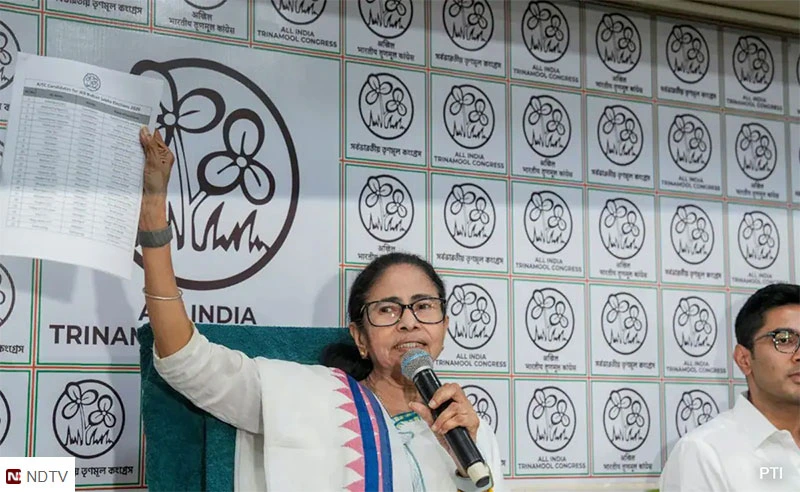
The announcement of the Trinamool Congress candidate list for the Bengal Elections 2026 has sparked a massive TMC Revolt across several districts in the state. While the party high command dropped 74 sitting MLAs to counter anti-incumbency, the move backfired as disgruntled supporters and sidelined veterans took to the streets in protest.
Consequently, this internal defiance has forced the leadership into damage-control mode just weeks before the first phase of voting. From block-level offices to key constituencies, the party now faces an uphill battle to restore order and ensure that these internal rifts do not damage its prospects at the ballot box.
The 2026 TMC candidate list has triggered a revolt after 74 sitting MLAs (33%) were dropped to combat anti-incumbency.
What Is Surprising in the 2026 Candidate List?
- The biggest shock is the removal of 74 sitting MLAs.
- This decision has surprised both party workers and political observers.
- As a result, dissatisfaction is growing rapidly.
Therefore, observers feel this move as a major political shake-up.
Why Are Party Workers Reacting So Quickly?
Specifically, many political analysts did not expect such large-scale changes. Furthermore, ticket distribution always creates tension.
Moreover, removed candidates often influence local supporters.
Because of these reasons, protests and rebellion started almost immediately.
What Should You Look at Next?
Now, it is important to analyze:
- Which MLAs didn’t get nomination in 2026 election
- Which new faces came in
- How this may impact elections
So, let’s take a closer look at the full candidate list and its impact.
Key Features of the TMC Candidate List for Bengal Election 2026
| Category | Sub-category | Number | Percentage |
|---|---|---|---|
| MLA Retention (out of 224 sitting MLAs) | Retained | 135 | 60% |
| Retained with constituency change | 15 | 7% | |
| Dropped | 74 | 33% | |
| Gender Representation (Total 291 candidates) | Male | 239 | 82% |
| Female | 52 | 18% | |
| Community Representation | General + OBC | 149 | 51% |
| SC | 78 | 27% | |
| ST | 17 | 6% | |
| Minority | 47 | 16% |
Therefore, the party has tried to maintain a social balance, but representation varies across groups.
What Does This Data Tell Us About the Political Strategy?
- First, the party has taken a bold step by dropping 33% MLAs before crucial West Bengal Assembly Election 2026.
- Hence, it is trying to balance caste and community representation.
- However, gender diversity is still low.
Overall, this list shows a mix of risk-taking and calculated political strategy.
What Does “Perform or Perish” Mean in Trinamool Congress Politics?
We hear often hear about discussion on the idea of “perform or perish” in the Trinamool Congress. Consequently, this has become more important as 2026 Bengal Election is going to a tough fight.
However, the meaning of “performance” appears different from a typical corporate setup.
According to political observers, performance may include:
- Essentially, Strong opposition to Bharatiya Janata Party (BJP)
- Moreover, Aggressive political messaging and public attacks
- Gaining approval from party leadership, especially Mamata Banerjee
In addition, leaders who successfully mobilize specific voter groups qualify as “high performers”.
Why Are Some Leaders Getting Tickets Despite Controversies?
Undoubtedly, recent candidate selections have raised questions.
For example: Monirul Islam did not receive a ticket, even after strong actions during SIR protest and ransacking BDO Office. On the other hand, Jyotipriya Mallick got a ticket despite past legal issues.
Therefore, selection decisions do not always follow a fixed or transparent rule.
Finally, the top leadership, Mamata Banerjee and Abhishek Banerjee, determines the meaning of “performance”.
As a result, candidate selection depends heavily on leadership judgment, not just public actions.
Why Is There Rebellion Over Shaukat Molla’s Candidacy?
For Instance, the party has shifted Shaukat Molla from Canning to Bhangar.
This is notable because: Mamata Banerjee publicly criticized him previously. Despite that, he still received a ticket. Consequently, this decision triggered strong reactions:
As a result, Arabul Islam has left the party and joined ISF on 19 March, 2026. Local leaders are raising the “outsider” issue against Shaukat Molla
What Does This Tell Us About Internal Party Dynamics?
- First, there is no single clear definition of performance
- Next, leadership decisions can override controversies
- Finally, ticket distribution often leads to internal conflict and rebellion
So, the situation highlights growing tension within the party ahead of elections.
Why Did a BJP Leader Get a Ticket from Trinamool Congress?
Pabitra Kar recently joined the Trinamool Congress from the Bharatiya Janata Party. Surprisingly, he got a ticket immediately.
What makes it more interesting?
- He is going to take on the heavyweight leader Suvendu Adhikari
- The contest is in Nandigram, a high-profile political battleground
Therefore, this move signals a high-risk, high-impact strategy by the party.
Why Are There No New Tollywood Stars in the Candidate List?
This time, one major change stands out clearly. There are no new Tollywood celebrities in the candidate list.
This is surprising because:
- Mamata Banerjee is known for giving opportunities to film stars
- Thus, in past elections, many Tollywood faces joined politics and got tickets
Earlier, we saw:
- A strong presence of film personalities in both Parliament and Assembly elections
- Hence, mammoth inclusion of celebrities to attract voters
What Does This Shift in Strategy Indicate?
- First, the party seems to be moving away from glamour-based politics
- Furthermore, the focus appears to be on ground-level political strength
- Moreover, candidate selection looks more calculated and strategic
As a result, this election is being treated very seriously.
Is This a “Do or Die” Election for Mamata Banerjee?
All signs suggest that Mamata Banerjee is approaching this election as a crucial battle
Key indicators include:
- Fielding strong candidates in key constituencies
- Avoiding experimental choices like new celebrities
- Taking bold and sometimes controversial decisions
Therefore, it looks like a “make or break” moment for the party.
Why Did Rajganj Seat Trigger Immediate Rebellion?
In Rajganj, a major change shocked party workers. Sitting MLA Khageshwar Roy was denied a ticket. Instead, Swapna Barman, an Asian Games gold medalist, was chosen.
As a result:
- Khageshwar Roy turned rebellious after being a candidate since 2009
- He even alleged that the seat was sold for money
Clearly, replacing an old leader with a new face has created strong backlash.
Can Other Roles Replace an MLA Ticket?
Mamata Banerjee said: Those who did not get tickets will be given other responsibilities
However, ground reality is different:
- Many leaders see MLA posts as power and prestige
- Therefore, alternative roles often fail to satisfy them
So, frustration among denied candidates continues to grow.
Why Is Party Discipline Weak Compared to Left Parties?
Earlier, strong discipline was seen in parties like the Left Front.
But in the Trinamool Congress:
Key challenges include:
- Centralized leadership control
- Dependence on a single dominant leader (Mamata Banerjee)
- Lack of internal consensus and democracy
As a result, rebellion becomes almost inevitable.
What Happened in Harishchandrapur Seat?
In Harishchandrapur, another controversy emerged.
Tajmul Hossain (former minister): Claimed he was “shocked” and “betrayed”. He had defeated BJP’s Motibur Rahaman by 77,000 votes in 2021
But now: The same Motibur Rahaman has been given the ticket for Trinamool Congress
Naturally, accepting this decision is very difficult for him.
Where Else Has TMC Revolt Started?
TMC Revolt through protests are spreading to multiple constituencies:
Key flashpoints include:
- Khandaghosh – Opposition over ticket to Nabina Bagh
- Nalhati – MLA Rabindra Nath Ghosh hinted at retirement after denial
Therefore, dissatisfaction is not limited to one or two seats.
What Does This Wave of Rebellion Indicate?
- First, ticket denial is creating emotional and political backlash
- Next, replacing strong local leaders is proving risky
- Moreover, internal unity is under pressure
- The Decision of top leaders of TMC is coming under question
Overall, the situation shows that candidate selection has triggered widespread unrest within the party.
Is the 2026 West Bengal Election a Make-or-Break Test for Mamata Banerjee?
Internal rebellion in the Trinamool Congress is not unusual during candidate selection.
However, this time, the situation is more complex and intense.
Several major challenges are coming together:
- The SIR issue adding political pressure
- Large-scale administrative and police reshuffles
- Growing concerns over corruption and anti-incumbency
- Lawlessness and lack of women security
- Rising internal rebellion from denied leaders
- Suvendu Adhikary has already started campaigning in Bhabanipur Assembly
As a result, managing the party has become more difficult than ever for Mamata Banerjee, particularly when TMC Revolt has shaped.
Moreover, uncertainty remains over whether elections will be held under normal conditions or President’s Rule.
Therefore, the 2026 West Bengal election is shaping up to be a true “Litmus Test” for Mamata Banerjee.
Bottom Line:
The 2026 election is not just another poll. Rather it is a high-stakes political battle and a real test of control, strategy, and survival. Will Mamata Banerjee re-envision the need for a de novo poll strategy before the 2026 election?
Key Takeaways:
- The Trinamool Congress dropped 33% of sitting MLAs, triggering massive TMC Revolt
- Internal rebellion started within days of the candidate list release (March 17, 2026)
- “Perform or perish” politics is now driven by loyalty and leadership approval
- Big leaders denied tickets have turned open rebels across multiple constituencies
- New faces like Swapna Barman are replacing old leaders, causing friction
- Party switching is rewarded, leaders from Bharatiya Janata Party are getting key tickets
- No new Tollywood stars this time, showing a shift away from glamour politics
- High-voltage battles expected in seats like Bhabanipur
- Social engineering is visible, but gender gap remains high (only 18% women)
- Multiple factors like SIR issue, corruption debate, and administrative reshuffle are increasing pressure
- Leadership decisions by Mamata Banerjee remain the final word
- Uncertainty still exists over possible President’s Rule during elections
People Also Ask (PAA)
Why is there rebellion in the Trinamool Congress candidate list 2026?
The rebellion started mainly because the party dropped around 33% of its sitting MLAs, which created strong dissatisfaction among leaders and workers. Moreover, sudden ticket denial and lack of clear communication have led many leaders to openly protest or turn rebellious.
How many MLAs were dropped in the 2026 West Bengal election?
Out of 224 sitting MLAs, a total of 74 were dropped, which is nearly one-third of the existing representatives. This large-scale change is one of the biggest reasons behind the growing unrest within the party.
Who are the key faces in the 2026 candidate list?
Some notable names include Swapna Barman, who has been introduced as a fresh face, and Suvendu Adhikari, who is expected to be at the center of a high-voltage contest in Nandigram. At the core of all decisions is Mamata Banerjee, who continues to lead the party strategy.
Why are there no Tollywood stars in this election?
Unlike previous elections, no new Tollywood celebrities have been given tickets this time. This indicates a clear shift in strategy, where the party seems to be focusing more on political strength and ground-level influence rather than glamour and star power.
What does “perform or perish” mean in TMC politics?
In this context, “perform or perish” does not strictly follow governance metrics. Instead, it often refers to how effectively a leader can oppose the Bharatiya Janata Party, maintain loyalty to leadership, and influence voters on the ground.
Is the 2026 election crucial for Mamata Banerjee?
Yes, the 2026 election is widely seen as a crucial and high-stakes battle for Mamata Banerjee. Internal rebellion, anti-incumbency pressure, and bold candidate changes have made this election a real test of her leadership.
Can President’s Rule be imposed before elections?
There is ongoing political discussion and speculation about the possibility of President’s Rule. However, as of now, there is no official confirmation, and the situation remains uncertain.
What is the biggest takeaway from the 2026 candidate list?
The biggest takeaway is that the party has taken bold and risky decisions, which have triggered internal conflict but also reflect a strategic shift. Overall, this election appears to be a make-or-break moment for the ruling party.